
| Direct answer: Yes, rooftop solar can supply some or all of the annual electricity used to charge an EV. In a normal on-grid home, the solar inverter supplies the home’s AC system and the EV charger behaves like another load; the grid covers any shortfall. Size solar from daily driving and measured energy use, then add household consumption. A battery is optional for daytime or net-metered charging but may be required for independent night or outage charging. |
An electric vehicle can become one of the largest new loads in a home. Rooftop solar can offset that energy, but the correct system is not chosen from the EV battery size alone. Daily distance, real-world efficiency, charging losses, household consumption, parking time, local solar yield, roof constraints and the electricity connection all matter.
This guide shows how electricity moves from the panels to the car, how to calculate incremental and total solar capacity, when grid power or stationary storage is needed, how charger power changes charging time, and what Indian homeowners should verify before installation.
Quick Takeaways
- Use daily kilometres and real kWh/km, not the EV’s full battery size, to estimate routine charging energy.
- Separate energy (kWh) from power (kW): solar size affects annual energy; charger size affects charging rate.
- A charger can draw solar and grid power together, so a 7.2 kW charger does not automatically require a 7.2 kW array.
- Standard on-grid solar normally shuts down during a power cut because of anti-islanding protection.
- Daytime charging maximises direct self-consumption; night charging uses the grid or a compatible stationary battery.
- PM Surya Ghar CFA supports eligible residential rooftop solar capacity, not the private EV charger itself.
- Check sanctioned load, phase, cable route, protection, earthing and charger/vehicle compatibility before purchase.
How Solar EV Charging Actually Works
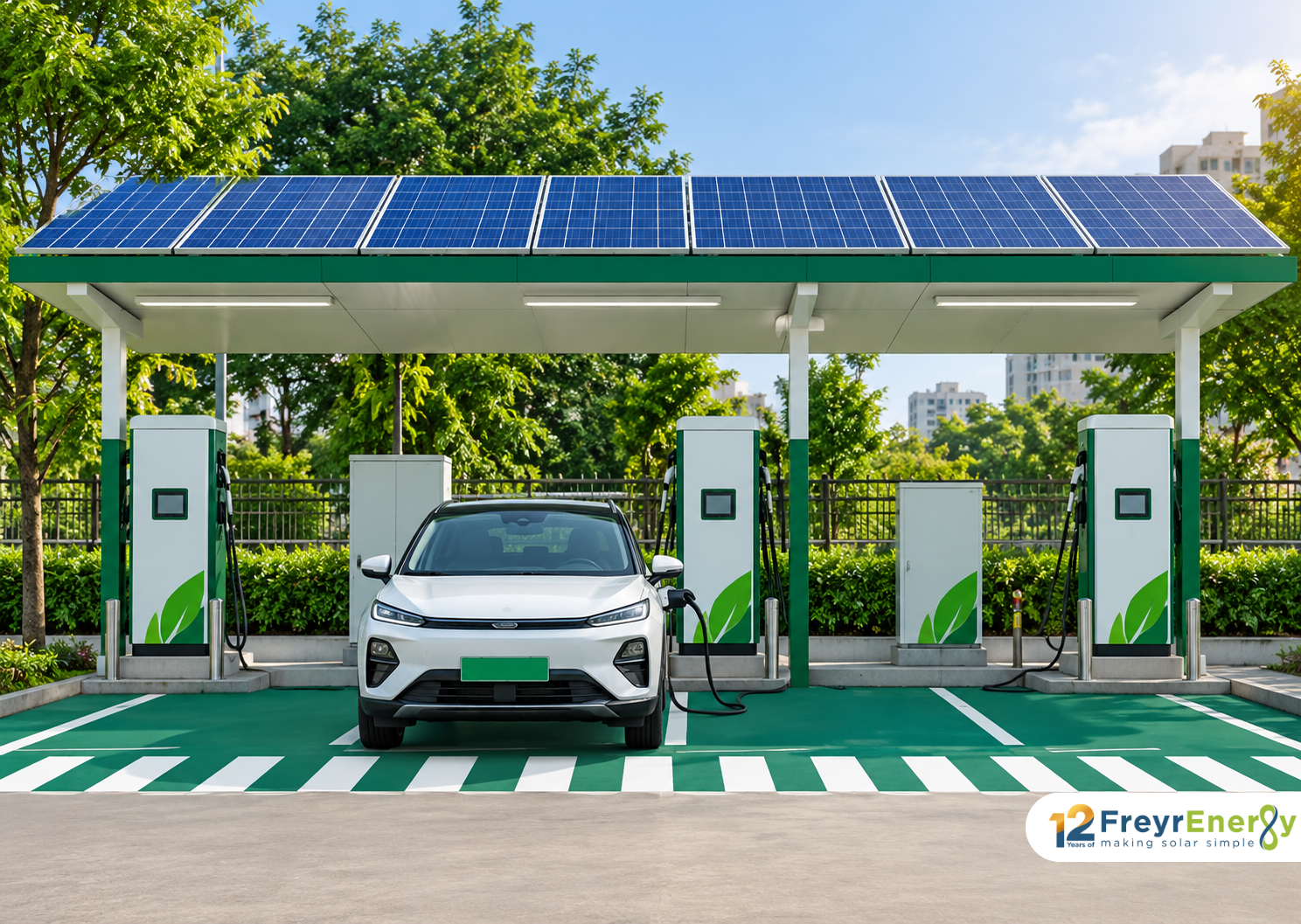
| Stage | What happens |
| Solar array | PV modules produce DC electricity when sunlight is available. |
| Solar inverter | A grid-tied or hybrid inverter converts solar DC into AC electricity for the premises. |
| Home distribution board | Solar power serves active home loads, including the EV charger; the grid supplies any instantaneous shortfall. |
| EVSE / wall box | The charging equipment provides control, protection and a safe connection to the vehicle. |
| Vehicle onboard charger | For AC charging, the car converts AC into DC to charge its traction battery and limits accepted power. |
| Grid and meter | Surplus may export and later imports are recorded under the applicable state/DISCOM arrangement. |
Raw panel output should not be connected directly to a car. A purpose-designed system must coordinate the PV inverter, electrical distribution, EVSE, vehicle and grid or battery interface.
kW, kWh and km/kWh: The Three Numbers to Understand
| Unit | Meaning | EV charging use |
| kW | Instantaneous power or rate of energy transfer. | A 7.2 kW wall box can deliver energy faster than a 3.3 kW charger if the vehicle and supply accept it. |
| kWh | Amount of energy. | A 40 kWh battery stores energy; a home may consume several kWh to replace a day’s driving. |
| kWh/km | Energy consumed per kilometre. | Multiply by daily distance to estimate traction energy. |
| km/kWh | Distance delivered per unit of battery energy. | Convert to kWh/km by dividing 1 by km/kWh. |
How to Calculate Solar Capacity for EV Charging
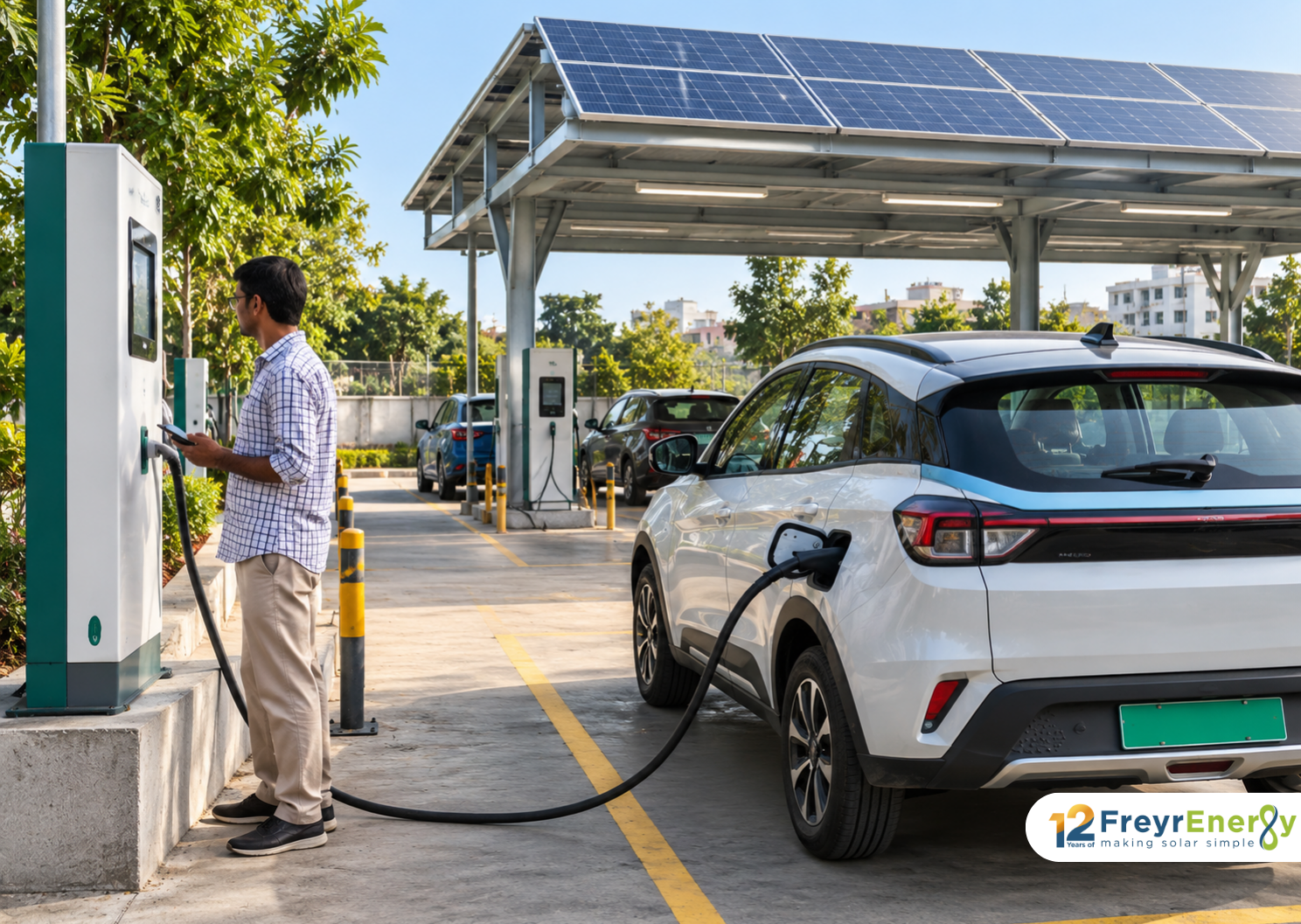
- Record typical daily kilometres. Use a weekly or monthly average if driving varies.
- Find real energy consumption from the vehicle display or charging records. Manufacturer range is less useful than your own climate, speed and accessory use.
- Calculate traction energy: daily kilometres × kWh/km.
- Allow for AC charging losses: electricity drawn from the premises = traction energy ÷ charging efficiency.
- Obtain site-specific PVOUT in kWh per installed kWp from a reliable solar-resource tool or professional simulation.
- Incremental solar capacity = daily EV electricity from the premises ÷ expected daily PV energy per kWp. Add design margin only after checking seasonality, shade and roof constraints.
| Sizing formula: Incremental solar kW ≈ (daily km × real kWh/km ÷ charging efficiency) ÷ site-specific daily kWh/kWp. |
Worked Example: 40 km of Daily Driving
Assume 40 km/day, measured consumption of 0.15 kWh/km, 90% wall-to-battery charging efficiency and a planning PV yield of 4.0 kWh/kWp/day. These are illustrative inputs, not national guarantees.
| Step | Calculation | Result |
| Traction energy | 40 km × 0.15 kWh/km | 6.0 kWh/day |
| Premises electricity | 6.0 ÷ 0.90 | 6.67 kWh/day |
| Incremental solar | 6.67 ÷ 4.0 | 1.67 kW before project-specific margin |
| Practical starting point | Round to an available design after roof and approval checks | Evaluate about 2 kW additional solar |
MNRE says most parts of India receive 4–7 kWh/m²/day of solar energy, but irradiation is not the same as finished-system output. Use PVOUT or a location-specific simulation that accounts for temperature, orientation, shading, soiling, inverter and wiring losses.
Illustrative Solar Requirement by Daily Driving
The following table uses the same 0.15 kWh/km, 90% charging efficiency and 4.0 kWh/kWp/day assumptions. It shows EV-only incremental capacity; household energy must be added separately.
| Daily driving | Electricity from premises | Indicative additional solar to evaluate |
| 20 km/day | About 3.3 kWh/day | About 1 kW |
| 40 km/day | About 6.7 kWh/day | About 2 kW |
| 60 km/day | About 10.0 kWh/day | About 3 kW |
| 80 km/day | About 13.3 kWh/day | About 4 kW |
| 100 km/day | About 16.7 kWh/day | About 5 kW |
Do not use this table as a quotation. A less efficient EV, highway driving, hot weather, steep terrain, charging losses, monsoon season or a shaded roof can increase required capacity.
How to Size Solar for the Home and EV Together
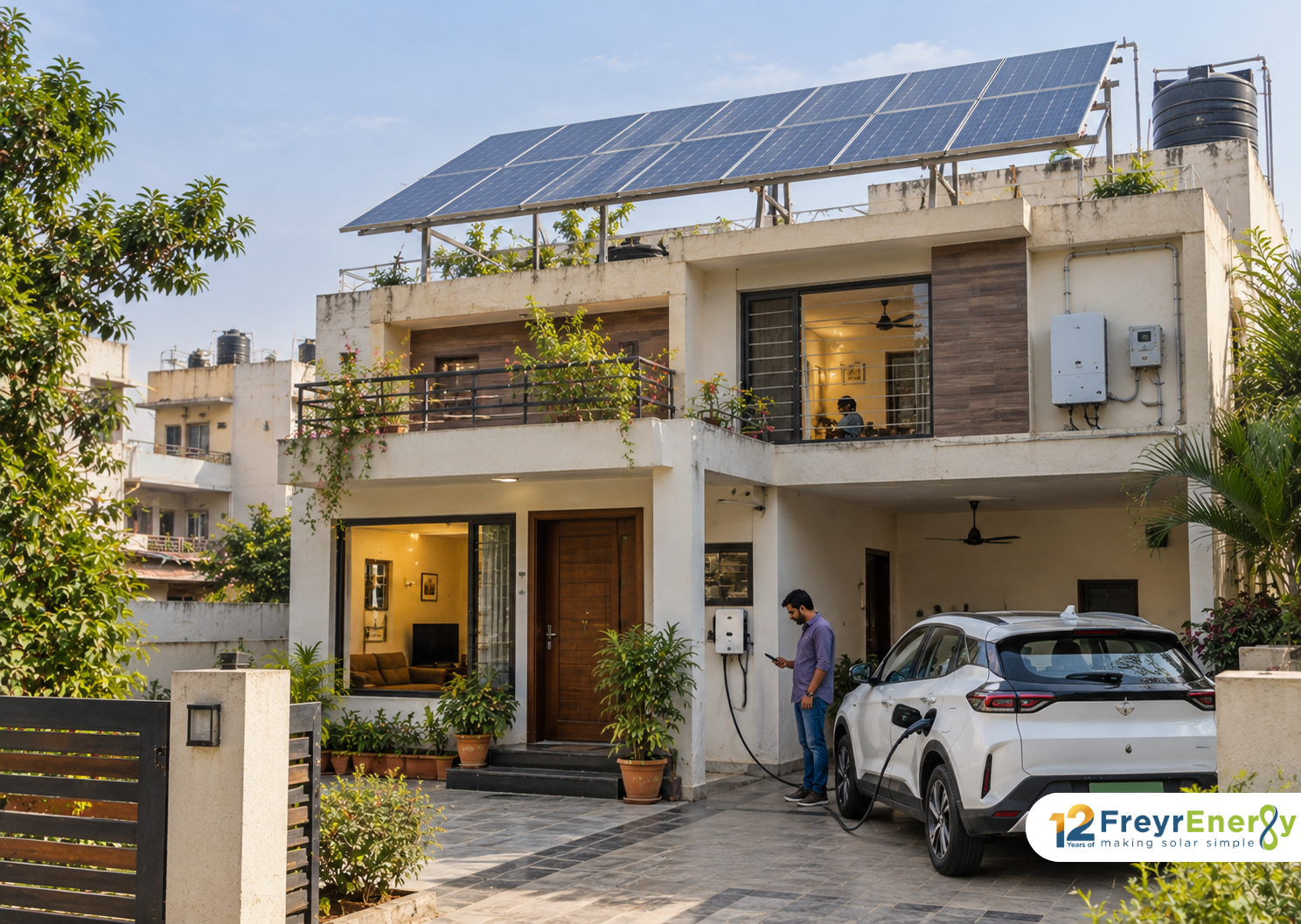
Adding only the EV requirement can leave the home undersized. Start with at least 12 months of electricity bills, separate daytime and night loads where possible, and add expected EV charging energy. Account for future air conditioners, heat pumps or a second EV only when they are realistic.
| Planning input | Illustrative value |
| Average household electricity | 8.0 kWh/day |
| EV electricity from 40 km/day example | 6.67 kWh/day |
| Combined requirement | 14.67 kWh/day |
| At 4.0 kWh/kWp/day planning yield | 14.67 ÷ 4.0 = 3.67 kW |
| Starting design to evaluate | Approximately 4 kW, subject to roof, seasonality, approvals and economics |
For grid-connected systems, annual or billing-cycle energy offset may matter more than matching every minute of EV demand. The design must also respect sanctioned load, inverter limits, applicable net-metering capacity and roof area.
How Many Solar Panels Are Needed?
Panel count depends on the selected module wattage and final DC array size. Use: panel count = required DC watts ÷ module watts, rounded up to a compatible string and inverter design. For example, about 2.2 kW of modules could use four 550 W panels. Final count can change with module availability, string voltage, roof geometry, access paths and shading.
Charger Power and Charging Time
Solar capacity and charger power solve different problems. Solar capacity determines how much energy the site can generate over time. Charger power determines the maximum rate at which energy can flow, subject to the vehicle’s onboard charger, the EVSE, the connection and any smart-control limit.
| Charging option | Typical role | Important check |
| Portable or lower-power AC charging | Long dwell time and modest daily energy replacement. | Approved outlet/circuit, continuous-load suitability and OEM instructions. |
| 3.3 kW-class AC charging | Common home charging rate for overnight or long parking windows. | Vehicle acceptance, dedicated circuit and sanctioned load. |
| 7.2 kW-class AC wall box | Faster home charging when the vehicle and supply support it. | Single-/three-phase requirements, cable/protection design and load increase. |
| 11 kW or 22 kW AC | Higher-power premises or fleet/workplace applications. | Three-phase supply and the vehicle’s onboard AC limit. |
| DC fast charging | Rapid public or fleet charging using external DC conversion. | High connection capacity, compatible connector, standards and commercial case. |
| Charging-time formula: Ideal hours ≈ energy required from the charger (kWh) ÷ accepted charging power (kW). Actual time can be longer because power may taper, the battery conditions itself, loads vary and the vehicle limits charging. |
Example: replacing 40 kWh from the wall takes at least about 12.1 hours at 3.3 kW or 5.6 hours at 7.2 kW under loss-free constant-power arithmetic. Real time is normally longer. Daily top-ups are usually much smaller than a full battery charge.
Does a 7.2 kW Charger Need 7.2 kW of Solar?
No. If a 7.2 kW charger is drawing power while the array produces 4 kW and the house uses 1 kW, the grid can supply the balance in an on-grid system. Alternatively, a smart charger can reduce EV power to follow available surplus solar. The correct design depends on whether the goal is fast charging, maximum direct solar use, annual bill offset or backup independence.
Smart Solar Charging and Load Management
A basic EVSE charges when the vehicle is connected and authorised. A solar-aware charger or site energy-management system can use meter or current-transformer data to change charging power according to PV production, home load and an import limit. Features differ, so confirm how the exact charger communicates and what happens if internet, meter data or the solar inverter is unavailable.
| Control mode | What it does | Best use |
| Scheduled charging | Starts or stops charging during selected hours. | Aligning with parking windows or time-of-day tariffs. |
| Solar-surplus mode | Raises or lowers EV power according to measured export or available PV surplus. | Maximising direct solar use without a stationary battery. |
| Dynamic load balancing | Limits EV power so the home remains below a connection or circuit threshold. | Avoiding overload when other large appliances operate. |
| Minimum-energy target | Ensures a required charge by departure time, using grid power if solar is insufficient. | Drivers who need reliability as well as solar optimisation. |
| Fleet sharing | Allocates available site power among several connected vehicles. | Apartments, workplaces and depots with multiple chargers. |
Ask whether the charger can read whole-site import/export, whether a minimum charging current affects surplus tracking, whether the user can override the schedule, and who retains access to charging history. A solar label alone does not prove compatibility with the existing inverter or meter.
Can an Existing Rooftop System Charge an EV?
Usually, an EV charger can be added as another electrical load, but the existing array may not generate enough annual energy to offset the new consumption. Before connecting, verify:
- Current household and solar generation data over several months.
- Inverter rating, spare distribution-board capacity and approved solar expansion limits.
- Sanctioned load, phase configuration and the proposed charger’s input requirements.
- Cable route, earthing, protection, parking location and weather exposure.
- Whether expanding the PV capacity requires revised DISCOM feasibility, net-metering or portal documentation.
- Whether the monitoring or energy-management platform can control surplus-based charging.
On-Grid, Hybrid or Off-Grid Solar EV Charging?
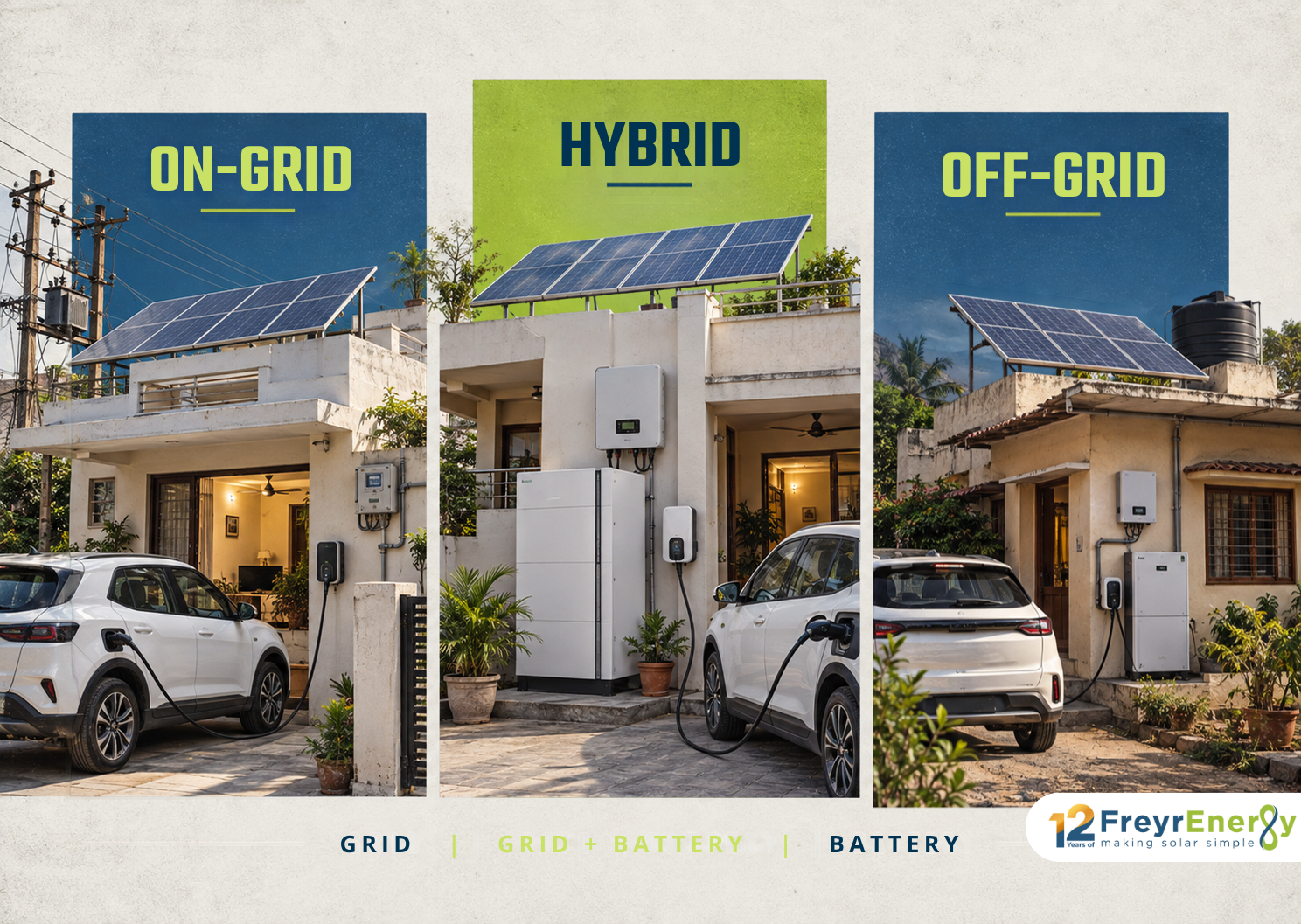
| System | How EV charging works | Outage behaviour | Best fit |
| On-grid | Solar and grid share the premises load; surplus may export under applicable rules. | Standard systems normally shut down when the grid fails. | Most grid-connected urban homes seeking bill offset. |
| Hybrid | Solar, grid and compatible stationary storage can be prioritised by system controls. | Selected backup circuits may remain powered after safe grid isolation. | Homes needing resilience or time-shifting, subject to cost and design. |
| Off-grid | Solar and storage must meet charging energy, peak power and low-sun autonomy. | Independent of the grid if correctly sized. | Remote sites with no practical grid; usually expensive for EV-scale energy. |
What Happens During a Power Cut?
A normal grid-tied inverter uses anti-islanding protection and stops energising the premises when the grid fails. This protects utility workers and equipment. Solar panels may be in full sun, yet the standard on-grid EV charger will not operate. Backup charging requires a compatible hybrid or off-grid architecture, safe isolation, an adequately rated inverter and battery, and a circuit deliberately included in the backup design.
Because EV charging is a large load, many backup systems exclude it or limit its power. Do not assume that adding a battery automatically makes the EV charger outage-capable.
Do You Need a Stationary Battery?
No battery is needed when the EV is available during solar hours or when grid imports and the local billing arrangement meet the objective. A battery becomes relevant when you want to move solar into the night, charge during outages or operate off-grid. This adds conversion losses, cost, power limits and eventual degradation.
Illustrative Battery Sizing for Night Charging
If the EV needs 6.67 kWh from the premises each night and the stationary battery permits 90% usable depth with 90% discharge-path efficiency, rated storage for the EV alone is about 6.67 ÷ (0.90 × 0.90) = 8.23 kWh before reserve, ageing and household backup. The battery inverter must also support the charger’s kW demand. This is why using the grid at night and offsetting energy through rooftop solar can be more economical where local rules are favourable.
Direct Daytime Solar vs Net-Metered Night Charging
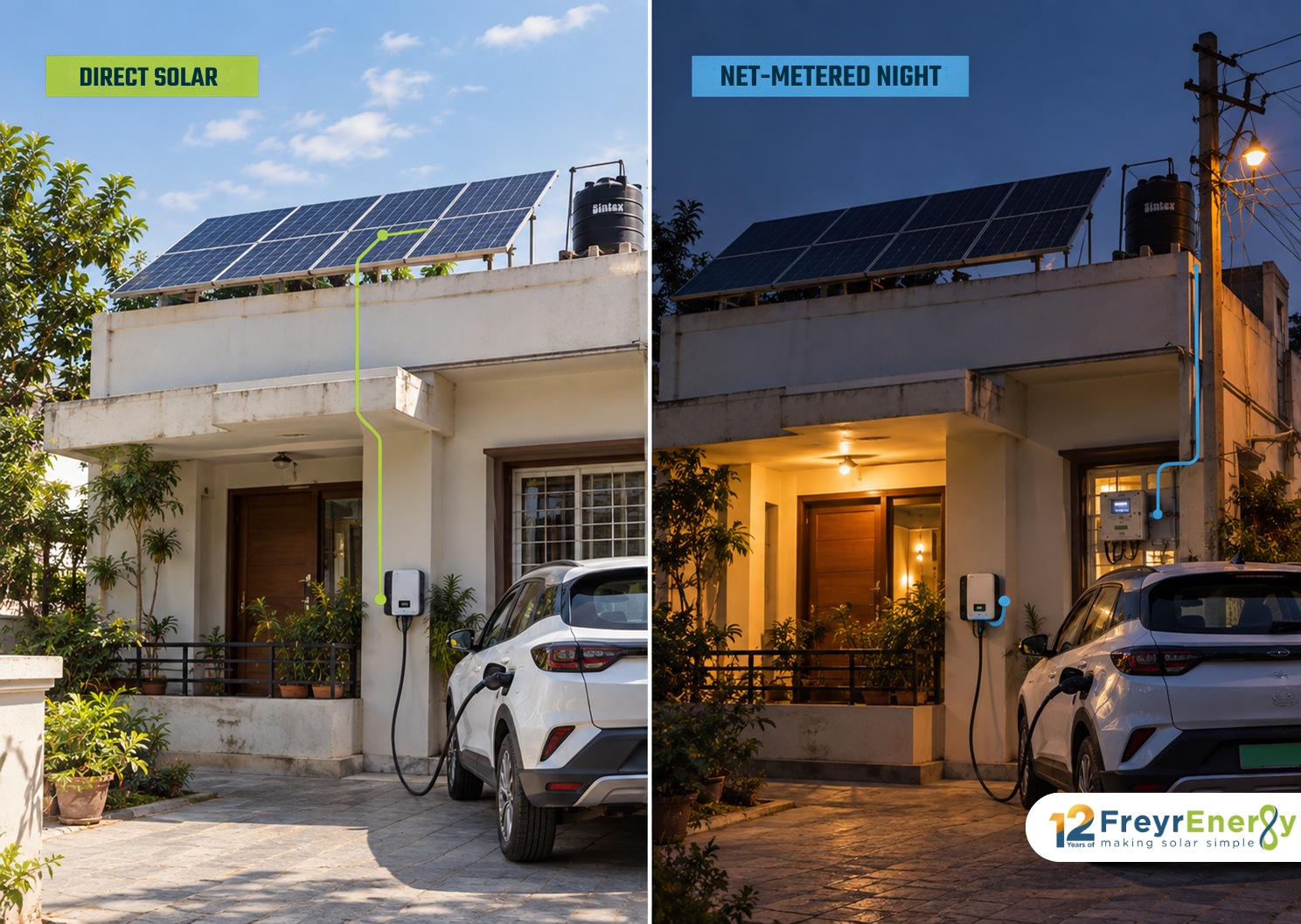
| Route | Physical energy flow | Economic point |
| Direct daytime self-consumption | Solar serves the EV charger while the car is connected; grid fills any shortfall. | Usually avoids buying a unit at the applicable retail tariff. |
| Daytime export, night import | Solar exports when the EV is away; the EV later imports grid electricity. | Value depends on state/DISCOM metering and settlement rules. |
| Battery time-shift | Solar charges a stationary battery, which later charges the EV. | Adds battery capital cost and round-trip losses but can provide resilience. |
Net metering is an accounting arrangement, not physical storage. An exported daytime unit and imported night unit may not have equal financial value. Verify current state regulations, billing period, banking, fixed charges and export treatment.
Seasonal Solar Output: Annual Offset Is Not Daily Independence
An array may generate enough energy across a year to offset estimated EV charging while still falling short on cloudy or monsoon days. Monthly production, not only an annual average, should be compared with the driving schedule. On-grid homes can use the grid for daily variability; off-grid and backup designs must instead account for low-sun periods, autonomy and recharge time.
Avoid oversizing solely to make the worst solar month match every day of driving unless export treatment, roof capacity and economics support it. A transparent proposal should show monthly generation, household self-use, EV charging, expected exports and imports, plus the loss assumptions behind each figure.
Electrical Connection, Safety and Standards
The Ministry of Power’s 2024 EV charging-infrastructure guidelines apply to private, semi-public and public charging locations. For residential charging, owners may use the existing connection, request a separate metered connection, and must seek a sanctioned-load increase if the charger requires more power than the current limit. Domestic electricity rates apply to charging at home under those guidelines, subject to the applicable state tariff order.
Use vehicle- and EVSE-compatible equipment and a qualified installer. The final design should follow the equipment manuals, applicable Indian standards and local electrical rules. Verify at least:
- Dedicated circuit capacity and cable size for sustained charging current.
- Correct MCB/isolator and residual-current/leakage protection specified by the EVSE manufacturer and applicable standard.
- Earthing, surge protection, enclosure/IP rating and safe mounting away from impact or water accumulation.
- Connector compatibility, communication, maximum vehicle AC acceptance and charger derating conditions.
- Emergency isolation, signage and access control where the charger is shared.
- Single-line diagram, test results, labels, manuals and handover training.
IS 17017 is a key Indian EV-charging standard family, while ARAI identifies AIS-138 Part 1 for conductive AC charging and Part 2 for DC charging. Ask which standards apply to the exact EVSE rather than accepting a generic “approved charger” statement.
Step-by-Step Installation Process
- Collect 12 months of electricity bills, solar generation history if available, daily kilometres and vehicle charging records.
- Define the objective: fastest charging, annual energy offset, maximum daytime self-use, night time-shift or outage backup.
- Check parking ownership, cable route, roof rights, shading, usable roof area and structural condition.
- Confirm charger power, connector and the vehicle’s maximum accepted AC rate with the OEM documentation.
- Ask the DISCOM or qualified project team to verify sanctioned load, phase and any required connection upgrade.
- Model home and EV energy together using location-specific PV yield and seasonal production.
- Choose on-grid, hybrid or off-grid architecture and document power flow during normal operation and outage.
- Obtain an itemised quotation covering modules, inverter, EVSE, structure, cables, protection, earthing, approvals, metering and monitoring.
- Complete installation, inspection, testing, commissioning and portal/DISCOM steps that apply.
- Receive as-built drawings, model and serial records, warranties, charger settings, monitoring access and safe shutdown instructions.
Solar EV Charging Cost in India
There is no reliable single price per kW without a defined scope. Freyr Energy’s published indicative installed rooftop ranges, checked on 21 September 2026, are shown below before subsidy. They are company-specific planning ranges, not universal India prices or guaranteed quotations.
| System capacity | Freyr indicative installed range before subsidy |
| 1 kW solar system | ₹1.20–₹1.30 lakh |
| 2 kW solar system | ₹1.80–₹1.90 lakh |
| 3 kW solar system | ₹2.30–₹2.40 lakh |
| 5 kW solar system | ₹3.50–₹3.70 lakh |
| 10 kW solar system | ₹6.30–₹6.40 lakh |
The EVSE, long cable route, distribution-board or sanctioned-load upgrade, civil work, taxes, net-metering charges and stationary battery may be additional. Ask for a complete installed price and keep the following separate: rooftop solar, private EV charger, storage, DISCOM work, government CFA, company discount and financing cost.
Government Subsidy and Policy Treatment
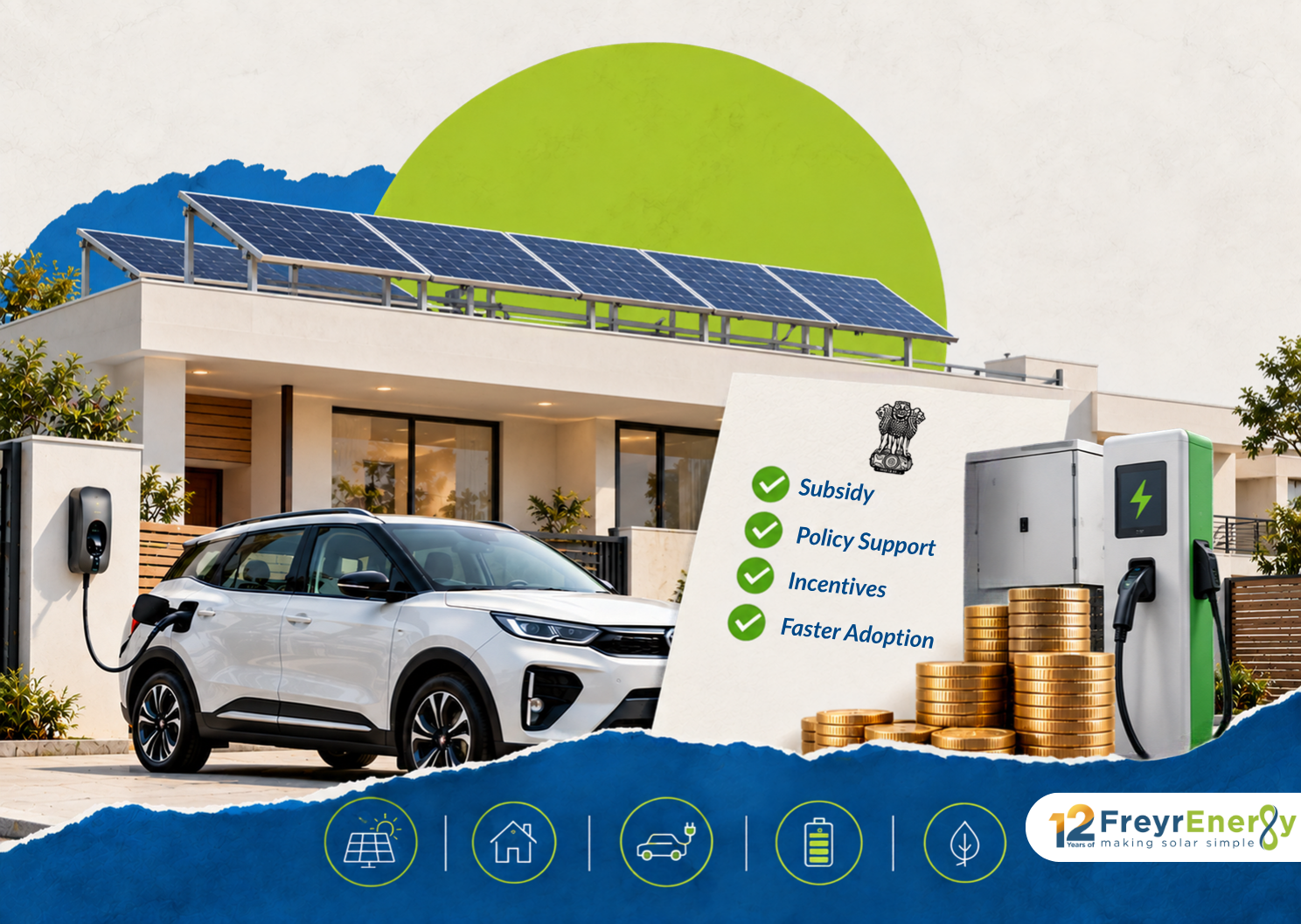
There is no central CFA that should be presented as a private home-EV-charger subsidy. PM Surya Ghar CFA applies to eligible residential grid-connected rooftop solar under current scheme rules. For a normal-category individual household, the central structure is:
| Eligible residential rooftop capacity | Central CFA |
| 1 kW | ₹30,000 |
| 2 kW | ₹60,000 |
| 3 kW or above | ₹78,000 maximum under the normal-category individual-household structure |
The CFA is linked to qualifying solar-module capacity and scheme compliance, not kilometres driven, EV battery capacity, EVSE power or stationary-battery capacity. Commercial establishments do not receive the individual-household residential CFA. PM E-DRIVE includes support for public EV charging infrastructure through its own operational framework; do not present that as a rebate for a private household wall box.
Charging Cost per Kilometre
Use the marginal electricity tariff from the actual bill. Grid charging cost per kilometre ≈ (vehicle kWh/km ÷ charging efficiency) × tariff per kWh. The example below assumes 0.15 kWh/km and 90% charging efficiency, or about 0.167 kWh drawn per kilometre.
| Illustrative marginal tariff | Approximate electricity cost per km |
| ₹6/kWh | ₹1.00/km |
| ₹8/kWh | ₹1.33/km |
| ₹10/kWh | ₹1.67/km |
Rooftop solar does not make charging economically “free”: the system has capital, financing, maintenance and replacement costs. Its value is usually the grid purchase avoided for directly consumed energy, or the applicable credit for exported energy. Fixed charges and tariff slabs can remain.
How to Estimate ROI and Payback
Model the solar project for home and EV together. Annual benefit should include avoided grid purchases and export credits using the relevant settlement rules, then subtract recurring costs. Simple payback = net installed investment ÷ estimated annual net benefit. Keep government CFA, company discount and loan interest as separate lines.
Run at least three cases: conservative solar yield/high losses, expected case and lower driving or changed parking schedule. A system sized for an EV that is regularly away during the day may export more and self-consume less than expected.
Apartments, Workplaces and Fleets
Apartment or Housing Society
Confirm parking rights, common-area connection, metering, billing, cable routes, fire access, load management and society approval. Shared chargers may need authentication and energy allocation. Rooftop solar may serve common loads or charging under an approved electrical and commercial arrangement; do not assume an individual flat can claim the roof or subsidy benefit.
Workplace Charging
Workplace parking aligns well with solar hours. Design for employee dwell time, access control, billing, peak demand, diversity and future charger additions. Dynamic load management can prevent all chargers from drawing maximum power at once.
Fleet or Commercial Charging
Use route schedules, return-to-base windows, daily fleet energy, charger availability, demand charges, transformer capacity, redundancy and service uptime. Solar can reduce energy cost, but reliable fleet charging may still require grid capacity or storage. Model coincident vehicle demand rather than multiplying nameplate charger power blindly.
Electric Two-Wheelers and Three-Wheelers
Light EVs generally need less daily energy than cars, but they still require the OEM-specified charger and a suitable electrical outlet or EVSE. Do not assume that a car wall box can charge every two- or three-wheeler. Record the vehicle’s actual wall energy, daily distance, connector and charging schedule, then apply the same solar-sizing method. Shared delivery or commercial fleets also need fire-safe parking, cable management, access control and a plan for simultaneous charging.
Can the EV Power the Home? V2H and V2G
Vehicle-to-home (V2H) and vehicle-to-grid (V2G) use bidirectional charging so an EV battery can discharge to a building or grid. A vehicle with a large battery may appear ideal for backup, but the feature cannot be assumed from battery size or charging connector. It requires a vehicle that supports bidirectional operation, compatible certified equipment, electrical isolation and protection, software control, warranty acceptance and any utility or regulatory approval.
Treat V2H/V2G as a separate engineered project unless the vehicle manufacturer, charger supplier and electricity provider explicitly support the proposed configuration. Do not connect an ordinary AC charger or use an improvised inverter arrangement to back-feed a home.
Monitoring and Maintenance After Commissioning
Track solar generation, grid import/export and EV charging energy separately where possible. A fall in solar output is not always a panel fault: shade, soiling, inverter downtime, seasonal weather or a changed charging schedule can explain the difference. Keep the commissioning baseline, monthly reports, equipment serial numbers and warranty contacts.
- Review EVSE alerts, connector condition, enclosure, cable strain and signs of overheating according to the manufacturer’s schedule.
- Keep vents, clearances and the charger area unobstructed; do not pressure-wash electrical equipment.
- Have protection, earthing and terminations inspected after faults, water exposure, renovation or unexplained tripping.
- Update smart-charging limits when sanctioned load, solar capacity, tariffs, vehicle or major home loads change.
- Use qualified service personnel and retain test results after repairs or component replacement.
Advantages and Limitations
| Potential advantages | Important limitations |
| Can reduce grid energy purchased for routine driving. | Output changes with weather, season, shade, temperature and soiling. |
| Daytime parking can increase direct solar self-consumption. | Many cars are away from home during peak solar hours. |
| Can use the same rooftop system for home and mobility loads. | Roof, sanctioned load and inverter limits can constrain expansion. |
| Smart charging can follow surplus or lower-power windows. | Compatibility and controls must be verified across inverter, meter and EVSE. |
| Hybrid designs can add resilience for selected loads. | EV charging requires substantial energy and may be excluded from backup circuits. |
Common Solar EV Charging Mistakes
- Sizing from full battery capacity instead of typical daily driving.
- Confusing charger kW with the solar kW required for annual energy offset.
- Ignoring household consumption, charging losses and seasonal PV output.
- Assuming a standard on-grid system will charge the EV during a blackout.
- Installing a high-power wall box without checking sanctioned load, phase and cable capacity.
- Treating net metering as if the grid stores daytime solar one-for-one.
- Adding a stationary battery without checking usable kWh, output kW, losses and replacement economics.
- Using extension cords or an unsuitable socket for sustained charging.
- Comparing a solar-only price with a complete solar, charger and electrical-upgrade quote.
- Calling PM Surya Ghar CFA an EV charger subsidy.
Buyer Checklist
| Question | Evidence to obtain |
| How much energy does the EV need? | Daily km, measured kWh/km, wall-charging history and expected future driving. |
| How much energy does the home need? | Twelve-month bills, load profile and planned additions. |
| What can the roof generate? | Shade/layout survey and location-specific monthly PV simulation. |
| Can the electrical connection support charging? | Sanctioned load, phase, DB capacity, cable and protection assessment. |
| What happens during an outage? | Single-line diagram showing grid isolation and backed-up circuits. |
| What exactly is included? | Itemised equipment, model numbers, labour, approvals, taxes and exclusions. |
| Who supports each component? | Separate panel, inverter, EVSE, battery and workmanship warranty routes. |
| How will performance be checked? | Solar, grid, home and EV monitoring plan with customer data access. |
How Freyr Energy Can Support the Project
A solar-plus-EV project should begin with the household bill, roof, future load and charging pattern, not a generic package size. Freyr Energy provides end-to-end rooftop solar support, including site assessment, customised design, 3D preview and shadow analysis, financing and subsidy assistance, installation support, net-metering coordination, and project and generation monitoring through the Freyr Energy Solar App.
For an EV-ready proposal, ask Freyr Energy or any provider to document the assumed EV kilometres, household consumption, PV yield, solar size, charger interface, sanctioned-load requirement, normal and outage power flow, monitoring, exact equipment, installed cost and warranty responsibilities. Charger supply and compatibility should be confirmed in the final quotation rather than assumed from the solar package.
Conclusion
Solar panels can offset EV charging effectively, but the right design begins with energy data. Calculate routine kilometres and real efficiency, include charging losses, add household consumption and use location-specific PV output. Then check charger power, vehicle acceptance, sanctioned load, roof capacity and the applicable billing arrangement.
For most grid-connected homes, an on-grid system with daytime or managed charging is the simplest starting point. A hybrid or off-grid design may add resilience or night-time solar shifting, but storage must be justified by usable kWh, power rating, losses and cost. The final proposal should show the calculations and responsibilities clearly enough that another qualified provider can reproduce and compare them.