
A ₹2,000–₹3,000 monthly electricity bill may seem manageable today, but over the years, those payments can add up to lakhs of rupees. Your rooftop could already be generating the power you spend money on every month.
That is why many Indian homeowners are choosing 2kW rooftop solar systems as an affordable way to reduce electricity expenses without investing in a large solar setup. Ideal for 1–2 BHK homes with moderate electricity consumption, a 2kW solar system can generate around 8–10 units of electricity every day and power essential appliances like lights, fans, refrigerators, TVs, and laptops.
But before installing solar, homeowners usually have a few important questions:
- What is the actual cost of a 2kW solar system after subsidy?
- How much electricity can it generate every month?
- How quickly can I recover my investment?
- Is 2kW enough for my home?
This complete guide explains the 2kW solar panel price in India (2026), including installation cost, subsidy, panels required, roof space, electricity generation, savings, payback period, maintenance, and everything you need to decide whether a 2kW solar system is the right choice for your home.
Quick Overview: 2kW Solar System at a Glance
| Feature | Details |
| System Capacity | 2kW |
| On-grid Solar Price Before Subsidy | ₹1.8 lakh – ₹1.9 lakh |
| Government Subsidy | Up to ₹60,000 under PM Surya Ghar Yojana |
| Freyr Energy Installation Benefit | ₹22,000 |
| Approximate Effective Cost | ₹98,000 – ₹1.08 lakh |
| Daily Electricity Generation | 8–10 units |
| Monthly Generation | 240–300 units |
| Annual Generation | 2,800–3,600 units |
| Solar Panels Required | 4–5 panels |
| Roof Space Required | 120–150 sq. ft. |
| Suitable For | 1–2 BHK homes |
| Recommended System Type | On-grid solar |
What Is a 2kW Solar System?
A 2kW solar system is a rooftop solar installation designed to generate up to 2 kilowatts of electricity under standard conditions.
It includes:
- Solar panels that convert sunlight into electricity
- Solar inverter that converts solar energy into usable AC power
- Mounting structure to securely install panels on the roof
- Electrical wiring and safety components
- Monitoring system to track solar generation
For homes with moderate electricity consumption, a 2kW system can reduce dependence on grid electricity and lower monthly power bills.
2kW Solar Panel Price in India
The price of a 2kW on-grid solar system in India ranges between ₹1.8 lakh and ₹1.9 lakh before subsidy.
The final cost depends on:
- Solar panel quality
- Inverter brand and efficiency
- Roof design and installation complexity
- Electrical requirements
- Location and labour charges
2kW Solar System Cost by Type
| System Type | Approximate Cost |
| On-grid Solar System | ₹1.8 lakh – ₹1.9 lakh |
| Hybrid Solar System | ₹2.1 lakh – ₹2.3 lakh |
| Off-grid Solar System | ₹2.3 lakh – ₹2.6 lakh |
Prices are indicative and may vary based on components, installation requirements, and site conditions.
2kW Solar System Price Breakdown
A solar system cost includes multiple components, not just solar panels.
| Component | Contribution to Cost |
| Solar Panels | Highest share |
| Solar Inverter | Second-largest component |
| Mounting Structure | Moderate |
| Installation Labour | Moderate |
| Wiring & Protection Equipment | Smaller share |
While lower-cost components may reduce upfront investment, high-quality equipment generally provides better efficiency, reliability, and long-term performance.
2kW Solar Subsidy Under PM Surya Ghar Yojana
The Government of India provides financial support for residential rooftop solar installations through the PM Surya Ghar Muft Bijli Yojana, helping homeowners reduce the initial installation cost.
For a 2kW solar system, eligible homeowners can receive:
| System Size | Central Subsidy |
| 1kW | Up to ₹30,000 |
| 2kW | Up to ₹60,000 |
| 3kW and above | Up to ₹78,000 |
Example: 2kW Solar System Cost After Subsidy
| Cost Calculation | Amount |
| 2kW On-grid Solar System Price | ₹1,85,000 |
| PM Surya Ghar Subsidy | ₹60,000 |
| Freyr Energy Installation Benefit | ₹22,000 |
| Approximate Effective Cost | ₹1,03,000 |
Eligibility for 2kW Solar Subsidy
You generally need:
- Residential electricity connection
- Suitable shadow-free rooftop space
- Installation through approved vendors
- Completion of DISCOM approval process
Documents Required
- Identity proof
- Address proof
- Electricity bill/consumer number
- Bank details
- Roof ownership documents (where applicable)
Subsidy Application Process
- Register on the PM Surya Ghar portal
- Submit rooftop solar application
- Receive DISCOM feasibility approval
- Select an approved installer
- Complete installation
- Apply for inspection and net metering
- Receive subsidy after successful commissioning
How Many Solar Panels Are Needed for a 2kW System?
The number of solar panels required for a 2kW solar system depends on the wattage of individual panels.
| Panel Capacity | Panels Required |
| 400W | 5 panels |
| 450W | 5 panels |
| 500W | 4 panels |
| 550W | 4 panels |
Most modern residential 2kW installations use 4–5 high-efficiency solar panels.
How Much Roof Space Is Required for a 2kW Solar System?
A 2kW rooftop solar system generally requires around:
120–150 sq. ft. of shadow-free roof space
The exact requirement depends on:
- Panel size and efficiency
- Roof layout
- Panel placement
- Maintenance spacing
A professional site survey helps determine the ideal panel arrangement and expected electricity generation.
How Much Electricity Does a 2kW Solar System Generate?
A properly installed 2kW solar system generates approximately:
| Period | Electricity Generation |
| Daily | 8–10 units |
| Monthly | 240–300 units |
| Annual | 2,800–3,600 units |
The actual solar power generation depends on:
- Location and sunlight availability
- Roof direction and tilt
- Shading from trees or nearby buildings
- Weather conditions
- Solar panel quality
- System maintenance
Homes in high-sunlight regions generally achieve higher generation compared to areas with frequent cloud cover.
What Can a 2kW Solar System Run?
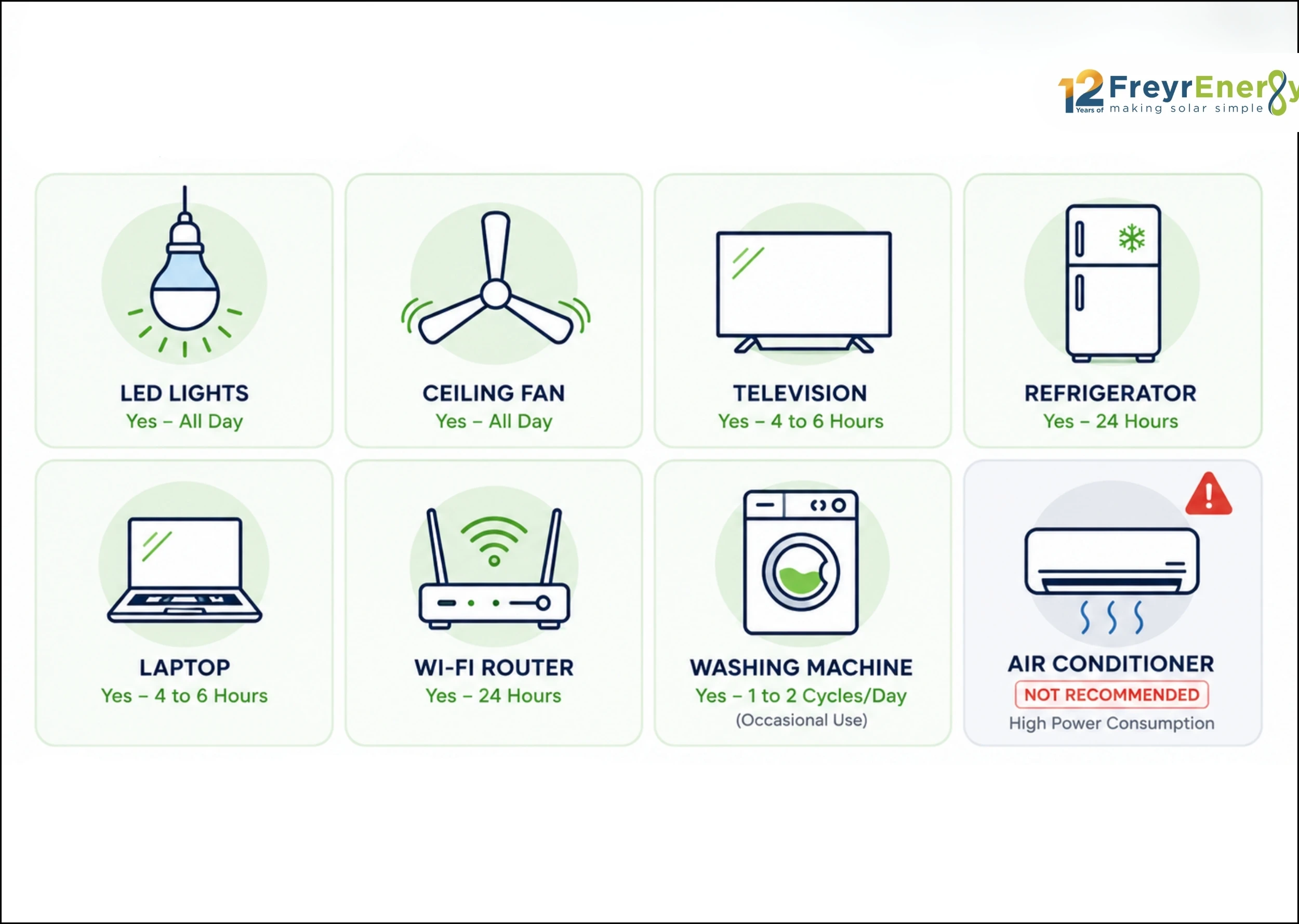
A 2kW solar system is suitable for small households with moderate electricity consumption.
| Appliance | Usage Capability |
| LED Lights | 8–10 |
| Ceiling Fans | 4–6 |
| Refrigerator | 1 |
| Television | 1 |
| Laptop | Multiple |
| Wi-Fi Router | Yes |
| Washing Machine | Moderate usage |
| Mixer Grinder | Yes |
| Air Conditioner | Limited / not recommended for continuous use |
A 2kW system is ideal for homes that mainly use basic appliances. If your home regularly runs ACs, electric geysers, or multiple high-power appliances, a 3kW or larger system may be more suitable.
Types of 2kW Solar Systems
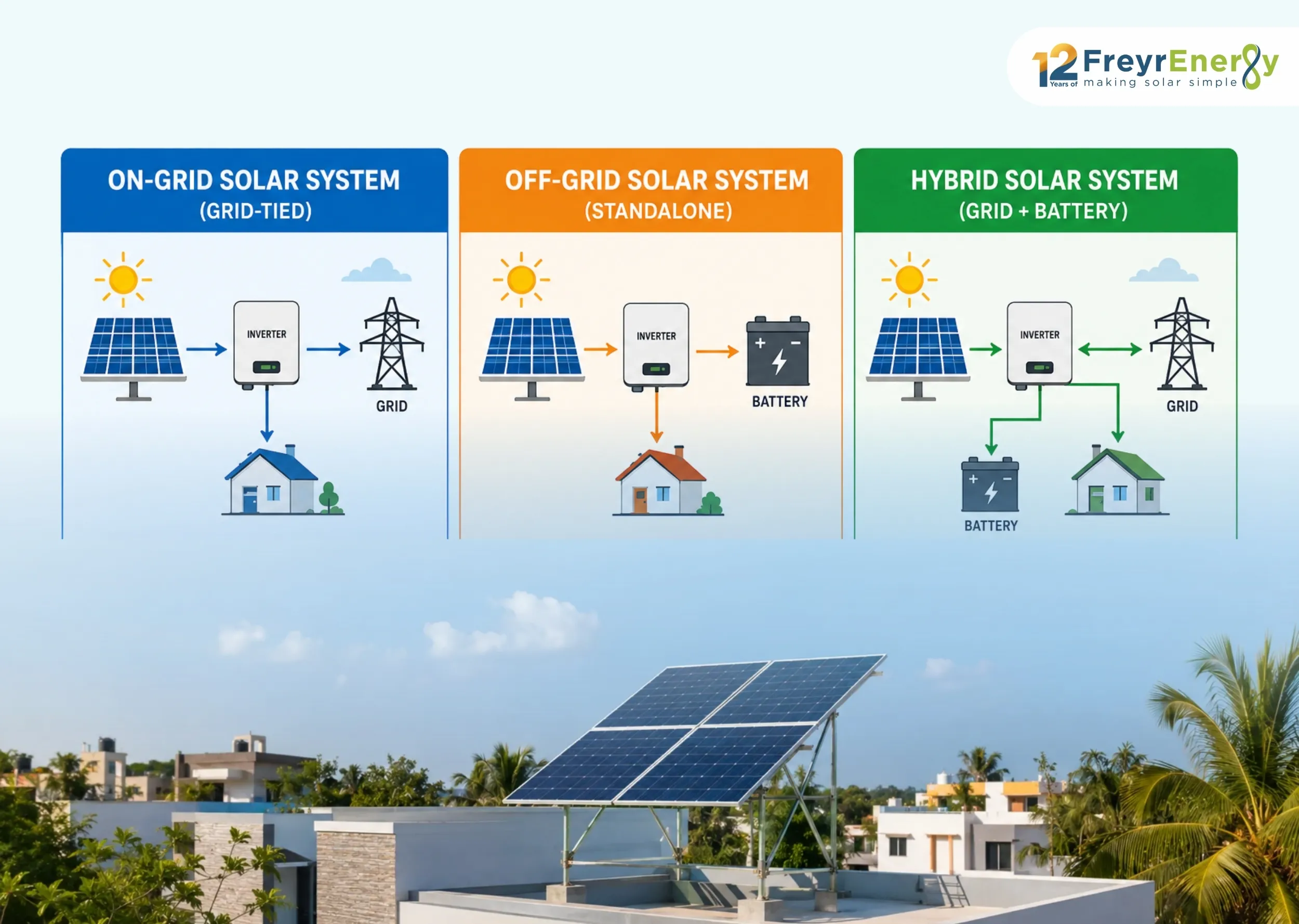
Before installation, homeowners can choose between three main system types.
1. On-Grid 2kW Solar System
An on-grid solar system is directly connected to the electricity grid and is the most common choice for residential homes.
Benefits:
- Lowest upfront investment
- No battery requirement
- Eligible for net metering
- Excess electricity can be exported to the grid
- Best return on investment
Best suited for:
Homes with reliable electricity supply that want maximum electricity bill savings.
2. Off-Grid 2kW Solar System
An off-grid system works independently using battery storage.
Benefits:
- Provides backup during power cuts
- Works without grid availability
- Suitable for remote locations
Considerations:
- Higher installation cost
- Battery replacement required after a few years
- More maintenance compared to on-grid systems
Best suited for:
Areas with frequent power outages or unreliable grid connectivity.
3. Hybrid 2kW Solar System
A hybrid solar system combines solar panels, battery storage, and grid connectivity.
Benefits:
- Provides backup during outages
- Reduces electricity bills
- Offers better energy independence
Considerations:
- Higher upfront investment
- Additional battery maintenance
Best suited for:
Homeowners who want both electricity savings and backup power.
For most urban and semi-urban homes with stable electricity supply, an on-grid 2kW solar system provides the best balance between cost and savings.
2kW Solar Installation Process
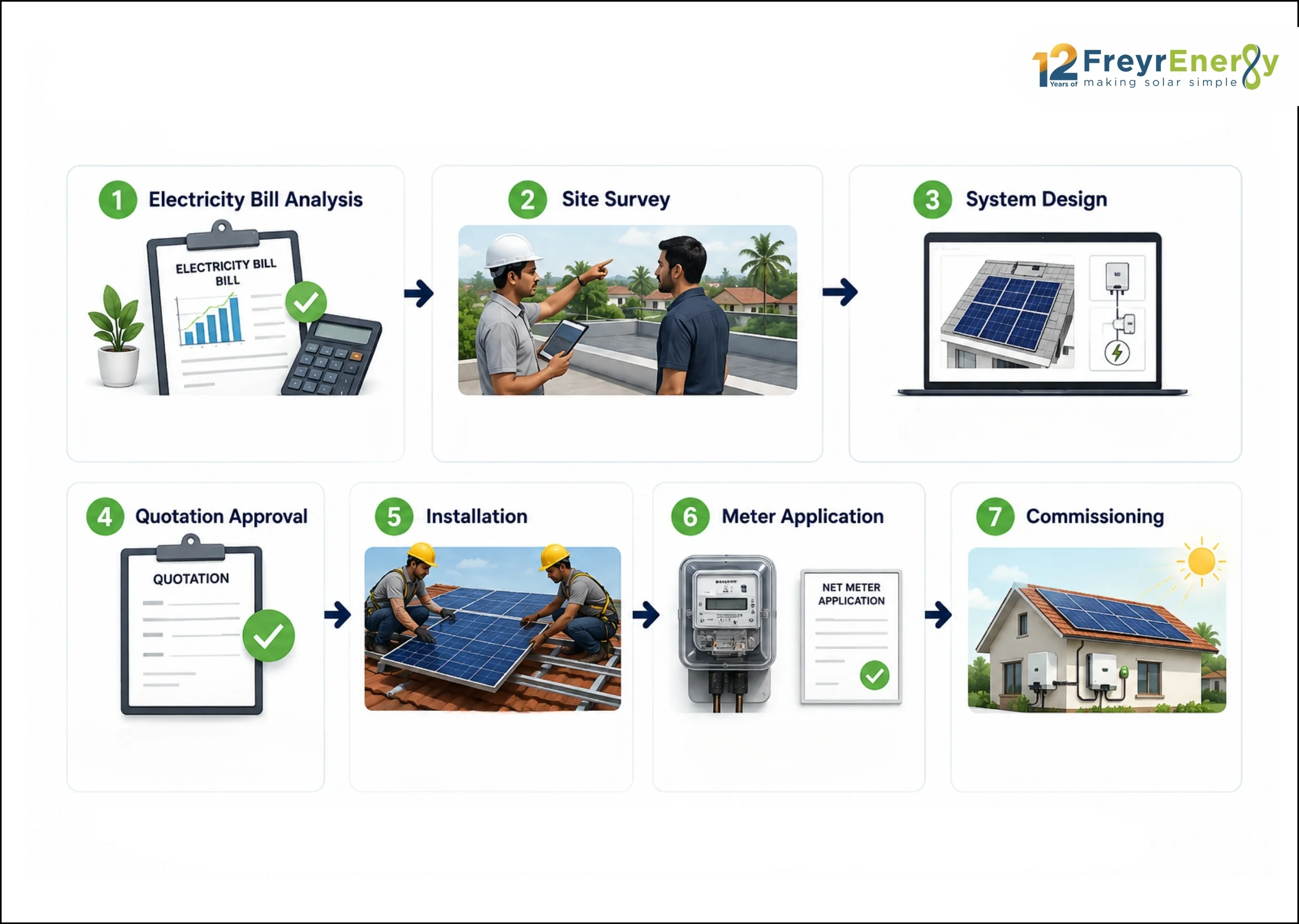
Installing a rooftop solar system involves several steps to ensure proper performance and safety.
1. Electricity Bill Assessment
The solar provider reviews your electricity consumption to confirm whether a 2kW system is suitable for your home.
2. Site Survey
A technician checks:
- Available rooftop space
- Shading conditions
- Roof strength
- Panel placement options
3. System Design
The installation team finalises:
- Number of panels
- Panel layout
- Inverter location
- Wiring design
- Mounting structure
4. Quotation Approval
You receive the final proposal including:
- System cost
- Components included
- Warranty details
- Installation timeline
5. Installation
The team installs:
- Mounting structure
- Solar panels
- Inverter
- Electrical wiring
- Safety components
The physical installation usually takes 1–3 days.
6. Net Metering Application
For on-grid systems, the installer helps complete the net metering process with the local DISCOM.
7. System Commissioning
After inspection and approval, the system is activated and starts generating solar electricity.
The complete process from application to commissioning usually takes a few weeks, depending on DISCOM approval timelines.
How Much Can You Save With a 2kW Solar System?
The biggest benefit of a 2kW solar system is reducing monthly electricity expenses.
A 2kW system can generate around 240–300 units per month, helping reduce your dependence on grid electricity.
Actual savings depend on:
- Monthly solar generation
- Electricity tariff
- Household consumption
- Net metering benefits
- System performance
Example: 2kW Solar Savings Calculation
| Calculation | Amount |
| Monthly Solar Generation | 270 units |
| Electricity Tariff | ₹8/unit |
| Estimated Monthly Savings | ₹2,160 |
| Estimated Annual Savings | ₹25,920 |
2kW Solar System Payback Period Example
| Cost Calculation | Amount |
| 2kW Solar System Price | ₹1,85,000 |
| PM Surya Ghar Subsidy | ₹60,000 |
| Freyr Energy Installation Benefit | ₹22,000 |
| Effective Investment | ₹1,03,000 |
| Estimated Annual Savings | ₹25,920 |
| Approximate Payback Period | Around 4 years |
After recovering the initial investment, the electricity generated by your solar system continues to provide savings throughout its lifespan.
Most quality solar panels come with a 25-year performance warranty, making rooftop solar a long-term investment for reducing electricity expenses.
Actual savings and payback vary depending on electricity tariff, location, system performance, and household consumption.
Is a 2kW Solar System Worth Installing?
A 2kW solar system is a good choice if:
✅ Your monthly electricity bill is around ₹1,500–₹3,000
✅ You live in a 1–2 BHK home
✅ Your electricity consumption is moderate
✅ You have 120–150 sq. ft. of shadow-free roof space
✅ You want to reduce long-term electricity expenses
A larger system may be better if you:
- Use air conditioners regularly
- Have electric water heaters
- Plan EV charging
- Expect higher future electricity consumption
2kW Solar Panel Maintenance Guide
Rooftop solar maintenance is relatively simple and requires only basic care to ensure consistent performance over the system’s lifespan
Regular Panel Cleaning
Dust, dirt, and bird droppings can reduce electricity generation.
Cleaning panels every 2–4 weeks helps maintain performance, especially in dusty areas.
Monitor Solar Generation
Use your inverter display or solar monitoring app to track:
- Daily generation
- Monthly performance
- Sudden drops in output
Check Inverter Performance
Regularly check for:
- Error messages
- Warning indicators
- Performance issues
Annual Inspection
A yearly inspection helps ensure:
- Proper wiring connections
- Mounting structure stability
- Safe electrical operation
Solar Panel Warranty and Lifespan
A rooftop solar system is designed for long-term performance.
| Component | Typical Warranty |
| Solar Panels | Up to 25 years performance warranty |
| Solar Inverter | 5–10 years |
| Mounting Structure | Depends on material and manufacturer |
High-quality components and professional installation help maintain reliable performance throughout the solar system’s lifespan.
2kW vs 3kW Solar System: Which One Should You Choose?
The right solar system size depends on your electricity consumption, family size, and future requirements.
| Factor | 2kW Solar System | 3kW Solar System |
| Suitable Home Size | 1–2 BHK | 2–3 BHK |
| Daily Generation | 8–10 units | 12–15 units |
| Monthly Generation | 240–300 units | 360–450 units |
| Roof Space Required | 120–150 sq. ft. | 180–220 sq. ft. |
| Investment | Lower | Higher |
| Suitable Appliances | Lights, fans, TV, fridge, laptops | Includes higher loads and limited AC usage |
Choose 2kW If:
- You have moderate electricity consumption
- Your home has limited rooftop space
- You want lower initial investment
- Your priority is reducing electricity bills
Choose 3kW If:
- Your electricity consumption is increasing
- You use AC regularly
- You have a larger family
- You want additional capacity for future appliances
Read our full 3kW solar panel price in India guide for a detailed breakdown.
Why Choose an Experienced Solar Installer?
Installing solar is a long-term investment, so choosing the right solar installer is as important as selecting the right system size.
An experienced solar company helps with:
- Correct system sizing
- Quality components
- Safe installation
- Net metering support
- After-sales service
- Long-term system performance
Freyr Energy has installed 20,000+ rooftop solar systems and helps homeowners switch to clean energy with reliable installation, monitoring, and support.
Conclusion
A 2kW solar system is a practical choice for small households looking to reduce electricity bills and switch to clean energy. With 8–10 units of daily generation, government subsidy support, and long-term savings, it offers a good balance between affordability and performance.
Before installing, consider your electricity usage, rooftop space, and future energy needs to choose the right system size.
Explore your 2kW solar savings with Freyr Energy and take the first step towards lower electricity bills and cleaner energy.