
| Direct answer: HJT, or silicon heterojunction technology, uses a crystalline-silicon absorber with thin amorphous-silicon passivation and carrier-selective layers. Current Indian-listed HJT modules can reach 23.5% front-side efficiency and a −0.24%/°C Pmax coefficient. HJT can outperform a specific TOPCon module in heat or rear-side response, but TOPCon may offer a lower project cost or easier supply. Choose by modeled annual kWh and installed value, not the label. |
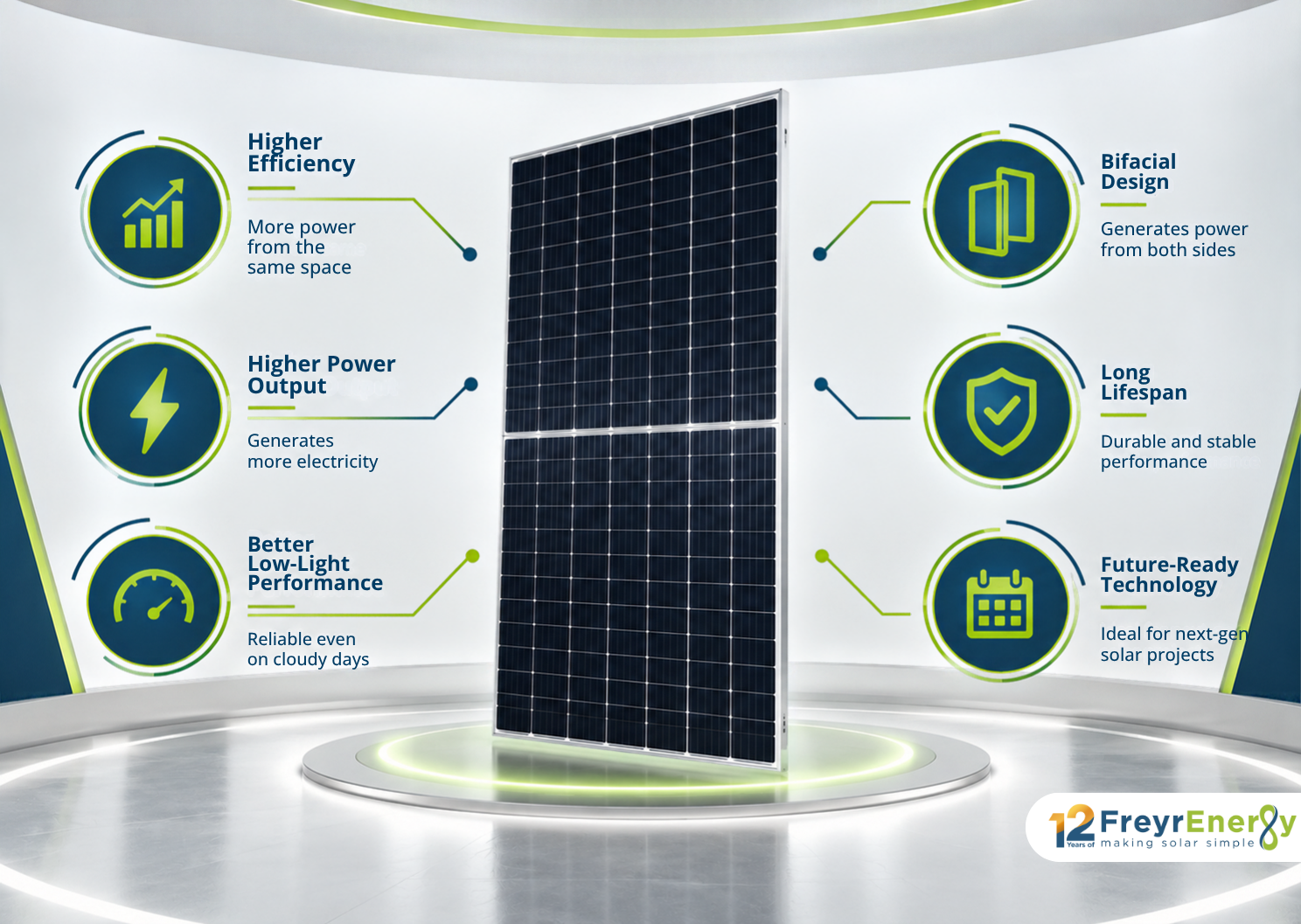
HJT solar panels combine a crystalline-silicon wafer with very thin amorphous-silicon layers. This heterojunction can deliver strong surface passivation, high voltage, high module efficiency and a favourable power temperature coefficient. Those strengths make HJT attractive for space-constrained and high-temperature projects, but the technology name alone does not guarantee better economics.
A valid comparison must use exact module data: front-side efficiency, dimensions, weight, current, temperature coefficient, bifaciality, degradation warranty, ALMM status, availability and complete installed price. This guide explains those specifications and compares current Waaree HJT and TOPCon series as a worked example, not a universal ranking.
Quick Takeaways
- HJT and SHJ commonly refer to silicon heterojunction technology; exact cell stacks vary by manufacturer.
- HJT’s low-recombination contacts can support high efficiency and a favourable temperature coefficient.
- High panel wattage can come from a larger module as well as higher efficiency; always compare area and dimensions.
- Bifaciality describes rear-side response, not guaranteed rear-side energy gain on a roof.
- N-type HJT avoids the classic boron-oxygen LID mechanism associated with many p-type wafers, but it is not immune to all degradation.
- HJT can be ALMM-listed: eligibility must be checked at the exact manufacturer, factory and model level.
- For an unconstrained roof, extra installed HJT capacity or lower total cost may matter more than a small efficiency difference.
HJT Solar Panels at a Glance
| Question | Practical answer |
| What does HJT mean? | Heterojunction technology; silicon heterojunction is also abbreviated SHJ. |
| Typical absorber | Usually an n-type monocrystalline silicon wafer in current commercial products. |
| Key layers | Crystalline silicon, intrinsic/doped amorphous silicon, transparent conductive oxide and metal contacts. |
| Primary strengths | High efficiency potential, favourable Pmax temperature coefficient and strong bifacial potential in suitable modules. |
| Primary trade-offs | Different manufacturing equipment, material use, premium positioning, supply and service availability. |
| Best decision method | Compare exact modules and project-level annual energy, layout and installed cost. |
What Is an HJT Solar Cell?
A conventional crystalline-silicon cell uses a silicon wafer as the light-absorbing body. An HJT cell adds very thin hydrogenated amorphous-silicon layers to the wafer surfaces. The intrinsic layers passivate defects at the crystalline surface, reducing carrier recombination. Doped amorphous layers help create carrier-selective contacts.
Transparent conductive oxide, often referred to as TCO, helps conduct current while allowing light into the cell. Metal fingers and busbars collect that current. The finished cells are interconnected, encapsulated and assembled into a module with glass, back glass or backsheet, frame, junction box, cables and connectors.
HJT Cell Structure: Layer by Layer
| Layer or component | Role |
| Front glass and encapsulation | Protect the cells and transmit light; construction influences weight and durability. |
| TCO layer | Provides transparent lateral conductivity and optical management. |
| Doped amorphous-silicon layer | Forms a carrier-selective contact. |
| Intrinsic amorphous-silicon layer | Passivates the crystalline-silicon surface and reduces recombination. |
| Crystalline-silicon wafer | Absorbs most incoming light and generates electron-hole pairs. |
| Rear contact stack | Collects rear-side carriers and, in bifacial designs, admits useful rear irradiance. |
| Metallisation | Transfers current into the module interconnection system. |
A cross-section diagram is useful for understanding the concept, but buyers should not infer cell quality from a marketing illustration. Finished-module design, process control and bill of materials still determine reliability.
How HJT Solar Panels Generate Electricity
- Photons enter the module and are absorbed mainly in the crystalline-silicon wafer.
- The absorbed energy creates electron-hole pairs.
- The heterojunction and built-in electric field help separate charge carriers.
- Passivated surfaces reduce the chance that carriers recombine before collection.
- TCO and metal contacts transport current to the cell interconnections and module leads.
- The inverter converts module DC output into usable AC electricity for the site or grid.
How HJT Manufacturing Differs From TOPCon
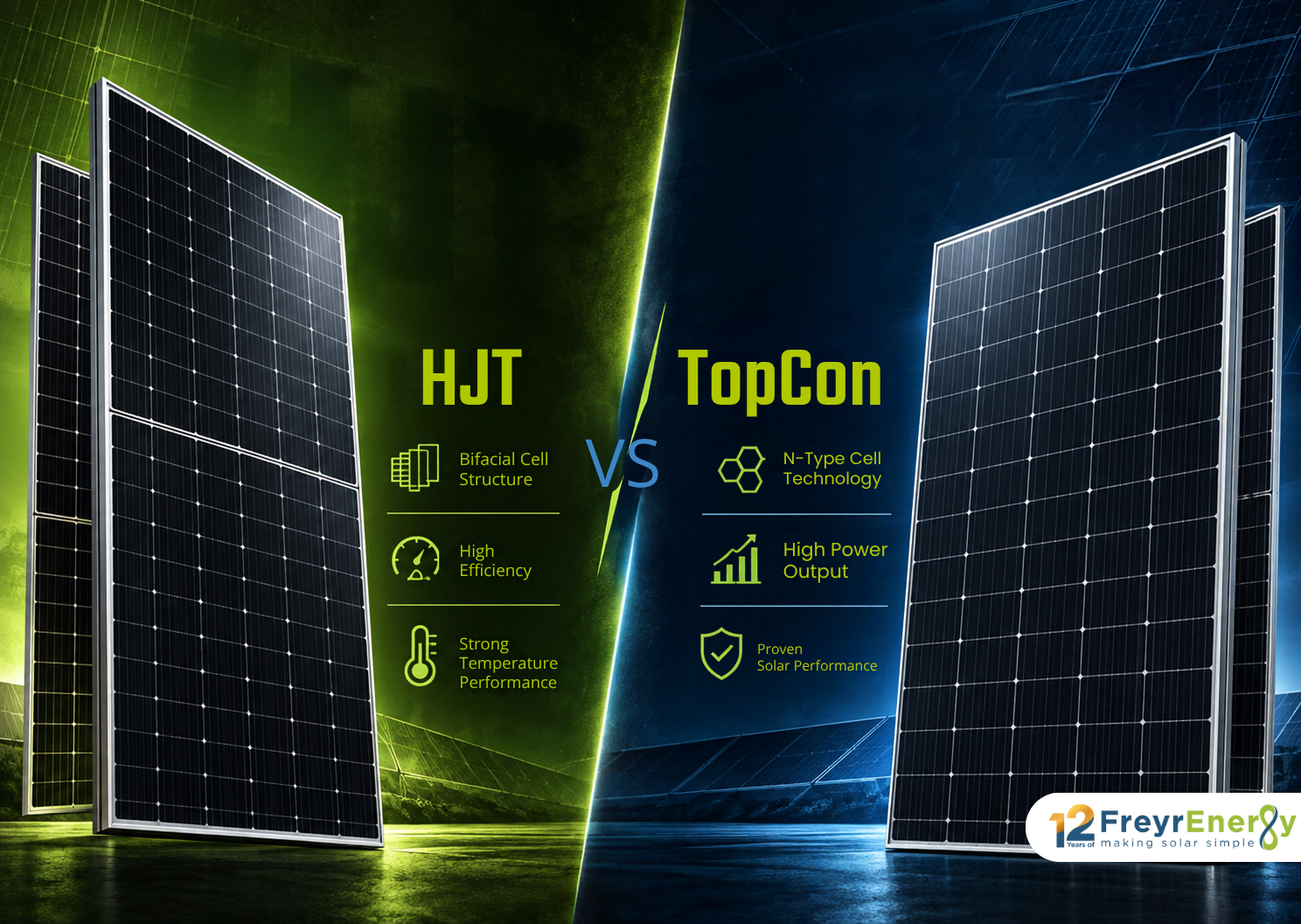
Both HJT and mainstream TOPCon use passivating-contact concepts, but their process routes differ. HJT relies on amorphous-silicon and TCO deposition, commonly at relatively low processing temperatures, followed by compatible metallisation. TOPCon uses a very thin tunnel oxide and doped polysilicon contact and can build more directly on high-temperature crystalline-silicon manufacturing experience.
| Manufacturing factor | HJT | TOPCon |
| Passivating contact | Amorphous-silicon heterojunction stack. | Tunnel oxide plus doped polysilicon contact. |
| Process temperature | Generally lower-temperature cell processing. | Includes higher-temperature steps. |
| Key deposition/tooling | PECVD/PVD-type thin-film and TCO processes. | Oxide/polysilicon deposition and high-temperature processing. |
| Metallisation challenge | Low-temperature-compatible contacts; material reduction is an active focus. | Industrial metallisation with its own paste and contact optimisation. |
| Factory transition | Can require a different equipment set from PERC. | Often viewed as a more evolutionary transition from PERC manufacturing. |
IEA PVPS has highlighted silver use as a cost and supply-chain issue across PV technologies, with HJT historically requiring more silver per watt in the cited 2024 industry data. Manufacturers are pursuing thinner wafers, silver-coated copper, copper plating and busbar changes. Do not assume every current product uses the same metallisation recipe.
HJT Efficiency: What 23.5% Actually Means
Module efficiency is rated DC power divided by incident test power over module area under standard test conditions. It is not the share of annual sunlight converted under all weather. A more efficient module produces more rated watts from the same module area, which is valuable when usable roof area is constrained.
Waaree’s PLEXUS BiH-11 series datasheet lists 700–730 W models with 22.53%–23.50% front-side module efficiency. The 730 W figure is measured at standard test conditions on a large 2384 × 1303 mm module. Its high wattage comes from both efficiency and physical area.
Efficiency, Wattage and Area Are Different
| Specification | What it tells you | Buying mistake to avoid |
| Efficiency (%) | Rated power density under defined test conditions. | Assuming it guarantees more annual kWh for equal installed kW. |
| Wattage (Wp) | Maximum rated DC power of one module at STC. | Assuming a higher-watt panel is always more space-efficient. |
| Dimensions and area | How much physical roof each module occupies. | Ignoring walkways, setbacks, shade and module orientation. |
| Annual energy (kWh) | Modeled or measured production over time. | Using a datasheet wattage as a yearly generation promise. |
Worked Roof-Area Example
Using the compared Waaree datasheets: seven 730 W HJT modules provide 5.11 kW and occupy about 21.74 m² of raw module area. Eight 645 W TOPCon modules provide 5.16 kW and occupy about 22.36 m². In this example, HJT reduces module count and raw panel area modestly. The real layout can reverse or enlarge the advantage because roof shape, portrait/landscape orientation, access paths, row spacing and shade decide what actually fits.
HJT Temperature Coefficient
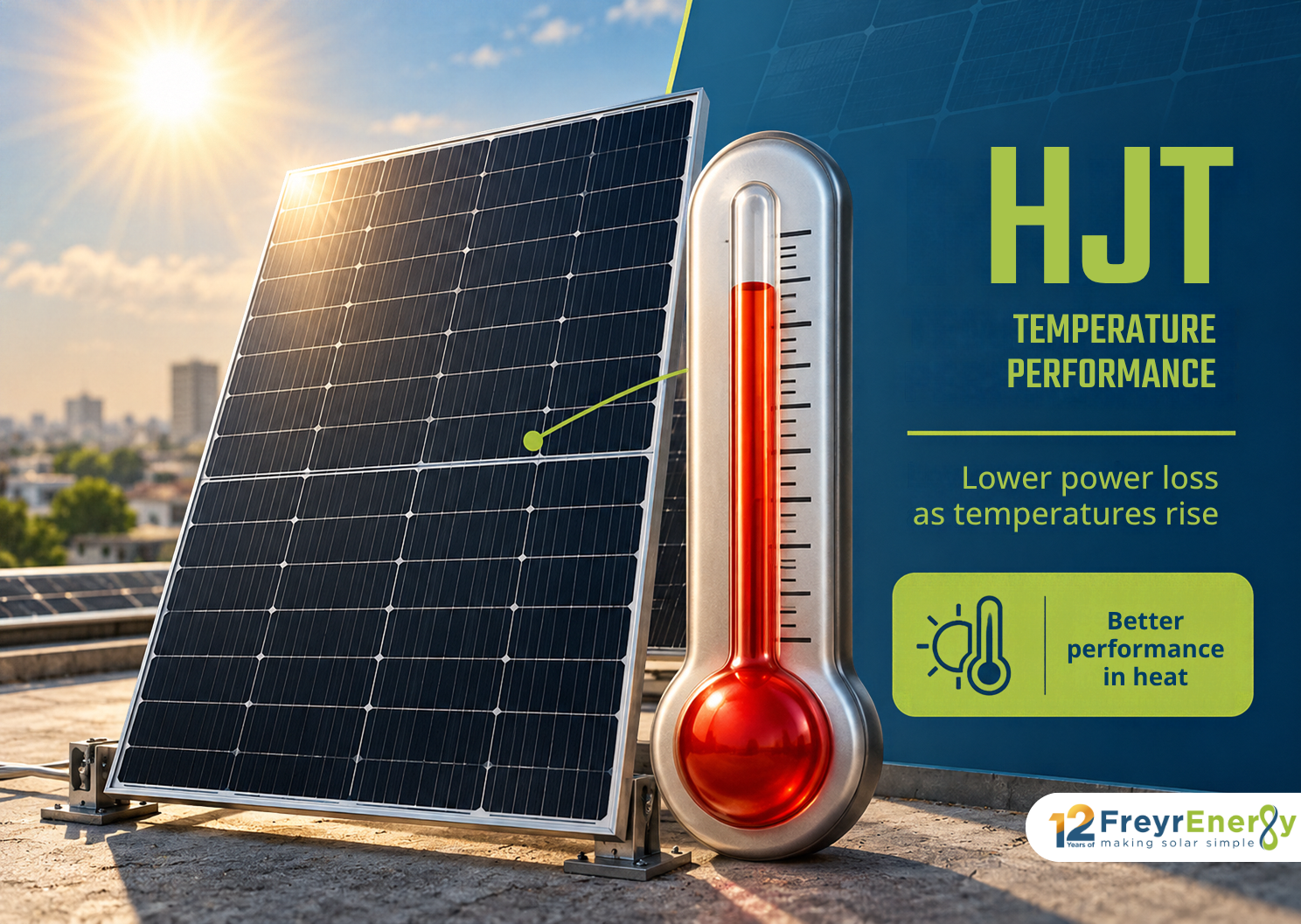
The Pmax temperature coefficient estimates how rated power changes as cell temperature moves away from 25°C. A less negative value means a smaller power reduction when cells become hotter. Cell temperature can be much higher than ambient air temperature under strong sun.
| Temperature formula: Approximate power change (%) = Pmax temperature coefficient (%/°C) × (cell temperature − 25°C). |
Worked HJT vs TOPCon Heat Example
At a 60°C cell temperature, the temperature rise above STC is 35°C. Using the compared Waaree datasheets:
| Module series | Pmax coefficient | Approximate loss at 60°C cell temperature |
| PLEXUS HJT | −0.24%/°C | 35 × 0.24% = 8.4% below the 25°C rating |
| ELITE TOPCon | −0.30%/°C | 35 × 0.30% = 10.5% below the 25°C rating |
The 2.1-percentage-point difference applies to this simplified operating moment, not annual generation. Annual advantage depends on hourly cell temperature, irradiance, wind, low-light response, inverter clipping, layout and downtime. Use energy modeling with the exact PAN/datasheet inputs when the premium decision is material.
HJT Bifaciality and Rear-Side Gain
Bifaciality is the ratio of rear-side to front-side electrical response under defined test conditions. Waaree lists 85 ± 10 for the PLEXUS HJT series and 80 ± 10 for the compared ELITE TOPCon series. That does not mean either module adds 85% or 80% energy at a site.
Actual bifacial gain depends on rear irradiance, which is controlled by surface reflectivity, clearance, tilt, row spacing, rear obstruction, self-shading, neighbouring structures, soiling and ground-cover changes. A dark roof under a low-flush module may deliver little rear contribution even when the cell has high bifaciality.
| Bifacial principle: Rear-side energy contribution ≈ rear irradiance fraction × bifaciality × system and mismatch factors. A bankable estimate needs a 3D/site-specific model, not a fixed marketing percentage. |
LID, LeTID, PID and Reliability
| Term | What it means | HJT buying implication |
| LID | Light-induced degradation after initial light exposure. | N-type wafers avoid the classic boron-oxygen mechanism common in many p-type products, but verify the model claim. |
| LeTID | Light- and elevated-temperature-induced degradation. | Cell architecture and processing matter; do not infer immunity from “n-type” alone. |
| PID | Potential-induced degradation under high system voltage and environmental stress. | Check module qualification, materials, grounding/system design and warranty exclusions. |
| UV/material ageing | Changes in encapsulant, passivation/contact or other materials under exposure. | Bill of materials and qualification are as important as cell architecture. |
| Mechanical stress | Cell cracks, glass/frame and interconnection stress from loads and handling. | Large glass-glass HJT modules need correct transport, lifting, clamps and structure. |
Recent field and laboratory research continues to study reliability differences between HJT, TOPCon and PERC under heat, UV and combined stress. Treat technology-wide “lowest degradation” claims cautiously; exact materials, process and climate can change the result.
HJT Degradation and Warranty
Waaree’s PLEXUS datasheet shows a 12-year product warranty and 30-year power-output warranty, with a performance chart indicating 99.0% after year one and 90.3% at year 30. That curve is model- and warranty-document-specific. It is not proof that every HJT module degrades at the same rate or that every loss mechanism is covered.
Read product and performance warranties separately. Check the warranted claimant, registration, start date, exclusions, test method, output remedy, labour, freight, removal/reinstallation and the position if the exact replacement model is no longer available.
HJT vs TOPCon: Model-Level Datasheet Comparison
The table compares two Waaree bifacial glass-glass series to reduce brand and documentation differences. It is an example, not a verdict on every HJT or TOPCon module.
| Specification | PLEXUS HJT BiH-11-730 | ELITE TOPCon BiN-17-645 |
| Rated power | 730 W | 645 W |
| Front-side module efficiency | 23.50% | 23.07% |
| Pmax temperature coefficient | −0.24%/°C | −0.30%/°C |
| Bifaciality | 85 ± 10 | 80 ± 10 |
| Dimensions | 2384 × 1303 × 35 mm | 2465 × 1134 × 35 mm |
| Weight | 39 kg | 34.5 kg |
| Cell architecture | G12 bifacial HJT | M10/M10R n-type TOPCon bifacial |
| Warranty shown on datasheet | 12-year product; 30-year power output | 12-year product; 30-year power output |
The HJT series leads these listed electrical metrics, while the TOPCon module is lighter and differently shaped. Project choice still depends on price, availability, string design, roof fit, ALMM/DCR status, installation handling, supply terms and service.
HJT vs TOPCon vs Mono PERC
| Factor | Mono PERC | TOPCon | HJT |
| Common wafer family | Often p-type in mainstream legacy products | Usually n-type | Usually n-type |
| Contact/passivation concept | PERC rear passivation and local contacts | Tunnel oxide and doped polysilicon contact | Amorphous-silicon heterojunction contacts |
| Current market position | Mature/value and legacy supply | Broad high-efficiency mainstream | Premium/specialised and growing |
| Temperature performance | Use exact model; often more negative | Commonly strong | Commonly very strong |
| Bifacial options | Available | Widely available | Common in current high-power products |
| Cost conclusion | Cannot be ranked without current quotes | Often competitive at scale | Premium may apply; verify actual quote |
Do not use technology averages as procurement specifications. A strong current TOPCon model can outperform an older or poorly designed HJT module on efficiency, dimensions, reliability, price or availability.
HJT Solar Panel Price in India
There is no defensible universal HJT price per watt without quantity, model, DCR status, tax, freight, pincode and commercial terms. As a dated retail example, Loom Solar’s HJT product page showed a sale price of ₹4,81,000 for a pack of 33 SHARK 730–750 W modules on 21 September 2026. At 730 W, that is about ₹14,576 per module and ₹19.97/W before interpreting shipping, tax, stock or project suitability. It is a bulk-pack snapshot, not a single-panel market benchmark or endorsement.
An installed rooftop quote also includes inverter, structure, protection, earthing, cables, transport, lifting, labour, approvals, monitoring, taxes and service. A high-current 39 kg glass-glass module may change handling, structure or inverter design costs. Compare complete installed HJT and TOPCon alternatives on the same DC capacity and scope.
Does the HJT Premium Pay Back?
Calculate the incremental value rather than assuming it. Premium payback ≈ additional installed HJT cost ÷ annual value of additional HJT generation. Additional generation should come from a location-specific model using exact efficiency, temperature coefficient, bifacial layout, degradation and clipping assumptions.
Illustrative Premium Test
Suppose an equal-capacity HJT design costs ₹20,000 more and the modeled advantage is 120 kWh/year. At an illustrative energy value of ₹8/kWh, first-year benefit is ₹960 and simple premium payback exceeds 20 years before discounting or degradation. If the same roof instead fits materially more HJT capacity, the benefit could be much larger. Replace every input with the actual site and tariff.
| Question | Why it matters |
| Does HJT fit more installed kW? | Space-constrained projects may gain more from power density than from small per-kW yield differences. |
| Is rear irradiance available? | High bifaciality has limited value when the rear receives little light. |
| Is inverter clipping different? | Extra DC output can be lost if AC capacity and design are unchanged. |
| What is the premium after all BOS changes? | Module price alone may miss structure, lifting, inverter and logistics differences. |
| How is energy valued? | Self-consumption, export credit, tariff and commercial demand effects differ. |
ALMM, DCR and PM Surya Ghar
ALMM eligibility is not restricted to TOPCon or PERC. The MNRE List-I updated 16 September 2026 includes HJT models such as Waaree BiH-11-700 through BiH-11-730 and several Reliance RNE HJT models. Listing is tied to the manufacturer, manufacturing location, model and validity—not to the HJT label generally.
For government-assisted, net-metered, open-access or other covered projects, verify the exact current rule and model entry before procurement. PM Surya Ghar also has applicable domestic-content and vendor requirements. The residential CFA is based on eligible rooftop capacity, not module efficiency or the HJT price premium:
| Eligible residential rooftop capacity | Normal-category individual-household central CFA |
| 1 kW solar system | ₹30,000 |
| 2 kW solar system | ₹60,000 |
| 3 kW solar system or above | ₹78,000 maximum |
Do not describe an entire brand as “ALMM approved.” A manufacturer can have listed and unlisted models, multiple factories and changing validity periods. DCR and ALMM are related procurement/compliance questions but are not interchangeable terms.
Are HJT Panels Suitable for Indian Conditions?
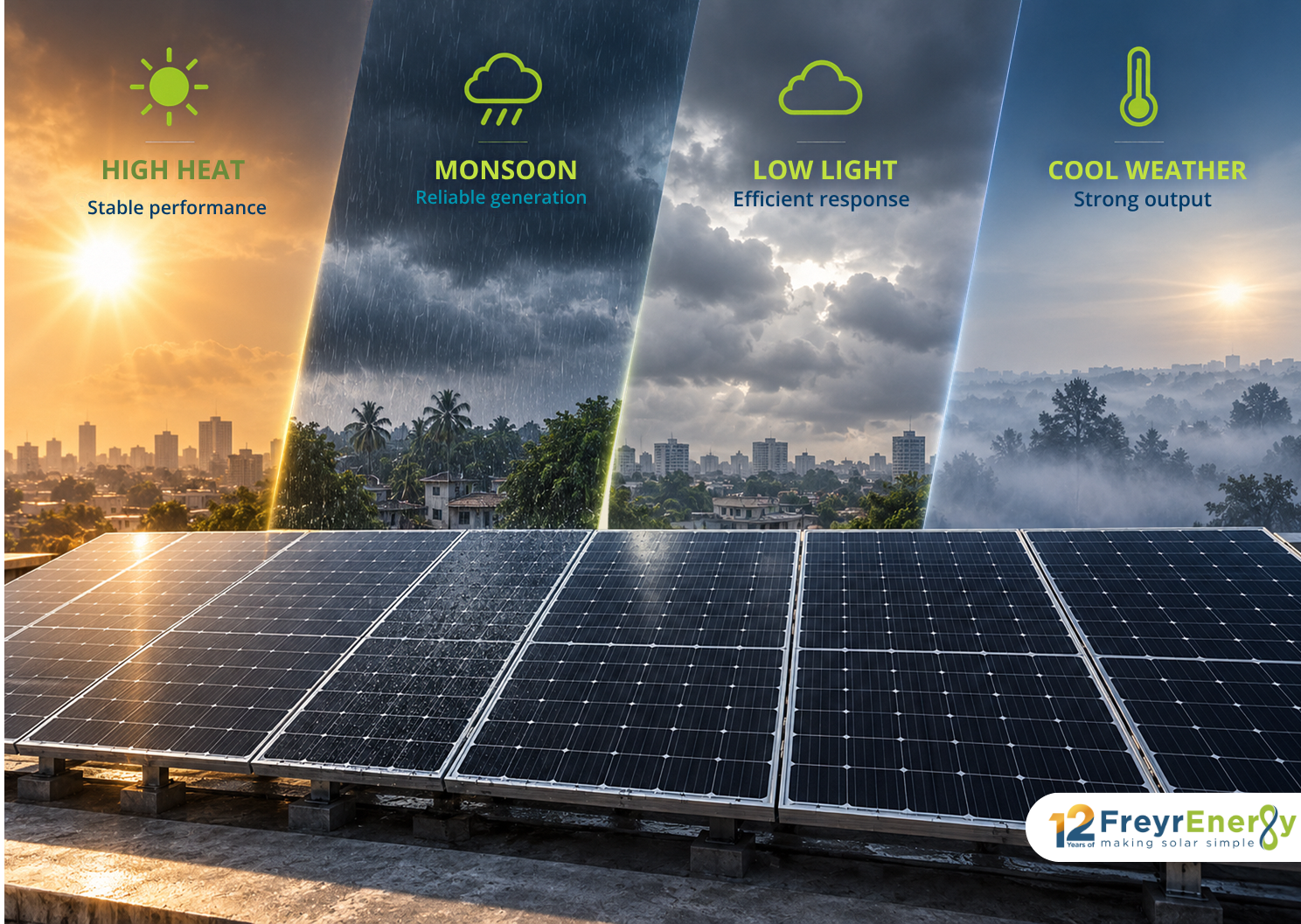
They can be. A favourable temperature coefficient is useful in hot, sunny conditions, while strong front efficiency can help constrained roofs. High bifaciality can add value on elevated or ground-mounted structures with useful rear irradiance. However, humidity, salt mist, dust, wind, structural loads, UV exposure and service availability still require site- and model-specific assessment.
Roof ventilation and mounting matter. Even a module with a good temperature coefficient loses power as cells heat up. Adequate airflow, correct spacing, electrical design, cleaning strategy and inverter sizing can be as important as the cell architecture.
Where HJT Can Make Sense
| Project situation | HJT opportunity | What to verify |
| Constrained rooftop | Higher power density may fit more DC capacity. | Actual layout, module size, access, shade and inverter limits. |
| Hot operating environment | Less-negative Pmax coefficient can reduce heat loss. | Hourly energy model, airflow and cell-temperature assumptions. |
| Elevated or ground bifacial array | High bifaciality may improve rear-side harvest. | Albedo, height, row spacing, mismatch and seasonal ground condition. |
| Commercial/industrial roof | Fewer modules may reduce some repetitive BOS quantities. | Lifting, roof loading, wind design, current and O&M access. |
| Unconstrained low-cost project | Technical advantage may not justify premium. | Equal-scope LCOE and supply-risk comparison. |
| Subsidised residential project | Possible only when exact model and project comply. | Current ALMM/DCR/portal/vendor requirements and local availability. |
Electrical and Mechanical Design Checks
- Maximum module Voc and string Voc at the site’s minimum design temperature.
- Operating current, inverter MPPT input-current limit, connector and cable ratings.
- String length, parallel strings, mismatch, shading and bypass-diode behaviour.
- DC/AC ratio and possible clipping under high front-plus-rear output.
- Module dimensions, weight, roof loading, wind uplift, clamp zones and structure certification.
- Safe transport and lifting plan for large glass-glass modules; manufacturer handling instructions.
- Fire/access pathways, drainage, waterproofing, cleaning reach and future roof maintenance.
- Earthing, surge/lightning protection, isolators, labels, testing and commissioning records.
A panel swap is not automatically electrical-equivalent. High-current modules can exceed an inverter MPPT limit even when total array wattage seems acceptable. Obtain an approved single-line diagram and model-specific compatibility check.
How to Compare Two HJT or TOPCon Quotations
- Record the full manufacturer, model code, factory, DCR/ALMM status and validity date.
- Compare front-side efficiency, wattage, dimensions and watts per square metre.
- Compare Pmax temperature coefficient using the same cell-temperature scenario.
- For bifacial modules, request the bifaciality value and the project’s modeled rear irradiance.
- Compare first-year and annual warranty curves, product warranty and claim obligations.
- Check voltage, current, string and inverter compatibility using the exact datasheets.
- Normalise total installed DC capacity, AC capacity, structure, protection and service scope.
- Request monthly and annual energy simulations with all losses and clipping disclosed.
- Compare price, financing and tariff assumptions separately from government CFA.
- Confirm local supply, spare/replacement strategy, logistics, installer experience and service route.
Common Buying Mistakes
- Choosing the highest module wattage without checking module area.
- Treating HJT as automatically superior to every TOPCon product.
- Applying a fixed bifacial gain to a low-clearance dark rooftop.
- Using temperature coefficient to promise a fixed annual-generation increase.
- Assuming n-type means zero degradation or zero PID risk.
- Ignoring module weight, handling, roof geometry and inverter input current.
- Comparing a bulk module price with a complete installed-system quote.
- Checking the brand on ALMM but not the exact model, factory and validity.
- Treating a 30-year performance warranty as a 30-year product warranty.
- Paying a premium without a project-level energy and payback calculation.
Future of HJT Technology
HJT development is focused on higher efficiency, thinner wafers, reduced silver use, copper-based metallisation, busbar changes and improved production throughput. HJT also serves as a potential silicon bottom cell for tandem architectures. These trends may reduce cost or increase performance, but buyers should purchase the current qualified product rather than a roadmap promise.
TOPCon is already broadly commercial and continues to improve. Back-contact products are also raising module efficiency. The likely market is not a permanent single-technology winner; it is continued competition among architectures, manufacturing routes and complete module designs.
How Freyr Energy Can Support the Decision
Choosing a panel technology should follow the roof survey and system design. Freyr Energy’s approved public scope includes customised design, 3D preview and shadow analysis, installation support, financing and subsidy assistance, net-metering coordination, and project and generation monitoring through the Freyr Energy Solar App.
Freyr Energy’s approved knowledge does not establish that every project can be supplied with HJT or a specific HJT model. Ask for the exact panel and inverter model, ALMM/DCR evidence where applicable, layout, energy simulation, installed-price breakdown and warranty documents in the final proposal. Compare HJT with an equal-scope TOPCon alternative before deciding.
Related Freyr Energy Guides
Compare high-efficiency solar panel technologies
Understand the main types of solar panels in India
Plan solar panels for your home
Estimate your rooftop solar requirement
Review the solar panel installation process
See how the Freyr Energy App supports project monitoring
Conclusion
HJT solar panels combine strong passivation, high module efficiency, favourable heat behaviour and high bifacial potential. Current India-listed products show that HJT is commercially real, not merely a laboratory technology. Yet none of those advantages removes the need for product and project verification.
Start with the constraint. If roof area, operating temperature or rear irradiance materially limits energy, HJT may justify a premium. If adequate roof area and competitive TOPCon supply are available, an equal-capacity TOPCon design may produce the stronger financial result. Compare exact modules, modeled annual kWh, layout, inverter compatibility, warranty and complete installed cost—not a technology name or wattage headline.