
Direct answer: Choose rooftop solar when the roof is sound, unshaded and land is scarce. Choose ground-mounted solar when suitable land is available and roof area, strength or orientation is limiting. Compare foundations, drainage, cable distance, security, access, approvals and future land or roof use before deciding. Compare lifetime energy and total property cost, including foundations or strengthening, cable routes, drainage, security, access, future repairs and removal.
Introduction
Rooftop and ground-mounted systems use similar modules and inverters, yet their project risks are very different. A roof saves land and may shorten cable routes, while a ground mount offers freedom over orientation, tilt and access. The right answer depends on structure, land value, shade, drainage, security, approvals and future property use. This guide compares both options across design, cost, generation, maintenance, scale and suitability.
Quick Takeaways
- Rooftops save land; ground mounts provide layout flexibility.
- Ground systems may add foundations, fencing, drainage and trenching.
- Roof systems may add strengthening, waterproofing and access requirements.
- Neither format automatically generates more electricity.
- Future roof and land use can change the lifetime choice.
Rooftop vs ground-mounted solar
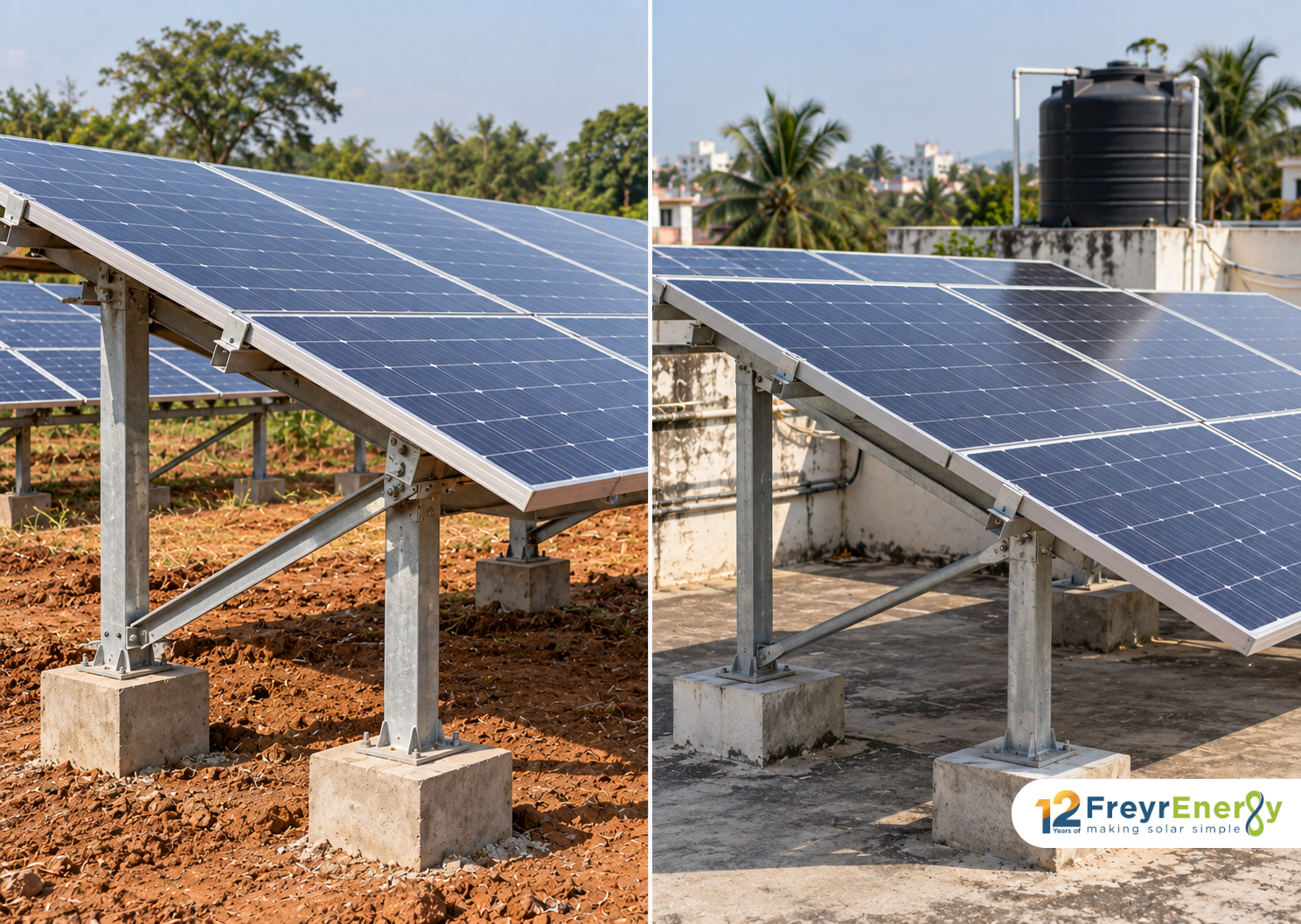
Criterion | Rooftop | Ground-mounted |
|---|---|---|
Space used | Existing roof | Dedicated land |
Orientation freedom | Limited by roof | High |
Civil work | Roof attachments/ballast | Foundations and trenching |
Access | May need height safety | Usually easier |
Future conflict | Roof repair/expansion | Land-use change |
Rooftop solar generally suits homes and businesses with a strong, shadow-free roof. Ground-mounted solar is more suitable when sufficient open land is available or the roof cannot support the required capacity.
Ground-Mounted vs. Rooftop Solar at a Glance
- Installation cost: Rooftop solar is generally more affordable.
- Space required: Rooftop systems use existing roof space, while ground-mounted systems require open land.
- Maintenance access: Ground-mounted panels are usually easier to reach.
- Design flexibility: Ground-mounted systems offer more freedom to select orientation and tilt.
- Security: Rooftop panels are less accessible to unauthorised visitors.
- Subsidy: Residential government assistance generally applies to qualifying rooftop installations.
What Is Rooftop Solar?
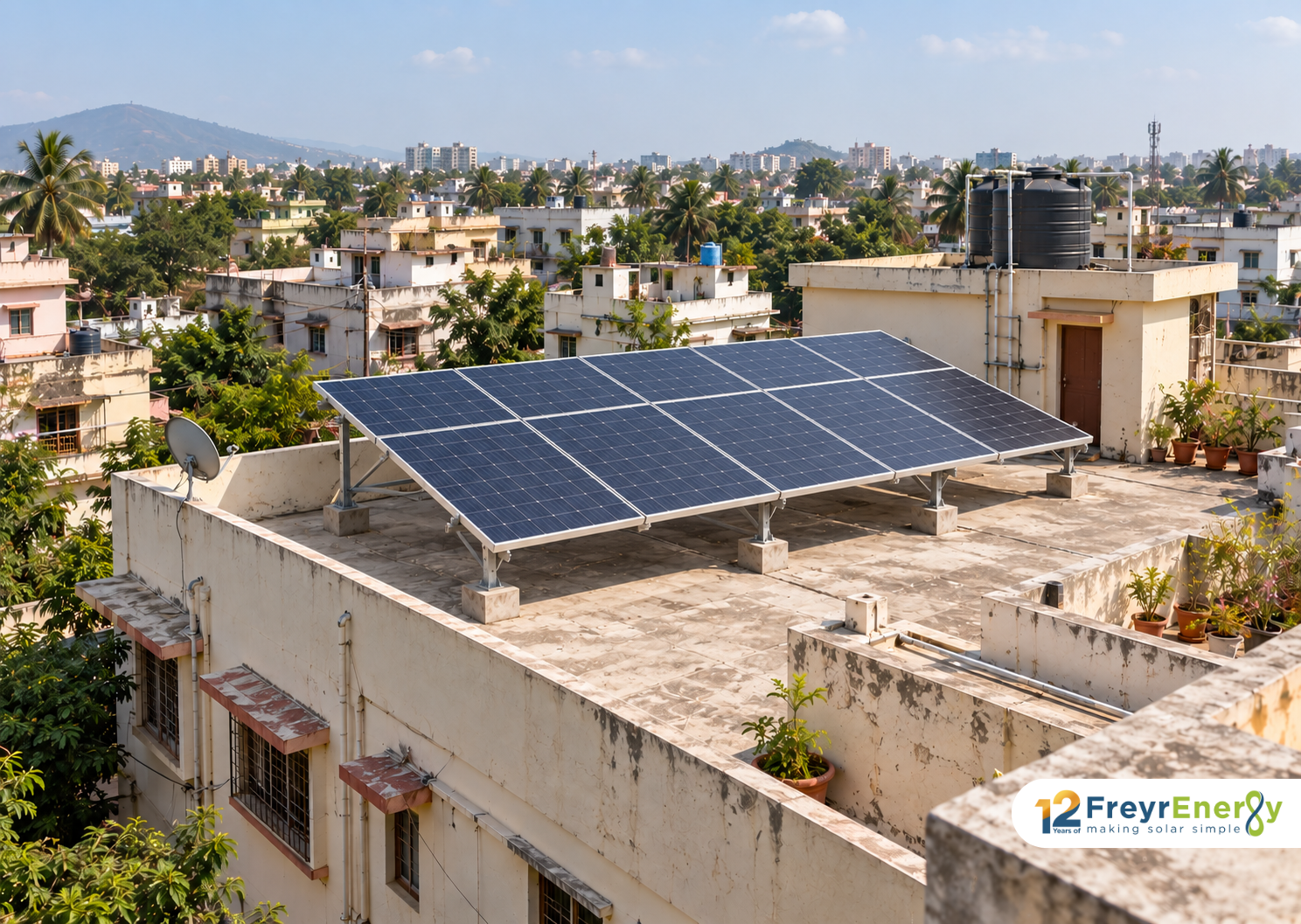
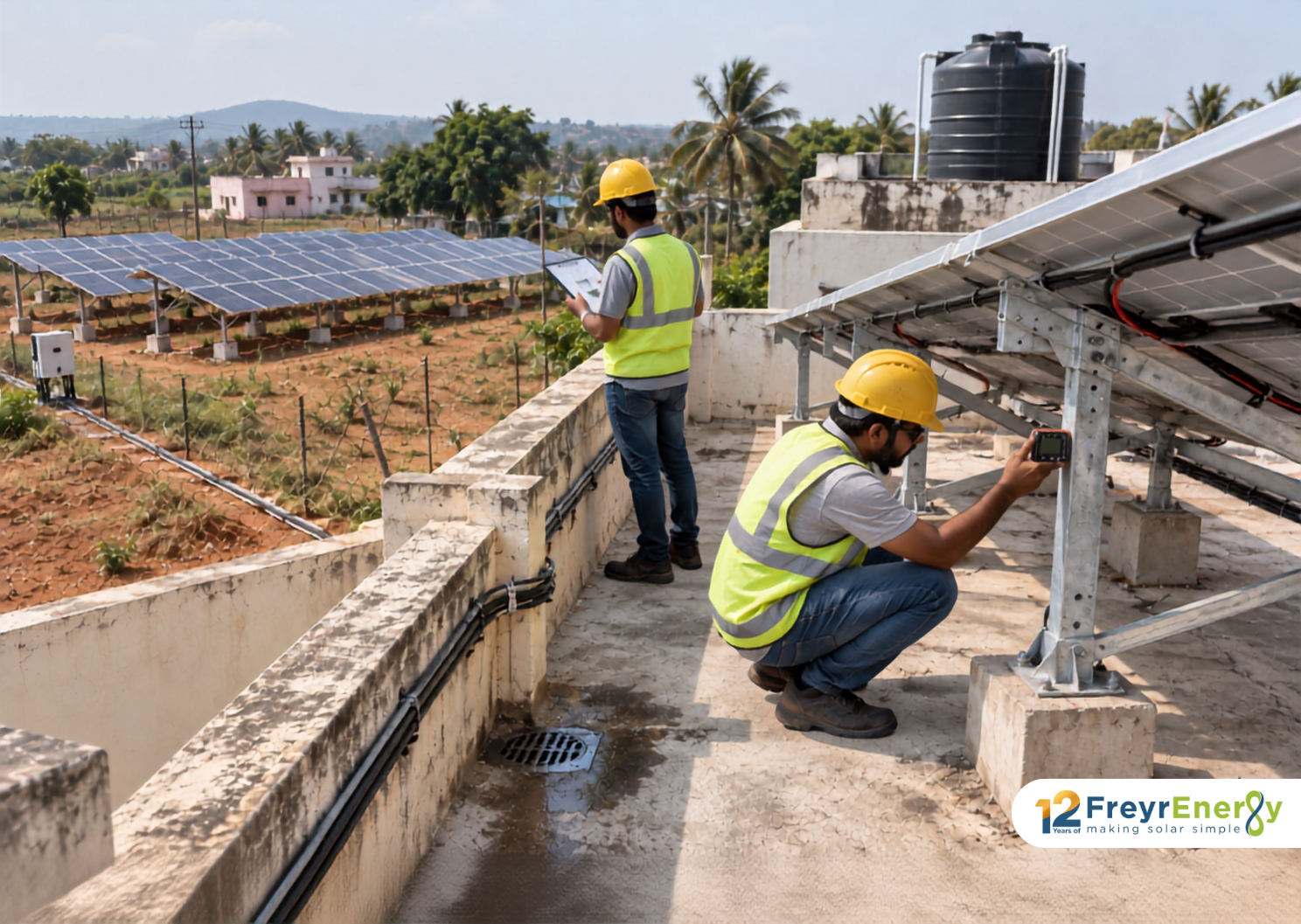
A rooftop solar system is installed on the roof of a home, office, factory or other building. The panels are secured using a solar mounting structure designed for the roof type and local conditions.
Advantages of Rooftop Solar
- Uses existing space without requiring additional land
- Generally costs less than a ground-mounted system
- Keeps panels away from routine ground-level activity
- Can reduce electricity purchased from the grid
- May qualify for residential solar subsidies when scheme conditions are met
Limitations of Rooftop Solar
- Installation depends on roof strength and condition
- Shading from nearby buildings or trees can reduce generation
- Roof direction and slope may limit panel placement
- Maintenance access can be more difficult
- Poor installation may damage waterproofing or cause leaks
A structural and waterproofing assessment should be completed before installing rooftop solar.
What Is Ground-Mounted Solar?
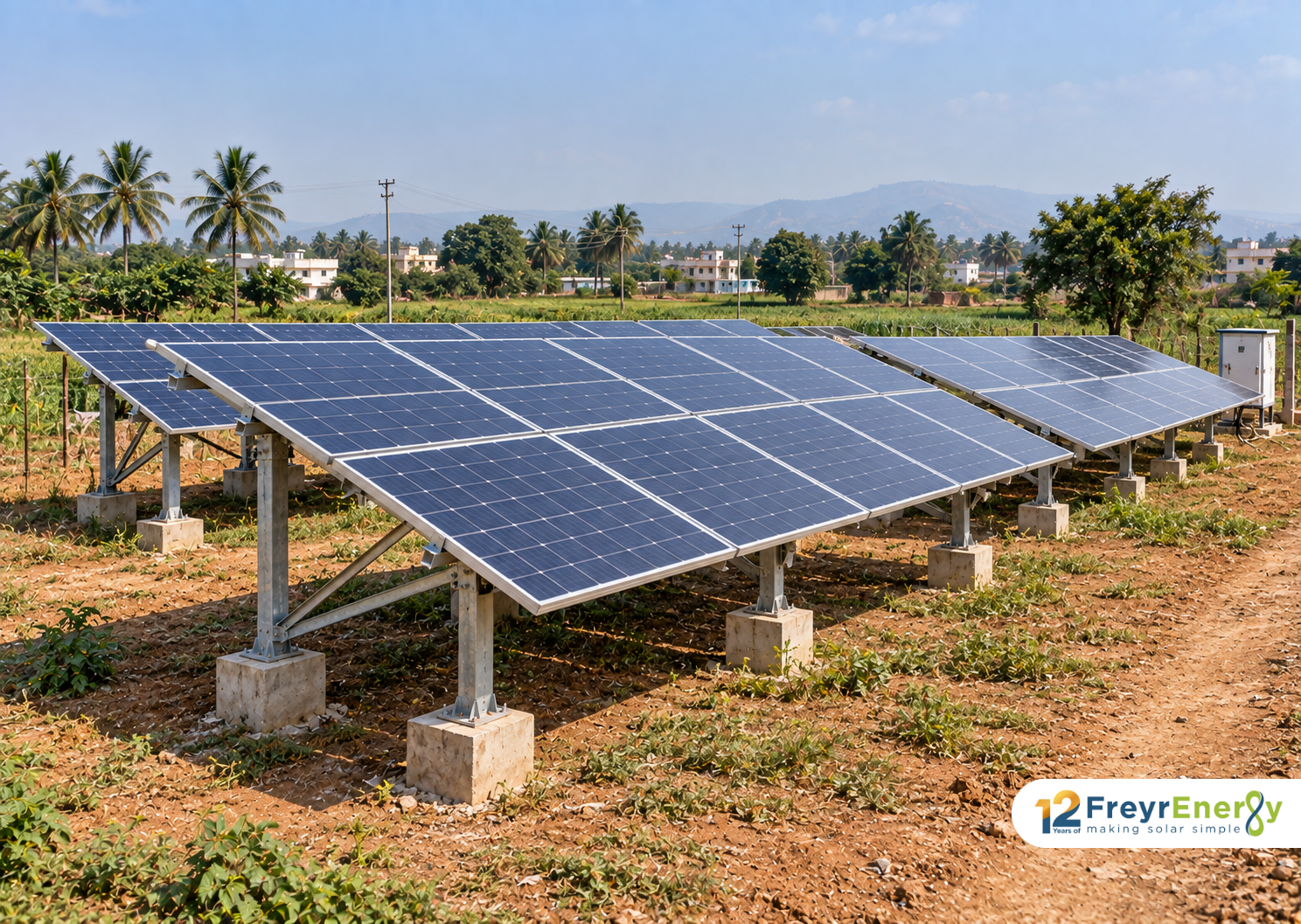
A ground-mounted solar system is installed on open land using a supporting structure fixed to foundations, poles or other engineered bases.
It can serve homes, businesses, farms and larger solar projects where sufficient land and electrical connectivity are available.
Advantages of Ground-Mounted Solar
- Greater flexibility in panel direction and tilt
- Easier access for cleaning, inspection and repairs
- Better airflow around the panels
- Not limited by roof size or roof orientation
- Can accommodate larger system capacities
Limitations of Ground-Mounted Solar
- Requires suitable open land
- Usually costs more because of foundations, trenching and additional cabling
- May need fencing or other security measures
- Can interfere with landscaping or future land use
- May require additional permissions and civil work
Ground-mounted panels do not automatically generate more electricity than rooftop panels. Their performance advantage depends on whether the design provides better orientation, lower shading or improved ventilation.
Which Option Costs Less?
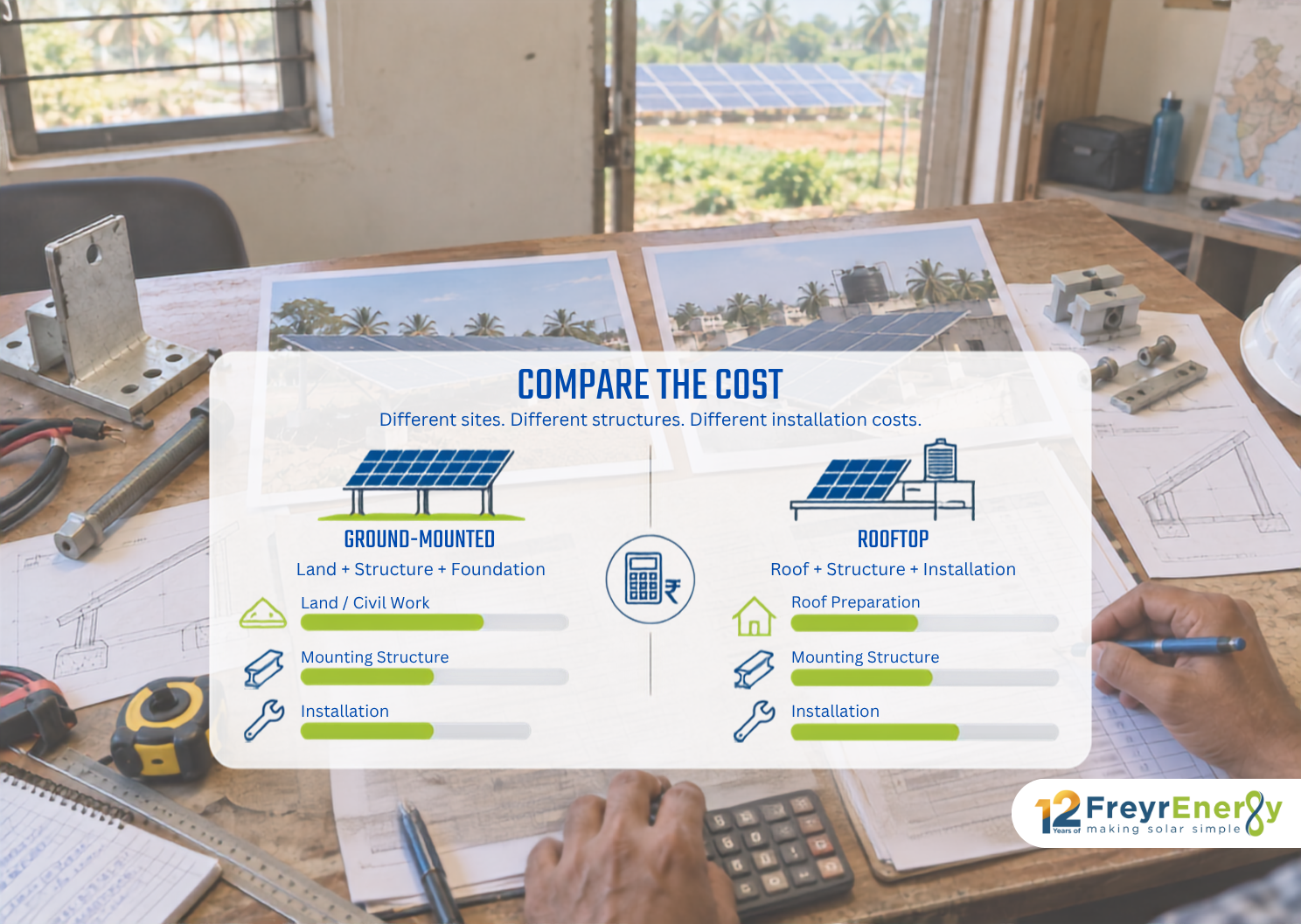
Rooftop solar generally costs less because the building already provides an elevated installation surface. Ground-mounted systems require additional structures, foundations, trenching and longer cable routes.
The final solar installation cost depends on:
- Required system capacity
- Roof or ground conditions
- Mounting structure
- Cable distance
- Selected panels and inverter
- Safety equipment
- Civil and electrical work
- Local approvals
A site-specific quotation is necessary for a reliable comparison.
Which System Should You Choose?
Choose rooftop solar if:
- Your roof is structurally suitable
- It receives sufficient shadow-free sunlight
- You have limited open land
- You want a more affordable installation
- Residential subsidy eligibility is important
Choose ground-mounted solar if:
- You have sufficient unused land
- Your roof is shaded, weak or too small
- You need a larger solar capacity
- Easy maintenance access is a priority
- Better orientation cannot be achieved on the roof
The right choice depends on your electricity use, available space, budget, system size and future plans for the property.
Compare the Complete Lifecycle Scope
Cost or risk | Rooftop solar | Ground-mounted solar |
|---|---|---|
Primary structure | Roof interface, access and possible strengthening | Foundations, piles or ballasted civil work |
Land or space value | Uses existing roof but can compete with services or future expansion | Uses land and may affect drainage, access or future development |
Cable route | Often closer to the building connection point | Can require longer trenches, cables and voltage-drop management |
Security | Building access can help, but roof safety is critical | Fencing, surveillance and theft or animal protection may be needed |
Maintenance | Access and roof safety can constrain cleaning | Usually easier access, but vegetation and soil management are added |
Future work | Roof repair can require removal and reinstatement | Land-use change or construction can displace the array |
Generation: Why Ground Mount Is Not Automatically Better
A ground mount can often use an ideal orientation, tilt and row spacing, but its actual energy depends on shading, soiling, module temperature, albedo, cable losses and availability. A well-designed unshaded roof close to the connection point can outperform a poorly drained or dusty ground site. Compare location-specific simulations using the same weather dataset, loss assumptions, module and inverter models.
Approvals and Site Due Diligence
- For rooftops, verify structural capacity, roof warranty, fire access, common-area rights and future repair plans.
- For ground mounts, verify title or lease rights, land-use permissions, access, drainage, flood level, soil and geotechnical conditions.
- For both, confirm electrical interconnection, sanctioned load, metering, setback and local authority requirements.
- Record who restores the roof or land at end of life and who bears removal, recycling and disposal costs.
A Simple Decision Rule
Choose the site that provides the best usable lifetime energy at an acceptable all-in cost and property risk. The comparison should include land opportunity cost, structural or civil work, cable route, security, cleaning, insurance and future redevelopment. A mixed design can be sensible for campuses with both sound roofs and suitable land, provided the electrical architecture and approvals are coordinated.
Roof-Mounted Variants Also Differ
A low-profile flush mount, tilted frame, elevated structure and parking canopy have different wind, access, waterproofing and cost implications. “Rooftop” is therefore not one standard design. An elevated array can preserve terrace use or improve orientation, but it increases structural height, steel quantity and wind loads and may require more detailed engineering.
Ground-Mount Variants
Fixed-tilt ground mounts are generally simpler than trackers. Single-axis tracking can increase energy in suitable large sites, but adds moving parts, land geometry, controls, maintenance and wind-stow requirements. For smaller properties, the added energy may not justify the complexity. Compare modelled lifetime energy and O&M, not the technology label.
Bifacial Considerations
Ground mounts and elevated canopies can create more rear-side exposure for bifacial modules than close-mounted roofs. The gain depends on albedo, height, spacing, rear obstruction and inverter sizing. A proposal should state the assumed bifacial gain and model method; it should not add a universal percentage to every site.
Technical Design Comparison
Design factor | Rooftop implication | Ground-mount implication |
|---|---|---|
Orientation and tilt | Constrained by roof and safe access | More freedom, subject to row spacing and land shape |
Temperature/airflow | Depends on mounting clearance and roof heat | Often stronger rear airflow |
Wind | Building height and edge zones matter | Open-terrain exposure and foundation loads matter |
Drainage/flood | Avoid roof drains and ponding | Site grading, flood level and erosion are critical |
Cable losses | Often shorter route to building supply | Long trench and collection routes may add loss/cost |
Bifacial gain | May be limited by close roof mounting | Can improve with height, albedo and spacing |
Approval and Ownership Comparison
Question | Rooftop | Ground mount |
|---|---|---|
Who controls the site? | Building owner, society, landlord or lender | Landowner, lessee and land-use authority |
What construction evidence is needed? | Structural and waterproofing responsibility | Geotechnical, foundation, drainage and access design |
What future change matters? | Roof replacement, services and vertical expansion | Land sale, agricultural use, road access and redevelopment |
What security risk exists? | Roof access and falling-object control | Fencing, theft, animals and public access |
What happens at end of life? | Removal and roof restoration | Removal, foundation treatment and land restoration |
Generation Comparison Method
Ask both bidders to use the same weather file, DC capacity, module and inverter, degradation, availability and soiling basis. Then isolate the effects of orientation, shade, temperature, bifacial gain and cable loss. A claim that ground mount always produces a fixed percentage more is not transferable across sites.
Mixed-Site Use Case
A campus may place one array on a sound unshaded factory roof and another on unused land. The electrical design must coordinate feeders, meters, protection and monitoring. The economic model should allocate civil, cable and maintenance cost to each zone so the project is not judged only on combined nameplate capacity.
Conclusion
Neither rooftop nor ground-mounted solar is universally better. Rooftop systems often win where land is valuable and the roof is ready; ground mounts win where land and access are available and roof constraints are severe. Compare the complete civil, electrical, approval and lifecycle scope. Include future roof replacement, building expansion and land use. The strongest design is the one that fits the property for decades, not the one with the best theoretical tilt on day one.