
If you’re planning to install solar for your home, a 3kW solar system is a popular choice for households with moderate electricity consumption. But the actual cost depends on whether you look at the price before subsidy, government subsidy, installer discounts, and the final effective cost.
This guide explains the 3kW solar system price in India in 2026, how much electricity it can generate, how the PM Surya Ghar subsidy works, expected savings, system types, components, financing, installation timelines, and how to decide whether 3kW is the right capacity for your home.
Quick Takeaways
- 3kW solar system price: ₹2.30 lakh–₹2.40 lakh before subsidy.
- Government subsidy: Eligible residential systems can receive up to ₹78,000 under PM Surya Ghar.
- Freyr Energy discount: Eligible customers can get up to ₹22,000 additional discount.
- Potential total savings: Up to ₹1 lakh, subject to applicable terms and eligibility.
- Solar generation: A 3kW system can typically generate around 12–15 units per day or 360–450 units per month.
- Electricity bill savings: A 3kW system can reduce monthly electricity bills by up to 90%, depending on consumption, tariff, generation and net-metering.
- Roof space: Approximately 250–300 sq. ft. of usable roof area may be required.
- System options: Choose from on-grid, hybrid or off-grid systems based on your electricity needs and backup requirements.
- Freyr Energy warranties: Up to 30 years panel performance warranty, 12 years panel product warranty and 10 years inverter warranty.
- Financing: EMI options start from ₹1,466/month, with eligible financing options available through partner lenders.
What Is a 3kW Solar Power System?
A 3kW solar system has a total solar generation capacity of 3 kilowatts (kW).
It is generally suitable for homes with moderate electricity consumption and can include:
- Solar panels
- Solar inverter
- Mounting structure
- DC and AC wiring
- Safety and protection components
- Net-metering-related equipment and support
The number of panels depends on the wattage of the individual modules. For example, a system using higher-wattage panels will require fewer panels than one using lower-wattage modules.
How Many Units Does a 3kW Solar System Generate?
Daily, Monthly and Yearly Generation
A 3kW rooftop solar system can typically generate approximately:
| Period | Indicative Generation |
| Per day | 12–15 units |
| Per month | 360–450 units |
| Per year | 4,300+ units |
These are indicative figures, not guaranteed output. Actual generation depends on factors such as:
- Location
- Solar irradiation
- Weather
- Season
- Roof orientation and tilt
- Shading
- Panel condition
- System efficiency
Does Solar Generation Change by Season?
Yes. Solar generation varies throughout the year.
Cloud cover and reduced sunlight can lower generation during monsoon periods, while longer periods of strong sunlight can increase generation during other parts of the year.
The actual seasonal variation depends on the installation location, so a single nationwide generation figure should not be treated as a guaranteed monthly output.
Is a 3kW Solar System Right for Your Home?
A 3kW system can be a suitable option for households with moderate electricity consumption, but system size should ideally be selected based on your actual electricity usage rather than the number of rooms or appliances alone.
It may be suitable for:
- 2–3 BHK homes
- Households consuming roughly 300–450 units per month
- Homes using common appliances such as fans, lights, refrigerators, TVs and washing machines
- Homes that use an air conditioner but want solar to offset a portion of their overall electricity consumption
What About AC Usage?
A 3kW solar system should not automatically be interpreted as being capable of running one or two ACs simultaneously.
For example, an AC can consume a significant portion of a home’s daily electricity usage. Whether a 3kW system is sufficient depends on:
- AC capacity
- Number of ACs
- Hours of operation
- Other household appliances
- Daytime versus nighttime consumption
- Local solar generation
- Net-metering arrangements
With an on-grid system, solar generated during the day can reduce the amount of electricity you need to purchase from the grid over the billing cycle. It does not mean that the solar system will continuously power the same appliances in real time.
If your electricity consumption is significantly higher than 300–450 units per month, a larger solar system may be more appropriate.
3kW Solar System Price in India: Full Cost Breakdown
Price by System Type
The cost of a 3kW system depends significantly on the type of solar system you choose.
| System Type | Price Before Subsidy | Government Subsidy* | Best For |
| 3kW On-Grid | ₹2,30,000–₹2,40,000 | Up to ₹78,000 | Homes with grid connectivity seeking lower upfront cost |
| 3kW Off-Grid | ₹3,60,000–₹4,80,000 | Not applicable* | Properties without reliable grid access |
| 3kW Hybrid | ₹3,40,000–₹4,50,000 | Not applicable* | Homes requiring battery backup |
*Subsidy eligibility depends on the applicable government scheme and current rules. Confirm eligibility before installation.
Which 3kW System Should You Choose?
Choose an on-grid solar system if your home has reliable grid electricity and your priority is reducing electricity bills at a lower upfront cost.
Choose a hybrid solar system if backup power during grid outages is important and you want batteries along with solar.
Choose an off-grid solar system if your property does not have a suitable grid connection and you need an independent power system.
Government Subsidy for a 3kW Solar System
The PM Surya Ghar Muft Bijli Yojana provides financial support for eligible residential rooftop solar installations.
For a 3kW system, the commonly applicable subsidy structure is:
- ₹30,000 per kW for the first 2kW
- ₹18,000 for the third kW
This results in a potential subsidy of:
₹30,000 + ₹30,000 + ₹18,000 = ₹78,000
The exact subsidy amount and eligibility should always be checked against the current government scheme rules before installation, as policies and implementation procedures can change.
Freyr Energy Discount & Total Potential Savings
In addition to the applicable government solar subsidy, Freyr Energy offers an additional discount of up to ₹22,000 on eligible systems, subject to applicable terms.
This can bring the maximum potential combined savings to:
₹78,000 government subsidy + ₹22,000 Freyr Energy discount = up to ₹1,00,000
For a system priced at ₹2,30,000–₹2,40,000 before these reductions, the potential effective cost would therefore be approximately ₹1,30,000–₹1,40,000, where all applicable eligibility conditions are met.
Important
The subsidy and discount are not automatically available to every customer in every situation. Confirm the applicable eligibility, system configuration, pricing and offer terms before making a purchase decision.
What’s Included in a 3kW Solar System?
A typical rooftop solar installation includes several components:
| Component | Purpose |
| Solar panels | Convert sunlight into DC electricity |
| Solar inverter | Converts DC electricity into AC electricity for household use |
| Mounting structure | Supports and positions the solar panels |
| Wiring & connectors | Connects the solar system components |
| Safety components | Help protect the system and electrical installation |
| Battery* | Stores electricity for backup in hybrid/off-grid systems |
*Battery storage is generally used with hybrid or off-grid systems and is not required for a standard on-grid system.
3kW Solar System Cost: How Much Can You Save?
The amount you save depends on your electricity consumption, tariff, solar generation and system configuration.
For example, if a household currently spends around ₹4,000 per month on electricity and its post-solar bill falls to around ₹500–₹800, the indicative annual reduction in electricity expenditure could be:
| Metric | Illustrative Value |
| Monthly bill before solar | ₹4,000 |
| Monthly bill after solar | ₹500–₹800 |
| Estimated annual savings | ₹38,400–₹42,000 |
| Illustrative payback | About 3–4 years* |
How Is the 3–4 Year Payback Calculated?
The illustrative 3–4 year payback corresponds approximately to the potential post-subsidy and discount effective cost of ₹1.30–₹1.40 lakh divided by estimated annual savings of ₹38,400–₹42,000.
For example:
₹1,30,000 ÷ ₹42,000 ≈ 3.1 years
₹1,40,000 ÷ ₹38,400 ≈ 3.6 years
Therefore, the 3–4 year figure should be treated as an illustrative calculation, not a guaranteed payback period.
If you calculate payback using the full pre-subsidy system price instead, the payback period would be longer.
Actual payback depends on:
- Your final purchase price
- Subsidy eligibility
- Applicable discounts
- Electricity tariff
- Monthly consumption
- Solar generation
- Net-metering arrangements
- Future electricity prices
On-Grid vs Off-Grid vs Hybrid Solar Systems
Understanding the difference between these three systems is important before choosing a 3kW installation.
| System | Best For | Relative Cost | Main Benefit |
| On-grid | Homes with reliable grid supply | Lowest | Lower upfront cost and bill reduction |
| Hybrid | Homes with frequent outages | Medium | Solar + battery backup |
| Off-grid | Locations without suitable grid access | Highest | Independent power supply |
What Happens During a Power Cut?
A standard on-grid solar system does not provide backup electricity during a grid outage because it shuts down for safety.
If backup power is important, consider a hybrid system with battery storage.
Components, Brands & Solar Panel Technology
Solar System Components
The main components of a rooftop solar system include:
- Solar panels
- Solar inverter
- Mounting structure
- Wiring and connectors
- Protection and safety equipment
- Battery, where applicable
Solar Panel Technologies
Solar panel technologies should not be treated as completely separate categories because some characteristics can overlap. For example, bifacial describes how a module can capture light from both sides, while technologies such as TOPCon describe the underlying solar-cell technology.
| Technology / Feature | Key Characteristic | Generally Suitable For |
| Monocrystalline | High efficiency and widely used for rooftops | Homes with limited roof space |
| TOPCon | Higher-efficiency modern cell technology | Buyers prioritising performance |
| Bifacial | Can generate additional energy from rear-side light when site conditions allow | Suitable open installations with favourable surroundings |
| Polycrystalline | Older, generally lower-efficiency technology | Budget-oriented installations where available |
| Thin-film | Lower efficiency but useful in specific applications | Certain commercial/industrial applications |
Which Technology Should You Choose?
If roof space is limited, higher-efficiency modules can help maximise generation from the available area.
TOPCon can be considered when higher-efficiency, modern module technology is a priority.
Bifacial modules can be beneficial when the installation environment allows meaningful light to reach the rear side of the panels.
The right choice ultimately depends on roof area, system design, budget, installation conditions and product availability.
Freyr Energy Solar Panels, Inverters & System Options
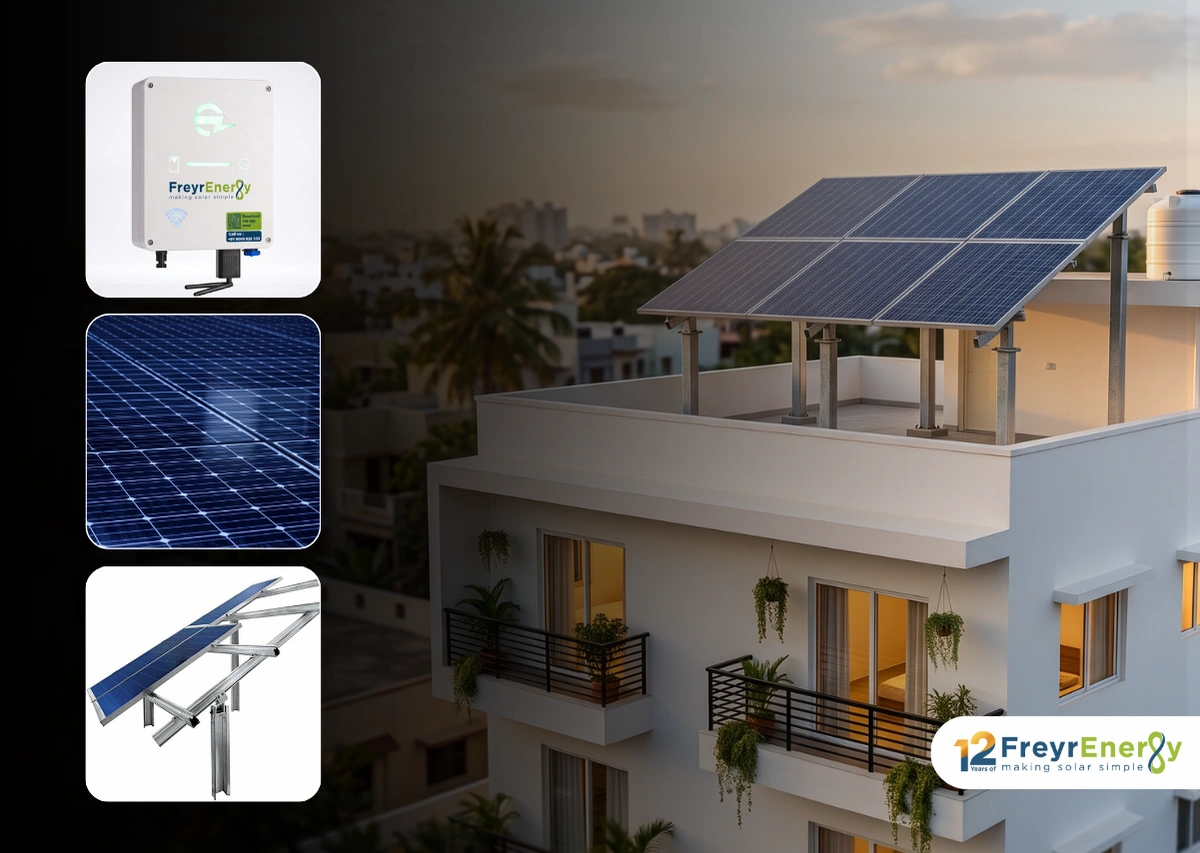
Freyr Energy’s current product information includes solar panels from Premier and Satvik, and inverters from Freyr Energy, Polycab and Luminous.
Product availability and brand combinations can vary, so customers should confirm the current product lineup and specifications when receiving their proposal.
Solar Panel & Inverter Warranty
Warranty is an important part of the long-term value of a rooftop solar system.
Freyr Energy’s stated warranty terms include:
| Component | Warranty |
| Solar panel performance warranty | 30 years |
| Solar panel product warranty | 12 years |
| Inverter warranty | 10 years |
| Mounting structure warranty | 10 years |
Always review the warranty document for the specific products included in your proposal, including the applicable terms and exclusions.
Free Insurance Coverage
Freyr Energy’s current business information states that installations include free 1-year insurance coverage of up to ₹3 lakh against specified risks including:
- Fire
- Burglary
- Natural disasters
The exact insurance provider, policy terms, exclusions and claim conditions should be confirmed before purchase.
Related article: Solar Panel Insurance Guide: Coverage, Cost, and Claim Process
Solar Panel Maintenance & Cleaning
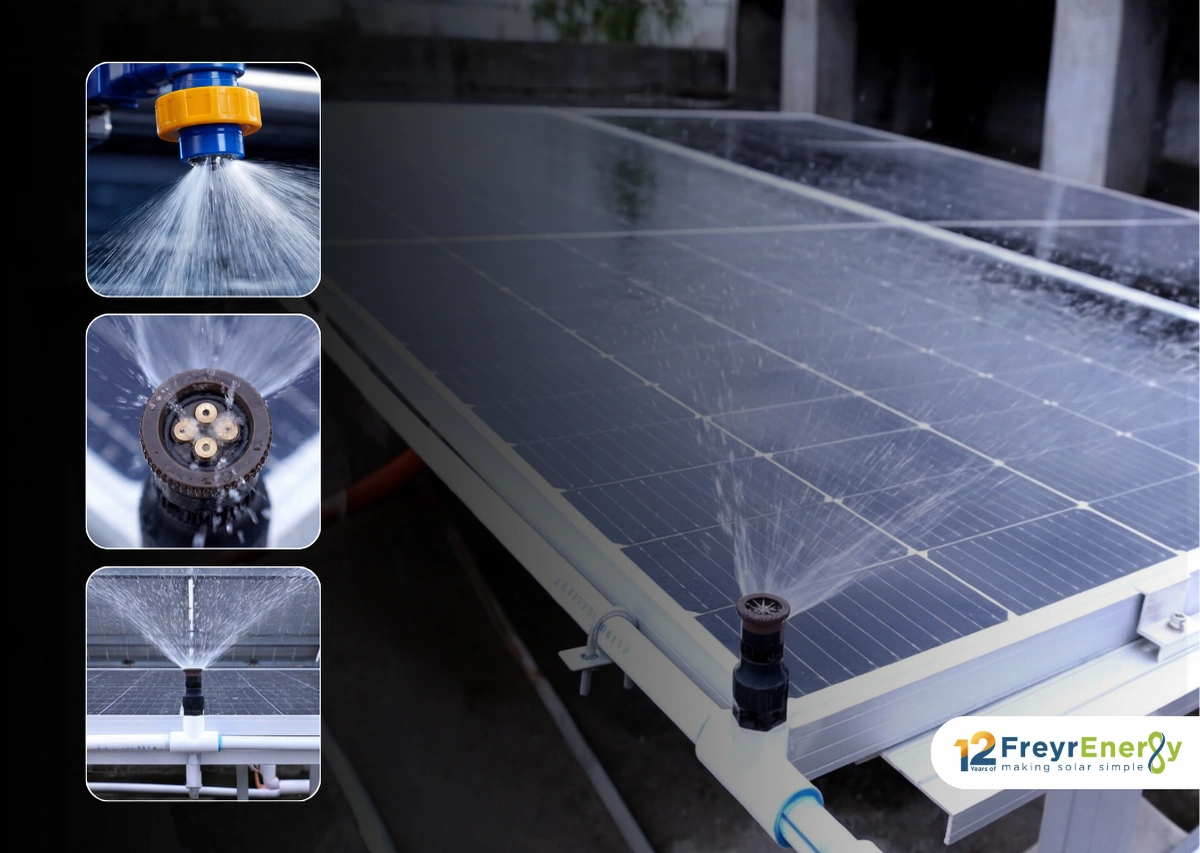
Solar panels require relatively low maintenance, but keeping them reasonably clean can help maintain performance where dust or other soiling accumulates.
Cleaning frequency should depend on your local conditions rather than following one fixed schedule for every location.
Areas with:
- High dust levels
- Construction activity
- Heavy pollution
- Limited rainfall
may require more frequent cleaning than locations that receive regular rainfall.
Avoid harsh chemicals or abrasive cleaning methods that could damage the panel surface.
You should also monitor system generation so that a sudden, unexplained reduction in output can be investigated.
Freyr Energy also offers a self-cleaning, sprinkler-based system designed to help with dust removal in rooftop installations.
Related articles:
- Maintenance Tips for Long-Lasting Rooftop Solar Panel Performance
- Do We Need to Clean the Solar System Once it’s Installed?
3kW Solar System Financing & EMI Options
Freyr Energy offers solar financing options that can help customers spread the cost of a solar installation.
Current stated financing information includes:
- EMI starting from ₹1,466/month
- 10–20% down payment
- 6–120 month loan tenure
- Zero-cost EMI for up to 12 months through CreditFair for eligible customers
- Financing partners including Fibe, Ecofy, Bajaj and CreditFair
The actual EMI, interest rate, loan approval and applicable terms depend on the customer’s eligibility, selected financing partner and loan terms.
3kW Solar Installation Process
A typical Freyr Energy installation process includes the following stages:
| Process | Typical Timeline |
| Site survey | Within 6 days |
| Solar proposal | Instant |
| Loan approval | 24–48 hours |
| Installation | Within 7 days after material dispatch |
| Net metering | 15–21 days |
| System commissioning | 3–5 days after net metering |
| Subsidy disbursement | Around 35 working days after work order generation and bank details submission |
These are typical timelines rather than guaranteed completion dates. Actual timelines can vary depending on site conditions, material availability, financing, DISCOM procedures, documentation and other factors.
How Does the PM Surya Ghar Subsidy Process Work?
Eligible residential customers apply for the PM Surya Ghar subsidy through the government’s designated solar portal as part of the rooftop solar installation process.
For a Freyr Energy installation, the company provides support with the subsidy-related process.
The exact responsibilities of the customer, installer and DISCOM can vary depending on the current portal and local implementation process. Customers should confirm the latest procedure and documentation requirements before installation.
How Much Roof Space Does a 3kW Solar System Need?
A 3kW rooftop system generally requires around 250–300 sq ft of usable roof area, depending on panel dimensions, layout and installation design.
For better solar generation, the roof should ideally have:
- Adequate shadow-free space
- Suitable orientation and tilt
- Minimal obstruction from trees or nearby buildings
- Sufficient structural suitability for installation
A site survey is the best way to determine whether your roof can accommodate the required system capacity.
Where Does Freyr Energy Install 3kW Solar Systems?
Freyr Energy currently serves customers in:
Solar installation and net-metering procedures can vary between states and DISCOMs. Therefore, actual approval and commissioning timelines may differ by location.
Why Choose Freyr Energy for a 3kW Solar System?
Freyr Energy provides an end-to-end rooftop solar solution, from system design and financing assistance to installation and post-installation support.
Key company credentials include:
- 12+ years of rooftop solar experience
- 20,000+ customers served
- 150+ MW of rooftop solar capacity installed
- 4.7★ Google rating
- 4,739+ customer reviews
- Solar generation monitoring through the Freyr Energy mobile Solar app
- Customer support before and after installation
- Custom system design and project proposal
These credentials provide useful context when comparing solar installation companies, but customers should also compare the exact system specifications, warranty terms, pricing and service included in each quotation.
3kW Solar System Price vs Other System Sizes
If you’re unsure whether 3kW is the right size, comparing the available system capacities can help.
| Solar System Size | Price Before Subsidy |
| 1kW solar panel | ₹1,20,000–₹1,30,000 |
| 2kW solar panel | ₹1,80,000–₹1,90,000 |
| 3kW solar panel | ₹2,30,000–₹2,40,000 |
| 5kW solar panel | ₹3,50,000–₹3,70,000 |
| 10kW solar panel | ₹6,30,000–₹6,40,000 |
These are Freyr Energy price ranges and should not be interpreted as universal market prices across India.
The most suitable system size depends on your electricity consumption, roof space, budget and expected future electricity needs.
Conclusion
A 3kW solar system can be a practical choice for Indian homes with moderate electricity consumption. Freyr Energy’s current 3kW system price is ₹2.30–₹2.40 lakh before subsidy, while eligible customers may benefit from up to ₹78,000 in government subsidy and an additional discount of up to ₹22,000, subject to applicable terms.
A 3kW system can typically generate around 12–15 units per day and can reduce monthly electricity bills by up to 90%, depending on your consumption, tariff, solar generation and net-metering arrangement.
Before choosing a system, compare the 3kW solar system price, expected generation, subsidy eligibility, roof requirements, warranties, financing, installation support and after-sales service rather than looking at the upfront price alone.