Direct answer: For an eligible individual household in a normal-category state, PM Surya Ghar CFA is ₹30,000 for 1 kW, ₹60,000 for 2 kW and a maximum ₹78,000 for 3 kW or above. Approval and payment remain conditional on the applicant, equipment, installation, inspection and portal process. |
|---|
Quick Takeaways
- PM Surya Ghar CFA primarily supports qualifying residential grid-connected rooftop systems.
- Normal-category individual-household CFA stops increasing after 3 kW, even if the system is larger.
- Special-category states and UTs use higher central rates, with a maximum of ₹85,800 at 3 kW.
- The exact module and cell compliance, current ALMM/DCR position and registered-vendor status matter.
- Registered vendors must provide five years of comprehensive maintenance under the scheme guidelines.
- Government CFA, a vendor discount and a loan are three different financial items.
- “Up to 300 units free” is an objective dependent on generation, consumption and billing rules, not a blanket waiver.
PM Surya Ghar Subsidy Amounts for Individual Households 
| Installed DC module capacity | Normal-category CFA | Calculation |
| 1 kW | ₹30,000 | 1 × ₹30,000 |
| 2 kW | ₹60,000 | 2 × ₹30,000 |
| 3 kW and above | ₹78,000 maximum | No additional individual-household CFA beyond 3 kW |
Special-Category State and UT Rates
The scheme guidelines prescribe higher benchmark-based CFA for Uttarakhand, Himachal Pradesh, Jammu and Kashmir, Ladakh, the North-Eastern states including Sikkim, the Andaman and Nicobar Islands, and Lakshadweep.| Installed DC module capacity | Special-category CFA | Important note |
| 1 kW | ₹33,000 | Subject to eligibility and approval |
| 2 kW | ₹66,000 | Subject to eligibility and approval |
| 3 kW and above | ₹85,800 maximum | No additional individual-household CFA beyond 3 kW |
Who Is Eligible?
For CFA under the standard consumer-funded route, the installation must be a qualifying residential rooftop solar system tagged to a residential electricity connection of the serving DISCOM. Eligible locations can include a roof, terrace, balcony, elevated structure or qualifying building-integrated PV. Group, virtual or other metering arrangements may qualify where approved by the relevant DISCOM and state regulations.| Applicant or system | General CFA position | What must be confirmed |
| Individual household with residential grid connection | Potentially eligible | Portal application, registered vendor, compliant system, inspection and approval. |
| Commercial, industrial, institutional or government connection | No residential CFA | Evaluate business economics and other applicable programmes. |
| Pure off-grid solar system | Not eligible under this route | System architecture and current scheme rules. |
| Grid-connected behind-the-meter or battery-hybrid system | May qualify subject to regulatory/DISCOM approval | Reverse-power protection, inspection and approved arrangement. |
| Rented home or shared roof | Do not assume eligibility | Consumer account, roof authority, owner/society consent and DISCOM documentation. |
| Existing subsidised rooftop system being expanded | Balance CFA may be available | Prior benefit and eligible balance up to 3 kW overall. |
Existing Systems: How Additional CFA Can Work
An existing installation that already received MNRE rooftop CFA is not always automatically excluded from additional support. If the system is expanded, the guidelines allow additional CFA for the eligible balance capacity up to 3 kW of the overall plant size. An installation receives CFA only once after each qualifying installation event, and relocating an already subsidised system does not create a new claim. The total assistance across the original installation and any qualifying expansion cannot exceed the applicable 3 kW household cap. Confirm the prior-benefit record, remaining eligible capacity and portal route before ordering an expansion.Can Housing Societies and RWAs Receive CFA?
Eligible Group Housing Societies, RWAs, apartment owner associations and similar resident bodies can receive CFA for a connection dedicated to common facilities, including EV charging. The normal-category rate is ₹18,000 per kWp; the special-category rate is ₹19,800 per kWp. Supported capacity is the lower of the installed common-facility capacity, 3 kWp per dwelling and 500 kWp, after accounting for individual systems within the society as prescribed.| Example | Eligible supported capacity | Normal-category CFA |
| 100 kW common system, 20 households | Lower of 100 kW and 20 × 3 kW = 60 kW | 60 × ₹18,000 = ₹10.8 lakh |
| 100 kW common system, 50 households | Lower of 100 kW and 50 × 3 kW = 100 kW | 100 × ₹18,000 = ₹18 lakh |
How to Apply Online: Step-by-Step 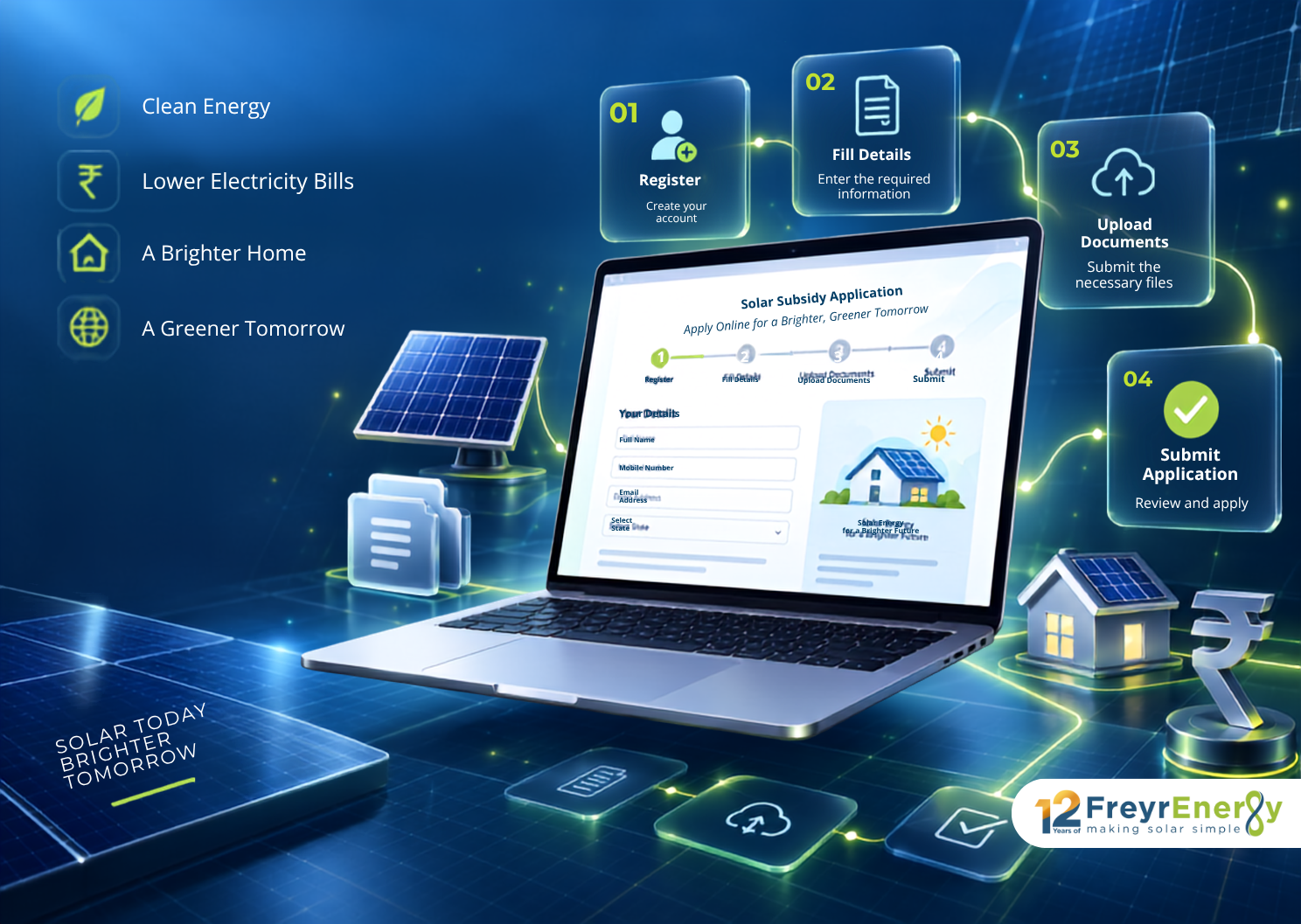
- Size the system from annual consumption, daytime use, roof area, shade and future loads. Do not size only to reach the subsidy cap.
- Register on the official PM Surya Ghar National Portal using the correct state, DISCOM, consumer number and contact details.
- Submit the rooftop-solar application and follow the feasibility status shown by the portal. A deemed-approval/feasibility waiver has been introduced nationally for systems up to 10 kW, but implementation details can still appear differently by DISCOM.
- Compare registered vendors on the portal. Agree in writing on design, exact components, gross price, exclusions, warranties, five-year CMC and responsibility for portal corrections.
- Install the system using compliant equipment and retain model numbers, serial numbers, invoices, DCR evidence and photographs.
- Update the plant details and upload the documents and geo-tagged photographs required by the portal.
- Complete the applicable metering agreement, DISCOM inspection and commissioning. The DISCOM may approve, return the application for correction or reject it with reasons.
- After approval, verify the activated e-token or current redemption control, submit the correct bank or loan account details and redeem the claim.
- Track the payment reference in the portal and keep copies of the complete submission trail.
- The August 2026 government update describes the consumer journey as end-to-end digital and reports PFMS-enabled subsidy release within 15 days. The original guidelines specify processing within 15 days after DISCOM approval. This is not the total time from registration to installation, inspection and commissioning, and should not be promised as a guaranteed customer timeline.
Documents and Evidence to Keep Ready 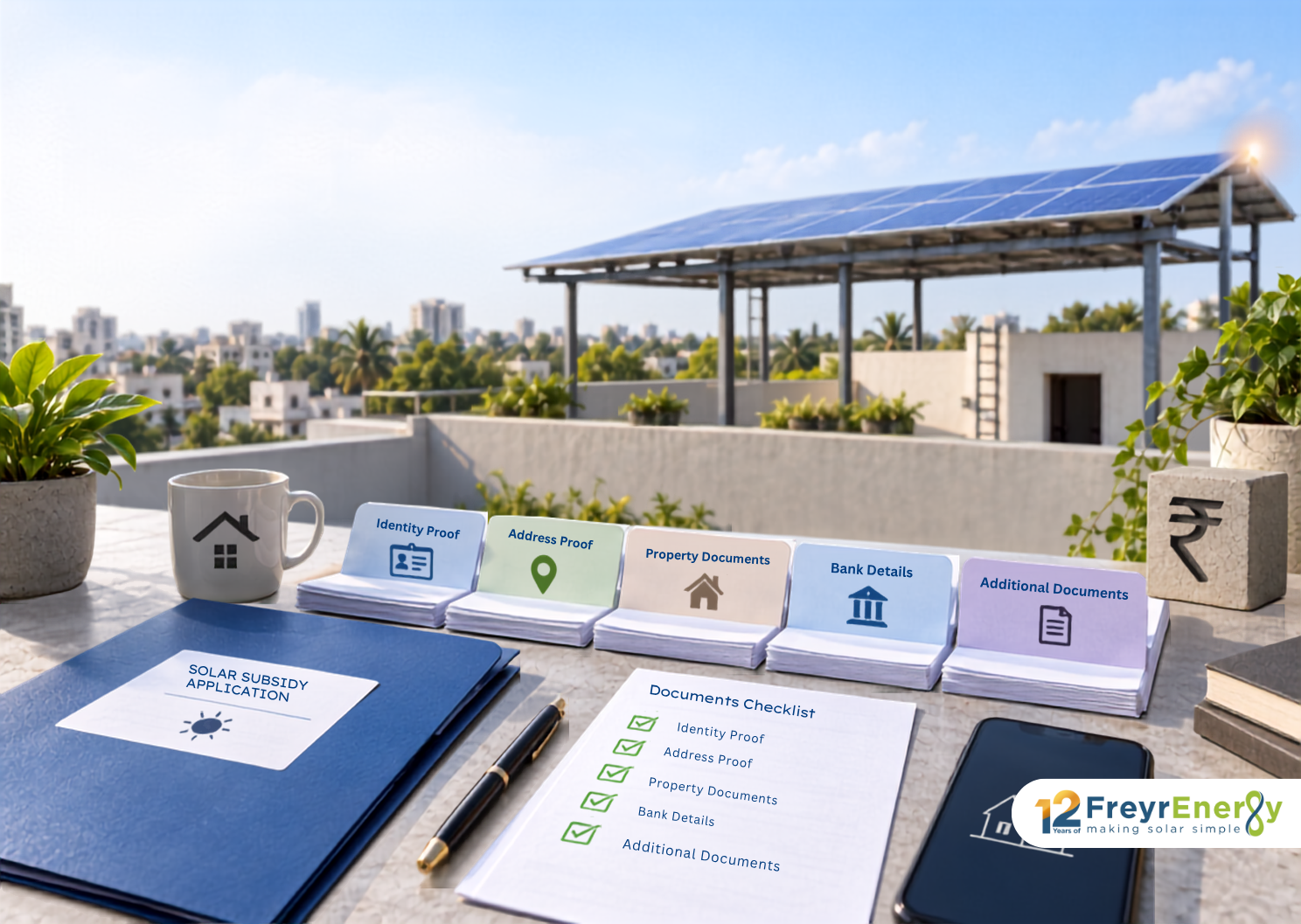
Exact uploads vary by stage and DISCOM. Keep the following records consistent and accessible:- Latest electricity bill, consumer account number and correct DISCOM details.
- Registered mobile number and email used for portal access.
- Identity, address, ownership, occupancy or authorisation documents requested for the specific case.
- Signed vendor agreement, itemised quotation and final tax invoice.
- Module and inverter datasheets, exact model codes, serial-number list and compliance evidence.
- Geo-tagged installation photographs, test records, metering agreement and commissioning certificate.
- Bank proof held in the consumer’s name, such as a cancelled cheque, statement or passbook record.
- Loan-account details if the project is financed through an eligible loan.
DCR and ALMM: Related but Not Identical
Domestic Content Requirement means the modules must be domestically manufactured using domestically manufactured cells for a CFA claim under this route. Non-DCR modules make the installation ineligible for CFA. ALMM is the Ministry’s approved-model and manufacturer framework: List-I covers modules and List-II covers cells. Both lists and their clarifications changed repeatedly in 2026. Do not accept “the brand is approved” as sufficient evidence. Verify the exact module model, manufacturing facility and applicable cell requirement on the current MNRE records and confirm how the portal validates DCR for the project. A brand can sell several models with different eligibility positions.Registered Vendor Responsibilities and Five-Year Maintenance
The scheme guidelines require CFA installations to use a vendor registered on the National Portal. They also require the registered vendor to provide repair and maintenance services free of cost for a five-year comprehensive maintenance period from commissioning. Non-performing or under-performing components are to be repaired or replaced during that period, subject to the scheme framework and applicable OEM warranties. Before signing, ask the vendor to identify the five-year CMC in the agreement, list exclusions, provide escalation contacts and explain who bears labour, freight and access costs. Keep the OEM warranty documents as well; a component warranty and the vendor’s CMC serve different purposes.How to Budget Before CFA Reaches the Account 
| Financial item | How to treat it | What to verify |
| Gross installed price | Starting project cost | Equipment, taxes, civil work, metering, approvals and exclusions. |
| Government CFA | Conditional assistance | Capacity slab, consumer category, DCR/ALMM, inspection and portal approval. |
| Vendor promotion | Separate commercial offer | Eligibility, validity, taxes and effect on base price. |
| Loan or EMI | Payment method, not a saving | Interest, fees, tenure, foreclosure and CFA-credit treatment. |
What “Up to 300 Units Free” Means
The scheme objective is to help households obtain free or low-cost electricity up to 300 units per month through rooftop generation. It is not a universal government waiver of 300 billed units. The result depends on system size, solar resource, shade, consumption timing, tariff, the approved metering arrangement and settlement rules. Fixed charges, duties, meter charges and unoffset grid imports may remain.What Can Delay or Block a Claim?
| Stage | Evidence to retain | If progress stops |
| Registration/application | Application ID and correct consumer details | Correct the state, DISCOM, consumer number or contact mismatch. |
| Feasibility/status | Portal or DISCOM response | Check sanctioned load, state rule, transformer or document issue. |
| Vendor/installation | Agreement, compliant equipment and invoice trail | Reject unrecorded model or capacity substitutions. |
| Inspection/metering | Inspection acknowledgement and metering record | Close technical observations with dated evidence. |
| Commissioning/redemption | Commissioning status, e-token/control and account proof | Verify plant capacity, bank/loan account and pending approval. |
| Disbursement | Portal transaction or payment reference | Raise a documented portal/DISCOM query using the application ID. |
Six Questions to Ask a Registered Vendor
- Is the quoted DC module capacity identical across the design, invoice and portal record?
- Which exact module and cell evidence demonstrates current DCR/ALMM compliance?
- What is excluded from the gross price, subsidy support and metering assistance?
- Who fixes a rejected document or inspection defect, and can an extra fee be charged?
- Will I receive portal access, invoices, serial numbers, warranties and commissioning records?
- How are the five-year CMC, loan-account credit and any vendor discount documented separately?