
Direct answer: Solar net metering uses a bidirectional meter to record electricity imported from the grid and eligible surplus solar electricity exported to it. The bill adjusts those readings under the State Commission and DISCOM rules. Fixed, demand, meter, duty or other charges may remain, while carry-forward and end-of-settlement treatment differ by jurisdiction. |
|---|
Solar net metering helps a grid-connected rooftop system receive billing value for eligible electricity exported to the utility network. The idea sounds simple, but the final bill depends on four separate quantities: solar generation, solar used inside the property, electricity exported, and electricity imported. Confusing these numbers is the main reason new solar owners think credits are missing.
This guide explains the energy flow, bill calculation, metering alternatives, application sequence, first-bill checks, outage limitation and state-level rules. It also shows why a system should be sized around consumption and the current export-credit arrangement, not around a promise of a permanently zero bill.
Quick Takeaways
- The inverter records total solar generation; the utility meter records grid import and export. They are not the same values.
- Net metering, net billing and gross metering value exported electricity differently.
- State Commissions and DISCOMs determine the operative eligibility, capacity, tariff and settlement rules.
- A standard on-grid system normally shuts down during an outage; net metering does not provide backup.
- Fixed and statutory charges can remain even when net imported energy is low.
- Review the first post-commissioning bill against meter photographs and inverter data.
What Is Solar Net Metering?
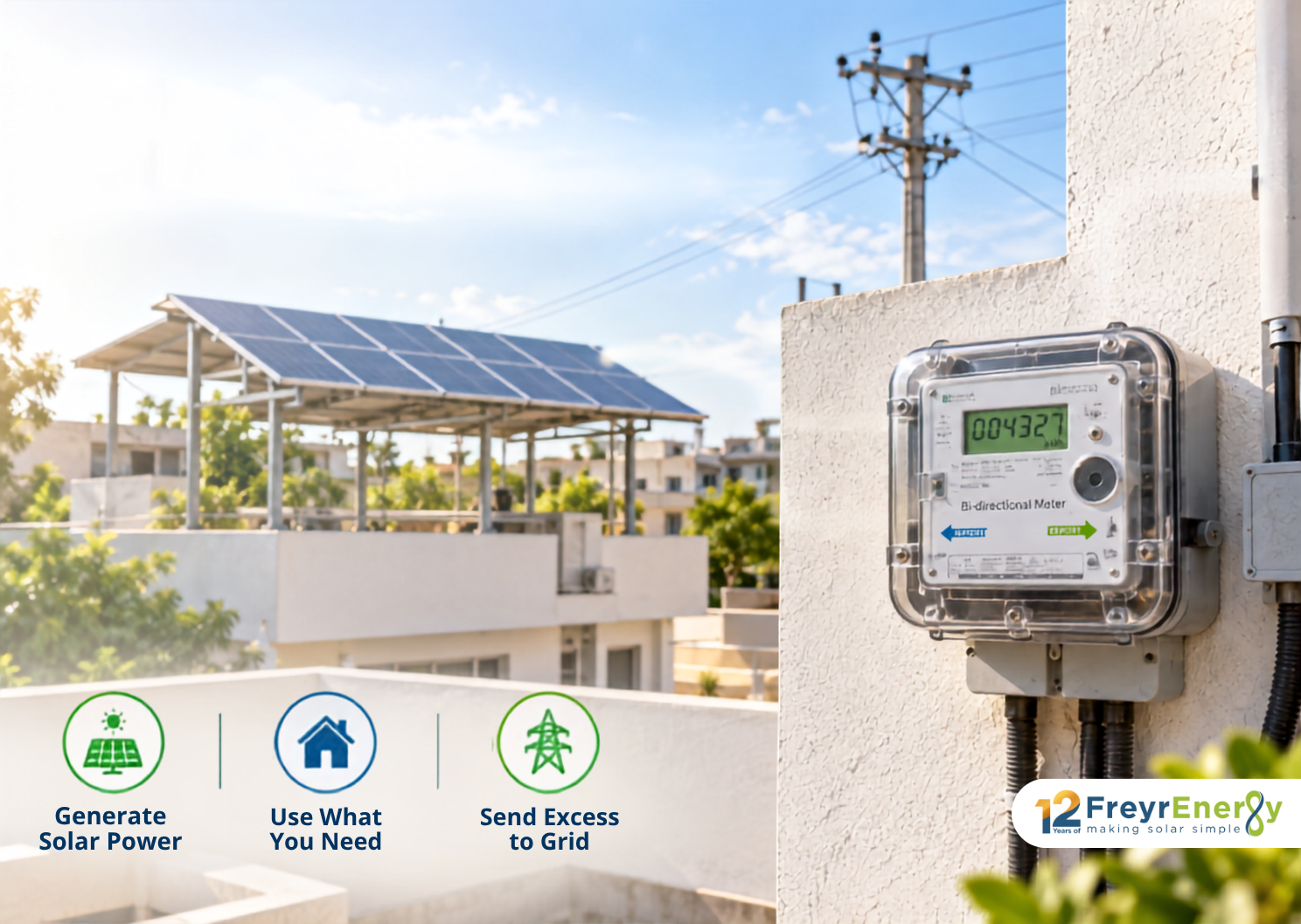
Solar net metering is a regulated billing arrangement for a grid-interactive rooftop solar system. Solar electricity first serves loads operating inside the property. When generation exceeds those loads, the surplus flows through a bidirectional meter to the grid. When demand is higher than solar output, or after sunset, the property imports electricity from the grid.
The meter maintains separate cumulative registers for import and export. The DISCOM then applies the approved billing and settlement method. A meter therefore does not need to physically “run backwards,” and the grid does not store the same electrons for later return.
For a broader residential-system overview, see Freyr Energy’s solar panels for home guide.
Four Numbers That Explain the Bill
| Quantity | Where it is measured | What it means |
| Solar generation | Inverter or separate generation meter | All AC energy produced by the solar system, subject to metering boundaries. |
| Self-consumed solar | Calculated or measured behind the meter | Solar used inside the property before any surplus reaches the grid. |
| Grid export | Export register of bidirectional meter | Surplus solar delivered to the utility network. |
| Grid import | Import register of bidirectional meter | Electricity drawn from the grid when property demand exceeds solar output. |
| Reconciliation formula: Solar generation ≈ self-consumed solar + grid export. Property consumption ≈ self-consumed solar + grid import. Small differences can arise from reading periods, meter boundaries and system losses. |
How Net Metering Changes the Electricity Bill
Under a simple unit-credit illustration, eligible exports are deducted from imports for the billing period. If a home imports 420 kWh and exports 180 kWh, the net energy position is 240 kWh before prior credits, time-block treatment and other billing rules.
| Billing item | Illustrative value | What to check |
| Grid import | 420 kWh | Import register and billing dates |
| Grid export | 180 kWh | Export register and commissioning status |
| Illustrative net energy | 240 kWh | Whether local rules net units in this way |
| Other charges | As applicable | Fixed, demand, duty, meter, fuel adjustment, arrears and taxes |
This is an example, not a nationwide tariff rule. Under net billing, imports can be charged at the retail tariff while exports receive a separate monetary credit. Time-of-day rules may also match or value energy by time block. End-of-period surplus can be carried forward, settled at a notified rate or treated another way under the applicable regulation.
Net Metering vs Net Billing vs Gross Metering
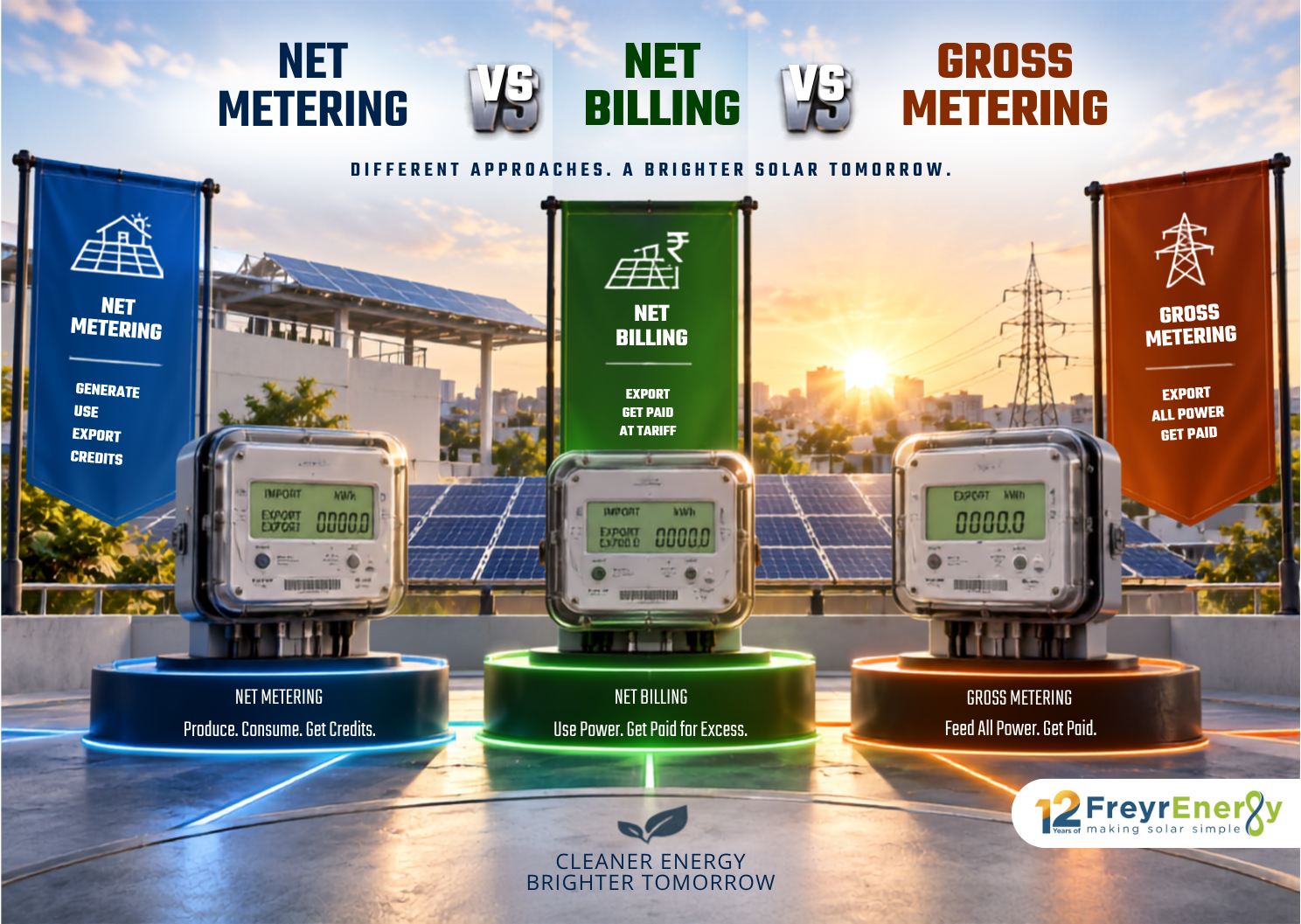
| Arrangement | Energy flow | Export treatment | Main planning risk |
| Net metering | Solar normally serves on-site load first; surplus exports. | Eligible export units offset imports under the approved rules. | Assuming all charges disappear or credits never expire. |
| Net billing / net feed-in | Solar normally serves on-site load first; surplus exports. | Imports and exports are valued separately, often at different rates. | Modelling export at the retail import tariff without evidence. |
| Gross metering | Eligible generation is separately metered for supply to the grid. | All qualifying generation is purchased at the notified tariff. | Assuming on-site consumption receives the same treatment as net metering. |
| No-export / self-consumption | Solar serves internal loads and export is restricted. | Export receives no credit or is prevented. | Oversizing creates curtailment or unused output. |
Freyr Energy also provides a dedicated comparison of net metering, gross metering and net billing. Use the current State Commission and DISCOM documents as the final authority.
Which Rules Apply in India?
India has a central consumer-rights framework, but the operative arrangement is state-specific. The Electricity (Rights of Consumers) rules state that net metering, gross metering, net billing or net feed-in arrangements are to be specified by the State Commission. The central 2021 amendment also contains fallback language under which a Commission may allow net metering up to 500 kW or the sanctioned load, whichever is lower, where its regulations do not provide an arrangement. This should not be presented as a universal entitlement or the current cap in every state.
The 2024 amendment simplified rooftop-solar processing. For systems up to 10 kW, the technical-feasibility study is not required; applications are treated as accepted, subject to specified capacity conditions. After the consumer submits the installation certificate, the distribution licensee is required to complete the connection agreement, meter installation and successful commissioning within 15 days. That 15-day provision is not the total time from choosing a vendor to final activation.
Current official examples show why local verification matters. Tamil Nadu’s utility FAQ explains that newer applications use net feed-in billing, while Punjab’s energy agency reports that its 2026 framework permits net metering, net billing, group net metering, gross metering, virtual net metering and behind-the-meter arrangements. Readers must check the latest rule for their own state, consumer category and DISCOM.
Who Can Apply?
Residential, commercial, industrial, institutional and public-sector consumers may have access to one or more grid-interactive arrangements, depending on the state regulation. Eligibility should be checked against the consumer category, sanctioned or contract load, proposed DC and AC capacity, connection phase, transformer or feeder conditions, roof rights, metering arrangement and electrical-safety requirements.
Apartment and housing-society projects may use a common-facility connection, group net metering or virtual net metering where the jurisdiction permits it. Do not assume that credits can be allocated across flat meters merely because the society owns the roof.
How to Apply for Solar Net Metering
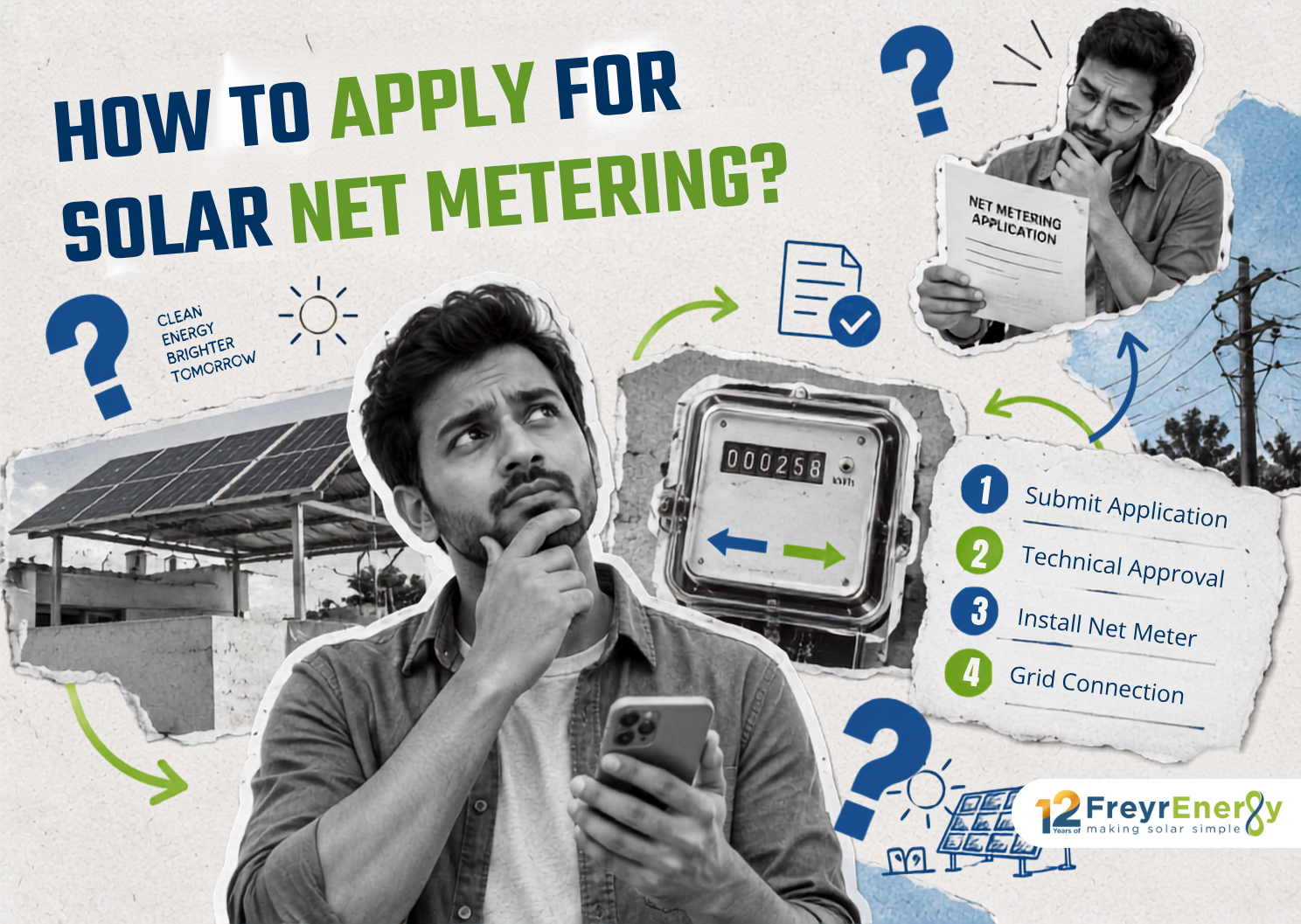
- Find the latest State Commission regulation, DISCOM procedure and online application route for the electricity connection.
- Review at least 12 months of bills and record sanctioned load, phase, tariff category, daytime use and seasonal demand.
- Choose the proposed system size only after confirming the eligible metering arrangement, capacity conditions and expected export value.
- Submit the application with the correct consumer, site, ownership or authorisation, load and technical details.
- Respond to feasibility, document or capacity queries shown by the DISCOM portal. Apply the current national simplification for systems up to 10 kW only as implemented in the local workflow.
- Install the approved system with compliant modules, inverter, protection, earthing, wiring and mounting. Do not substitute capacity or equipment without updating the approved record.
- Submit the installation certificate, single-line diagram, test records, photographs and other required evidence.
- Complete the connection agreement, inspection, meter installation and commissioning. Record meter serial numbers and opening readings.
- Check the first bill and raise any mapping, reading or credit issue promptly with dated evidence.
Equipment and Inspection Checks
- Grid-connected inverter with required synchronisation, protection and anti-islanding functions.
- Bidirectional meter approved, installed or sealed according to the DISCOM process.
- AC/DC isolation, overcurrent and surge protection appropriate to the design.
- Earthing and lightning protection supported by test records where required.
- Single-line diagram, approved capacity, inverter settings and actual installation aligned.
- Accessible isolation points, warning labels and safe meter wiring.
- CEA lists current metering regulations and technical specifications, including 2026 amendments. The exact meter class, communication features, ownership and test requirements should come from the latest applicable regulation and DISCOM specification, not from a generic product listing.
Does Net Metering Work During a Power Cut?
No. A standard grid-tied solar inverter normally disconnects when grid voltage or frequency disappears. This anti-islanding behaviour prevents a rooftop system from energising a line that utility workers expect to be de-energised. The bidirectional meter is a billing device; it does not provide backup energy.
Homes that need outage support should compare a compliant hybrid design and battery. Freyr Energy explains the architectures in its on-grid vs off-grid solar guide and its guide to solar operation during a power outage.
How to Read the First Net-Metered Bill

- Match the bill period with inverter data and meter photographs taken on the same dates.
- Confirm that import and export registers are present and mapped in the correct direction.
- Check whether the bill uses unit netting, monetary export credit or another approved method.
- Trace previous credit, current export, current import, adjusted energy and closing credit.
- Review time-of-day blocks, meter multipliers and estimated-reading flags where applicable.
- Identify fixed, demand, meter, duty, tax, fuel-adjustment, arrears or minimum charges that remain.
| Why inverter generation is higher than meter export: The property consumes part of the solar electricity before it reaches the utility meter. Export is only the surplus. If generation is 360 kWh and export is 140 kWh, approximately 220 kWh was self-consumed before measurement differences and losses. |
What Can Delay or Distort Credits?
| Issue | Evidence to retain | Next check |
| Export remains zero | Meter photos, inverter data, commissioning record | Meter direction, register mapping and activation date |
| Bill uses estimated reading | Actual meter display and complaint reference | Request correction under the DISCOM process |
| Unexpectedly low credit | Tariff order, agreement and bill calculation | Export rate, time block, settlement rule or cap |
| Generation and bill periods differ | Daily inverter export and billing dates | Compare matching dates before alleging a meter error |
| Capacity or meter replacement changed | Approved application, old/new serial numbers, opening readings | Confirm migration and credit balance |
How to Size a Net-Metered Solar System
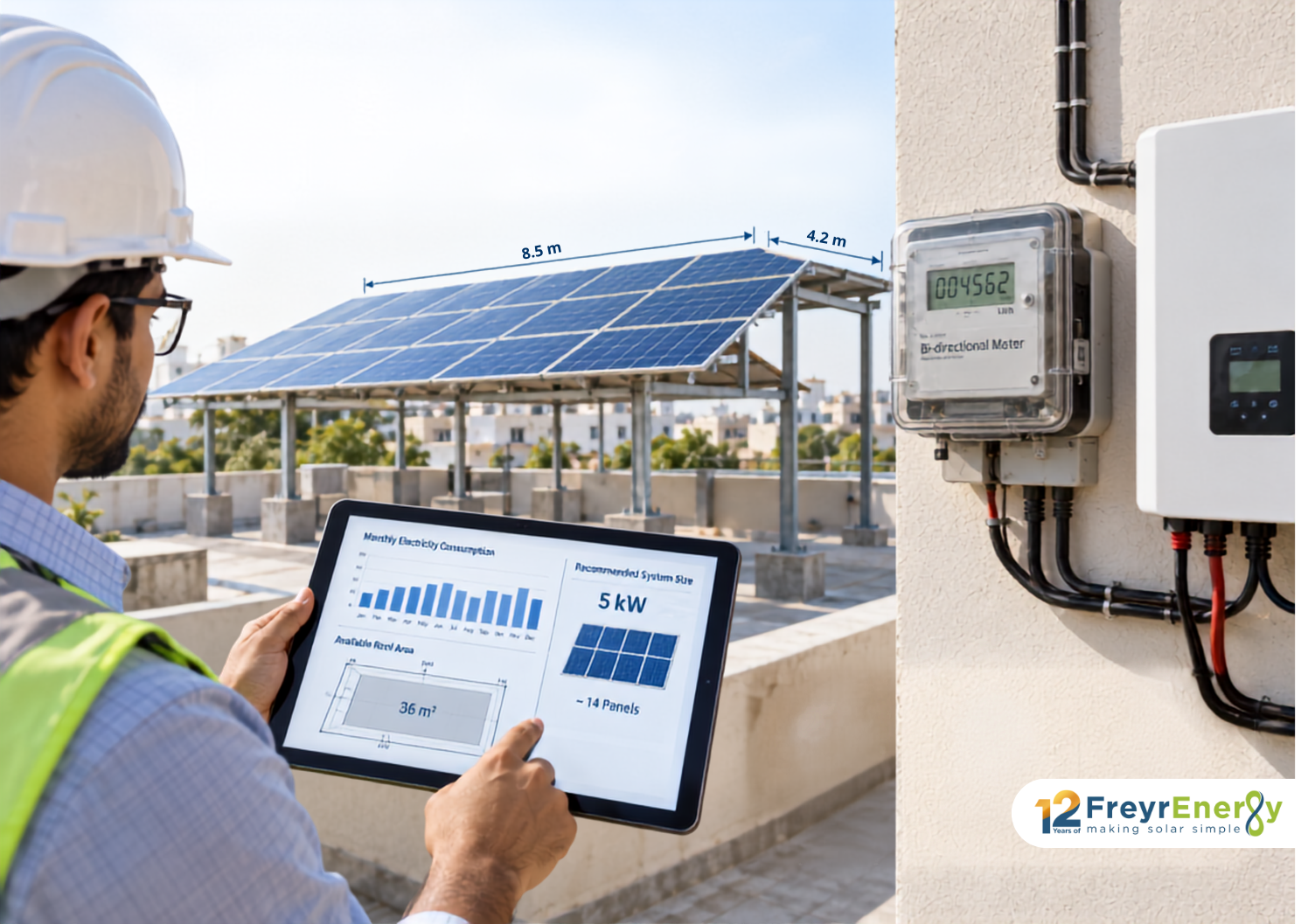
Start with annual and monthly consumption, then estimate solar generation for the actual roof. Separate daytime self-consumption from likely export and apply the current local value to each. Include shade, orientation, seasonal variation, future EV or cooling loads, sanctioned load, usable roof area and any export cap or settlement expiry.
Self-consumed electricity usually has the clearest value because it replaces an import at the applicable retail tariff. Export can still be valuable, but the model should use the notified credit method and a conservative scenario. A larger system is not automatically better when credits expire, export is valued below retail, or the roof design creates avoidable shade.
Questions to Ask Before Signing
- Which exact regulation and DISCOM procedure govern this connection today?
- Is the billing arrangement net metering, net billing, net feed-in, gross metering or no-export?
- How are import, export and surplus treated during the billing cycle and at settlement?
- Which charges remain after solar credits are applied?
- What capacity, sanctioned-load, phase, feeder or transformer conditions apply?
- Who supplies and owns the meter, what fees apply, and who corrects a rejected inspection?
- What evidence will I receive: approvals, serial numbers, test results, agreement and commissioning record?
How Freyr Energy Can Support the Process
A useful provider should connect the billing rule to the physical design. That means reviewing consumption and roof conditions, confirming the intended grid-interactive architecture, specifying compliant equipment, documenting the approved capacity, supporting the application and meter process, and helping the customer monitor performance after commissioning.
Freyr Energy’s approved company information states that it supports customised design, documentation, installation, net metering, subsidy-claim submission where applicable, project tracking and performance monitoring through the Freyr Energy App. Government or DISCOM approval should never be guaranteed; the customer should retain portal access, agreements, meter readings and every submitted record.
Conclusion
Solar net metering is best understood as a state-regulated billing arrangement, not as a universal promise that every exported unit will erase every imported unit forever. The bidirectional meter records import and export; the inverter records total generation; and the DISCOM applies the approved credit, carry-forward and settlement rules.
Before buying, verify the current regulation, proposed capacity, sanctioned load, export value and charges that remain. After commissioning, photograph the opening meter registers, compare the first bill with matching inverter dates and preserve the approval trail. A well-sized system should create value from daytime self-consumption first and treat export credit according to the rule that actually applies to the connection.
Sources and Fact Notes
Ministry of Power: Electricity (Rights of Consumers) Amendment Rules, 2024
Ministry of Power: Electricity (Rights of Consumers) Amendment Rule, 2021
PM Surya Ghar / National Rooftop Solar Portal consumer FAQ
Central Electricity Authority: current metering regulations, including 2026 amendments
Tamil Nadu electricity utility: rooftop solar and net feed-in FAQ
Punjab Energy Development Agency: rooftop solar metering arrangements and 2026 amendment context