
Solar Panel Price in India (2026): Complete Guide to Costs, Subsidies & Savings
- Home
- Solar Panel Price in India
Are you planning to install solar but confused about how much it will actually cost?
When you search for solar panel prices in India, the prices you see online can be confusing because some refer only to the solar panels, while others cover the complete rooftop solar system. A complete system includes much more than the panels themselves.
The final cost depends on factors such as the system capacity, panel technology, inverter, mounting structure, installation requirements, location, and applicable government subsidy.
For example, two 3kW solar systems can have different prices depending on the panels and inverter used, the quality of the mounting structure, your roof conditions, and what installation and after-sales services are included in the quotation.
That's why comparing only the headline price can give you an incomplete picture.
Let’s break down the complete solar system price in India in 2026, including costs for different system sizes, price per watt, government subsidy, electricity generation, savings, payback period, and the factors you should compare before choosing a rooftop solar system.
Freyr Energy Solar Calculator
Freyr Energy Solar Calculator
Calculate Your Savings
Explore the potential of solar energy and start saving from Day One!
Your Ideal System Size
3 kW
Annual Savings
₹ 30,000

Annually Generated Energy
4,286 Units
Roof Space Required
238 Sqft
 Price (Excluding Subsidy & GST) ₹ 1,99,138
 Subsidy + Freyr Energy Discount
 Effective Cost ₹ 99,138
Down payment
₹ 21,138Loan Amount
₹ 78,000Option 1: Shortest Tenure
6 Months
₹ 0
Option 2: Longest Tenure
120 Months
₹ 0
Calculate your savings in seconds!
You Save
₹12,000
Every Year
(*Taxes + Net-metering Extra)
Connect With us For More Details.
Down payment
₹ 9,354Loan Amount
₹ 37,415Option 1: Shortest Tenure
6 Months
₹ 6,512
Option 2: Longest Tenure
120 Months
₹ 604
Solar Panel Price in India 2026 — Quick Price Guide
The solar panel price in India depends mainly on the capacity of the system you install. The table below should show the approximate price of a complete rooftop solar system, along with the applicable central subsidy for eligible residential consumers.
| System size | Complete system price | Central subsidy* | Approx. price after subsidy | Suitable for |
|---|---|---|---|---|
| 1 kW | ₹1.20–₹1.30 lakh | ₹30,000 | ₹90,000–₹1.00 lakh | Small homes |
| 2 kW | ₹1.80–₹1.90 lakh | ₹60,000 | ₹1.20–₹1.30 lakh | Small/medium homes |
| 3 kW | ₹2.30–₹2.40 lakh | ₹78,000 | ₹1.52–₹1.62 lakh | Typical family homes |
| 5 kW | ₹3.50–₹3.70 lakh | Up to ₹78,000 | ₹2.72–₹2.92 lakh | Large homes |
| 10 kW | ₹6.30–₹6.40 lakh | Up to ₹78,000 | ₹5.52–₹5.62 lakh | Large homes / high-consumption properties |
*Subsidy as per applicable government scheme norms. Prices are approximate and may vary by site and equipment.
The final quotation can still vary depending on panel and inverter specifications, mounting structure, roof conditions, location, electrical work, and other installation requirements.
What Does a Complete Rooftop Solar System Include?
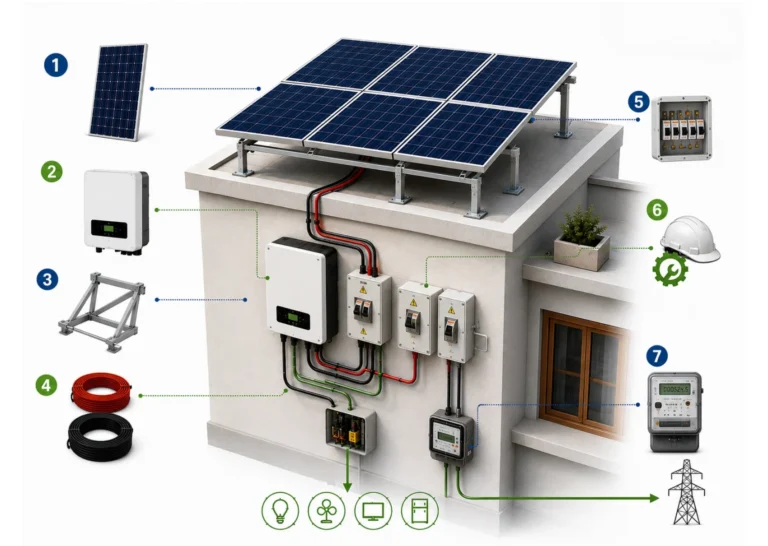
A complete rooftop solar system includes much more than solar panels. The panels generate electricity, but the inverter, mounting structure, cables, safety equipment, installation and grid connection are all needed to make the system work safely and efficiently.
Solar Panels
Solar panels convert sunlight into DC electricity. Their technology, wattage and efficiency affect how much electricity can be generated from the available roof space.
Solar Inverter
The inverter converts the DC electricity produced by the panels into AC electricity that can be used by your household appliances or supplied to the grid. Inverter efficiency, warranty and quality can therefore affect both system performance and price.
Mounting Structure
The mounting structure securely holds the panels and positions them to receive sufficient sunlight. Its design depends on factors such as the roof type, system layout and installation requirements. Freyr notes that aluminium and galvanised steel are commonly used for solar mounting structures.
DC & AC Cables
Solar cables carry electricity between the panels, inverter and electrical system. Correct cable selection and sizing are important because unsuitable cables can increase electrical losses and affect system performance.
Protection & Electrical Components
A complete system also requires safety components such as ACDB, DCDB, earthing, isolators, fuses, and surge protection devices. Lightning protection may also be required depending on the installation.
These components protect both the solar equipment and the property from electrical faults and voltage surges.
Installation & Commissioning
Installation includes mounting the panels and inverter, completing the electrical connections, testing the system and commissioning it for operation. Before commissioning, the electrical components and safety measures should be checked to identify any faults.
Net Metering & DISCOM-Related Services
For an on-grid system, a bidirectional meter records electricity imported from and exported to the grid. Freyr states that its project management includes support for solar subsidy and net-metering processes.
The key point: a ₹/W figure for solar modules alone cannot be directly compared with the quotation for a complete installed rooftop system. When comparing solar system prices, check exactly which equipment, installation work, safety components, warranties and services are included in the final quotation.
Solar System Price by Capacity
The cost of a rooftop solar system increases with its capacity, but a larger system also generates more electricity and can deliver higher savings.
The right capacity should therefore be based primarily on your electricity consumption and available roof space, rather than the size of your house alone.
As a general benchmark, a 1kW rooftop system can generate around 4 units of electricity per day, although actual generation varies with location, sunlight, shading, weather and system design.
1kW Solar System Price
A 1kW solar system costs around ₹1.20–₹1.30 lakh based on the pricing used in this guide. Eligible residential consumers can receive a central subsidy of ₹30,000, bringing the approximate cost down to ₹90,000–₹1 lakh.
It can generate roughly 120 units per month and generally requires around 80–100 sq. ft. of shadow-free roof space. It is suitable for small households with relatively low electricity consumption.
2kW Solar System Price
Visit a A 2kW solar system costs approximately ₹1.80–₹1.90 lakh. With a ₹60,000 central subsidy for eligible residential installations, the effective investment can fall to around ₹1.20–₹1.30 lakh.
A system of this size can generate roughly 240 units per month, depending on local conditions. It is suitable for small to medium-sized homes whose electricity consumption falls within this range.
3kW Solar System Price
Visit a A 3kW solar system costs approximately ₹2.30–₹2.40 lakh. Eligible residential consumers can receive up to ₹78,000 in central subsidy, reducing the approximate investment to ₹1.52–₹1.62 lakh.
A 3kW system can generate around 360 units per month and typically needs approximately 250–300 sq. ft. of roof space. This makes it a practical option for many Indian households with moderate electricity consumption.
5kW Solar System Price
Visit a A 5kW solar system costs around ₹3.50–₹3.70 lakh. For an eligible residential installation, the central subsidy is capped at ₹78,000, bringing the approximate effective cost to ₹2.72–₹2.92 lakh.
A 5kW system can generate around 600 units or more per month and typically requires approximately 400–500 sq. ft. of usable roof space. It is better suited to larger homes with higher electricity consumption, including households using multiple air conditioners or other high-load appliances.
10kW Solar System Price
Visit a A 10kW rooftop solar system costs approximately ₹6.30–₹6.40 lakh based on the pricing used in this guide. For an eligible residential consumer, the central subsidy remains capped at ₹78,000 rather than increasing proportionately beyond 3kW.
Based on the same generation benchmark, a 10kW system can produce approximately 1,200 units per month, although actual output will vary by location and site conditions. It is generally suited to large homes and properties with significantly higher electricity consumption.
Solar System Price Per Watt — How to Compare Quotes
Price per watt (₹/W) is a useful way to compare solar quotations of different sizes. However, it only works when you are comparing similar complete systems. A lower ₹/W does not automatically mean you are getting a better deal.
How to Calculate Solar Price Per Watt
The formula
Solar price per watt = Total system price ÷ System capacity (in watts)
For example, if a complete 3kW solar system costs ₹2.40 lakh:
- ₹2,40,000 ÷ 3,000 W = ₹80/W
If another 3kW system costs ₹2.10 lakh, its price works out to ₹70/W.
At first glance, the ₹70/W system looks cheaper. But the comparison is incomplete until you check what both quotations actually include.
Why ₹/W Alone Isn't Enough?
Two systems with the same capacity can have different prices because their specifications and service scope may be different. When comparing the ₹/W of two quotations, also check:
- Solar panel technology and efficiency
- Panel wattage and warranty
- Inverter type and warranty
- Mounting structure specifications
- Electrical and safety components
- Installation scope
- Net-metering support, if included
- After-sales service
The client’s final outline specifically requires ₹/W to be treated as a quote-comparison metric, rather than simply presenting the market price of individual solar modules.
Example: Comparing Two Solar Quotes
Suppose you receive these quotations for a 3kW rooftop system:
| Specification | Quote A | Quote B |
|---|---|---|
| System capacity | 3kW | 3kW |
| Total price | ₹2.10 lakh | ₹2.40 lakh |
| Price per watt | ₹70/W | ₹80/W |
| Panel technology | Mono PERC | TOPCon |
| Inverter | Standard | Higher-specification |
| Mounting structure | Standard | Enhanced specification |
| Installation | Included | Included |
| Monitoring | Check quotation | Included |
| Warranty | Check individual components | Longer component coverage |
| After-sales support | Limited / check scope | Included |
Quote A is ₹30,000 cheaper, but that alone doesn’t make it the better option. If Quote B includes higher-efficiency panels, better warranties, stronger components or more comprehensive service, the additional ₹10/W may offer better value over the system’s operating life.
So, use price per watt to shortlist quotations, but make the final decision only after comparing them on a like-for-like basis.
Next comes an important distinction that makes these comparisons much easier: solar panel price vs complete solar system price.
Solar Panel Price vs Complete Solar System Price
A solar panel price usually refers only to the cost of the photovoltaic modules. A complete solar system price includes the equipment and services required to turn those panels into a working rooftop power system.
| Panel-only price | Complete solar system price |
|---|---|
| Solar modules only | Complete rooftop solution |
| No inverter | Inverter included |
| No mounting structure | Structure included |
| No installation | Installation included |
| No electrical BOS | Electrical & safety components included |
| No service scope | Installation/service scope included |
This distinction is important when comparing prices online. A low module price may look attractive, but you will still need an inverter, structure, cables, protection equipment and installation.
So, when searching for the solar panel price in India, first check whether the quoted amount refers to the panels alone or the complete installed system.
Why Does Freyr Energy Offer Solar Systems at This Price?
A solar quotation should be evaluated by what you receive for the price, not simply by the final number.
What You Get With a Freyr Solar System?
Freyr’s quotation should be compared on the complete scope of equipment and services included.
| Feature | Freyr Energy | Typical market quote |
|---|---|---|
| Panel specification | As per selected Freyr system | Varies |
| Panel warranty | Up to 30 years* | Varies |
| Product warranty | Up to 12 years* | Varies |
| Inverter warranty | Up to 10 years* | Varies |
| Structure warranty | Up to 10 years* | Varies |
| Installation | Included as applicable | Varies |
| Monitoring | Freyr Energy App | Varies |
| Financing/EMI | Available | Varies |
| After-sales support | Included | Varies |
| Experience | 12+ years* | Varies |
| Customers | 20,000+* | Varies |
*Final claims and warranty periods should be checked against the currently offered system before publication.
Where Does Your Solar System Investment Go?
Your investment covers more than panels. It includes the inverter, mounting structure, electrical components, installation, monitoring, warranties and service support required to operate the system reliably.
01
Why a Lower Solar Quote May Not Mean Better Value
A cheaper 3kW system and a higher-priced 3kW system are not necessarily identical products. Differences can include panel technology, inverter specifications, structure quality, warranties, installation scope, electrical work and after-sales service.
02
The right comparison is therefore:
Same capacity → Same technology → Same specifications → Same installation scope → Same warranties → Final price
Compare what is included in the quotation, not just the final price.
Solar System Cost Before & After Government Subsidy
The PM Surya Ghar: Muft Bijli Yojana provides Central Financial Assistance to eligible residential consumers installing rooftop solar.
| System capacity | Central subsidy |
|---|---|
| 1kW | ₹30,000 |
| 2kW | ₹60,000 |
| 3kW or above | Maximum ₹78,000 |
The subsidy is capped at 3kW, so installing a 5kW or 10kW residential solar system does not increase the central subsidy beyond ₹78,000.
For example, a 3kW system costing ₹2.30–₹2.40 lakh would have an approximate effective cost of ₹1.52–₹1.62 lakh after a ₹78,000 subsidy, subject to eligibility.
Residential consumers with a grid-connected DISCOM connection can apply through the PM Surya Ghar National Portal. State-level incentives may also be available in some locations and should be checked separately.
How Much Electricity Does a Solar System Generate?
Solar generation depends on sunlight, location and system design. Using an approximate benchmark of 4 units per kW per day, the following table provides a simple estimate:
| System size | Approx. daily generation | Approx. monthly generation |
|---|---|---|
| 1kW | 4 units | 120 units |
| 2kW | 8 units | 240 units |
| 3kW | 12 units | 360 units |
| 5kW | 20 units | 600 units |
| 10kW | 40 units | 1,200 units |
These figures are estimates rather than guaranteed output. Actual generation varies according to location, solar irradiation, roof orientation, shading, weather, panel efficiency and system losses.
How Much Can You Save With a Solar System?
The amount you save with rooftop solar depends on your electricity consumption, solar system size, electricity tariff, solar generation, and applicable net-metering rules.
A properly sized rooftop solar system can meet a large portion of your household’s electricity needs and may help reduce your electricity bill by up to 90%, depending on your usage pattern and system performance.
Example: Saving With a 3 kW Solar System?
- Costs ₹2.35 lakh
- Receives ₹78,000 subsidy
- Leaves a net investment of approximately ₹1.57 lakh
- Generates around 360 units per month
Suppose your home uses around 400 units of electricity per month and you install a 3 kW rooftop solar system.
| Particulars | Example |
|---|---|
| Solar system cost | ₹2.35 lakh |
| Government subsidy | ₹78,000 |
| Net investment after subsidy | Approx. ₹1.57 lakh |
| Estimated solar generation | Approx. 360 units/month |
| Electricity bill before solar* | Approx. ₹3,200/month |
| Electricity bill after solar* | Approx. ₹320/month |
| Monthly savings | Approx. ₹2,880 |
| Annual savings | Approx. ₹34,560 |
| Bill reduction | Up to 90% |
At an electricity rate of ₹8 per unit, a household using 400 units would pay around ₹3,200 per month before solar. If the 3 kW system generates around 360 units, only about 40 units would need to come from the grid, bringing the energy cost down to approximately ₹320 per month.
Example — 5kW Solar System
- A 5kW system generating approximately 600 units per month would produce electricity worth around ₹4,800 per month at an ₹8/unit tariff, or approximately ₹57,600 per year.
- These examples are illustrative. Actual savings depend on your tariff, generation, self-consumption and net-metering arrangement.
- Recent government data shows that rooftop solar has substantially reduced bills for participating households, with more than 18.9 lakh households even reporting zero electricity bills in some months under PM Surya Ghar.
The decision should ultimately come down to net investment versus expected lifetime electricity savings, not simply whether solar is popular.
Solar System Payback Period in India
The payback period tells you how long your solar savings will take to recover the initial investment. Before choosing an installer, compare quotations on a like-for-like basis.
The Formula
Payback period = Net investment ÷ Annual electricity savings
Using the earlier 3kW example:
₹1,57,000 ÷ ₹34,560 ≈ 4.5 years
However, there is no single payback period that applies to every solar installation.
Your actual payback depends on:
- System cost
- Government subsidy
- Electricity tariff
- Annual generation
- Electricity consumption
- Location
- Future tariff increases
A personalised calculation based on your electricity bill provides a more useful estimate than a universal ROI claim
System cost
Government subsidy
Electricity tariff
Annual generation
Electricity consumption
Location
Future tariff increases
A personalised calculation based on your electricity bill provides a more useful estimate than a universal ROI claim.
Which Solar System Size Do You Need?
The right system should primarily match your electricity consumption.
| Monthly consumption | Approx. system requirement |
|---|---|
| Up to 120 units | Around 1kW |
| 120–240 units | Around 2kW |
| 240–360 units | Around 3kW |
| 360–600 units | Around 3–5kW |
| 600+ units | 5kW or higher |
Calculate Your Solar Savings
Estimate your solar installation cost, applicable subsidy, potential electricity bill savings, and expected payback period.
Receive a Personalised Solar Proposal
Based on your requirements, you can receive a customised proposal with a recommended system size, estimated investment, and expected savings.
Based on Appliances
Fans, lights, televisions and refrigerators create relatively moderate loads. Air conditioners, geysers, water pumps, induction cooktops and EV charging can increase electricity consumption substantially.
Instead of counting appliances alone, check your electricity bills over the previous 12 months to understand actual usage.
What If Your Consumption Increases?
Factor in future requirements before finalising capacity. If you’re planning to add another AC, buy an EV or increase household occupancy, your future electricity consumption may be considerably higher than it is today.
How Much Roof Space Do You Need for Solar?
A simple planning estimate is around 80–100 sq. ft. of usable roof area per kW, although modern high-wattage panels and system design can change the requirement.
| System size | Approx. roof space |
|---|---|
| 1kW | 80–100 sq. ft. |
| 2kW | 160–200 sq. ft. |
| 3kW | 240–300 sq. ft. |
| 5kW | 400–500 sq. ft. |
| 10kW | 800–1,000 sq. ft. |
The usable area must also account for shading, water tanks, parapet walls, panel spacing, maintenance access and other rooftop obstructions.
Which Solar Panel Technology Is Best for Your Home?
For most residential buyers today, the practical comparison is between Mono PERC, TOPCon and, in suitable applications, bifacial panels.
Mono PERC
Mono PERC offers a good balance between cost and efficiency and remains suitable for homeowners who want reliable performance without paying for the newest technology.
TOPCon
TOPCon offers higher efficiency and improved long-term performance. It is particularly useful where roof space is limited and maximising generation from the available area matters.
Bifacial
Bifacial panels can generate electricity from both sides, but their additional benefit depends heavily on mounting height, surface reflectivity and installation design.
TOPCon vs Mono PERC — is the higher price worth it?
TOPCon can justify its higher price when roof space is limited or maximum lifetime generation is the priority. If adequate roof space is available and the price difference is substantial, Mono PERC may still provide better value.
Compare lifetime generation and system cost rather than choosing solely because one technology is newer.
On-Grid vs Hybrid vs Off-Grid Solar Systems
| System | Battery | Works during grid outage | Relative cost | Best for |
|---|---|---|---|---|
| On-grid | No* | ₹2.30–₹2.40 lakh | Electricity bill savings | |
| Hybrid | ₹3–₹5 lakh | Savings + backup | ||
| Off-grid | ₹3–₹5 lakh+ | Areas with unreliable/no grid |
*A standard on-grid system shuts down during a power cut for anti-islanding safety, even when the sun is shining.
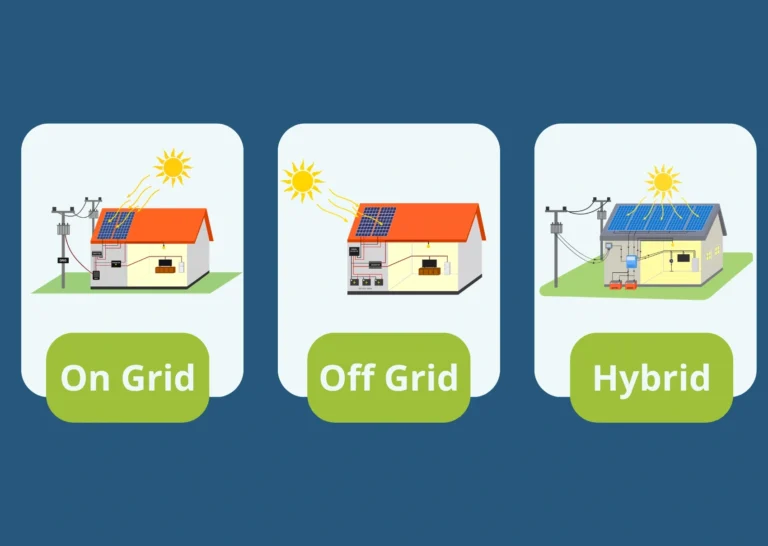
For most urban homes focused primarily on reducing electricity bills, an on-grid system is usually the simplest option. Hybrid and off-grid systems cost more because battery storage is required.
How to Compare Solar Installation Quotes
Before choosing an installer, compare quotations on a like-for-like basis.
Compare the Same Capacity
Don’t compare a 3kW system with a 3.3kW or 4kW system solely by final price.
Check Panel Specifications
Compare technology, wattage, efficiency, manufacturer and warranties.
Compare Inverters and Structures
Check inverter capacity and warranty along with the material and specifications of the mounting structure.
Check What Installation Includes
Confirm whether civil work, wiring, earthing, safety equipment and commissioning are included.
Compare Warranties
Separate the panel performance warranty from product, inverter, structure and workmanship warranties.
Check Subsidy and Net-Metering Scope
Confirm what assistance the installer provides and what remains your responsibility.
Check After-Sales Support
Ask who handles faults, monitoring and warranty claims after installation.
Finally, ask for an all-inclusive price so that additional charges don’t appear after you’ve selected the installer.
Solar System Price Trends in India 2026
The solar market in 2026 is being shaped by technology upgrades, domestic manufacturing and changing compliance requirements.
Higher Adoption of TOPCon
The market continues to shift towards higher-efficiency technologies such as TOPCon as manufacturers expand production and buyers prioritise greater output from limited roof space.
Growth in Domestic Manufacturing
India continues to expand domestic module and cell manufacturing capacity. This is particularly important as government programmes strengthen requirements around approved and domestically produced equipment.
DCR and ALMM Requirements
ALMM remains an important part of the solar procurement framework. MNRE’s List-I covers approved module models and manufacturers, while List-II for solar PV cells has also become relevant under the evolving 2026 framework.
In July 2026, the government also provided a limited exemption window for certain net-metering and open-access projects from ALMM List-II cell requirements until 31 December 2026, rather than providing a blanket extension.
Government Support Continues
PM Surya Ghar remains a major driver of residential rooftop adoption. By 22 July 2026, nearly 39.72 lakh rooftop systems had been installed under the scheme, benefiting more than 48 lakh households.
Should You Buy Now or Wait?
Waiting purely for panel prices to fall can be misleading because modules are only one part of the complete installation cost. If your roof is suitable, electricity consumption is high and the economics work at today’s price, delaying installation also means delaying electricity savings.
Who Should Install a Solar System?
Solar delivers the greatest value where electricity consumption and available roof space justify the investment.
| User | Suitable system | Primary benefit |
|---|---|---|
| Homeowners | On-grid rooftop | Lower electricity bills |
| Large homes | 3–10kW | Higher savings |
| Offices | Commercial rooftop | Daytime consumption |
| Factories | Large rooftop | High energy offset |
| Schools | Rooftop | Daytime generation |
| Hotels | Commercial solar | High electricity usage |
| Hospitals | Solar + suitable backup | High energy demand |
| Farmers | Agricultural solar | Pump / energy savings |
| Housing societies | Shared rooftop | Common-area savings |
The final system design should always be based on actual electricity consumption and site conditions rather than these categories alone.
Is Solar Worth the Investment in 2026?
The Experience Centre is designed for anyone considering rooftop solar and wanting to understand the technology before making an investment.
Solar makes more sense when:
- Your electricity bills are significant.
- You own the property.
- Your roof receives good sunlight.
- You have sufficient shadow-free space.
- You expect to use the property for several years.
Consider the investment more carefully when:
- Your electricity consumption is very low.
- Most of the roof is shaded.
- Major structural work is required.
- You expect to move soon.
- Usable roof space is insufficient.
The decision should ultimately come down to net investment versus expected lifetime electricity savings, not simply whether solar is popular.
Solar Buying Checklist — 10 Things to Check Before You Pay
Before finalising your rooftop solar installation, check:
- Correct System Capacity
- Solar Panel Technology
- Panel Efficiency and Wattage
- Inverter Specifications
- Mounting Structure
- Complete System Price Per Watt
- Product and Performance Warranties
- Applicable DCR and ALMM Compliance
- Government Subsidy Eligibility
Correct system capacity
Solar panel technology
Panel efficiency and wattage
Inverter specifications
Mounting structure
Complete system price per watt
Product and performance warranties
Applicable DCR and ALMM compliance
Government subsidy eligibility
Product and performance warranties
Get every major specification and service commitment mentioned in the final quotation.
Final Buying Advice

Don’t choose a solar system simply because it has the lowest price.
- Start by comparing the complete system cost and ₹/W, and then look deeper into the panels, inverter, mounting structure, electrical components, warranties and installation scope.
- After that, calculate the applicable subsidy, expected electricity generation, annual savings and likely payback period.
- A cheaper quotation can offer good value if the specifications are comparable. But if the lower price comes from cheaper components, limited installation work or weaker after-sales support, the savings at purchase may cost more later.
- For homeowners, the economics of rooftop solar have also improved with the continued availability of central financial assistance under PM Surya Ghar.
- Before making the final decision, get your roof assessed and calculate the system size based on your actual electricity consumption.
- A personalised solar proposal can then show you the complete cost, eligible subsidy and expected savings before you invest.

Ready to Experience Solar?
Visit your nearest Freyr Energy Solar Experience Centre and explore rooftop solar in person.
See our solar panels, inverters, electrical components, residential and commercial solar models, and speak with our solar experts about your requirements.
FAQs
Have any specific questions?
Connect with our solar specialists for personalized guidance.
1How much do solar panels cost in India?
A complete residential rooftop solar system can cost around ₹1.20–₹1.30 lakh for 1kW, ₹2.30–₹2.40 lakh for 3kW and ₹3.50–₹3.70 lakh for 5kW, based on the pricing used in this guide. Actual prices depend on specifications and installation requirements.
Try the Freyr Energy Solar Panel Calculator
2What is the average solar panel price per watt?
A complete Freyr Energy rooftop solar system typically costs around ₹70–₹80 per watt for a 3 kW installation. This includes more than the panels, such as the inverter, mounting structure and installation. The exact per-watt price varies with capacity, components and roof requirements.
3 Which type of solar panel is best for home use?
Mono PERC and TOPCon are both suitable for homes. TOPCon offers higher efficiency, while Mono PERC may offer better value where roof space isn’t limited.
Related article: Types of Solar panels in India
4How much roof space is required for rooftop solar?
As a simple estimate, allow around 80–100 sq. ft. per kW. Actual requirements depend on panel wattage, roof design, shading and spacing.
5 Is visiting a Solar Experience Centre free?
Yes, visiting a Freyr Energy Solar Experience Centre and consulting its solar experts is completely free. You can view working panels, inverters, mounting structures and monitoring systems in person. Experts can also provide a personalised estimate of system size, cost, savings and subsidy eligibility.
Know more: Solar Experience Centre
6How much can I save on my electricity bill?
A correctly sized Freyr Energy rooftop system can reduce electricity bills by up to 90%, depending on consumption, generation, tariffs and net-metering rules. The Freyr Energy Solar Calculator provides a personalised estimate using your electricity requirements. Customers can subsequently monitor generation and savings through the Freyr Energy App.
7How long does it take to recover the investment?
Freyr Energy estimates that many residential systems can recover their effective investment in approximately 3–4 years through electricity-bill savings. The actual payback period depends on system cost, subsidy eligibility, electricity tariff and solar generation. A personalised proposal provides a more reliable estimate for your property.
8Do solar panels work during cloudy weather?
Yes. Solar panels still generate electricity when sunlight is diffused by clouds, but their output is generally lower than on clear, sunny days.
Related article: Do Solar Panels Work At Night and on Cloudy Days?
9Do solar panels work during power cuts?
The panels may be capable of generating electricity, but a standard on-grid system shuts down during a grid outage for safety. Backup requires an appropriately designed hybrid or off-grid system.
10How often do solar panels need maintenance?
Solar panels require periodic inspection and cleaning based on dust, weather and surrounding conditions; an annual professional inspection is a useful baseline. Freyr Energy’s self-cleaning rooftop solar system uses automated sprinklers to reduce dust accumulation. Customers can also monitor performance through the Freyr Energy App and investigate unusual generation drops.