
Apartment residents can use solar power, but the right model depends on who controls the roof and which electricity meter should receive the benefit. An RWA can install a shared rooftop plant for lifts, pumps, lighting, security systems, clubhouses and EV charging. A flat owner with documented roof rights may be able to install an individual system. In locations with approved virtual or group net metering, one solar plant may support more than one electricity connection. A small balcony system is a different product with different limits and safety requirements.
This guide explains solar panels for apartments in India from both perspectives: the resident trying to reduce a personal bill and the housing society trying to reduce common-area expenditure. It covers options, current subsidy rates, costs, sizing, metering, approvals and vendor selection without assuming that one arrangement works in every state.
Quick takeaways
- For most housing societies, the simplest solar solution is a grid-connected plant serving the common-area electricity meter.
- An individual resident normally needs exclusive roof or terrace rights, society permission and a compliant electrical connection.
- Under the current PM Surya Ghar framework, eligible individual residential connections can receive ₹30,000 for 1 kW, ₹60,000 for 2 kW and up to ₹78,000 for 3 kW or more in general-category states.
- Eligible GHS/RWA common-facility plants can receive ₹18,000 per kWp in general-category states, up to 500 kWp and subject to the scheme limit of 3 kWp per house.
- Virtual and group net metering are not uniform across India. Confirm current SERC and DISCOM rules before promising credits to individual flats.
- A solar panel for an apartment balcony may help with small loads or battery charging, but it is not automatically a legal plug-in grid system and cannot replace a society-scale rooftop plant.
Can apartments install solar panels?
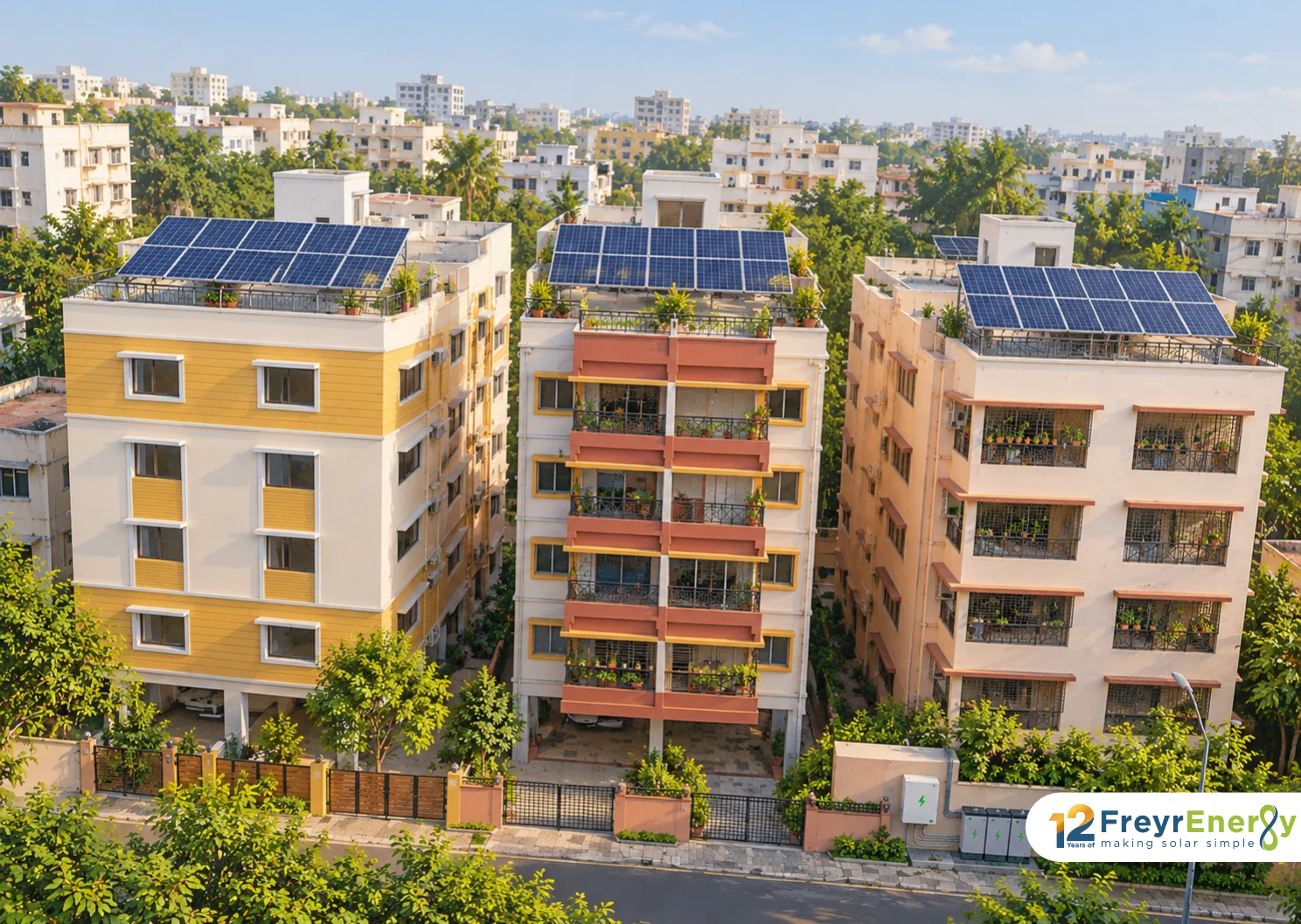
Yes. Solar for apartments can be installed for an individual flat, common society loads or multiple eligible meters, depending on roof rights and local regulations. The most widely practical route is rooftop solar for apartments connected to the society’s common meter. Personal systems and shared-credit models need additional approvals, metering support and clear allocation rules.
The best solar solutions for apartments begin with the beneficiary meter. Solar panels for apartment buildings usually serve shared loads, while solar panels for apartment complexes may span several towers and common connections. When choosing a solar system for apartment use, identify the roof rights, electricity account and intended benefit before comparing solar panel brands.
Choose the right apartment solar model
| Model | Who benefits | Best fit | Main condition |
| Society rooftop for common areas | All residents indirectly through lower common electricity expense | RWA with lifts, pumps, lighting, STP, clubhouse or EV charging loads | Common meter, usable roof and society approval |
| Individual rooftop system | One flat’s residential meter | Flat with exclusive or allocated roof rights | Written rights, RWA approval and DISCOM connection |
| Virtual or group net metering | Multiple participating meters | States and DISCOMs with an approved framework | Eligible consumers, allocation method and utility approval |
| Balcony or portable solar | One resident and small selected loads | Residents without roof access and with adequate direct sun | Safe mounting; compliant electrical use; no assumed grid export |
Option 1: Solar panels for housing society common areas
Solar panels for a housing society are usually connected to the common-area meter. Daytime generation can offset eligible consumption from lifts, water pumps, sewage-treatment equipment, corridor and parking lights, security systems, the clubhouse, ventilation and common EV charging. The grid supplies the shortfall, and surplus may be exported under the approved metering arrangement.
When comparing solar panels for residential society projects, the RWA should evaluate the complete plant and service scope rather than buying modules in isolation.
This model does not normally reduce each flat’s personal electricity bill directly. Residents benefit through lower common-area electricity expenses, a stronger maintenance budget or another allocation approved by the society. The RWA should document how savings will be measured and used.
Option 2: Solar power for an individual apartment
A resident may install a dedicated solar system for an apartment when there is usable space and a clear right to use it. This may apply to a top-floor unit with legally assigned terrace rights or a society-approved portion of the common roof. The system still needs an appropriate electrical connection, safe cable routing and the permissions required by the building and DISCOM.
A flat owner should not treat shared terrace access as exclusive ownership. Before paying a vendor, confirm the title or allotment document, society resolution, maintenance access, roof-repair responsibility and what happens when the flat is sold.
Option 3: Virtual and group net metering for apartments
Shared metering models can extend solar energy for apartments beyond the common meter, but terminology and eligibility must be read from the current state rules.
| Arrangement | How credits work | Typical apartment use |
| Net metering | Import and export are measured for one eligible electricity connection. | Society plant connected to the common meter or an approved individual system. |
| Group net metering | Surplus from a renewable system is adjusted against more than one connection of the same consumer, where rules allow. | A consumer with multiple eligible connections in the same DISCOM area. |
| Virtual net metering | Generation exported through a renewable or gross meter is allocated across multiple participating consumer connections. | An RWA or participating residents sharing credits under an approved allocation. |
Delhi’s 2024 amendment, for example, defines group and virtual net metering separately and permits adjustment across multiple connections within the same distribution licensee area. Maharashtra’s MSEDCL currently provides a virtual-net-metering application route. These examples show that the model exists, not that every apartment in India is eligible. Verify the latest regulation, consumer category, capacity limit, allocation rule, charges and settlement procedure locally.
Option 4: Solar panel for an apartment balcony
A balcony panel can be useful for charging a portable power station or battery and running compatible small loads through the manufacturer’s approved equipment. Output may be limited because balconies are often vertical, shaded by upper floors or neighboring towers, and exposed to wind. A panel that receives only a few hours of direct sun will not perform like an unshaded rooftop array.
Do not assume that an imported plug-in balcony kit can be connected to an Indian wall socket or export electricity legally. A grid-connected system needs suitable protection, anti-islanding, metering and DISCOM approval. External mounting may also affect the facade and create falling-object, wind-load and fire risks. Obtain written society approval and use a qualified professional for any fixed installation.
What balcony solar can and cannot do
| Can help with | Usually cannot do by itself |
| Charge a compatible battery or portable power station | Power an entire apartment continuously |
| Support selected low-energy devices through approved equipment | Run large air conditioners, geysers or induction loads reliably |
| Provide limited backup when paired with suitable storage | Export to the grid without an approved connection |
| Offer a movable option for some tenants | Bypass landlord, RWA, facade or electrical-safety requirements |
How much solar can an apartment building install
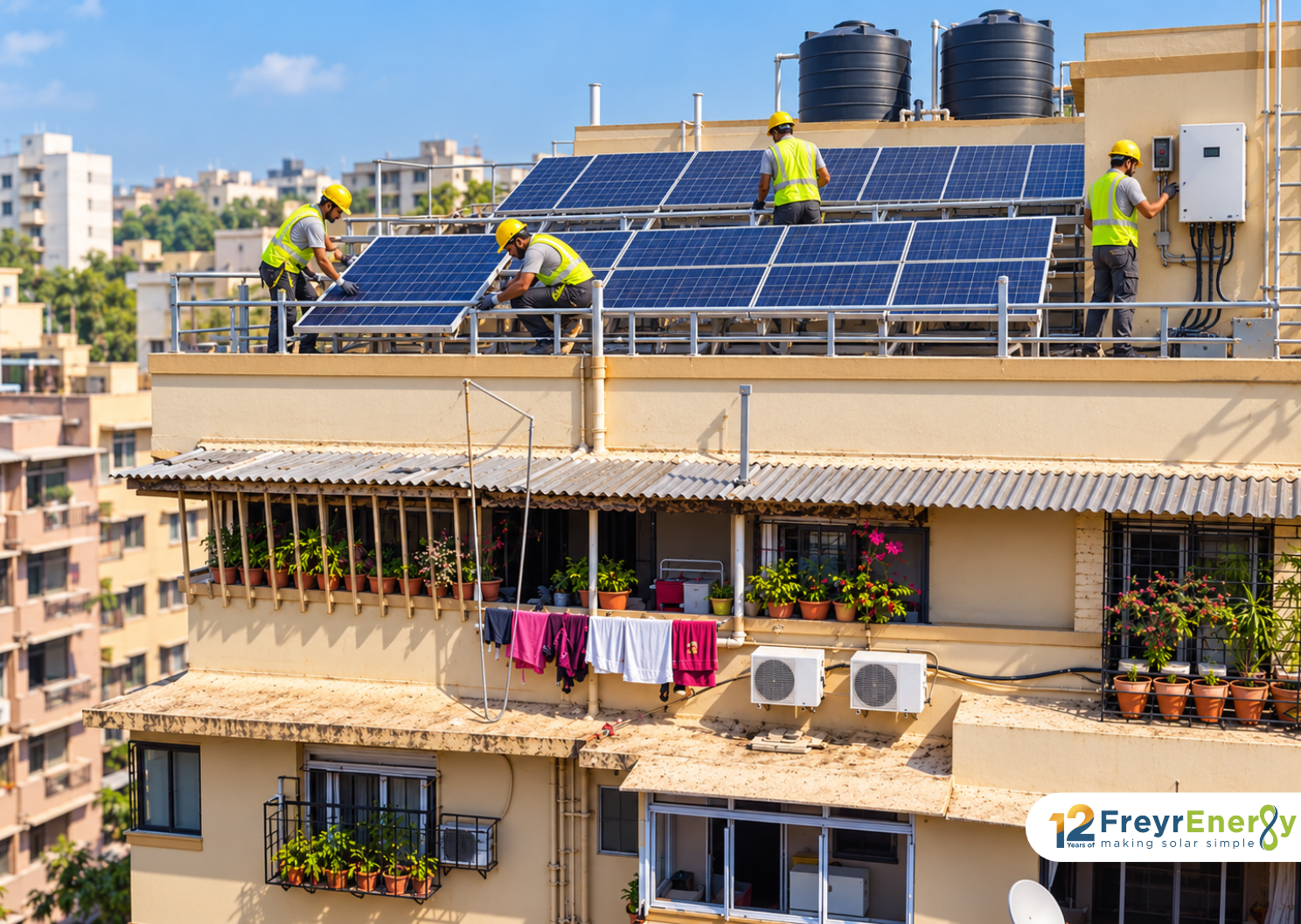
Capacity is constrained by both usable roof area and the electricity load the project intends to offset. Start with the society common meter rather than the number of flats alone. Remove tanks, lift rooms, vents, solar water heaters, shaded zones, pathways, fire access and structurally unsuitable areas from the roof calculation.
For early screening, allow roughly 80 to 100 square feet of usable roof per kW. Modern layouts can differ, so a measured design and structural assessment must establish the final number. High-rise buildings also require wind-load, safe-access and lifting assessments.
A practical sizing method for an RWA
- Collect 12 months of common-meter bills and calculate average monthly kWh, seasonal variation and daytime load.
- Estimate the generation expected from 1 kW at the specific site using a professional simulation.
- Divide the target monthly solar generation by the modeled monthly generation per kW.
- Check whether the resulting capacity fits on the usable roof and complies with sanctioned-load and DISCOM limits.
- Reduce or redesign the system if exports would be high and poorly compensated.
Illustrative example: if a society wants to offset 12,000 kWh per month and the proposal models 120 kWh per kW per month, the initial capacity estimate is 100 kW. At 80 to 100 square feet per kW, early roof screening would require about 8,000 to 10,000 square feet. Both the 120 kWh yield and the roof allowance are assumptions; the final design must use site data.
How much do solar panels for apartments cost
Solar panels for apartments cost different amounts because an individual residential system and a society-scale project have different structures, cabling, metering and access requirements. The apartment solar panel price should always mean the complete installed system, not only the module price.
Current Freyr Energy indicative residential prices
| System capacity | Indicative installed price before subsidy | Current general-category household CFA |
| 1 kW | ₹1.20 lakh to ₹1.30 lakh | ₹30,000 |
| 2 kW | ₹1.80 lakh to ₹1.90 lakh | ₹60,000 |
| 3 kW | ₹2.30 lakh to ₹2.40 lakh | ₹78,000 |
| 5 kW | ₹3.50 lakh to ₹3.70 lakh | ₹78,000 maximum |
| 10 kW | ₹6.30 lakh to ₹6.40 lakh | ₹78,000 maximum |
Price note: Freyr Energy published these indicative installed residential price ranges in September 2026. Final cost varies with roof, location, structure, components, taxes and project scope. CFA is separate and subject to current eligibility and scheme conditions.
Housing society solar cost
For a larger RWA plant, request a project-specific quotation. The cost per kW usually changes with scale, but a high-rise may also need taller structures, long cable runs, lightning protection, distribution-panel work, access equipment or structural reinforcement. A society quote should itemize:
- Modules, inverters, mounting structure and roof attachments.
- DC and AC cables, trays, distribution boxes, switchgear and protection.
- Earthing, lightning and surge protection, labels and isolation.
- Structural assessment, design, generation study and drawings.
- Lifting, scaffolding, work-at-height systems and site safety.
- Metering, DISCOM process, testing and commissioning.
- Monitoring, cleaning arrangement, O&M, spares and warranties.
- Taxes, statutory fees, roof repairs and every exclusion.
Solar subsidy for apartments under PM Surya Ghar
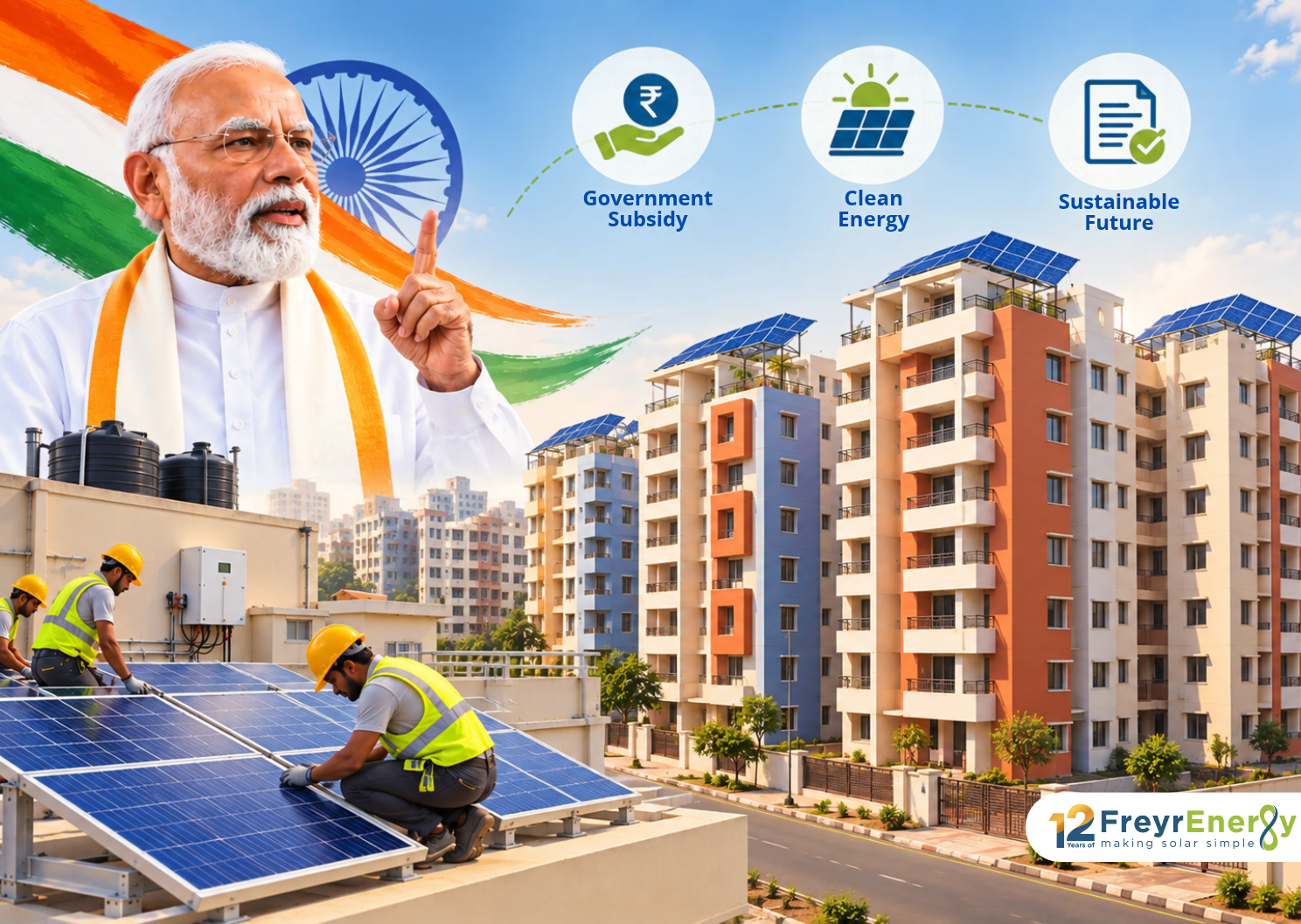
As of 23 September 2026, the official central CFA structure separates individual residential connections from GHS/RWA common-facility systems.
| Eligible segment | General-category CFA | Special-category CFA |
| Individual residential connection: first 2 kWp | ₹30,000 per kWp | ₹33,000 per kWp |
| Individual residential connection: next 1 kWp | ₹18,000 per kWp | ₹19,800 per kWp |
| Individual capacity beyond 3 kWp | No additional CFA | No additional CFA |
| GHS/RWA common facilities including EV charging | ₹18,000 per kWp | ₹19,800 per kWp |
The GHS/RWA provision applies up to 500 kWp, subject to the scheme limit of 3 kWp per house, and includes individual rooftop plants already installed by residents when the overall cap is evaluated. Special-category rates apply to the locations listed in the official scheme documents. Always confirm the current portal and DISCOM process before commitment.
How solar subsidy for housing society projects works
| Eligible common-facility capacity | General-category CFA at ₹18,000 per kWp | Important condition |
| 25 kWp | ₹4.50 lakh | Within both 500 kWp and 3 kWp-per-house limits |
| 50 kWp | ₹9.00 lakh | Within both limits |
| 100 kWp | ₹18.00 lakh | Within both limits |
| 500 kWp | ₹90.00 lakh | Maximum scheme capacity and still subject to 3 kWp per house |
These are arithmetic illustrations of the published CFA rate, not approvals. Actual eligibility, system acceptance and disbursement depend on current scheme and DISCOM requirements.
Who can claim which subsidy
- An eligible flat with its own residential electricity connection may use the individual residential CFA route for an approved system tied to that connection.
- A GHS/RWA may use the common-facility CFA route for eligible common services, including EV charging.
- The society and individual residents should coordinate because the scheme capacity ceiling considers individual plants within the GHS/RWA.
- CFA is not a vendor discount and should not be treated as guaranteed until eligibility and installation are verified.
How to apply for apartment rooftop solar subsidy
- Confirm whether the applicant is an individual residential consumer or a GHS/RWA common-facility connection.
- Check the current PM Surya Ghar National Portal and the local DISCOM procedure.
- Register the eligible electricity connection and submit the required application or feasibility details.
- Select an eligible vendor and equipment that meet current scheme requirements.
- Complete installation, inspection, metering and commissioning.
- Submit the required completion and bank details, then track CFA status through the official process.
Do not start solely on a salesperson’s assurance. Confirm the electricity-connection category, vendor status, domestic-content requirements, approved capacity and document sequence on the current official portal.
How much can a housing society save
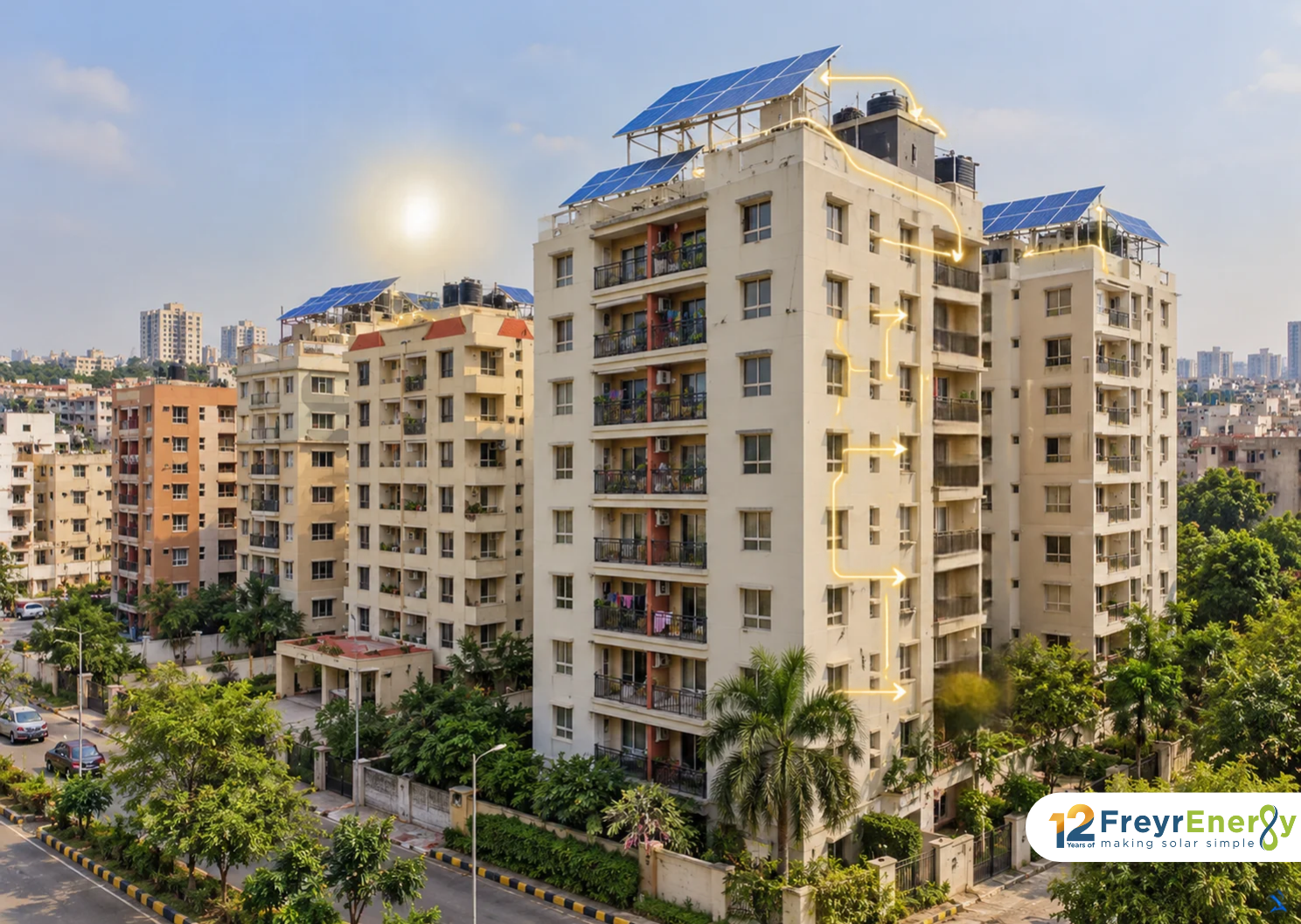
Savings depend on annual generation, how much energy is used behind the common meter, the avoidable electricity charge, export credits, downtime and O&M. A society should calculate gross savings and recurring costs separately.
Annual net saving = value of self-consumed solar + export credit − annual operating costs
Illustrative example: a 100 kW system modeled to generate 145,000 kWh in the first year, with 85% self-consumption valued at ₹8 per kWh and 15% export valued at ₹3 per kWh, creates a gross energy value of about ₹10.51 lakh. If annual O&M and reserves are ₹1 lakh, first-year net saving is about ₹9.51 lakh. Replace every assumption with the society’s tariff, load and approved export rule before calculating payback.
Can apartment solar power lifts and water pumps
Yes, but a normal grid-tied system offsets the energy used by lifts and pumps; it does not necessarily run them during a grid outage. Engineers must account for motor starting current, simultaneous operation, operating hours, phase balance and the existing backup arrangement. Backup requires compatible inverters, controls, batteries or a coordinated generator system.
Solar panels for apartment EV charging
Society solar can support common EV chargers when charging demand, available connection capacity and solar generation are studied together. Daytime charging increases direct solar use. Night charging may require grid electricity or storage. The RWA should define charger access, billing, demand management and whether EV charging is included in the common-facility subsidy application.
Do apartment solar systems need batteries
| Grid-tied solar | Solar plus battery |
| Best for reducing eligible electricity purchases | Best where selected-load backup or time shifting is required |
| Lower capital cost and simpler operation | Higher cost, controls, space and replacement planning |
| Normally shuts down during a grid outage | Can supply designed backup loads when correctly configured |
| Grid handles shortfalls and eligible exports | Battery stores part of the energy for later use |
For most apartment complexes focused on common-area bill reduction, an on-grid system is the starting point. Add storage only after defining the backup load, duration, cycling strategy, fire-safety requirements and lifecycle cost.
What are the best solar panels for apartments
The best solar panels for apartments are not determined by brand or efficiency alone. A constrained apartment roof may justify higher-wattage or higher-efficiency modules because they fit more capacity into limited space. A large unshaded roof may favor a different cost-performance balance. Evaluate the complete system:
- Module model, rated output, efficiency, temperature coefficient and degradation terms.
- Product and performance warranties and who will honor them locally.
- BIS, IEC and current scheme-compliance requirements.
- Inverter design, MPPT layout, monitoring and service support.
- Mounting compatibility with the roof and local wind conditions.
- Generation simulation, shading assumptions and system losses.
- Installer workmanship, safety process, O&M and response obligations.
Approvals and governance checklist for an RWA
- Confirm the society’s legal authority over the roof and the common electricity connection.
- Pass the resolution required under the society’s governing documents and applicable law.
- Document system objective, approved capacity, funding source and resident contribution.
- Define whether benefits reduce maintenance charges, build reserves or support another approved purpose.
- Obtain structural, electrical, fire and access reviews for the proposed design.
- Confirm metering, CFA and grid-connection requirements with the local DISCOM.
- Protect roof warranties and define responsibility for leaks, repairs and future reroofing.
- Approve vendor scope, payment milestones, performance assumptions, insurance and O&M.
Apartment rooftop solar installation process
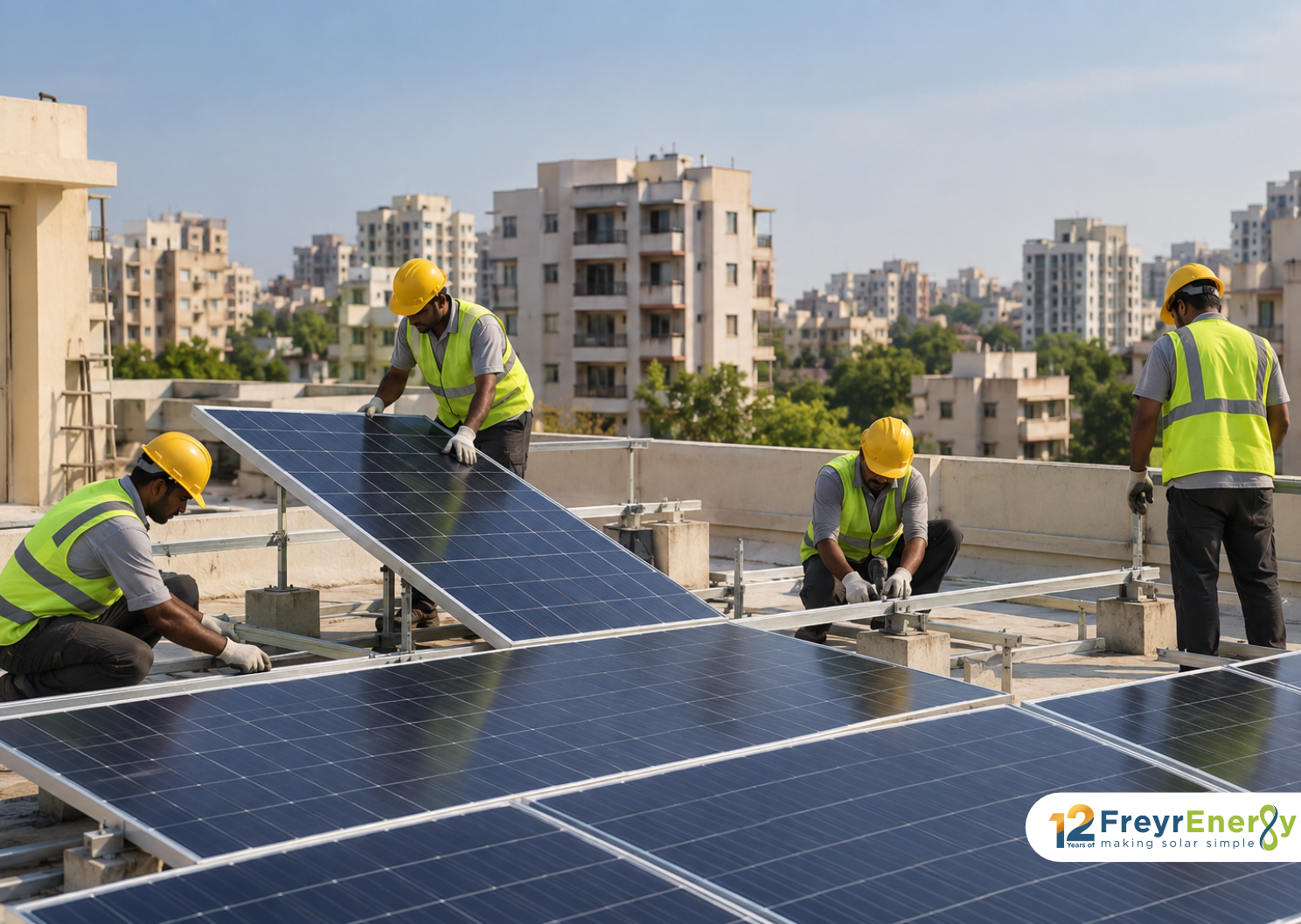
- Review common and individual bills, meter categories and the project objective.
- Survey usable roof area, shade, structure, access, wind exposure and electrical systems.
- Select the individual, common-meter, VNM or GNM route that is actually available.
- Model capacity, generation, self-consumption, export, cost, CFA and payback.
- Complete society resolution, owner permissions and DISCOM application.
- Compare detailed proposals and approve the contract and safety plan.
- Install, inspect, test, meter and commission the system.
- Train the responsible team and begin monitored O&M and savings reporting.
How to compare apartment solar proposals
- Compare modeled annual kWh and assumptions, not only system kW and headline price.
- Check whether price includes structure, protection, cables, earthing, metering, taxes, access equipment and approvals.
- Ask for the usable-roof layout, shadow analysis, single-line diagram and structural basis.
- Verify CFA eligibility separately from the commercial quotation and company discount.
- Review module, inverter, mounting and workmanship warranties as distinct commitments.
- Define performance monitoring, cleaning, fault response and reporting.
- Check exclusions for roof repair, transformer or panel upgrades, water supply and civil work.
- Model a downside case with lower generation, lower export value and equipment replacement.
Pros and limitations of solar energy for apartments
| Benefits | Limitations or trade-offs |
| Can reduce common-area electricity expenditure | Shared roof rights and collective approval can slow decisions |
| Uses otherwise underutilized roof area | Tanks, lift rooms, fire access and shade reduce usable space |
| Current CFA can improve eligible project economics | Eligibility, equipment and process conditions apply |
| Can support common EV charging | Night charging may not align with solar output |
| Monitoring makes generation visible | O&M and inverter replacement still require planning |
| VNM or GNM may extend benefits to several meters | Availability and settlement rules are state-specific |
Is solar worth it for an apartment complex
Solar is often worth evaluating when the building has a structurally suitable roof, meaningful common daytime demand, a stable common meter and an RWA willing to govern the asset for the long term. It may be less attractive when the roof area is heavily obstructed, reroofing is imminent, common consumption is low, export is restricted or residents cannot agree on funding and benefit allocation.
The decision should rest on a measured roof plan, common-load profile, verified CFA and metering route, itemized project cost and a conservative cash-flow model. A generic “cost per flat” can be useful for collecting contributions, but it is not a sizing method.
Planning apartment solar with Freyr Energy
Freyr Energy provides a verified housing-society solar page and customised rooftop design support. For an apartment project, the useful starting package is the last 12 months of common-meter bills, electricity-connection details, roof drawings or measurements, photographs, society approvals, planned EV charging and any known roof or structural issue. These inputs allow the proposal to connect system size, current subsidy eligibility, roof design and expected savings.
Freyr Energy’s approved capabilities include customised design, 3D preview, shadow analysis, project tracking and solar monitoring through the Freyr Energy Solar App. Use these features where they answer the society’s due-diligence needs; final equipment, pricing, timelines, warranties and financing must match the current project proposal and terms.
Conclusion
Solar panels on apartments can lower common-area electricity costs and, in some regulatory frameworks, extend solar credits to participating residents. The key is choosing the correct route. A common-meter system is usually the simplest RWA project. An individual flat system needs clear roof rights. Virtual or group net metering needs explicit state and DISCOM support. Balcony solar should be treated as a small, safety-sensitive solution rather than a substitute for a compliant rooftop plant.
Before installation, verify the roof, meter, society approval, current CFA, equipment eligibility and financial assumptions. A well-governed apartment solar project is as much about rights, billing and maintenance as it is about selecting panels.