
Direct Answer
A solar battery is useful when you require backup energy. You can also use the solar battery after sunset. It adds cost. Homes with a reliable grid supply may not need one.
Rooftop solar reduces your electricity bill. But it’s worth understanding what happens when the sun sets. Or during a grid failure. That’s when solar battery storage comes to the rescue. This stored energy is used during these types of emergencies. So, is this extra cost worth it? Stored solar energy is useful only if you have frequent power cuts and the budget to support it. If you have a reliable grid supply, then on-grid solar is the best option.
Key Takeaways
- Batteries store surplus solar electricity. You can use this energy during power breaks or at night.
- Hybrid systems can provide backup during grid outages.
- The size of storage depends on loads and backup hours.
- LFP batteries are expensive. However, they last longer.
What Is Solar Battery Storage and How Does It Work?
A solar battery stores electricity from rooftop panels. It is most useful when solar energy production is below average or low.
How does a solar battery store excess electricity?
Whenever panels produce more than the home consumes, the inverter sends the extra energy to the battery. The battery thus stores the surplus energy.
How does a battery work with rooftop solar panels?
Panels produce direct current. A hybrid inverter transforms that current into usable electricity and supplies to panels, battery, home and grid.
When does a solar battery supply electricity to your home?
The battery supplies power to selected circuits after sunset. You can also use it during a power break. Power backup depends on a few factors, such as battery capacity, inverter rating and connected loads.
What happens when the battery is fully charged?
Charging stops. Solar powers household appliances. It exports surplus to the grid, as per the guidelines laid by the authorities.
Simple working diagram
Solar panels → Hybrid inverter → Home appliances
↘ Battery storage
Battery → Hybrid inverter → Essential backup loads
Why Are Indian Homeowners Considering Solar Battery Storage?
Power cuts is a big issue in some areas. A battery can keep essential appliances running. In addition, it can transfer daytime solar power to be used in the evening. But homes with reliable grid supply and net metering may not need one.
Types of Solar Systems: With Battery vs Without Battery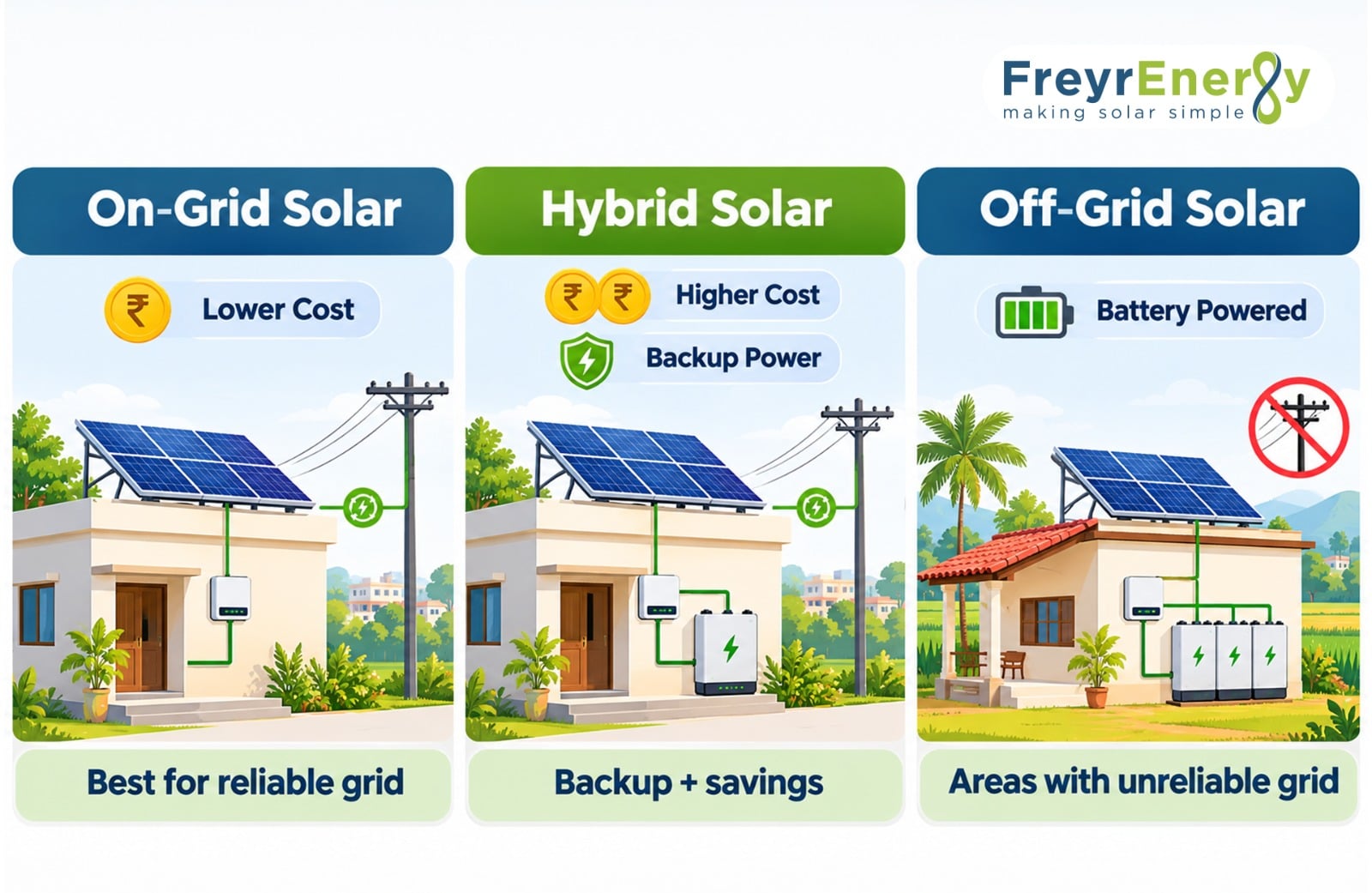
On-grid solar system without battery
This system connects to the grid. Solar energy powers the home first. The extra energy can be exported as per the guidelines. It costs less than battery-based solar. A standard on-grid inverter shuts down during a grid outage. However, this is a safety measure.
Hybrid solar system with battery
A hybrid solar system comprises panels, grid connection and battery storage. It can power selected circuits during outages.
Off-grid solar system with battery
An off-grid system works without a regular grid connection. Batteries store power after sunset. Hence, careful sizing is essential.
Which solar system is best for Indian homes?
| Feature | On-grid solar | Hybrid solar | Off-grid solar |
| Battery required | No | Usually yes | Yes |
| Grid connection | Yes | Yes | Usually no |
| Power backup | No, typically | Selected loads | Yes |
| Net metering | Subject to rules | Subject to rules | Generally no |
| Initial cost | Lower | Higher | Higher |
| Best suited for | Reliable grid | Backup and savings | Unreliable grid |
Solar Battery Price in India: How Much Does It Cost?
The solar battery price may vary. Capacity, brand and installation are a few factors that can impact the price. The rates are mere estimates.
| Storage capacity | Lead-acid | Lithium LFP |
| 2 kWh | ₹18,000–₹30,000 | ₹50,000–₹1 lakh |
| 5 kWh | ₹45,000–₹70,000 | ₹1 lakh–₹2.5 lakh |
| 10 kWh | ₹95,000–₹1.3 lakh | ₹1.9 lakh–₹4.8 lakh |
These are indicative ranges. A hybrid inverter, backup wiring, and installation can add to the cost. When comparing prices, it is wise to look at usable capacity, not just the rated kWh.
Cost of a 2kWh, 5kWh and 10kWh solar battery
If you need backup for a short time, a 2 kWh battery suffices the need. For more flexibility, go for a 5 kWh unit. 10 kWh supports longer backup or higher loads.
Lithium-ion vs lead-acid battery costs
Lead-acid costs less upfront but is heavier and offers less usable capacity. LFP costs more, but generally allows deeper discharge and more charge cycles.
Hybrid inverter and installation expenses
A battery needs a compatible inverter. You might have to replace the existing inverter or at least have it engineered to solve the purpose. Backup circuits, wiring and protection devices add cost. Do not assume a regular grid-tied inverter can accept a battery.
Factors affecting solar battery installation costs
It depends on the brand, chemistry, warranty, usable capacity and inverter compatibility. In addition to that, how complex the installation is and the overall number of backup circuits also affect the quote.
| Cost factor | Lower-cost option | Higher-cost option | Impact on price |
| Battery chemistry | Lead-acid | Lithium-ion (LFP) | Lithium costs more initially. |
| Storage capacity | 2 kWh | 5–10 kWh | Higher capacity increases investment. |
| Hybrid inverter | Existing compatible inverter | New hybrid inverter | Replacement adds to the cost. |
| Backup circuits | Essential appliances only | Multiple household circuits | More wiring and protection are needed. |
| Installation work | Simple installation | Electrical upgrades and longer cable runs | Labour and materials increase. |
| Warranty and service | Standard coverage | Extended coverage and support | Better coverage may cost more. |
How Much Battery Storage Does Your Home Need?
You could end up paying more if you just count your bedrooms and choose a battery. It’s best to make a list of your appliances and figure out when you’d need solar power to back you up. You just multiply watts by required hours and you will have a near perfect estimate. Take into account inverter and battery discharge losses.
Battery capacity for a 2BHK home
It absolutely depends on your consumption. A battery of 2-5 kWh will be enough. It can power basic lights and fans. It can also supply power to run a router and charge your phone.
Battery capacity for a 3BHK home
Around 5 kWh can support essential loads in a typical 3BHK. It includes selected fans, lights and a refrigerator.
Battery capacity for a 5kW rooftop solar system
A 5 kW rooftop solar system doesn’t mean that you will need a 5 kWh battery. It might only help you provide backup after sunset. If consumption is higher, you may require an additional battery of 5-10 kWh.
How long can a 5kWh solar battery provide backup?
Usable energy is lesser than rated capacity. If a 4 kWh is available, a 500 W load can run for about eight hours. A 1 kW load may run for four hours. Actual time may vary as per losses and appliance use. Fridges and pumps also have starting surges, so check inverter capacity.
Benefits of Adding a Battery to Your Rooftop Solar System
A battery stores surplus energy, which can be used during power outages and/or at night. It is the best option to have power during emergencies. The extra energy which you transfer to the grid also helps you cover most of the cost of your energy bills.
Disadvantages of Solar Battery Storage
Batteries come at a price, which might disturb some buyers. They also need more space. Over the years, they tend to lose their capacity, with an evident replacement. Also, to run all appliances, you need to go for large-sized batteries, as small ones do not power all appliances.
Is Adding a Solar Battery Financially Worth It in India?
Power backup is definitely valuable. However, a battery isn’t a direct bill-saving investment.
How much can you save with solar battery storage?
You can store the surplus energy in a battery, which you can use later. It means you can use more energy with a battery. Monetary benefits depend on:
- Surplus energy you export to the grid.
- Pice you get for it, and
- Charging patterns.
Solar with battery vs solar without battery: Cost comparison
An on-grid system doesn’t need a battery and inverter. As these two elements aren’t needed, the system costs less. A hybrid system costs more but adds backup. Compare the extra cost with the value of outages avoided.
How net metering affects solar battery savings
You can export surplus power with net metering. If you are getting a decent value for the extra energy you transfer to the grid, then you can save better on your electricity bills. A battery adds conversion losses too. Check your DISCOM’s billing arrangement.
What is the payback period of a solar battery?
There is no standard payback period. Include replacement, losses and backup value. Reliable power may matter more than quick financial returns.
When does adding a battery make financial sense?
It is good for homes facing regular power-breaks. Also for homes where electricity consumption is high. They are very useful where backup generators are expensive or cannot be used. On-grid solar may be more economical at regions with reliable on-grid systems.
Which Type of Solar Battery Is Best for Indian Homes?
Lithium-ion solar batteries
Lithium batteries are compact and commonly used for homes.
LiFePO4 (LFP) batteries
LFP uses lithium iron phosphate chemistry. LFP offers good thermal stability with a longer lifespan. However, check how the battery management works. Also check the warranty terms.
Lead-acid solar batteries
Lead-acid comes at a lower purchase price. Tubular models are common. However, they need more space. They also require frequent water checks. Usable capacity is generally lower. Therefore, you may need to go for a large-sized battery.
Lithium-ion vs lead-acid: Which should you choose?
In case of frequent cycling, choose LFP. They are also ideal if the discharge is deeper. Lead-acid batteries is good when you don’t require regular backup. Buy them only if you need occasional backup and if you are on a tight budget. Compare lifetime costs before finalising.
Does PM Surya Ghar Subsidy Cover Solar Batteries?
PM Surya Ghar CFA is calculated on the basis of eligible capacity of rooftop solar panels. The cost of battery is not covered. Battery storage is allowed as an additional component. The subsidy does not cover the full cost of the battery purchase. System should still meet scheme and DISCOM requirements. Check conditions before you order.
How to Choose the Right Solar Battery for Your Home
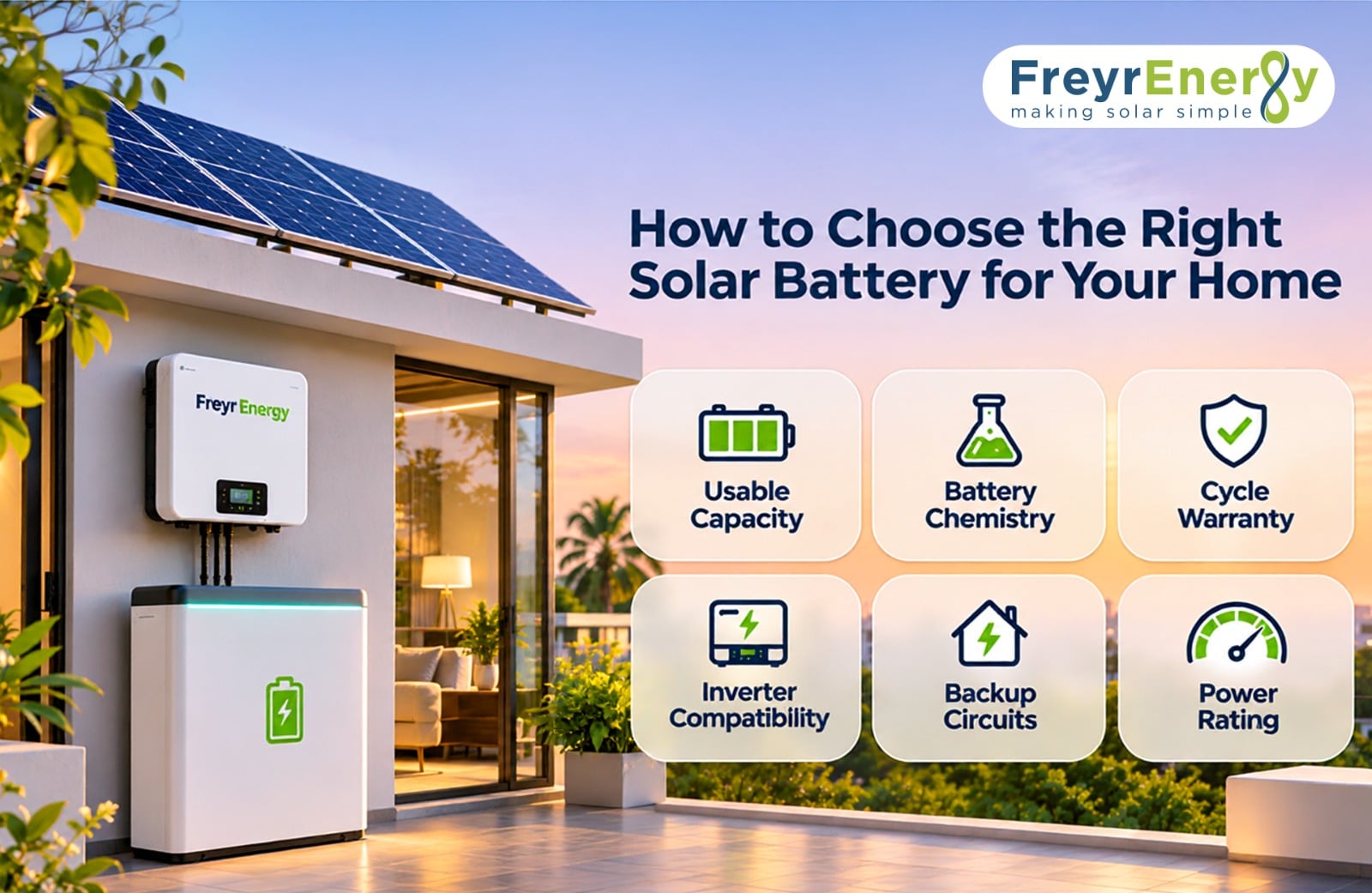
Check usable capacity, chemistry, cycle warranty and inverter compatibility. Confirm backup circuits and power rating. Request a written quote covering the battery, inverter and installation.
Is a Solar Battery Worth It for Your Home? Final Verdict
A battery is useful when backup matters. It stores solar power for later but raises the upfront cost. If your grid is steady, on-grid solar may be enough. Compare backup needs with the full cost.
Get Expert Advice on the Right Rooftop Solar System
Not sure whether you need a battery? List the appliances needed during outages. Freyr Energy can assess system size and storage options. Use the solar calculator for an initial estimate.