
A solar battery can keep selected appliances running during a power cut and move daytime solar energy into the evening. But the word “battery” hides several decisions: chemistry, usable capacity, output power, inverter compatibility, safety, warranty and total installed cost. A low headline price can be poor value if the battery cannot support your load or if the existing inverter cannot charge it correctly.
This guide explains the main solar battery types used in Indian homes, shows current price examples, and gives you a practical sizing method. Prices and policies are dated 8 September 2026 because both can change.
Direct answer: For frequent outages or daily solar cycling, an LFP battery paired with a compatible hybrid inverter is usually the stronger long-term fit. A tubular lead-acid battery can still make sense when the budget is tight and backup is occasional. If the grid is reliable and your export arrangement is favourable, an on-grid solar system without a battery may offer better financial value.
Quick Takeaways
- Choose energy capacity in kWh from the loads and hours you actually need; do not start with a brand or battery count.
- Check both usable capacity (kWh) and continuous/peak output (kW). A large battery can still fail to start a pump or air conditioner if its power rating is too low.
- LFP generally suits frequent cycling; tubular lead-acid remains a lower-entry-cost option for occasional backup.
- Confirm inverter voltage, charge profile and, for lithium, BMS communication on the manufacturer’s approved compatibility list.
- Compare complete installed cost, not the battery box alone.
- Under PM Surya Ghar, battery storage may be added, but central CFA is calculated from eligible solar-module capacity, not battery capacity.
What Is a Solar Battery?
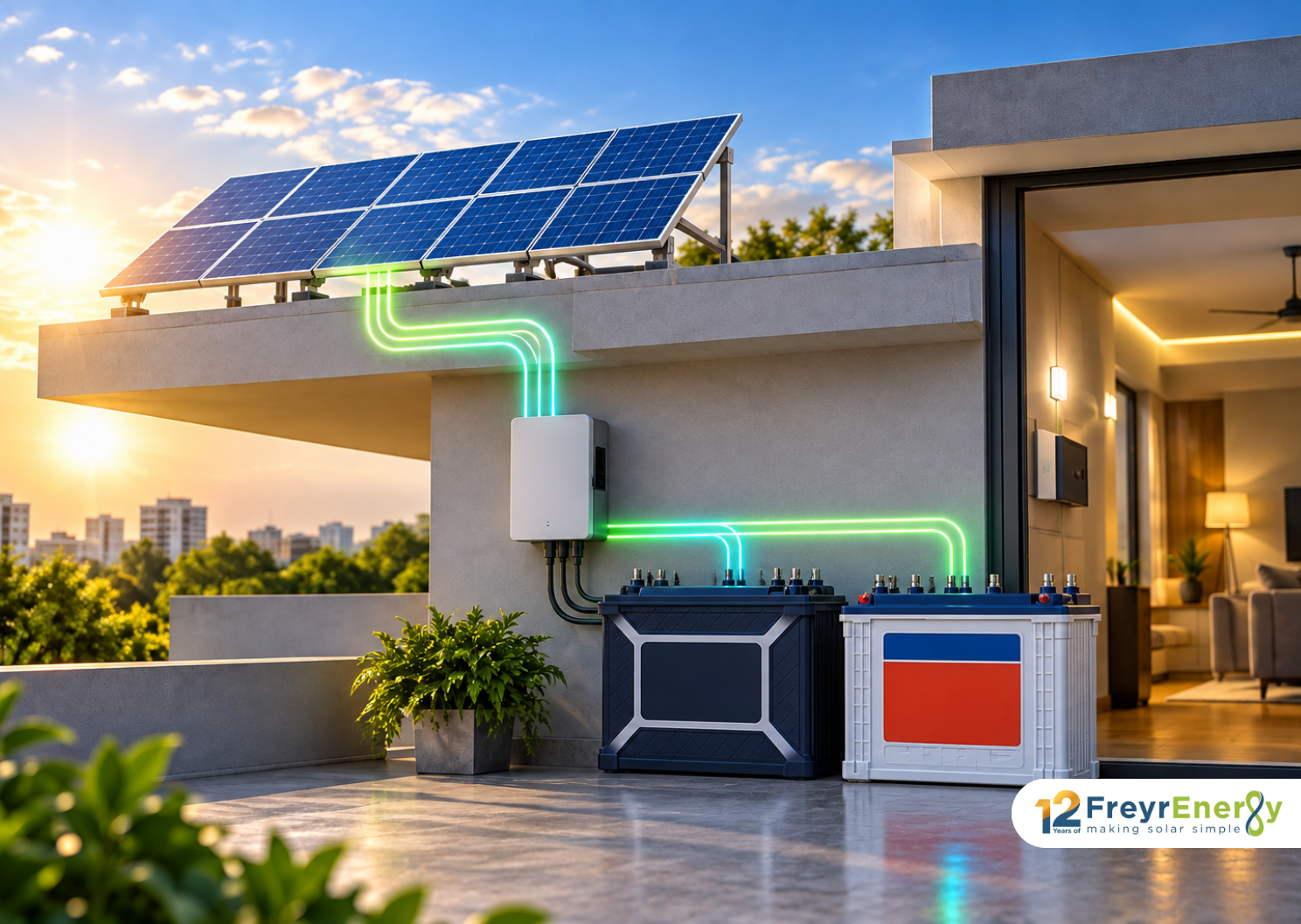
A solar battery is a rechargeable energy-storage device used with a solar PV system. It stores DC electricity directly or receives converted electricity through a battery inverter, then releases that energy when the home needs it. The battery is only one part of the system: the inverter or power-conversion equipment controls charging and converts stored DC energy into AC electricity for appliances.
A battery’s value depends on what you want it to do. Backup during outages, higher self-consumption after sunset, and off-grid operation are different design goals and may require different inverter architecture, capacity and electrical circuits.
How a Solar Battery Works
In normal daylight
Solar generation first serves connected household loads. Depending on system settings, surplus energy can charge the battery and, where permitted, export to the grid. The exact order is programmable on many hybrid systems.
After sunset
The battery discharges to supply the selected loads until it reaches its reserve or minimum state-of-charge setting. The grid then supplies the remaining demand when available.
During a power cut
A standard grid-tied inverter shuts down when the grid fails to protect utility workers and equipment. Backup requires equipment designed to isolate the home from the grid and energise a protected-load or emergency-power circuit. A battery alone does not make every solar system blackout-capable.
Battery Capacity and Battery Power Are Not the Same
| Specification | What it tells you | Simple analogy |
| Energy: kWh | How much electricity the battery can store and deliver over time. | Size of the water tank |
| Power: kW | How much load the battery/inverter can support at one moment. | Width of the pipe |
| Peak/surge power | Short-duration ability to start motors and compressors. | Brief rush of water |
| Usable capacity | Rated energy after the permitted depth of discharge or reserve. | The part of the tank you may use |
For lead-acid batteries sold in ampere-hours (Ah), nominal energy is approximately voltage × Ah ÷ 1,000. A 12 V, 150 Ah battery is therefore 1.8 kWh nominal. That is not a promise of 1.8 kWh of AC output: discharge rate, allowed depth of discharge, battery condition, temperature and inverter losses reduce real delivery.
Types of Solar Batteries
| Type | Strengths | Trade-offs | Best fit |
| Flooded tubular lead-acid | Lower upfront price; established service network; solar-specific deep-cycle models available. | Needs ventilation and periodic electrolyte checks; bulky and heavy; deep discharge can shorten life. | Occasional backup and tight budgets. |
| AGM / VRLA | Sealed; no water topping; low routine maintenance. | Sensitive to heat and incorrect charging; replacement cost can be high for the usable energy delivered. | Compact standby or modest backup where the specified charge profile is supported. |
| Gel / VRLA | Sealed, low maintenance and resistant to electrolyte leakage. | Requires the correct charging profile; product availability and pricing vary. | Selected backup or off-grid applications designed for gel. |
| LFP / LiFePO4 | High usable capacity, compact size, low routine maintenance and strong cycle performance in suitable products. | Higher upfront cost; needs a BMS and verified inverter communication/charge settings. | Frequent outages, daily cycling and space-conscious homes. |
| NMC lithium-ion | High energy density and compact packaging. | Safety and thermal-management requirements are product-specific; less common than LFP in stationary home offers. | Space-constrained systems supplied as a certified, integrated product. |
Chemistry alone does not determine quality. For example, one current Waaree 5.12 kWh LFP datasheet specifies 90% depth of discharge and more than 3,000 cycles under stated laboratory conditions, while one Luminous 150 Ah tubular product lists up to 1,500 cycles at 80% depth of discharge. These are model-specific claims under defined conditions, not universal chemistry averages.
LFP vs Lead-Acid: Which Is Better?
| Decision factor | LFP | Tubular lead-acid |
| Initial purchase price | Higher | Lower |
| Frequent cycling | Usually better suited | Possible, but life is more sensitive to discharge depth and recharge quality |
| Usable energy from nameplate | Typically higher; use model datasheet | Typically lower for life-conscious operation; discharge rate matters |
| Maintenance | Low routine maintenance | Water checks and ventilation for flooded models |
| Space and weight | Usually more compact and lighter per usable kWh | Bulky and heavy |
| Integration | BMS and inverter communication/settings are critical | Correct charger voltage and C-rate still matter |
Choose LFP when the battery will work most days, space is limited, or maintenance access is difficult. Choose tubular lead-acid when the upfront budget is the deciding constraint, outages are occasional, and you can provide a ventilated installation area and regular upkeep. Do not treat AGM and gel as automatically superior to flooded tubular simply because they are sealed; the duty cycle and charger must match the product.
Solar Battery Price in India: September 2026 Snapshot
There is no single reliable “solar battery price per kWh” for India unless the comparison states chemistry, voltage, rated energy, usable depth, warranty and installation scope. The official online examples below were visible on 8 September 2026 and are included to show order of magnitude, not to endorse a brand or promise a local price.
| Example official listing | Listed capacity | Observed online price | Scope note |
| Luminous LPT 1240L solar tubular | 12 V, 40 Ah | ₹6,599 | Battery product; taxes included on listing |
| Luminous LPTT 12150H solar tubular | 12 V, 150 Ah (1.8 kWh nominal) | ₹19,099 | Battery product; taxes included on listing |
| Luminous LPTT 12200H solar tubular | 12 V, 200 Ah (2.4 kWh nominal) | ₹24,799 | Battery product; taxes included on listing |
| Loom Solar CAML LFP | 1.28 kWh | ₹34,500 | Battery product |
| Loom Solar CAML LFP | 2.56 kWh | ₹64,375 | Battery product |
| Loom Solar CAML LFP | 5.0–5.12 kWh | ₹99,000–₹115,000 | Battery product; rack/wall variants |
| Loom Solar CAML LFP | 10.24 kWh | ₹230,000 | Battery product |
Prices can change by pincode, stock, promotion and configuration. A complete project may also require a hybrid or battery inverter, changeover/backup panel, isolators and protective devices, cables, enclosure or rack, transport, labour, commissioning, monitoring, taxes, and upgrades to the distribution board. Ask each vendor to mark every inclusion and exclusion.
Does PM Surya Ghar Subsidise the Battery?
The MNRE residential CFA guidelines allow rooftop installations to include battery storage and other additional components. However, the central financial assistance calculation is based on the eligible capacity of the installed solar modules, not the battery capacity. The guidelines also state that behind-the-meter battery-hybrid systems may be eligible subject to approval by the relevant State Electricity Regulatory Commission, while off-grid installations are not eligible for CFA under the scheme.
In practical terms, do not subtract the PM Surya Ghar subsidy from a battery-only quote. Confirm the latest system eligibility, metering arrangement and documentation with the official portal and your DISCOM before ordering equipment.
How Much Solar Battery Capacity Do You Need?
Choose the loads that truly need backup. Separate essential loads such as lights, fans, Wi-Fi and a refrigerator from discretionary loads such as geysers, ovens, large pumps and air conditioners.
Record each appliance’s running watts, quantity and required backup hours. For motors and compressors, also record starting surge.
Calculate delivered energy: sum of watts × hours ÷ 1,000 = required AC kWh.
Convert delivered energy to rated battery energy: required AC kWh ÷ (permitted depth of discharge × inverter efficiency). Use the actual manufacturer values and your chosen reserve.
Check power separately. The inverter and battery must support the simultaneous running load and peak surge, not merely the total kWh.
Check recharge. Solar-array size, weather, daytime loads and maximum charging current determine whether the battery can refill before the next outage.
Worked Example: Four Hours of Essential Backup
| Load | Quantity | Power each | Hours | Energy |
| LED lights | 6 | 10 W | 4 | 0.24 kWh |
| BLDC fans | 3 | 35 W | 4 | 0.42 kWh |
| Wi-Fi router | 1 | 15 W | 4 | 0.06 kWh |
| Refrigerator (planning average) | 1 | 120 W | 4 | 0.48 kWh |
| Laptop | 1 | 65 W | 4 | 0.26 kWh |
| Total | 1.46 kWh |
Illustrative assumptions: 80% permitted depth of discharge and 90% inverter efficiency. Required rated energy = 1.46 ÷ (0.80 × 0.90) = about 2.03 kWh. Adding a modest design margin suggests evaluating roughly 2.2–2.5 kWh of rated storage, then checking the refrigerator’s starting surge and the battery/inverter power limits. Replace every assumption with the chosen product’s datasheet and measured household load.
How Long Will a 5 kWh Solar Battery Last?
The loss-free maximum at a steady 500 W load is 5 kWh ÷ 0.5 kW = 10 hours. Real backup is shorter if 5 kWh is rated rather than usable capacity. At 90% usable depth and 90% inverter efficiency, estimated AC energy is 5 × 0.90 × 0.90 = 4.05 kWh, or about 8.1 hours at 500 W. A larger load, motor surge, battery temperature, ageing or a higher reserve will reduce runtime further.
Use the same method for any capacity: backup hours ≈ rated kWh × allowed DoD × inverter efficiency ÷ average load in kW. This is a planning estimate, not a performance guarantee.
Do You Actually Need a Battery?
| Your situation | Likely direction | Why |
| Reliable grid, favourable export credit, bill reduction is the main goal | Often no battery | On-grid solar avoids storage cost and conversion losses. |
| Frequent or long outages | Battery often useful | Backup value may matter more than simple payback. |
| Critical home-office or medical load | Battery may be justified | Design a protected-load circuit and confirm transfer behaviour. |
| Off-grid or weak-grid property | Battery usually necessary | Storage balances generation and demand; generator integration may still be needed. |
| High evening use with weak export compensation | Model the economics | Stored daytime solar may offset higher-value grid purchases. |
Benefits of a Solar Battery
- Backup for selected loads when the grid fails, provided the system has compatible islanding/backup equipment.
- Higher self-consumption by shifting daytime solar electricity into evening hours.
- Lower reliance on the grid where supply is unreliable or export compensation is weak.
- Potential resilience for remote work, communications, refrigeration and other essential loads.
- Programmable reserves and monitoring on suitably equipped systems.
Disadvantages and Trade-Offs
- Significant upfront cost and eventual capacity degradation or replacement.
- Energy is lost during charging, storage and conversion; stored solar is not free of system losses.
- A battery may deliver weak financial returns where net metering credits exported energy well.
- Poor sizing can leave you with unused capacity or inadequate backup.
- Lithium systems require correct BMS/inverter integration; flooded lead-acid requires ventilation and upkeep.
- High-power loads can require a larger inverter, battery discharge rating and protected circuit even when daily energy use is modest.
Solar Battery ROI: Use the Right Equation
For each discharged kWh, the economic benefit is approximately the grid purchase cost avoided minus the export credit you gave up, adjusted for round-trip losses. Annual net benefit should also reflect demand charges or time-of-day value where applicable, maintenance and expected replacement. Simple payback = complete installed battery-system cost ÷ estimated annual net benefit.
If export credits are close to the price you pay for grid electricity, the bill-saving case for a battery may be weak. Backup and resilience can still be valuable, but that value is personal and should be presented separately from cash savings.
Solar Battery vs Inverter Battery vs Portable Power Station
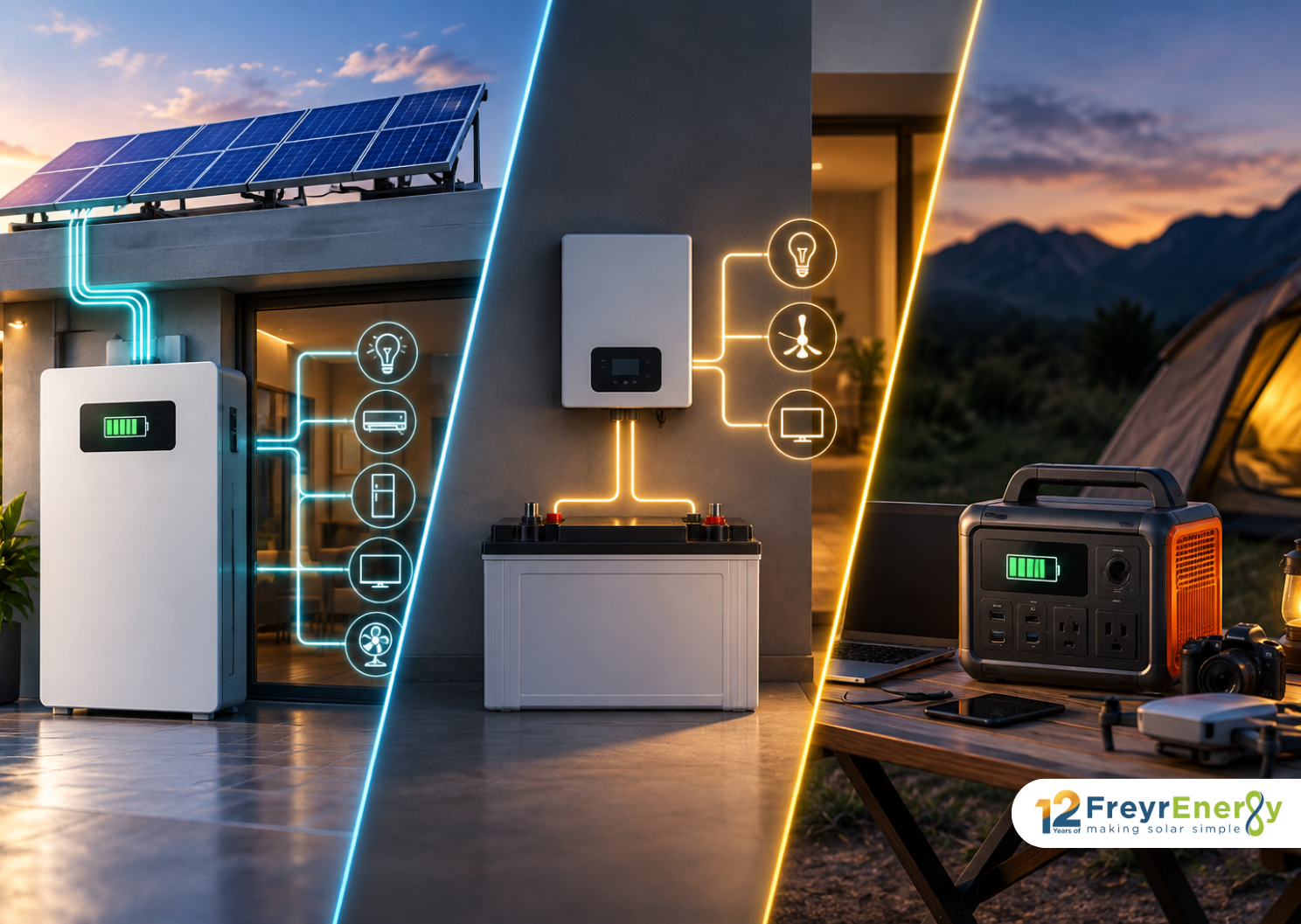
| Product | What it is | Best use | Watch for |
| Solar battery system | Storage designed and controlled as part of a PV/hybrid or off-grid system. | Regular solar cycling and/or home backup. | Inverter/BMS compatibility, power rating and installation scope. |
| Conventional inverter battery | A battery and home UPS/inverter primarily intended for grid-outage backup. | Occasional backup; solar charging only if the equipment supports it. | Charge profile, C-rate and whether daily cycling is warranted. |
| Portable power station | An integrated portable battery, inverter and outlets; some accept solar input. | Portable or plug-in backup for limited devices. | Solar input limit, output surge, battery expansion and whether it can back up fixed circuits. |
What to Check Before Buying
- Written load schedule: backed-up appliances, simultaneous watts, surge watts and hours.
- Rated and usable energy: kWh, permitted DoD, reserve setting and end-of-warranty capacity condition.
- Power capability: continuous and peak discharge, inverter continuous output, surge duration and phase configuration.
- Compatibility: DC voltage range, approved battery list, charging profile, maximum current, CAN/RS-485 communication and firmware version.
- Architecture: new hybrid system, DC-coupled retrofit, AC-coupled retrofit, or separate UPS. Confirm how it behaves when the grid fails.
- Warranty: years, cycles or throughput, retained-capacity threshold, exclusions, registration, service location and labour/transport coverage.
- Safety and location: applicable product certification, BMS protections, isolators/fuses, earthing, enclosure/IP rating, temperature range, ventilation and clearances.
- Complete cost: equipment, protection, backup panel, wiring, labour, taxes, commissioning and disposal/recycling route.
- Expansion: whether extra modules can be added later, matching rules, maximum parallel units and warranty implications.
- Evidence: insist on model-specific datasheets and a single-line diagram, not only brochure claims such as “long life” or “all-night backup.”
Maintenance and Safe Operation
Follow the manufacturer’s manual and use a trained installer. Keep all batteries within their specified temperature and environmental limits, protect them from water and direct heat, and maintain access for inspection. Flooded lead-acid batteries need a ventilated location and periodic electrolyte checks with the specified water. Sealed AGM and gel batteries do not need water topping, but they still need correct charging and temperature control.
For lithium systems, do not bypass the BMS, substitute an unapproved charger, mix unmatched modules, or change communication settings without the manufacturer’s procedure. IS 16805:2018 adopts IEC 62619 safety requirements for secondary lithium cells and batteries used in industrial applications, including stationary applications; ask the supplier which standards apply to the exact product and installation rather than accepting a generic “BIS compliant” statement.
Common Buying Mistakes
- Buying by Ah alone without checking voltage, C-rate and usable kWh.
- Sizing energy but ignoring inverter power and compressor or pump surge.
- Assuming an existing grid-tied inverter can accept a battery.
- Comparing a battery-only online price with a complete installed quote.
- Treating a model-specific cycle claim as a guaranteed service life in every climate and duty cycle.
- Assuming PM Surya Ghar CFA is calculated on battery capacity.
- Backing up the entire house when a smaller essential-load circuit would meet the real need.
- Choosing the largest battery without checking whether the solar array can recharge it reliably.
How Freyr Energy Can Help Plan the Wider Solar System
Battery choice should follow the site assessment, load profile and system architecture. Freyr Energy provides end-to-end rooftop solar support, including customised design, installation support, digital project tracking and monitoring through the Freyr Energy Solar App. Its official site also lists on-grid, off-grid, hybrid and energy-storage solutions. Because the approved company information does not specify battery models, chemistry, prices or battery warranties, these must be confirmed in the project quotation and OEM documents.
Before accepting a proposal, ask for the essential-load schedule, battery and inverter model numbers, usable capacity, power limits, compatibility confirmation, single-line diagram, installed-price breakdown, warranty terms and the latest DISCOM/subsidy treatment. That turns a generic quote into a system you can compare.
Conclusion
The best solar battery is not automatically the one with the most kWh or the lowest price. It is the battery that can safely deliver the required power for the required hours, recharge within your solar window, communicate correctly with the inverter and remain serviceable under a clear warranty. For frequent cycling, LFP is generally the stronger fit; for occasional backup on a constrained budget, tubular lead-acid can still be sensible. Some homes with reliable supply and favourable net metering may be better served by on-grid solar without storage.
Start with an appliance-level backup plan, compare usable energy and power separately, and request a complete installed quote. Recheck all prices, policies and product specifications immediately before purchase.