
Rooftop solar systems are low-maintenance, but they are not maintenance-free. For most Indian homeowners, the essential routine is simple: check solar energy generation regularly, keep panels free of significant dirt and shade, and arrange qualified help for electrical, structural or hard-to-reach work.
There is no single cleaning interval that suits every roof. A home near a construction site may need attention far more often than one in a low-dust area with regular rain. The best schedule combines a monthly visual and performance check with cleaning when dirt is visible, bird droppings are present or comparable-day generation has fallen without another clear cause.
Quick answer: Review your monitoring data every month, inspect the array visually from a safe place, clean only when site conditions and performance indicate a need, and have a qualified technician inspect the system at least once a year or as required by your equipment manuals and service plan.
Solar panel maintenance: quick takeaways
- Check generation and inverter alerts regularly so unusual changes are noticed early.
- Inspect panels monthly from a safe place, but clean according to visible dirt, local conditions and performance rather than a fixed national schedule.
- Use soft, non-abrasive tools and follow the module manufacturer’s instructions. Avoid pressure washers, harsh chemicals, hot glass and walking on panels.
- Leave wiring, connectors, earthing, inverter internals, mounting checks and unsafe roof access to trained professionals.
- Arrange a professional inspection at least annually, or at the interval specified in your manuals, warranty or service plan.
What does solar panel maintenance include?
Solar panel maintenance covers more than washing the glass. A sound residential plan has four parts:
- Performance monitoring: checking generation and inverter alerts so unusual changes are noticed early.
- Safe panel cleaning: removing dust, leaves and bird droppings without scratching the glass, shocking a hot module with cold water or putting a person at risk.
- Visual checks: looking from a safe position for new shade, debris, obvious cracks, loose-looking parts, pest activity or storm damage.
- Professional inspection: having trained personnel check electrical connections, protection devices, earthing, mounting, corrosion, inverter condition and any suspected fault.
The homeowner can monitor data and carry out limited cleaning only where access is genuinely safe. Opening an inverter, handling cables or connectors, tightening electrical connections, testing earthing, and walking on a roof or the modules are not DIY tasks.
How often should solar panels be cleaned in India?
Use the table below as a starting point, not a warranty rule. Your module manufacturer, installer instructions, and local conditions take priority.
Roof condition | Practical starting point | What should trigger action |
Low dust, regular effective rain, good tilt | Inspect monthly; cleaning may be needed only a few times a year | Visible film or debris, stubborn deposits after rain, or a repeatable output decline |
Typical urban or semi-urban roof | Inspect monthly; reassess cleaning every 1-3 months | Dust layer, bird droppings, nearby burning/traffic pollution or lower comparable-day output |
High dust, construction, highway, farm or industrial exposure | Inspect every 2-4 weeks during dry periods | Rapid soil build-up, dust storm or measurable performance loss |
Heavy bird activity or sticky contamination | Act promptly when deposits appear | Bird droppings, sap or residue that rain does not remove |
Monsoon period | Inspect from a safe place after severe weather; do not assume rain cleaned everything | Mud line, leaves, drainage blockage, storm damage or persistent residue |
Why the range is wide: photovoltaic soiling depends on local dust and pollution, rainfall, wind, humidity, panel tilt, nearby vegetation and the type of deposit. Research bodies and manufacturer guidance therefore support site-specific decisions rather than one national cleaning calendar.
Use monitoring to decide when cleaning is worthwhile
- Choose two reasonably clear days from the same season with similar weather. Compare generation over the same time period rather than comparing a sunny day with a cloudy one.
- Check for obvious explanations first: cloud cover, shorter winter days, new shade, a grid outage or an inverter alert.
- If panels are visibly dirty and generation is consistently lower, arrange safe cleaning.
- Compare output again under similar conditions. If the fall persists or the inverter reports a fault, contact the installer or a qualified technician.
Do not compare daily generation with the panel nameplate rating. Nameplate power is measured under standard test conditions; real-world output changes with sunlight, module temperature, weather, orientation, shading and system losses.
How to clean rooftop solar panels safely
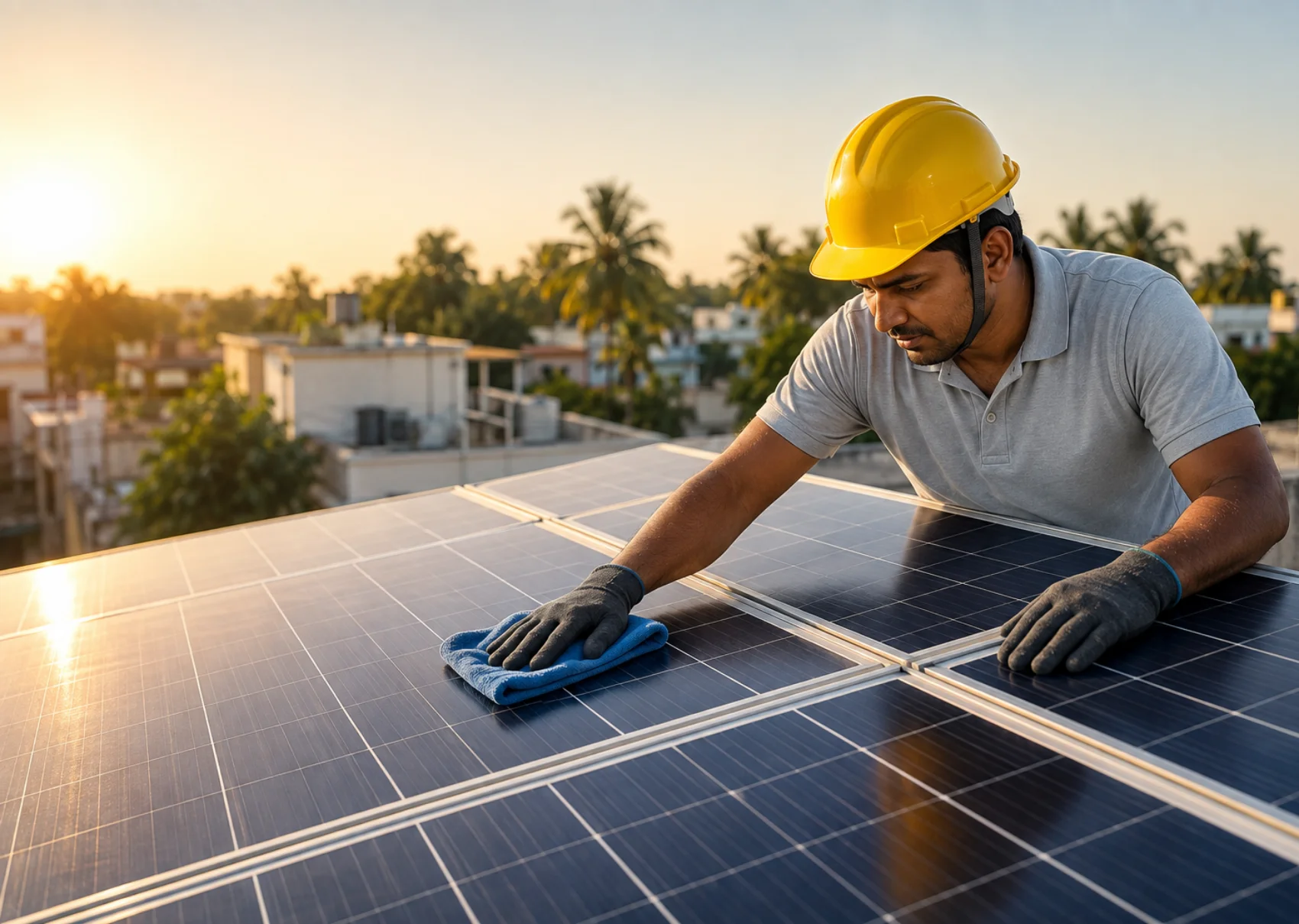
Safety first: Solar modules can produce DC electricity whenever light reaches them. Switching off an inverter does not make a sunlit module itself stop producing voltage. Follow the exact shutdown and cleaning instructions supplied with your system. Hire a trained professional when the roof, electrical isolation or access is uncertain.
Before you start
- Read the module and inverter manuals and check whether your installer or warranty specifies an approved method, tool, water quality or service provider.
- Do not climb onto a sloped, fragile, wet or unprotected roof. Do not work near an exposed edge. If the panels cannot be reached safely from a protected walking surface or the ground, use a professional service.
- From a safe place, look for cracked glass, loose parts, exposed wiring or damaged connectors. Do not wash a visibly damaged array; isolate it according to the system manual and call a technician.
- Choose a cool period such as early morning. Avoid cleaning hot modules because a large water-to-glass temperature difference can cause thermal stress.
A conservative cleaning method
- Follow the documented system shutdown procedure. Do not improvise with DC isolators, connectors or wiring.
- Use clean water with low mineral content where practical. Water close to the module temperature reduces thermal stress and helps avoid mineral marks.
- Wet the dirt first. Use a soft sponge, microfibre tool or soft non-abrasive brush approved by the module manufacturer.
- Use light pressure and work from the upper edge down. Keep water away from damaged areas and do not direct it at the backsheet, junction box, connectors or cable entries.
- Rinse gently. Allow drainage and restore the system only by following the documented start-up procedure.
- Check monitoring later under normal sunlight. Record the cleaning date and any change in output or alerts.
What not to use
- Pressure washers or concentrated jets unless the exact manufacturer instructions explicitly permit the pressure and method.
- Metal tools, hard bristles, abrasive pads, blades or dry scraping.
- Harsh detergents, solvents, alkali cleaners or unapproved chemicals.
- Very cold water on hot glass or cleaning during the hottest part of the day.
- Your body weight on a module. Never stand, sit or place heavy equipment on panels.
- Untrained handling of wires, connectors, isolators, earthing or inverter internals.
Can tap water be used?
That depends on water quality and the module manual. Hard water can leave mineral deposits as it dries. Low-mineral water is preferable; if only local tap or borewell water is a
vailable, ask the installer or module manufacturer about the approved method. Never add a chemical simply because plain water leaves marks.
Solar panel maintenance checklist
When | Homeowner check | Qualified technician or provider |
Weekly or fortnightly | Quick app glance for zero generation, repeated alerts or an obvious unexplained change | Investigate persistent alarms or system downtime |
Monthly | Compare generation with similar weather/season; inspect from a safe place for dirt, shade, debris and birds | Clean or inspect if access is unsafe or contamination is difficult |
As needed | Arrange cleaning after significant visible soiling, bird droppings or a dust event | Use fall protection and approved cleaning methods on high or difficult roofs |
Pre-monsoon | Clear loose items around the accessible roof area; check drains without touching solar wiring | Check mounting, cable management, water entry risk, earthing and surge/lightning protection as applicable |
Post-monsoon or after severe weather | Look from a safe place for debris, cracks, movement, leaks or persistent alerts | Inspect suspected storm damage, mounting movement or electrical faults before normal use |
At least annually | Review records, warranties, cleaning history and recurring alerts | Full electrical, inverter, mounting, corrosion, earthing and safety inspection per system documentation |
Your installer or equipment manual may require a different schedule. Battery-based systems also need battery-specific maintenance and safety procedures; do not apply an on-grid checklist to a battery bank.
DIY cleaning or professional maintenance?
Situation | DIY may be reasonable | Use a professional |
Access | Ground-mounted array or protected flat surface with no fall exposure | Sloped, fragile, wet, high or unprotected roof |
Task | Visual observation and manufacturer-approved surface cleaning | Electrical tests, wiring, connectors, earthing, inverter internals, mounting or leak diagnosis |
Condition | Loose dust or a small softened deposit on undamaged glass | Cracks, burn marks, corrosion, loose parts, nesting near cables or stubborn contamination |
Tools and documents | Correct manual, approved soft tool and suitable water are available | Method is uncertain or warranty requires authorised service |
Performance | Output recovers after safe cleaning and no alerts remain | No generation, a sudden large drop, repeated inverter alerts or no recovery after cleaning |
What about automated solar panel cleaning?
For homeowners who want to reduce routine manual cleaning, Freyr Energy offers a self-cleaning rooftop solar system with timer-enabled automated sprinklers. The system is designed to wash the panel surface on a scheduled cycle, which can be useful on dusty sites or roofs where arranging frequent manual cleaning is inconvenient.
Automated sprinklers do not make the complete solar installation maintenance-free. Homeowners should still monitor generation and alerts, check that water reaches the intended panel area, watch for blocked nozzles or drainage problems, and arrange professional electrical, inverter, mounting and safety inspections.
Before choosing an automated cleaning system, confirm panel and roof-layout compatibility, water quality, water pressure, drainage, cleaning schedule, warranty conditions and responsibility for servicing the pump, pipes, timer and nozzles. Freyr customers can review the Self-Cleaning Rooftop Solar System page or ask the project team how the system would be configured for their roof.
Solar panel maintenance cost in India
There is no regulated national tariff for residential solar maintenance. Prices vary by city, system size, panel count, roof height and slope, access equipment, travel, cleaning frequency, water availability, inspection depth, replacement parts and taxes.
Freyr Energy’s 2026 maintenance-cost guide publishes the following indicative ranges. Treat them as planning benchmarks, not a guaranteed quote:
Service | Indicative 2026 range | Important scope note |
Routine cleaning and basic maintenance | ₹1,000-₹3,000 | Published for small residential systems; confirm visits, panel count, access and travel |
Annual inspection and component check | ₹2,000-₹10,000+ | Confirm whether electrical testing, thermal inspection and minor parts are included |
Electrical repairs and wiring fixes | ₹500-₹5,000 | Fault- and part-dependent; obtain a diagnosis and itemised quote |
Annual Maintenance Contract | ₹800-₹1,500 per kW/year | Coverage, cleaning visits, response time, exclusions and taxes can differ |
Overall annual maintenance benchmark | ₹1,000-₹3,000 per kW/year | Broad on-grid benchmark, not a universal requirement or tariff |
Prices and service inclusions can change. Before publication, Freyr should confirm that these ranges remain current and clarify whether they include GST, travel, access equipment and replacement parts.
What should an AMC include?
An AMC can be useful for a hard-to-access roof, a dusty site, a larger home system or an owner who wants scheduled support. Compare contracts on scope, not just price:
- Number and timing of cleaning and inspection visits.
- Whether monitoring and proactive alerts are included.
- Electrical, earthing, inverter, mounting and corrosion checks.
- Response time for zero generation or safety-related faults.
- Labour, travel, access equipment, taxes and replacement-part exclusions.
- Who is authorised to work under the panel, inverter and installation warranties.
- Written service reports, photographs and generation observations after each visit.
- Cancellation, renewal and escalation terms.
Seasonal maintenance for Indian rooftops
Dry summer and dust events
Dust may accumulate faster during long dry periods and near construction, traffic or open land. Inspect more often, use monitoring to confirm a persistent change and avoid working on a hot roof or washing hot glass.
Before and during monsoon
Have a technician check mounting, cable support, sealing, corrosion and protection systems where required. Keep accessible drains clear without moving solar cables. Rain can remove loose dust, but it may not remove bird droppings, sticky particles or a mud line at the lower edge.
After heavy rain or high wind
Inspect only from a safe location. If you see cracked glass, displaced modules, loose material, water entry near electrical equipment or repeated inverter alarms, keep away from the affected area and contact a qualified technician.
Winter and changing shade
Shorter days and seasonal sun angles can reduce generation even when the system is healthy. Compare with the same season and check whether growing trees, new buildings, water tanks or antennas now cast shade.
Common problems: what you can check and when to call
Symptom | Safe first check | Next action |
Gradual generation decline | Compare similar-weather periods; look for dust, shade or seasonal change | Arrange safe cleaning if visibly soiled; call if output does not recover |
Sudden zero or near-zero generation | Check the monitoring app, visible inverter status and whether the grid is available | Record the error and contact the installer; do not open equipment |
Repeated inverter warning | Photograph or note the exact code and time | Use the manufacturer guidance or qualified service; do not repeatedly reset without instruction |
Cracked glass, burn mark or damaged cable | Keep people away; do not wash or touch the area | Follow emergency/isolation instructions and arrange urgent professional inspection |
Bird nesting under modules | Observe from a safe place; avoid disturbing wiring | Use a provider for humane, ventilation-safe barriers and a cable check |
Roof leak near mounting | Note when and where the leak appears | Contact the installer/roofer; do not loosen mounting hardware yourself |
Possible hot spot | Do not rely on touch or visual guesswork | Request thermal/electrical inspection by a trained technician |
Protect your warranty and maintenance records
Keep the installation handover pack, single-line diagram, module and inverter manuals, serial numbers, warranties, service contacts and shutdown/start-up instructions together. Record cleaning and service dates, error codes, photographs and replaced parts.
Follow the exact cleaning limits in your module warranty and manual. Damage caused by abrasive tools, unapproved chemicals, excessive pressure, dry scraping, walking on modules or unauthorised electrical work may not be covered. A performance warranty also does not mean every component has the same warranty period.
A simple maintenance plan for most homes
- Check the monitoring app regularly and investigate persistent, unexplained changes.
- Inspect the array monthly from a safe place for soil, shade, debris and visible damage.
- Clean by condition, not by habit, using the module manufacturer’s approved method.
- Schedule a professional system inspection at least annually or at the interval in your manuals and service plan.
- Escalate immediately for damaged modules, exposed wiring, burning smell, repeated faults, storm movement or unsafe access.
Conclusion
Good rooftop solar maintenance is less about frequent intervention and more about noticing the right signals. Monitor generation, keep the glass clean without damaging it, respect electrical and roof-access risks, and use trained technicians for anything beyond safe observation and approved surface cleaning.
Freyr customers can use the Freyr Energy Solar App to review generation and alerts. If output remains low after weather, shade and safe cleaning have been considered, record the symptoms and contact the service team for diagnosis. A clear history helps the technician solve the problem faster.