
Direct answer: Before going solar, check 12 months of consumption, daytime load, roof condition and shade, system type, sanctioned load, subsidy and net-metering rules, equipment models, safety scope, warranties, after-sales responsibility and the complete installed price. Compare itemised quotations on identical capacity and scope. Do not pay an advance until the final proposal identifies exact equipment, drawings, safety scope, exclusions, approvals, payment milestones and separate warranty responsibilities.
Introduction
Rooftop solar is a long-term property and electrical decision, not a quick appliance purchase. A good system begins with bills and roof conditions, then moves through sizing, design, approvals, equipment, safety, warranties, finance and service. This guide provides a complete pre-purchase checklist, explains how to compare quotations and highlights warning signs that can lead to poor generation, water leakage, approval delays or unexpected costs.
Quick Takeaways
- Start with annual consumption and the reason for installing solar.
- Inspect roof life, structure, shade, drainage and access.
- Compare itemised models, safety equipment and exclusions.
- Verify subsidy, net-metering and financing separately.
- Require written warranty and after-sales responsibility.
Pre-purchase solar checks
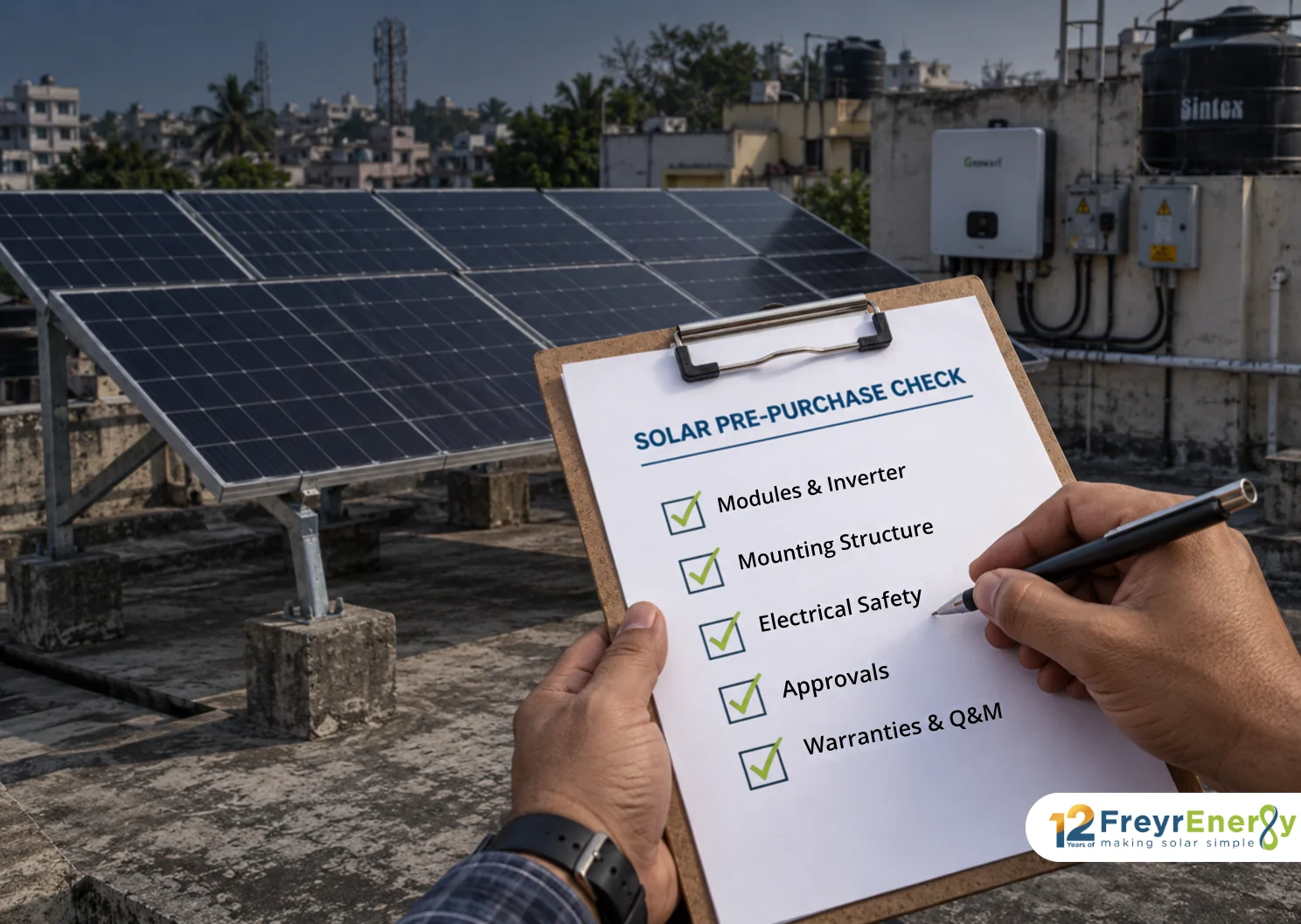
Quote item | What to compare | Common omission |
|---|---|---|
Modules/inverter | Exact make and model | Generic brand only |
Structure | Material, height, wind design | Civil work |
Electrical safety | DBs, SPD, isolators, earthing | Testing/documentation |
Approvals | Owner and fees | Net-meter cost |
Warranties/O&M | Issuer, term, response | Workmanship scope |
Before installing rooftop solar, consider the following factors.
1. Available Shadow-Free Roof Space
Solar panels generate the most electricity when they receive direct sunlight. Trees, water tanks, lift rooms, antennas, parapet walls and nearby buildings can cast shadows and reduce system output.
A professional solar site survey can identify shading throughout the day and determine how much usable roof space is available. The assessment should also consider panel orientation, tilt and future construction nearby.
2. Your Electricity Consumption
Review your electricity bills for the past 12 months to understand your average and seasonal consumption. This helps determine the appropriate system capacity.
A system that is too small may deliver limited savings, while an oversized system may generate more electricity than you can use or export. The ideal size depends on:
- Monthly electricity consumption
- Daytime energy use
- Sanctioned electrical load
- Available roof space
- Local net-metering regulations
- Expected future requirements
You can use the Freyr Energy solar calculator to obtain an initial estimate.
3. Roof Ownership and Usage Rights
Homeowners must have the legal right or necessary permission to use the roof for solar installation.
If you own an independent house, this is generally straightforward. In an apartment or housing society, the roof may be controlled by the builder, landlord or Resident Welfare Association. Written approval or a no-objection certificate may therefore be required.
Housing societies can also install rooftop solar for common-area loads such as lifts, water pumps, corridor lighting and EV charging.
4. Roof Condition and Structural Strength
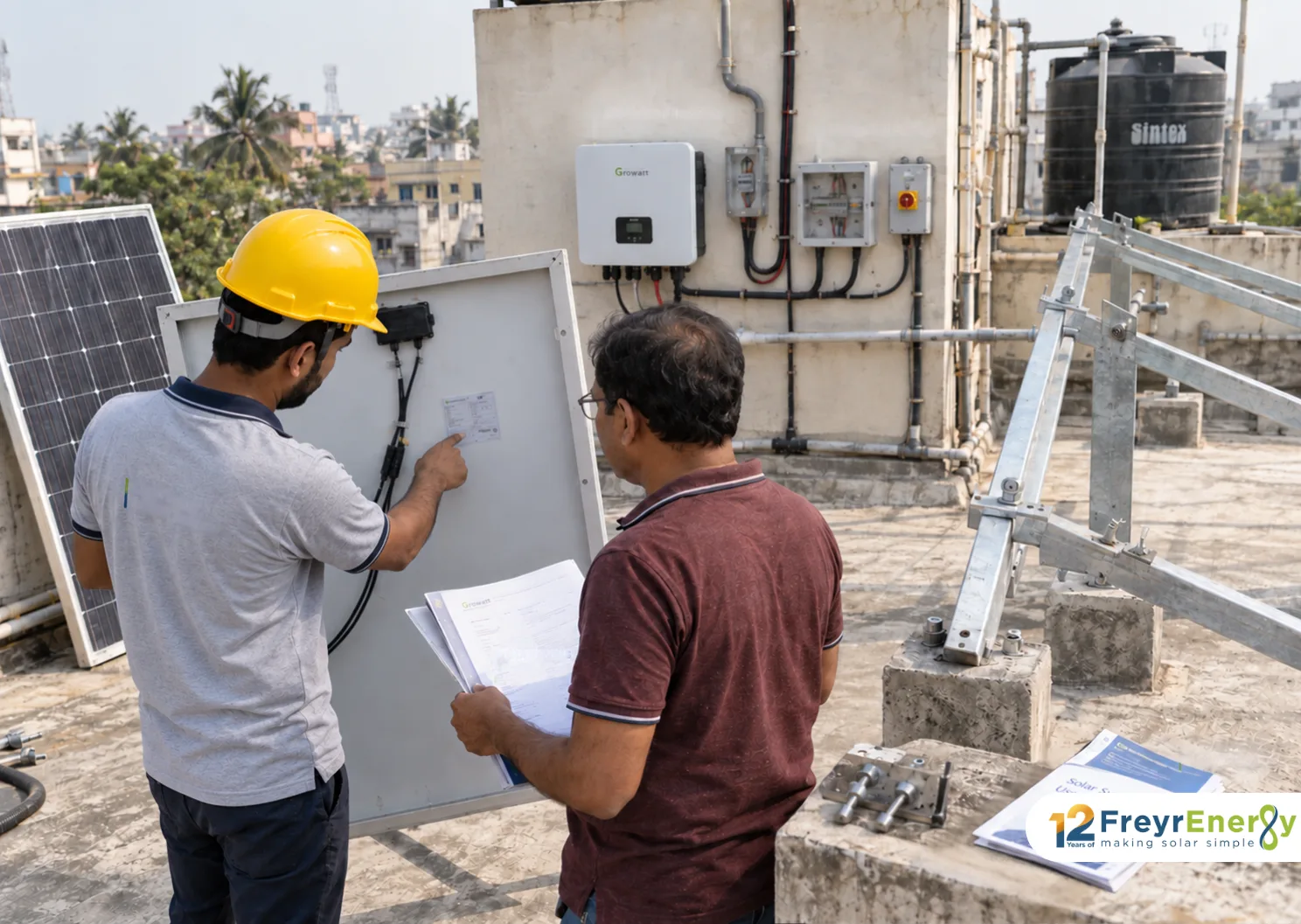
Solar panels and their mounting structures add weight to the roof. The structure should be inspected for cracks, leakage, corrosion and other signs of damage before installation.
Complete necessary waterproofing or repairs first. Installing panels on a damaged roof may create safety concerns and make future repairs more complicated.
5. Type of Solar System
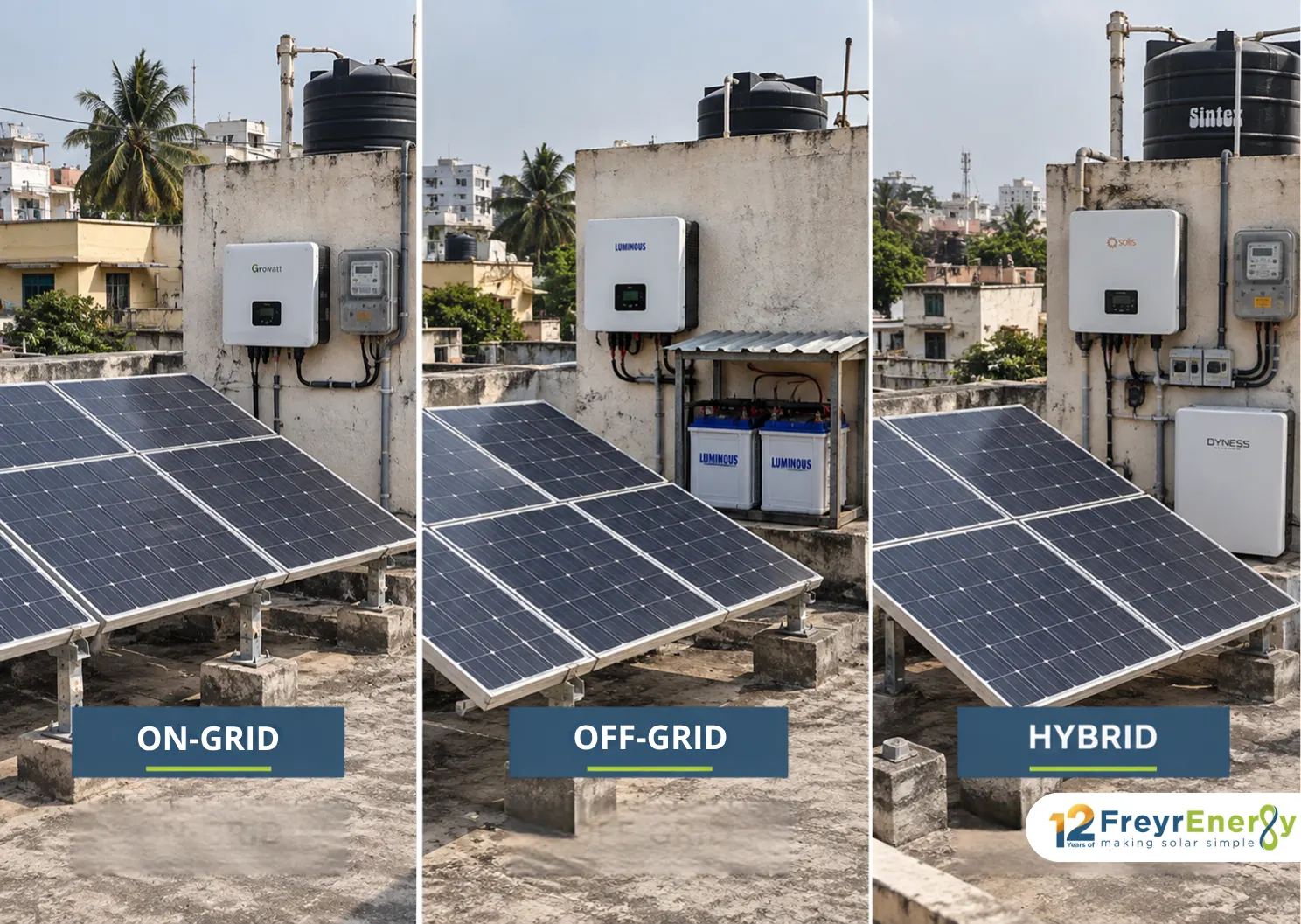
The three main types of solar energy systems are on-grid, off-grid and hybrid.
- On-grid solar system: Suitable for homes with a reliable electricity supply and a primary goal of reducing bills.
- Off-grid solar system: Designed for locations without dependable grid access and requires battery storage.
- Hybrid solar system: Combines grid connectivity with batteries to provide backup during outages.
A standard on-grid system normally shuts down during a power cut. Choose a hybrid system if battery backup is essential.
6. Solar Panels and Other Components
Do not select a system based only on panel price. The quality and compatibility of the inverter, mounting structure, wiring, protection equipment and monitoring system also affect safety and performance.
Compare quotations based on:
- Equipment specifications
- Product and performance warranties
- Installation standards
- Safety equipment
- Monitoring features
- Maintenance and after-sales support
- Total installed cost
7. Net Metering and Required Approvals
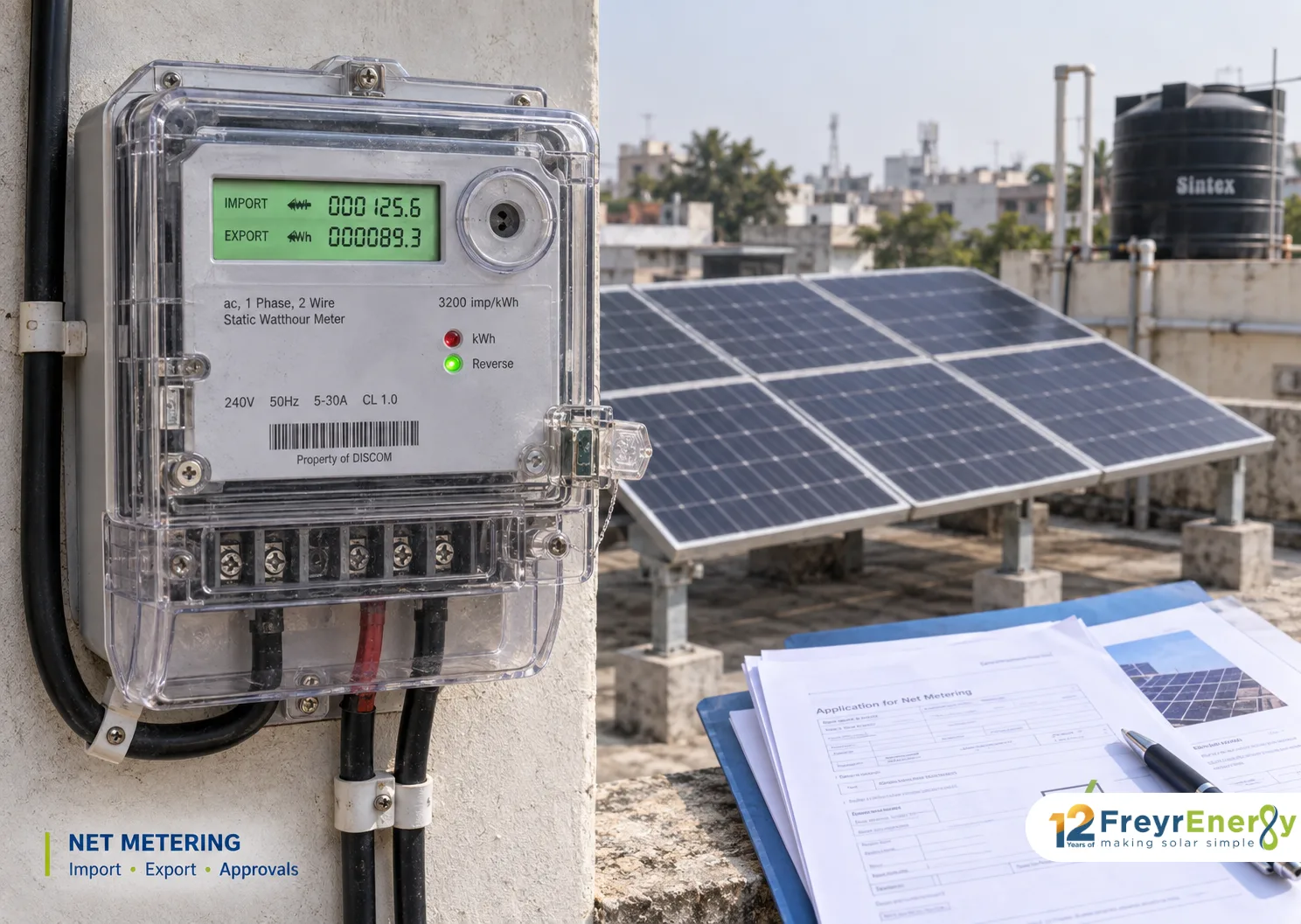
A grid-connected system may require approval from your electricity distribution company. Requirements for feasibility, system capacity, metering and export credits vary by state and DISCOM.
Under an approved net-metering arrangement, a bidirectional meter records electricity imported from and exported to the grid. Confirm the current local process before starting the installation.
8. Solar Subsidy Eligibility
Eligible residential grid-connected rooftop systems may qualify for financial assistance under the current central government scheme. Approval depends on factors such as applicant eligibility, qualifying equipment, installation through a registered vendor and DISCOM verification.
Check the latest requirements before purchasing equipment. Read this guide to solar subsidy in India for an overview of the process.
9. Installation Cost and Expected Savings
The cost of rooftop solar depends on system capacity, component quality, roof conditions, mounting requirements and installation complexity.
Savings vary according to solar generation, household consumption, electricity tariffs and net-metering rules. Request an itemised quotation and a site-specific generation estimate instead of relying on a guaranteed savings percentage.
Checks 10-15: The Details That Prevent Expensive Surprises
10. Electrical Safety and Protection
The proposal should identify DC and AC isolators, breakers, surge-protection devices, earthing, lightning protection where required, cable sizes, connector compatibility, labels and shutdown access. Ask who designs and signs off the system and which test reports are provided at handover.
11. Mounting Structure and Waterproofing
Confirm the structure material, corrosion protection, height, anchoring or ballast, design wind basis and roof interface. Waterproofing responsibility must be written, especially where fasteners penetrate the slab or an existing roof warranty is in force.
12. Product, Performance and Workmanship Warranties
A module product warranty, module performance warranty, inverter warranty and installer workmanship warranty cover different risks. Record the issuer, term, exclusions, claim route, labour or transport coverage and what happens if the installer or manufacturer is no longer available.
13. Monitoring, Maintenance and Service
Ask what the monitoring platform shows, who receives fault alerts, expected response times, cleaning responsibility and whether preventive inspections are included. The contract should define escalation contacts and charges after any included service period.
14. Insurance, Fire and Property Risk
Confirm whether the system is covered for fire, storm, theft, electrical damage, third-party liability and roof damage; check exclusions, deductibles and claim responsibility. Inform the property insurer and lender where required.
15. Handover Documents and Exit Planning
Collect the approved layout, single-line diagram, datasheets, serial numbers, invoices, warranty certificates, test results, approvals, meter documents, login credentials and maintenance instructions. Also ask how panels will be removed and reinstated if the roof is repaired, the building is extended or the property is sold.
Red Flags in a Residential Solar Proposal
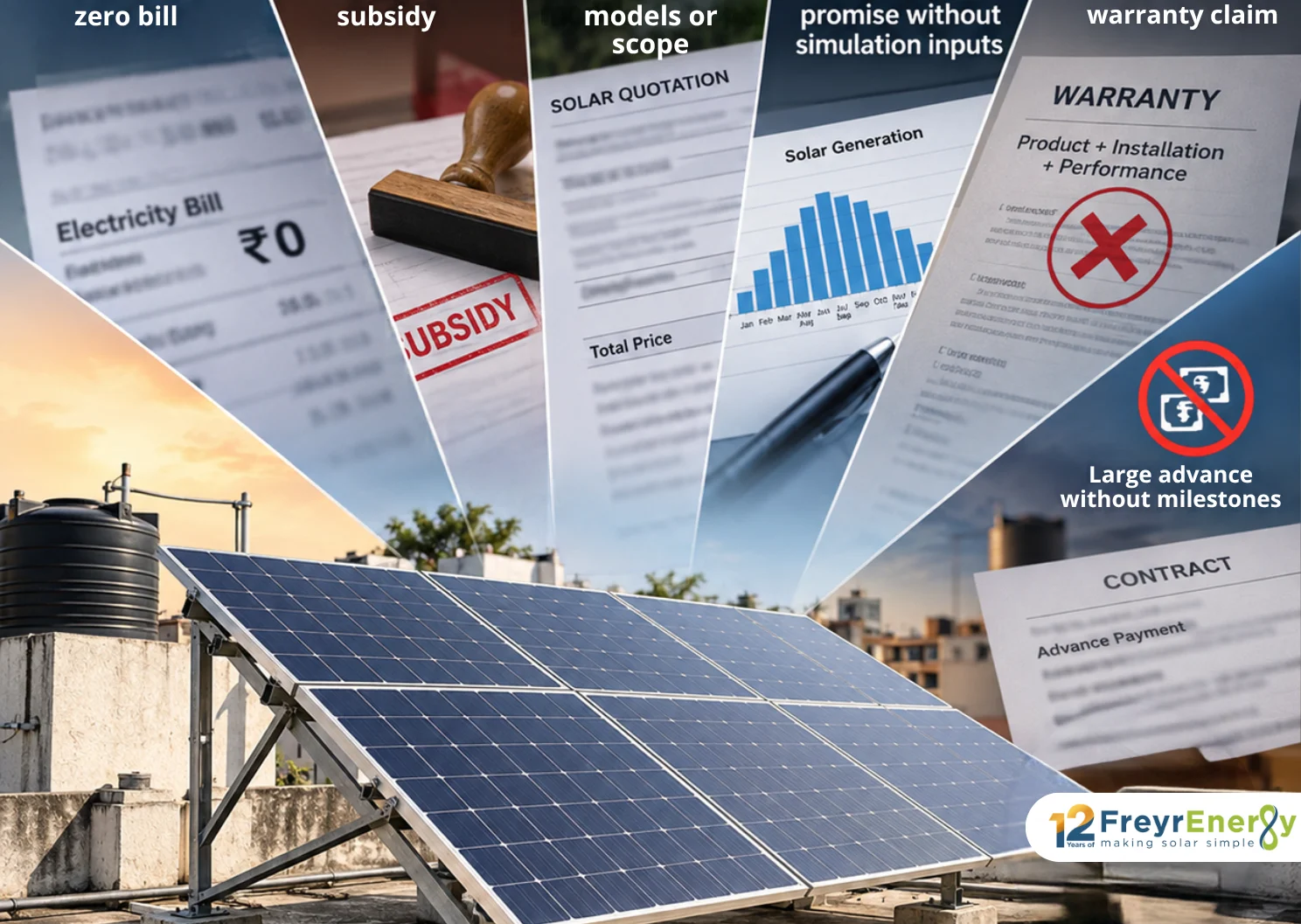
Red flag | Why it is risky | What a sound proposal provides |
|---|---|---|
Guaranteed zero bill | Fixed charges and variable generation are ignored | A range based on bills, generation and settlement assumptions |
Guaranteed subsidy | Government approval is outside the installer’s control | Eligibility support with a clear disclaimer |
Price without models or scope | Cheap substitutions and exclusions are easy | Itemised equipment, work, taxes, fees and exclusions |
Generation promise without simulation inputs | Shade and loss assumptions are hidden | Site-specific estimate with stated methodology |
One combined warranty claim | Different parties and risks are blurred | Separate product, performance and workmanship terms |
Large advance without milestones | Customer carries disproportionate delivery risk | Payments linked to documented project stages |
Use One Comparison Sheet for Every Vendor
Normalize capacity, module and inverter models, structure, protection, civil work, approvals, monitoring, warranties, maintenance, taxes and payment milestones. Keep central subsidy, state incentive, vendor discount and financing cost in separate rows. Only after the technical scope is equal should the final price and expected savings be compared.
Check the Savings Model, Not Only the Payback Number
Ask for annual generation, self-consumption, export, avoided tariff, export credit, degradation and recurring costs. A five-year payback claim can change materially if most generation is exported or if the quotation excludes roof work and finance. Request at least a base and conservative scenario.
Confirm Property and Society Rights
An apartment owner may not have exclusive rights to the common roof. A tenant may control the electricity bill but not the structure. A mortgaged property, heritage building or leased commercial premises may require additional consent. Resolve ownership, access, insurance and end-of-term removal before equipment is ordered.
Final Pre-Payment Gate
- Approved final layout and single-line diagram.
- Exact bill of materials and substitution rule.
- Itemised total price, taxes, exclusions and milestone payments.
- Written subsidy and DISCOM responsibility without guarantees.
- Separate warranties, service route and insurance wording.
- Cancellation, delay, roof-damage and dispute provisions.
- Named handover documents and monitoring access.
Quotation Comparison Matrix
What to compare | What you should verify |
Solar panels | Brand, model, wattage, quantity and warranty |
Inverter | Brand, model, capacity, phase and warranty |
Mounting structure | Material, height, corrosion protection and waterproofing |
Electrical safety | AC/DC protection, SPD, earthing and isolators |
Installation scope | Civil work, wiring, lifting and other inclusions |
Approvals | Net-metering, DISCOM documentation and applicable charges |
Warranty & service | Product, performance, workmanship and service support |
Final price | Total installed cost, taxes, subsidy, discount and financing charges |
Warranty Comparison Table
Warranty | Who usually issues it? | What to check |
|---|---|---|
Module product | Module manufacturer | Defects, term, exclusions, labour and transport |
Module performance | Module manufacturer | Output-retention curve and testing method |
Inverter product | Inverter manufacturer | Standard/extended term and replacement logistics |
Structure/workmanship | Installer or EPC | Corrosion, roof interface, leakage and installation defects |
Monitoring/service | Platform provider/installer | Data access, response time and charges |
Insurance | Insurer under policy wording | Perils, sum insured, deductibles and claim responsibility |
Installer Due-Diligence Questions
- Is the vendor registration valid for the applicant’s scheme and location?
- Who performs the structural and electrical design, and who signs the drawings?
- Which parts are installed by employees and which by subcontractors?
- Can the bidder show a comparable local project and service contact?
- What is the escalation route if generation, subsidy or metering is delayed?
- What happens to warranties and monitoring if the installer stops operating?
Final Acceptance Test
Before final payment, verify equipment models and serial numbers, inspect visible structure and cable routing, review test records, demonstrate inverter and meter readings, confirm monitoring login, and receive all approvals and warranties. Record incomplete items in a signed punch list with responsibility and due date.
Conclusion
A rooftop system should be bought from a complete technical and commercial specification. Review consumption and roof life, confirm local rules, normalize quotations and insist on written equipment, protection, warranty, approval and service responsibilities. Avoid guaranteed subsidy, generation or zero-bill claims. A little more work before the advance payment can prevent years of poor performance or disputes. The final proposal should make the expected energy, limitations, total cost and owner responsibilities understandable to a non-engineer.