A solar lease can reduce the amount you pay at installation, but it does not make the system free. A third party usually funds and owns the rooftop solar plant, while you make contractual payments or buy the electricity it generates. The details matter because India uses several related structures, including equipment leases, RESCO or OPEX agreements, power purchase agreements (PPAs), and roof leases. Each creates a different payment obligation.
Before comparing a lease with a solar loan or outright purchase, identify the actual model, calculate the total cost across the full term, and check who receives subsidies, handles downtime, owns the equipment and controls the roof. This guide explains the decision in an India-specific way.
Direct answer: In a solar lease, a provider generally owns the rooftop system and grants you the right to use it for a contractual payment. In India, many third-party-owned offers are actually RESCO or PPA arrangements, where you pay for solar electricity per unit rather than rent the equipment. Always verify the payment basis in the contract.
Quick Takeaways
- A low or zero upfront payment shifts cost into a longer contract; it does not remove the cost.
- A lease normally charges for use of equipment, while a PPA charges for electricity generated or consumed.
- In India, RESCO, PPA and roof-rental structures are sometimes loosely described as solar leasing.
- You will usually keep receiving a grid bill for night-time use, low-solar periods and applicable fixed charges.
- Subsidy treatment depends on the model. Under the PM Surya Ghar RESCO route, CFA is claimed by the registered RESCO vendor and must be reflected in the offered tariff.
- Compare total term cost, not only the first monthly payment, and obtain all maintenance, transfer, termination and end-of-term terms in writing.
What Is a Solar Lease?
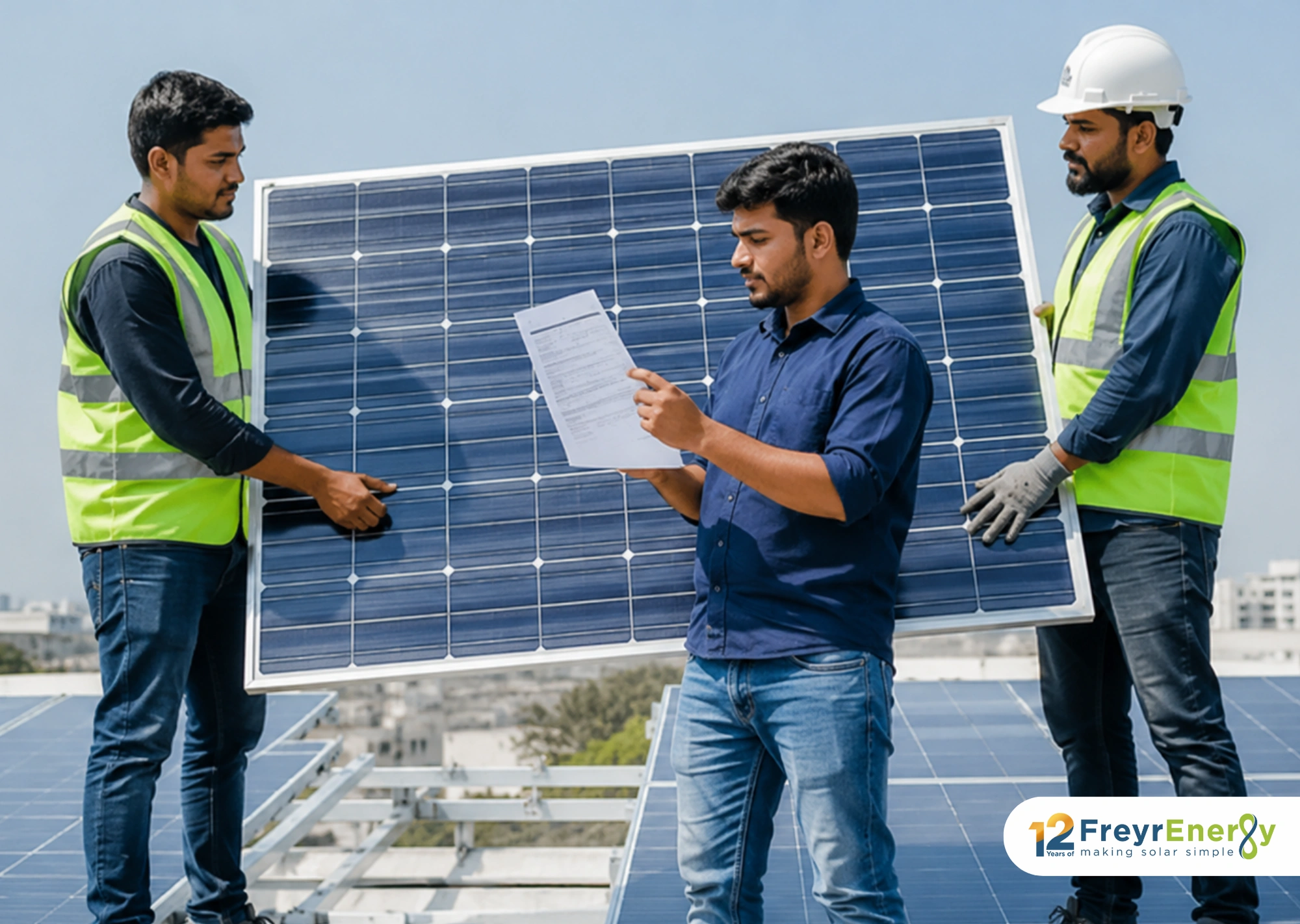
A solar lease is a contract under which the system owner gives another party the right to use a solar plant for an agreed period and payment. The owner normally retains title to the panels, inverter and associated equipment unless the agreement provides for a later transfer.
The term is easy to misunderstand in India because three different arrangements can involve the word lease:
| Arrangement | Who pays whom? | System owner | Primary benefit |
| Equipment lease | Customer pays a fixed or scheduled rental for use of the system | Provider/lessor | Customer uses solar electricity |
| RESCO/OPEX or PPA | Customer usually pays an agreed tariff per kWh of solar electricity | RESCO/project owner | Customer buys solar power; excess treatment follows the agreement and metering rules |
| Roof lease | Developer pays rent for the right to use the roof | Developer/project owner | Power may be sold to the grid, DISCOM or another contracted buyer |
Do not rely on the label in a sales pitch. The agreement’s ownership clause, payment formula, energy allocation and metering arrangement determine what you are actually signing.
How Does a Solar Lease Work?
- Provider and site screening. The provider reviews your electricity bills, sanctioned load, roof condition, usable shadow-free area, access and local DISCOM rules.
- Technical and financial proposal. The proposal should state system capacity, expected generation, equipment, payment basis, escalation, performance assumptions and every included service.
- Contract and approvals. The parties sign the lease, PPA, site-use or tripartite agreements required for the selected model. DISCOM and society or lender approvals may also be relevant.
- Installation and commissioning. The provider installs the plant, completes electrical protections and metering, and coordinates inspection or commissioning as applicable.
- Solar use and grid supply. Your property uses solar electricity according to the metering arrangement. The grid continues to supply electricity when generation is insufficient.
- Billing and service. You pay the rental or solar tariff defined in the contract. The provider performs only the monitoring, maintenance, repair and replacement duties written into the agreement.
- Transfer, purchase or handback. At expiry, the system may be transferred, purchased, renewed or removed, but only if the contract provides that option and defines the price and restoration duty.
How Much Does a Solar Lease Cost in India?
There is no single, reliable national monthly price for residential solar leasing in India. The quote depends on system size, site and roof work, expected generation, contract term, financing cost, maintenance scope, local tariff, metering rules and the provider’s risk assumptions.
Calculate the full obligation as:
Total lease cost = upfront payment + all scheduled rentals + escalation increases + taxes and fees + insurance or service costs not included + transfer, buyout, termination or removal charges.
Also add your expected residual grid cost. A solar lease payment does not normally replace the entire electricity bill because grid imports, fixed charges and other approved charges may continue.
What Is a Solar Lease Escalator?
An escalator raises the payment at a stated interval, usually annually. A small percentage can materially increase the total commitment when it compounds over many years.
Hypothetical example: if the first-year rental is Rs 4,000 per month and rises by 3% each year, ten years of rentals total about Rs 5.50 lakh before taxes, grid charges and other fees. With no escalation, the same starting rental totals Rs 4.80 lakh. This example illustrates the calculation only; it is not a market quote.
Ask for a year-by-year payment schedule and a zero-escalator alternative. Compare both with a cash purchase and a loan using the same system size, expected generation and analysis period.
Solar Lease vs PPA vs Solar Loan vs Cash Purchase
| Factor | Solar lease | RESCO/PPA | Solar loan | Cash purchase |
| Payment basis | Fixed/scheduled rental | Per kWh or agreed tariff | EMI: principal, interest and fees | Upfront purchase price |
| System ownership | Usually provider | RESCO/project owner | Customer, subject to lender security | Customer |
| Upfront cash | Usually low, contract-dependent | Usually low, contract-dependent | Down payment may apply | Highest |
| Maintenance | As contracted | Usually provider scope; verify remedies | Customer/vendor warranty and service | Customer/vendor warranty and service |
| Payment tied to generation | Usually no | Usually yes | No | No |
| Long-term flexibility | Lower | Lower | Moderate | Highest |
| Subsidy recipient | Depends on programme and ownership | Under eligible PMSG RESCO, CFA goes to RESCO vendor | Eligible consumer/loan account under CAPEX rules | Eligible consumer under CAPEX rules |
| Best fit | Capital preservation and predictable rental | Capital preservation and performance-linked billing | Ownership without full upfront payment | Ownership and maximum control |
The option with the lowest first payment is not necessarily the lowest-cost option. Compare the net present value of all payments where possible, or at minimum compare total undiscounted cash outflow over the same period.
Solar Leasing and PM Surya Ghar Subsidy
Solar Subsidy is one of the most important India-specific differences. As of 2 September 2026, PM Surya Ghar has separate implementation rules for consumer-funded CAPEX systems and third-party-funded RESCO or utility-led models.
For a standard residential CAPEX installation, the July 2025 amended guidelines list CFA of Rs 30,000 per kWp for the first 2 kWp and Rs 18,000 for the next 1 kWp in general-category states, with no additional CFA beyond 3 kWp. The maximum on that schedule is Rs 78,000. Higher rates apply in specified special-category states and union territories.
For an eligible RESCO installation, the consumer does not fund the initial investment and is not the asset owner for at least five years. The registered RESCO installs and maintains the system, and may charge the consumer an electricity tariff and/or compensate the consumer for roof-use rights. After DISCOM inspection and approval, CFA is released to the RESCO vendor, not automatically as cash to the household. The RESCO must tell the consumer that its offered tariff includes the CFA benefit.
Important: Do not treat a provider discount, financing offer or lower tariff as the same thing as government subsidy. Verify the model, current eligibility, registered vendor status, equipment requirements, metering approval and subsidy recipient on the official portal before signing.
Benefits of a Solar Lease
| Potential benefit | What it means in practice |
| Lower initial outlay | The provider funds most or all of the plant, subject to the agreement. |
| Capital remains available | Cash can remain available for other household or business priorities. |
| Defined service responsibility | A strong agreement can place monitoring, maintenance and repair duties on the owner. |
| Potentially predictable cost | A fixed lease can aid budgeting; a PPA can link payment to actual solar generation. |
| Possible path to later ownership | Some contracts allow transfer or buyout after a defined period. |
Disadvantages and Risks
| Risk | Why it matters |
| No immediate ownership | You may not control equipment changes, relocation or disposal. |
| Long-term payment obligation | A low starting payment can become expensive after escalation. |
| Two bills may remain | You may owe the provider and still pay the DISCOM for grid imports and fixed charges. |
| Downtime mismatch | A fixed rental may continue even if production falls unless the contract provides performance relief. |
| Roof access and repair | Removing and reinstalling panels for waterproofing or structural work can create cost and scheduling disputes. |
| Transfer or sale friction | A buyer, lender, society or new owner may not accept the existing contract. |
| Provider credit risk | Service continuity and handback become harder if the system owner changes or fails. |
| Exit cost | Early termination, buyout, relocation and removal may carry substantial charges. |
How to Evaluate a Solar Lease Agreement
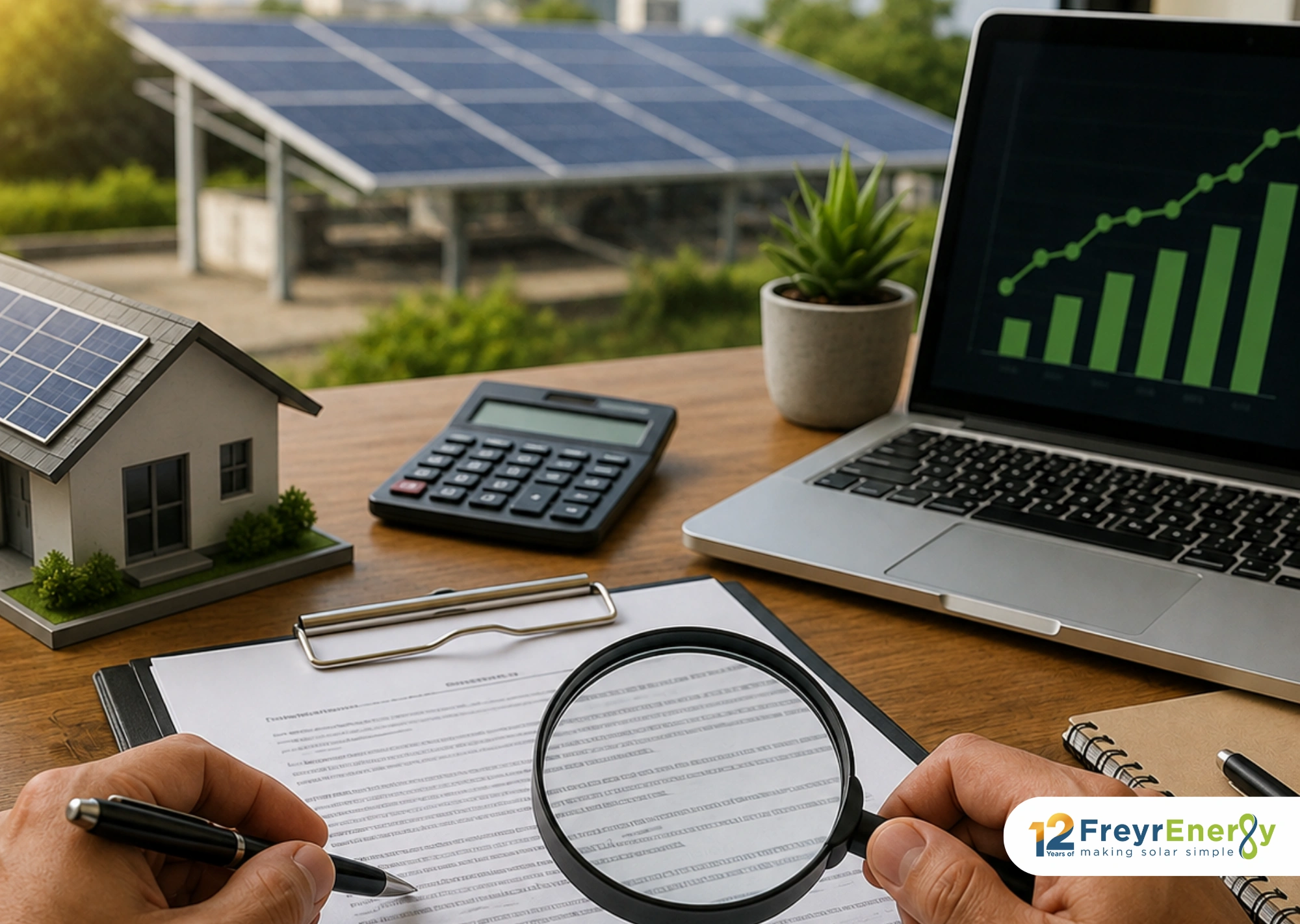
Ask the provider to identify every agreement that governs the project and obtain legal and financial review for a material long-term commitment. At minimum, confirm these points in writing:
- Exact legal owner of panels, inverter, structure, meters and environmental attributes.
- Payment basis: fixed rental, per-kWh tariff, service charge or roof rent.
- Upfront payment, deposit, taxes, fees and complete year-by-year payment schedule.
- Escalator percentage, timing and whether it compounds.
- System capacity, expected annual generation, degradation assumption and measurement method.
- Performance guarantee, exclusions, credit calculation and payment timeline for underperformance.
- Who receives government assistance, incentives and any other project benefit.
- Responsibility for monitoring, cleaning, preventive maintenance, repairs and major replacements.
- Response times, downtime remedies and payment treatment while the system is unavailable.
- Solar Insurance cover, deductibles, claim control and liability for fire, weather, theft and roof damage.
- Access rights and the process for roof repair, waterproofing, extension or redevelopment.
- DISCOM approvals, metering arrangement, export credits and responsibility for regulatory changes.
- Early termination formula, default cure period, buyout dates and valuation method.
- Property sale, lease, inheritance or occupancy-change transfer process and consent requirements.
- End-of-term ownership, renewal, removal, disposal and roof-restoration obligations.
- What happens if the provider, financier, installer or equipment manufacturer stops operating.
Can You Sell or Transfer a Property With Leased Solar?
Possibly, but do not assume the contract transfers automatically. The agreement may require provider consent, buyer qualification, notice, a buyout or settlement of outstanding amounts. In India, also check the title documents, lender conditions, housing-society rules and roof-access rights relevant to the property.
Before listing or transferring the property, request a written transfer pack containing the current payment schedule, buyout amount, service history, ownership evidence and exact steps for novation or assignment.
What Happens at the End of a Solar Lease?
The contract may allow purchase, ownership transfer, renewal or removal. None of these should be assumed. Confirm the option date, price or valuation method, taxes, transfer documents, remaining warranties and responsibility for dismantling and restoring the roof.
Under the PM Surya Ghar RESCO guidelines, plant ownership may transfer to the consumer after the project period according to the contract. The project period is not less than five years. That is permission for a contractual transfer, not an automatic promise that every consumer receives the plant free.
Is a Solar Lease Worth It?
A solar lease may suit a customer who wants to preserve capital, can accept a long site commitment and receives a transparent, competitively priced contract with strong service and exit protections. A PPA may be preferable when payment should track actual generation.
Buying with cash can offer the greatest control and often stronger long-term economics for customers who can fund the system. A solar loan can preserve ownership while spreading cost across EMIs, though interest, fees, eligibility and lender security must be considered.
Decision rule: Choose only after comparing lease, PPA, loan and cash options on the same system size, generation estimate, consumption profile and term. If the provider will not supply a complete cash-flow schedule and contract, do not rely on the headline monthly payment.
How Freyr Energy Fits the Decision
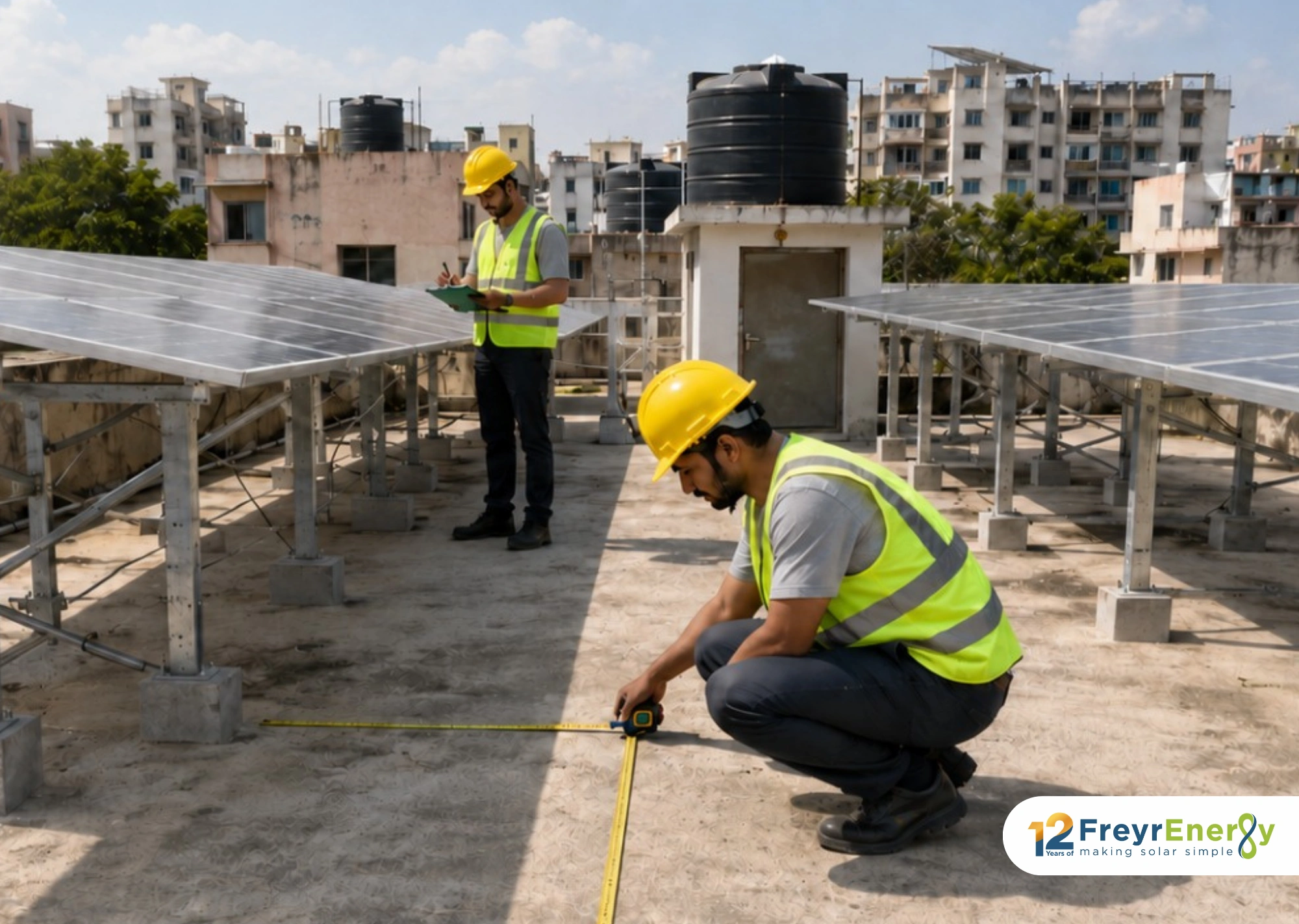
Freyr Energy’s verified public information currently emphasizes customer-owned rooftop solar with cash purchase or financing support, rather than advertising a standard solar lease. For homeowners comparing a lease with ownership, Freyr Energy provides site assessment, system design, installation, subsidy assistance, net-metering support and financing options, subject to eligibility and current terms.
Use Freyr Energy’s solar calculator for an initial estimate, then compare a customized ownership proposal against any lease or PPA on the same technical assumptions. Confirm current prices, loan terms, subsidy eligibility and service availability before making a decision.
Conclusion
Solar leasing can make rooftop solar accessible without a large initial payment, but the contract determines whether the deal is genuinely attractive. In India, first identify whether the offer is an equipment lease, a RESCO/PPA arrangement or a roof lease. Then verify local availability, metering, subsidy flow, service obligations and exit rights.
The best comparison uses one technical baseline and counts every rupee over the full term, including escalators, residual grid charges and end-of-term costs. For many homeowners, a cash purchase or solar loan may provide clearer ownership and stronger flexibility. The right answer depends on the verified numbers and the protections written into the agreement, not on a zero-upfront headline.