
Direct Answer
A home solar system in Pune should be sized from at least 12 months of electricity bills and a professional shadow and roof assessment. Freyr Energy’s approved indicative gross prices range from ₹1.20-₹1.30 lakh for 1 kW to ₹6.30-₹6.40 lakh for 10 kW. Eligible residential consumers may receive PM Surya Ghar central financial assistance of ₹30,000 for 1 kW, ₹60,000 for 2 kW and up to ₹78,000 for 3 kW or more, subject to the scheme process, compliant equipment, MSEDCL inspection and approval. A standard on-grid system can reduce electricity purchases but will normally shut down during a power cut.
Pune homeowners often consider rooftop solar to reduce the grid electricity they buy during the day and to manage long-term energy costs. The decision is not simply about choosing a panel brand. A suitable solar system for home in Pune must match the household’s electricity consumption, usable roof area, sanctioned load, MSEDCL requirements and budget.
Pune has good rooftop-solar potential, but every property is different. Apartment shadows, water tanks, terraces used by the family, roof condition and seasonal weather can all affect generation. This guide explains the five checks that matter most, along with indicative prices, the current residential subsidy, system sizing, net metering and the installation process.
Quick Takeaways
- Size solar from annual consumption and daytime use, not simply from the number of bedrooms.
- Keep gross system price, government subsidy, vendor discount and financing separate.
- A 3 kW system no longer always means nine panels; modern module wattage may reduce the panel count.
- South-facing modules are useful, but a professionally designed east-west layout may also work when it suits the roof and load profile.
- A standard on-grid inverter switches off when the grid fails. Backup requires a suitably designed hybrid or off-grid system with batteries.
- Pune consumers should follow current MSEDCL and MERC requirements for connectivity, metering and energy settlement.
- Compare the complete installed scope, warranties and generation assumptions rather than only the price per kW.
Top 5 Factors to Consider Before Installing a Solar System for Home in Pune
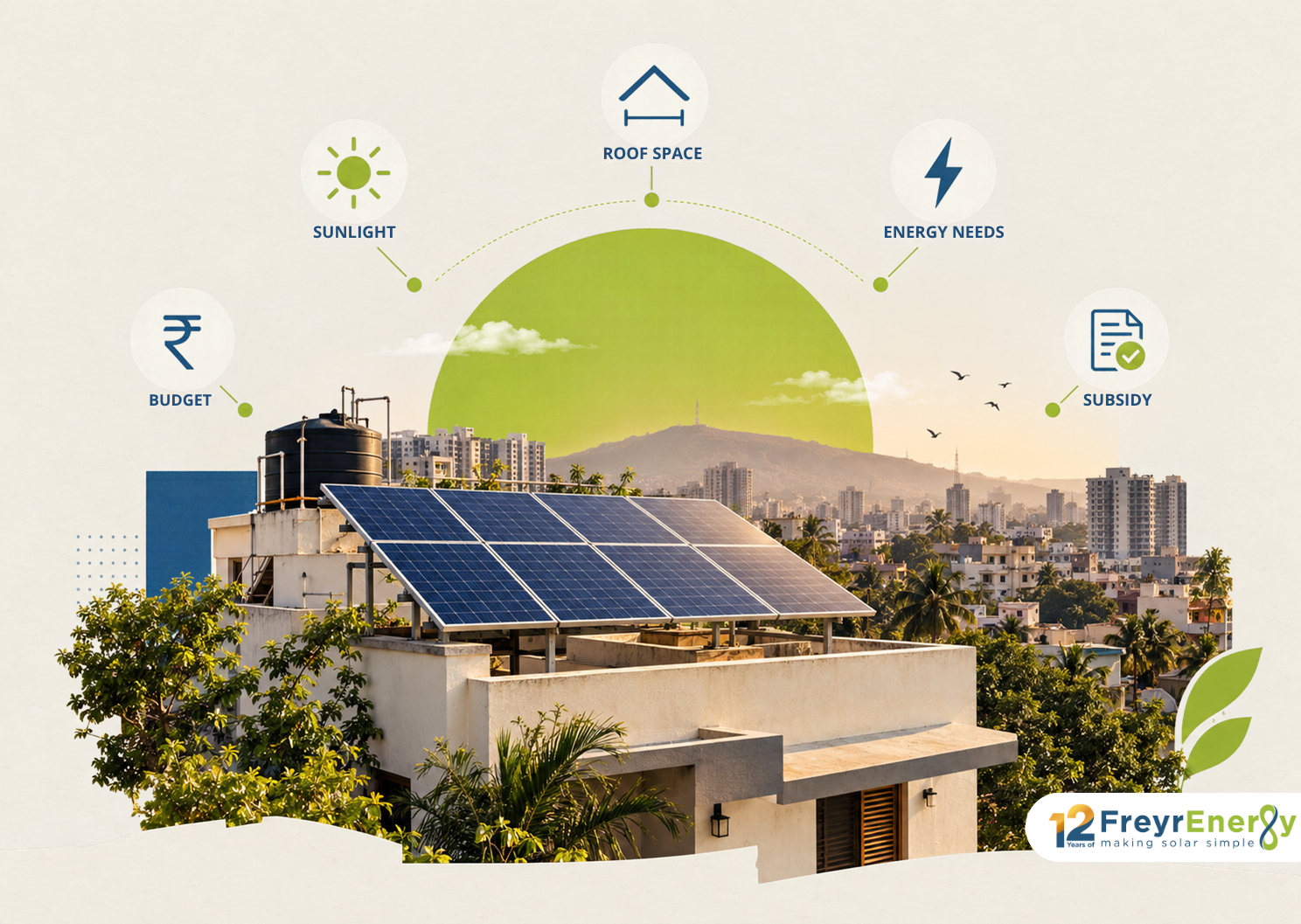
1. Sunlight, Shading and Panel Positioning
Before installing a solar system for home, measure how much of the terrace is genuinely usable. Nearby buildings, lift rooms, water tanks, trees, railings and antennas can cast shadows that change through the day and across seasons. Even when the total roof is large, safe access paths and maintenance clearances reduce the available solar area.
In Pune, south-facing modules at a suitable tilt can support strong annual generation. However, south is not the only workable direction. East-west layouts may fit more capacity on some roofs and can spread production across the morning and afternoon. The correct decision requires a shade analysis and energy model, not a universal direction rule.
Ask the installer to show:
- a scaled rooftop layout;
- annual and seasonal shadow analysis;
- panel orientation and tilt;
- access and fire-safety pathways;
- assumptions used in the generation estimate; and
- how water drainage and waterproofing will be protected.
2. Electricity Consumption and System Size
Review at least 12 months of bills because air-conditioning, monsoon weather, travel and seasonal appliance use can distort a single month. Add any expected loads such as an electric vehicle, heat pump, additional air-conditioner or home office before finalising capacity.
A 3 kW solar panel system is common for homes, but it is not automatically right for every household. Modern modules may be rated around 500-600 Wp, so 3 kW could require approximately five or six modules rather than the nine lower-wattage panels cited in older articles. The exact quantity depends on the selected module and the final DC capacity.
Use the table only for early planning. A site-specific simulation should replace it before purchase.
| Approximate system size | Indicative monthly generation range | Practical screening use | Approximate usable roof area |
| 1 kW | About 110-140 units | Low-consumption household or partial bill offset | Roughly 70-100 sq ft |
| 2 kW | About 220-280 units | Moderate household consumption | Roughly 140-200 sq ft |
| 3 kW | About 330-420 units | Many medium-consumption homes | Roughly 210-300 sq ft |
| 5 kW | About 550-700 units | Larger daytime load, multiple ACs or planned EV use | Roughly 350-500 sq ft |
| 10 kW | About 1,100-1,400 units | High-consumption bungalow or large residence | Roughly 700-1,000 sq ft |
Generation varies with irradiation, module temperature, orientation, shading, soiling, losses and downtime. Do not size the system solely to the highest summer bill or assume every exported unit will have the same value as a unit used in the home.
3. Budget, Gross Price and Financial Planning
Plan from the gross installed price before subsidy. Financing through loans may spread the investment, while current subsidies can reduce the effective cost for eligible residential installations. The value of exported power depends on applicable net metering rules and billing, so it should not be presented as guaranteed cash income.
The table below uses Freyr Energy’s approved indicative gross price ranges. It also shows simple arithmetic after the maximum applicable central assistance. It is not a final quotation or a promise of subsidy disbursement.
| System size | Indicative gross price | Maximum standard-category CFA if eligible | Arithmetic price after CFA |
| 1 kW | ₹1.20-₹1.30 lakh | ₹30,000 | ₹90,000-₹1.00 lakh |
| 2 kW | ₹1.80-₹1.90 lakh | ₹60,000 | ₹1.20-₹1.30 lakh |
| 3 kW | ₹2.30-₹2.40 lakh | ₹78,000 | ₹1.52-₹1.62 lakh |
| 5 kW | ₹3.50-₹3.70 lakh | ₹78,000 | ₹2.72-₹2.92 lakh |
| 10 kW | ₹6.30-₹6.40 lakh | ₹78,000 | ₹5.52-₹5.62 lakh |
The final solar installation in home costs can vary with the structure height, roof type, module and inverter selection, cable routes, earthing, lightning protection, sanctioned-load changes, metering charges and optional battery storage. The linked guide to a 1kW system can help with small-system planning, but obtain a current Pune-specific bill of quantities.
4. Equipment Quality and Installation Scope
A reliable home system needs more than high-wattage panels. Check the complete design and bill of quantities, including:
- module make, model, wattage and warranty
- inverter capacity, MPPT configuration, monitoring and warranty
- hot-dip galvanised or otherwise specified mounting structure and wind design
- DC and AC cable sizes and brands
- DC and AC distribution boxes
- earthing, lightning and surge protection
- generation meter, net meter and related scope
- workmanship warranty and complaint process
- maintenance responsibility after commissioning
Freyr Energy provides rooftop solar solutions, and homeowners can compare its site survey, design, equipment, installation, documentation and post-installation scope with other proposals. When considering solar companies in Pune, ask each bidder to price the same scope and state every exclusion. A lower headline price may exclude structural changes, additional cable, metering or service.
Freyr Energy’s approved process includes customised system design, a 3D preview, shadow analysis and project tracking through the Freyr Energy Solar App. Actual project timelines depend on the site, customer documents, material availability, financing and MSEDCL processes, so a completion date should be confirmed in the project proposal rather than assumed from a general article.
5. Maintenance, Monitoring and Service
Dust, bird droppings, leaves and deposits can reduce output. Pune’s monsoon may clean loose dust, but it can also reveal drainage, water-ingress or corrosion issues. Follow the module and installer instructions for safe cleaning and never step on panels or use abrasive chemicals.
Good monitoring establishes whether the system is working as expected. Compare daily and monthly generation with the approved estimate, while allowing for weather and seasonal changes. Investigate prolonged inverter faults, unexplained drops or repeated tripping promptly.
The Freyr Energy App supports project tracking, payment tracking, solar monitoring and performance insights. Monitoring does not replace physical inspection: periodically check accessible cables, mounting, earthing, protection equipment and signs of damage through a qualified technician.
How Many Solar Panels Are Needed for a Pune Home?
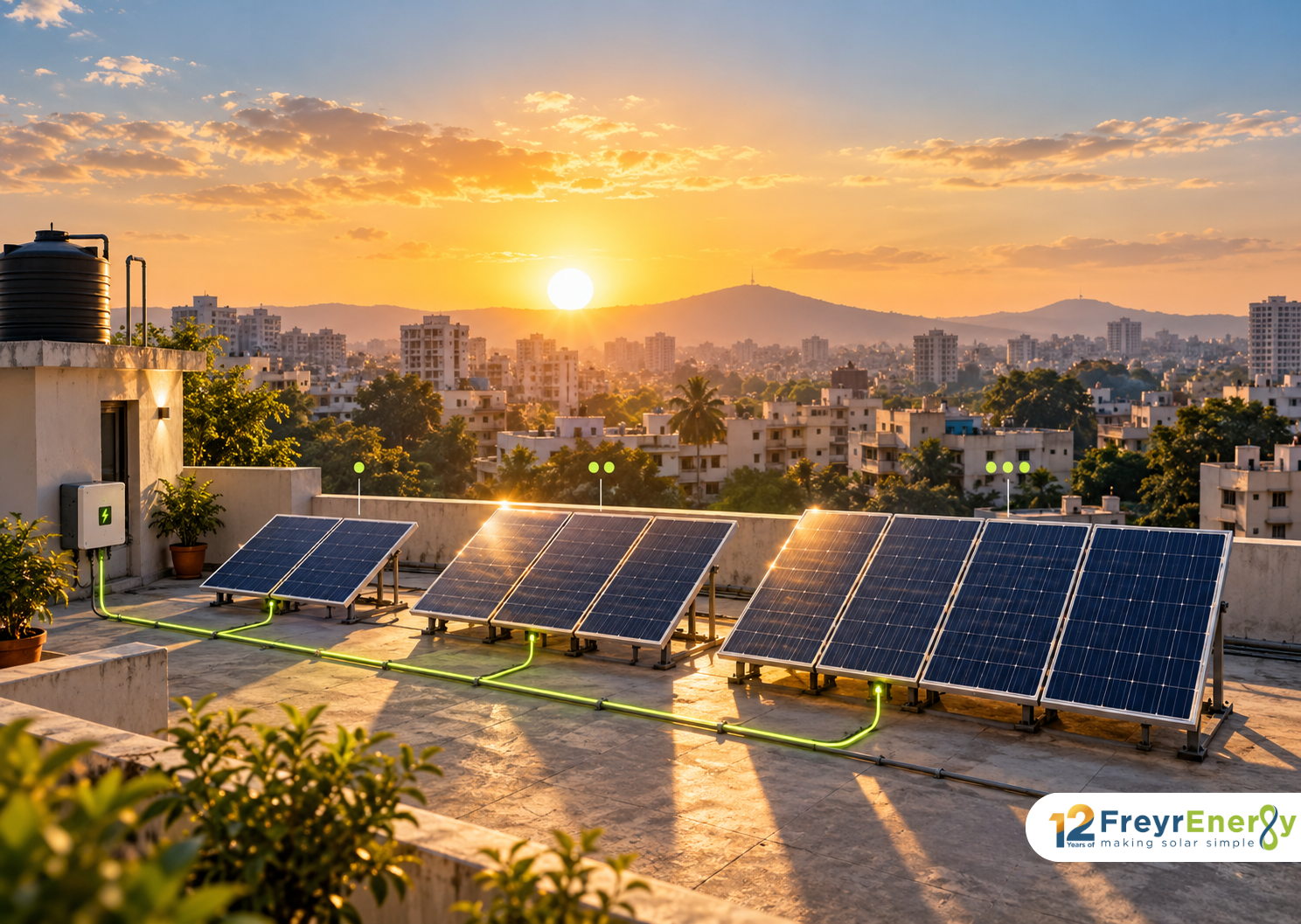
The number of panels depends on required DC capacity and the wattage of the selected module:
Approximate panel count = required system capacity in watts ÷ module wattage
For example, a nominal 3,000 W system using 550 W modules requires about 5.45 modules mathematically. The designer must choose a workable whole-module configuration and confirm inverter voltage, string design and the installed DC capacity. Do not round the calculation without checking the equipment design.
Step 1: Calculate Average Electricity Use
Add the units consumed across the last 12 bills and divide by 12. For a quick screening estimate, dividing average monthly consumption by about 120-140 units per installed kW can suggest an initial capacity range for Pune. A household using 1,000 units a month might therefore begin by evaluating roughly 7-8.5 kW, subject to roof space, daytime self-consumption and regulatory limits.
Use the linked solar power system guide to understand the basic components. Homeowners can also enter their bill and roof details in the Solar Calculator for an initial estimate. A calculator result should still be checked by a site survey.
Step 2: Check Panel Efficiency and Temperature Performance
Solar panels efficiency describes the percentage of incident sunlight converted to electricity under specified test conditions. Higher efficiency can be valuable when roof area is limited, but efficiency alone does not determine lifetime value. Compare degradation, temperature coefficient, product warranty, performance warranty, mechanical loading and manufacturer support.
Monocrystalline solar panels are widely used for modern rooftop systems because they can deliver more capacity within a limited area. Polycrystalline panels may appear in older quotations, but homeowners should compare current availability, datasheets and value rather than relying on outdated generic efficiency bands.
Step 3: Confirm the Roof, Structure and Electrical Connection
Get solar installation guidance before approving the layout. A qualified assessment should cover roof condition, water tanks and services, load-bearing capacity, mounting method, waterproofing, cable route, earthing locations and the existing electrical panel.
A best solar panel installation company in Pune claim should be treated as marketing unless it is supported by transparent evidence. Compare registration status, local execution capability, technical proposal, warranty process, customer references that can be verified and responsibility for MSEDCL documentation.
On-Grid, Hybrid or Off-Grid Solar for a Pune Home?
Understanding the difference between an off-grid or on-grid solar system prevents a common buying mistake.
| System type | Grid connection | Battery | During a grid outage | Typical reason to choose it |
| On-grid | Yes | Normally no | Shuts down through anti-islanding protection | Lower capital cost and electricity-bill reduction |
| Hybrid | Yes | Yes | Can supply selected backup loads if designed for it | Bill reduction plus defined backup requirement |
| Off-grid | No | Yes | Operates independently within battery and inverter limits | Sites without a reliable grid connection |
A standard on-grid plant does not provide electricity during an MSEDCL outage because the inverter must stop exporting power to protect line workers. If backup is important, list the essential loads and required backup duration before selecting the battery and inverter.
PM Surya Ghar Subsidy for Pune Homes
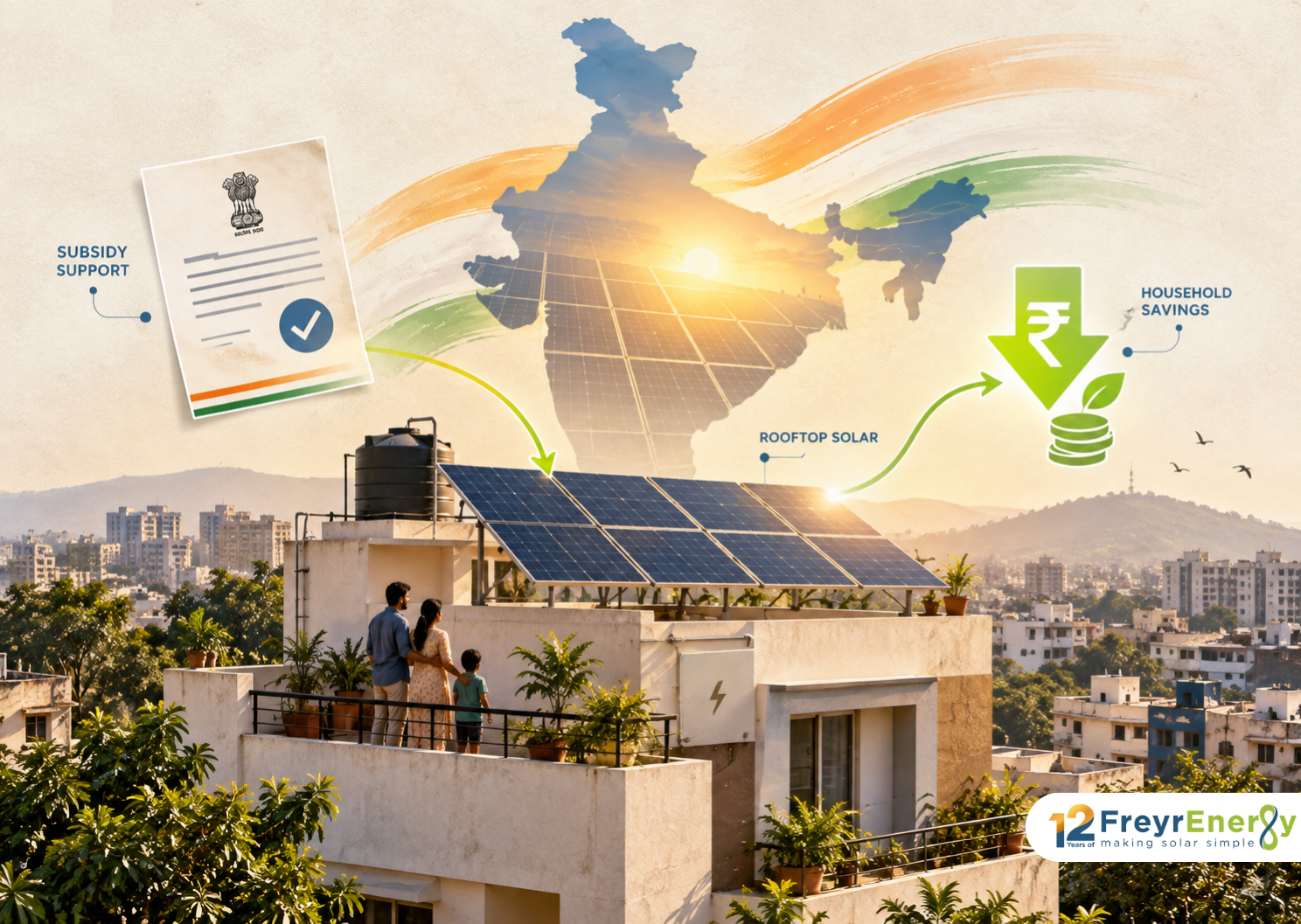
As of September 2026, the standard central financial assistance structure for an eligible individual residential rooftop installation is:
- ₹30,000 per kWp for the first 2 kWp
- ₹18,000 for the next 1 kWp
- no additional central assistance beyond 3 kWp, resulting in a maximum of ₹78,000 for an eligible system of 3 kWp or more
The installation must follow the prescribed National Portal and DISCOM process. Under the official guidelines, eligible systems use domestically manufactured modules made from domestically manufactured cells, and the system is inspected and commissioned through the relevant DISCOM process. Subsidy should not be shown as an automatic upfront discount or guaranteed payment.
Commercial and industrial connections are not eligible for this residential CFA. Housing societies and RWAs have a separate provision for common facilities, subject to scheme limits and conditions.
MSEDCL Net Metering and Approval in Pune
Pune consumers in MSEDCL’s supply area should use the current MSEDCL rooftop-solar process and the applicable MERC regulations. The 2024 MERC amendment provides simplified treatment for complete rooftop applications up to 10 kW: they are deemed accepted without a technical feasibility study, with any necessary sanctioned-load enhancement to be handled by the distribution licensee. Larger or unusual projects can require a feasibility study and network review.
Net metering does not mean the grid is a free battery in every circumstance. Energy accounting, carry-forward and settlement follow the applicable MERC regulations and the consumer’s tariff arrangement. Verify the current treatment on the application date.
Typical Application Journey
- Review the electricity connection, consumer details and sanctioned load.
- Register through the PM Surya Ghar National Portal when seeking residential CFA.
- Select a registered vendor and complete site survey and design.
- Complete the MSEDCL application and any required load or feasibility process.
- Install compliant equipment according to the approved design.
- Submit installation documents and request inspection and metering.
- Complete commissioning and portal requirements.
- Track subsidy processing separately from the vendor’s price and payment schedule.
Practical Installation Checklist for Pune Homeowners
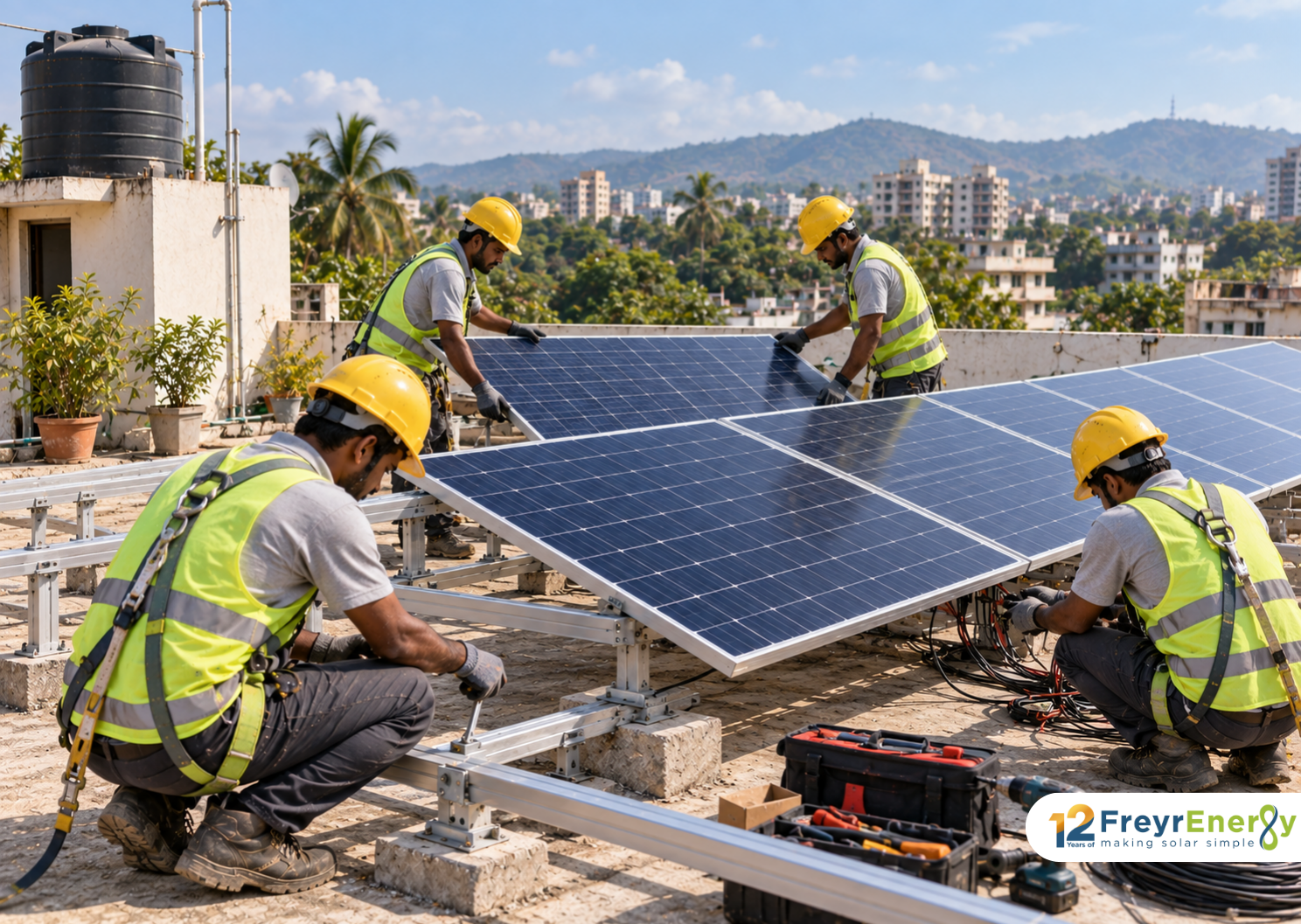
Before signing a contract, confirm:
twelve-month electricity consumption and anticipated new loads;
- usable, shadow-free roof area and structural condition;
- DC module capacity, AC inverter capacity and panel count;
- monthly generation estimate with documented loss assumptions;
- complete equipment makes, models and warranties;
- protection, earthing, lightning and cable specifications;
- waterproofing and roof-restoration responsibility;
- MSEDCL, metering and subsidy-document responsibilities;
- gross price, taxes, fees, financing and clear exclusions;
- payment milestones linked to actual project progress;
- monitoring access, training, maintenance and complaint handling; and
- what happens if subsidy is delayed or not approved.
Why Consult a Solar Professional?
An experienced installer can convert bills and roof measurements into a buildable design. The professional should test shading, assess the roof, select compatible components, prepare the electrical design, estimate generation and coordinate approvals. Speaking with multiple solar companies in Pune helps homeowners compare assumptions rather than relying on a single sales estimate.
Ask for the assumptions behind promised generation and savings. A useful proposal distinguishes guaranteed equipment specifications from estimated performance, and it explains limitations such as monsoon variability, shading, grid outages, degradation and future load changes.
How Freyr Energy Helps With Solar Installation in Pune
Freyr Energy serves residential customers in Maharashtra and can support site assessment, customised design, shadow analysis, installation planning, documentation and monitoring. The commercial content should follow the reader’s need: first establish the correct system size and roof suitability, then compare providers on equipment, execution, warranties and after-sales support.
Customised Solar Options
An On-Grid Solar System is generally suitable when the objective is electricity-bill reduction and grid supply is dependable. It uses modules, a grid-connected inverter, mounting, protection, metering and related balance-of-system components, without a battery in the standard configuration.
An Off-Grid Solar System includes battery storage and operates independently of the grid within its design limits. For many connected Pune homes that need some backup, a hybrid design may be more practical than going fully off-grid, but it should be sized from critical loads and backup hours.
Financing Guidance
Freyr Energy’s approved financing baseline includes EMI starting from ₹1,466 per month, indicative down payment of 10-20%, tenures of 6-120 months and zero-cost EMI for up to 12 months through CreditFair for eligible customers. These are not universal terms. Actual EMI, interest, down payment, tenure and approval depend on system price, lender policy and customer eligibility, and should be verified before publication and purchase.
Homeowners can switch to solar power after comparing the cash purchase and financed total cost, not merely the monthly EMI. The current solar panel price is only one part of the installed cost; structure, inverter, electrical safety, approvals, installation and service also determine value.
Conclusion
Installing rooftop solar in Pune can be a sound long-term decision when the design matches the home’s consumption, roof and electrical connection. Begin with 12 months of bills and a proper site assessment. Then compare gross cost, eligible subsidy, generation assumptions, equipment, warranties, MSEDCL responsibilities and financing on the same basis.
Avoid fixed panel counts, guaranteed savings and outdated price-per-watt claims. A modern 3 kW system may use five or six high-wattage modules, while the same nominal capacity can produce different results on two Pune roofs because of shadows, orientation, temperature and maintenance. The strongest proposal is the one that makes these assumptions transparent and supports them with a clear design, bill of quantities and service process.