
A large warehouse roof can look like an obvious place for solar panels, but roof area alone does not make a good project. The strongest warehouse solar projects combine a structurally suitable roof, a steady daytime load, a workable grid-connection arrangement, clear ownership rights and an ROI model based on realistic self-consumption. Cold storage, fulfilment centres, logistics parks and conventional godowns can have very different electricity profiles, so they should not be sized with the same rule of thumb.
This guide explains how solar for warehouses works in India, what drives warehouse solar panel cost, how to estimate the number of panels and system capacity, how to calculate payback, and what technical and commercial checks should happen before procurement.
Quick takeaways
- Warehouse solar panels are most attractive when the facility has a sound, unshaded roof and consumes substantial electricity during solar-generation hours.
- System capacity should be limited by both usable roof area and the site’s hourly load, not by monthly units or total roof size alone.
- Published 2026 market references for C&I rooftop projects span roughly ₹35,000 to ₹60,000 per kW, but warehouse quotes can move outside this range because of structure, roof condition, electrical scope and project size.
- A warehouse’s payback depends heavily on how much solar energy is self-consumed and how exported energy is credited under the applicable state and DISCOM rules.
- The central rooftop CFA described by MNRE is for eligible residential consumers, not a general subsidy for a standard commercial warehouse installation.
- Metal-sheet condition, structural reserve, wind design, waterproofing, fire access, earthing and operational shutdowns should be assessed before signing an EPC contract.
Is solar suitable for a warehouse?
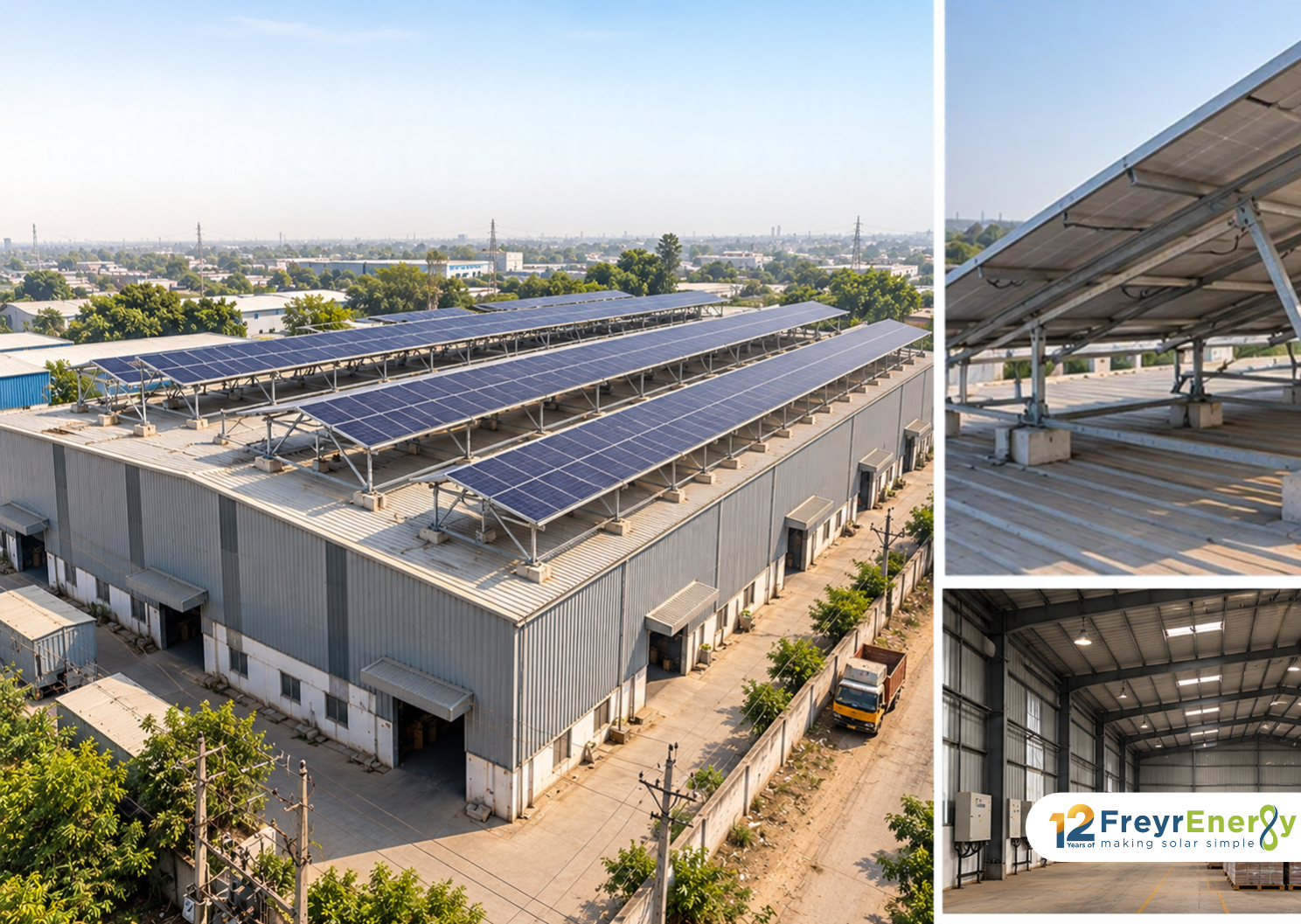
Yes, solar panels can be a strong fit for a warehouse when the roof is structurally suitable and the facility uses enough electricity during the day. The project is less attractive when the roof needs early replacement, daytime consumption is very low, most generation would be exported at an unfavorable rate, or the landlord and tenant cannot agree on asset ownership and bill savings.
Why warehouse rooftops can work well for solar
Warehouses often offer larger and less obstructed roofs than offices or retail buildings. That can reduce layout fragmentation and make construction more efficient. Solar output can also align with daytime loads such as lighting, ventilation, HVAC, refrigeration, conveyors, dock equipment, office areas, security systems and material-handling or EV charging.
The fit is not automatic. A dry-storage warehouse with efficient LED lighting may have a modest daytime baseload despite a very large roof. A cold-storage facility can have a high and relatively continuous load. An e-commerce fulfilment centre may sit between those two profiles, with peaks determined by shifts and automation. The electrical load profile, not the warehouse label, determines the usable solar opportunity.
Which warehouses benefit most
| Warehouse type | Typical solar fit | Critical sizing question |
| Cold storage and temperature-controlled logistics | Often strong because refrigeration and HVAC create sustained loads. | How much of the cooling load runs during solar hours, including seasonal peaks? |
| Fulfilment and distribution centre | Potentially strong where conveyors, automation, ventilation and charging run by day. | Does the operating schedule overlap solar generation throughout the year? |
| Conventional dry warehouse or godown | Site-dependent; roof area may exceed the facility’s electrical demand. | Will excess generation be exportable and economically valuable? |
| Multi-tenant logistics park | Good physical potential but more complex commercially and electrically. | Who owns the system, which meter receives the benefit, and how are savings allocated? |
| Leased single-tenant warehouse | Can work with a long lease and clear contractual rights. | Is the project term compatible with the remaining lease and roof warranty? |
How a warehouse rooftop solar system works
Solar modules produce direct-current electricity. Inverters convert it to alternating current and synchronize it with the warehouse electrical system. The warehouse consumes solar energy first when generation and demand occur at the same time. The grid supplies any shortfall. Surplus generation may be exported only under the applicable connection and settlement arrangement.
A conventional grid-tied system normally shuts down during a grid outage to protect utility personnel and equipment. Solar panels alone therefore do not provide backup. A backup requirement needs a deliberately designed system with compatible inverters, controls, batteries or another source; it changes cost, operating logic and safety design.
How to size solar for a warehouses
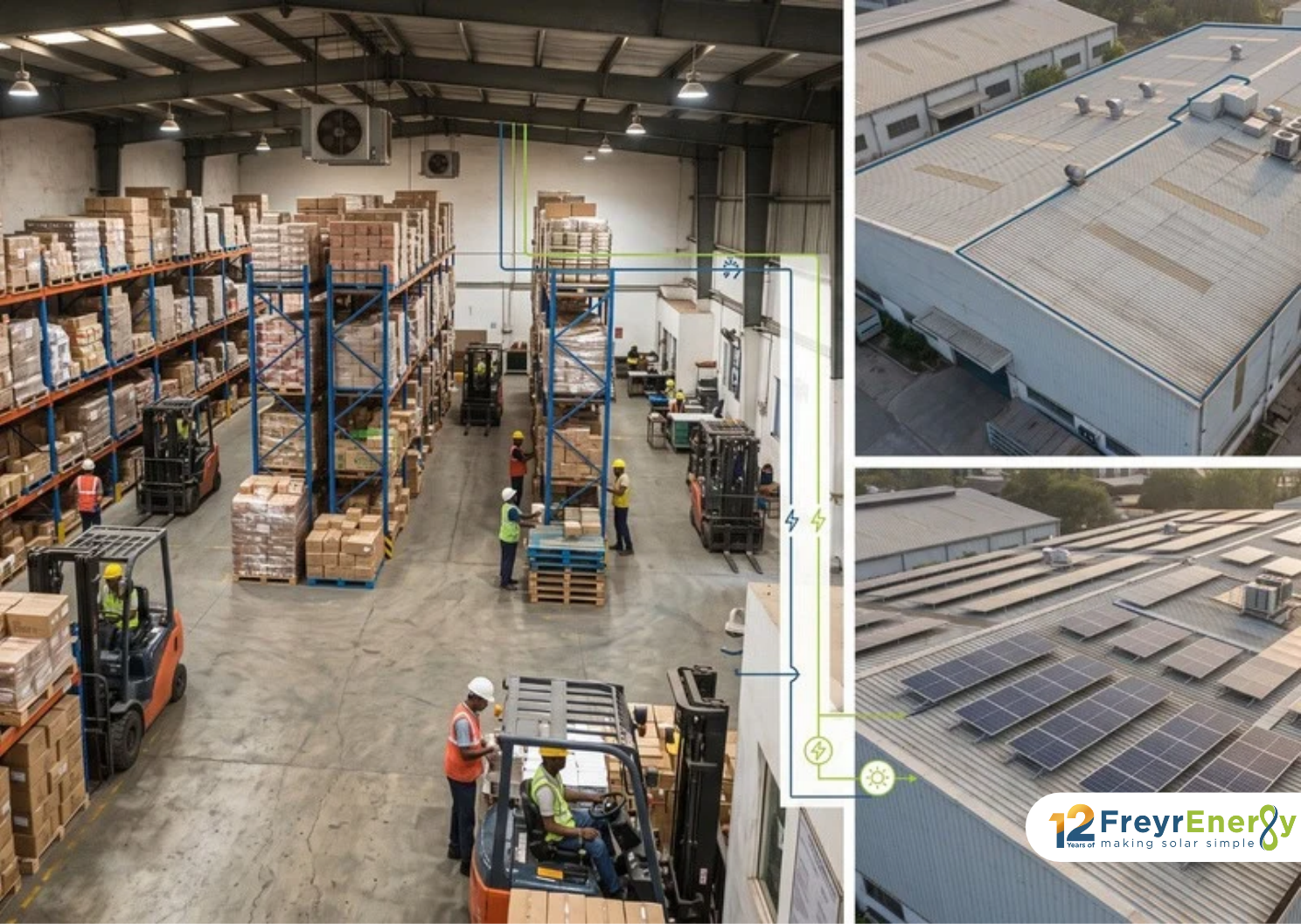
A sound design takes the lower of two practical limits: the capacity that fits safely on the usable roof and the capacity the warehouse can consume or economically export. Grid-connection limits, sanctioned load, transformer capacity and state regulations can reduce the final size further.
Step 1 Establish the usable roof area
Start with total roof area, then remove skylights, vents, HVAC equipment, smoke vents, drainage paths, fragile zones, fire-access routes, setbacks, shadowed areas and sections that cannot carry the required load. Metal roofs also need an assessment of sheet condition, purlins, corrosion, fasteners, remaining roof life and the mounting method.
For early planning, many commercial layouts use roughly 65 to 100 square feet of usable roof per kW. The actual density depends on module wattage, tilt, row spacing, orientation, access requirements and roof geometry. Treat this only as a screening range; a measured layout and structural review must establish the final capacity.
Step 2 Analyse interval load, not only monthly bills
Collect at least 12 months of electricity bills and, where available, 15-minute or 30-minute interval data. Identify sanctioned load, contract demand, energy charges, time-of-day charges, demand charges, power-factor penalties, seasonal consumption and operating days. The design team should overlay an hourly solar-production profile on this demand curve.
Monthly units can hide a poor daytime match. A warehouse may consume a large amount at night or in a short seasonal peak, while solar generates mainly during daylight. Sizing only from annual consumption can therefore produce avoidable exports and weaken ROI.
Step 3 Check the connection and export rules
Net metering, net billing, gross metering, export limits and settlement rates are governed through state regulations and DISCOM procedures. The Ministry of Power framework provides a national baseline, but the applicable state commission and DISCOM rules control the project in practice. Confirm the permitted capacity, application process, metering arrangement, transformer constraints, export credit and settlement period before financial closure.
How many solar panels does a warehouse need
Panel count is calculated from the proposed DC capacity and the wattage of the selected module:
Number of panels = system capacity in watts ÷ module wattage
Example: a 100 kW DC array using 550 W modules needs 100,000 ÷ 550 = 181.8, so the preliminary count is 182 modules. The final string design may adjust that number to match inverter voltage windows, MPPT configuration and layout constraints.
| DC system size | Panels at 550 W each | Planning roof range at 65 to 100 sq ft per kW |
| 50 kW | About 91 | 3,250 to 5,000 sq ft |
| 100 kW | About 182 | 6,500 to 10,000 sq ft |
| 250 kW | About 455 | 16,250 to 25,000 sq ft |
| 500 kW | About 910 | 32,500 to 50,000 sq ft |
| 1 MW | About 1,819 | 65,000 to 100,000 sq ft |
Planning note: these are arithmetic examples, not a design. Module wattage, access paths, setbacks, shading, roof capacity and local requirements change the count and space needed.
Warehouse solar panel cost in India

There is no single warehouse solar panel price. Published Indian C&I references in 2026 place broad installed-cost benchmarks at approximately ₹35,000 to ₹60,000 per kW. This range is useful for early budgeting, but it is not a Freyr Energy quotation and should not be used for approval without a site survey, single-line diagram, structural assessment and detailed bill of quantities.
| Illustrative size | Broad planning range | What can move the quote |
| 100 kW | ₹35 lakh to ₹60 lakh | Roof type, electrical interconnection, access and project scale |
| 250 kW | ₹87.5 lakh to ₹1.50 crore | Structural reinforcement, evacuation scope and equipment selection |
| 500 kW | ₹1.75 crore to ₹3.00 crore | HT integration, multiple sheds, transformer or protection upgrades |
| 1 MW | ₹3.50 crore to ₹6.00 crore | Site complexity, schedule, roof remediation and grid requirements |
Budgeting note: the table is a multiplication of the published ₹35,000 to ₹60,000 per kW market range. It does not state a guaranteed market price, include every tax or financing effect, or replace a project-specific quotation.
What should a warehouse solar quote include
- PV modules, inverters, module-mounting structure and roof attachments.
- DC and AC cabling, trays, combiner or distribution boxes, switchgear and monitoring.
- Earthing, lightning protection, surge protection, signage and emergency isolation.
- Structural assessment, design drawings, energy-yield report and generation assumptions.
- Installation access, lifting equipment, fall protection and site-safety provisions.
- Metering, DISCOM application support, testing and commissioning.
- Any transformer, HT panel, protection relay, power-quality or evacuation upgrade.
- Water supply or cleaning system, O&M scope, spares and monitoring responsibilities.
- Roof repairs, waterproofing, corrosion treatment or reinforcement, clearly shown as included or excluded.
- Taxes, insurance, financing costs, statutory fees and schedule-related exclusions.
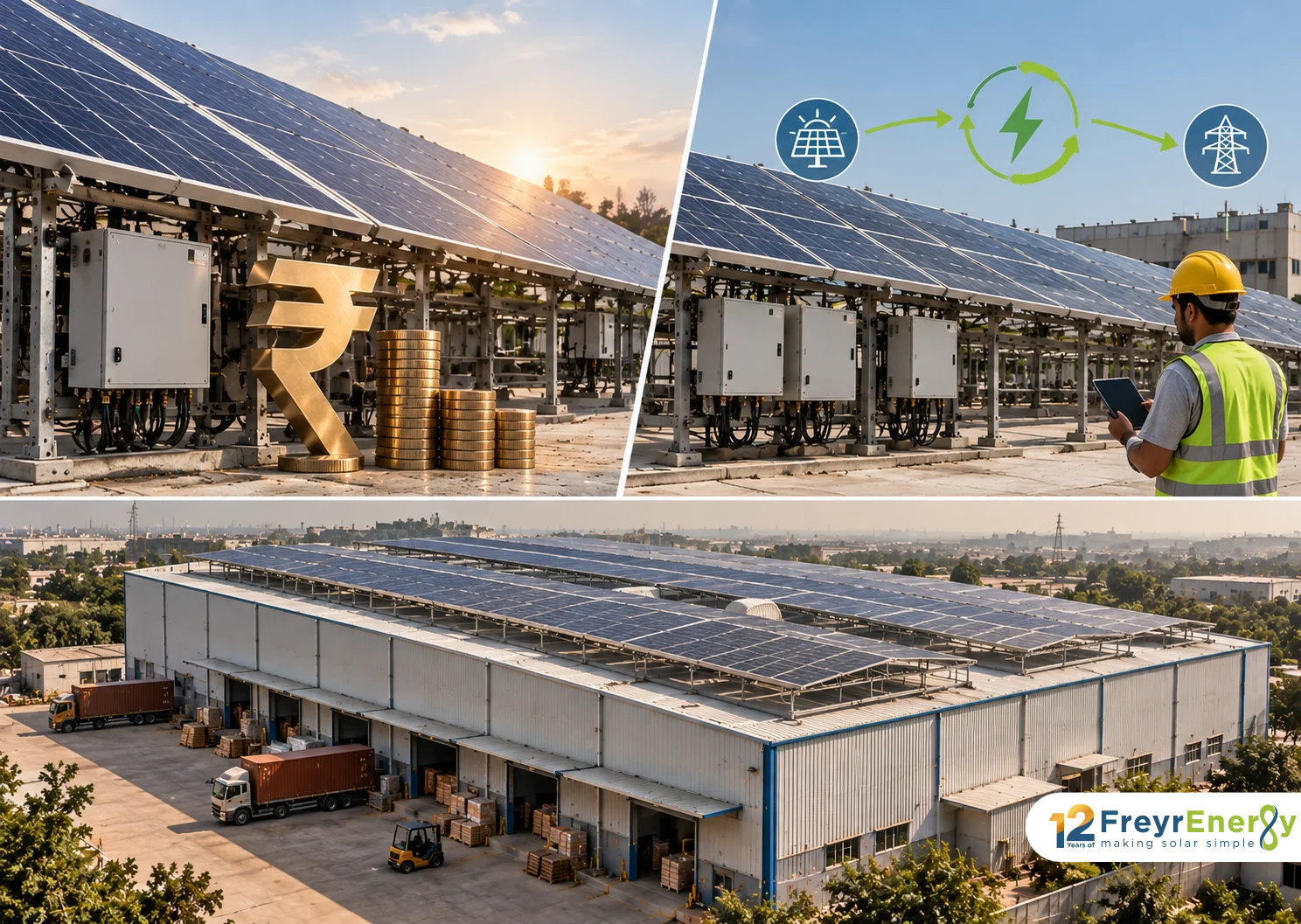
CAPEX vs OPEX or RESCO for warehouse solar
| Factor | CAPEX ownership | OPEX or RESCO model |
| Upfront payment | Warehouse owner or occupier funds the project. | Developer generally funds and owns the system, subject to contract terms. |
| Benefit | Owner retains energy savings and asset value. | Consumer purchases solar electricity under an agreed tariff or commercial structure. |
| Operations | Owner appoints or manages O&M. | Developer commonly retains performance and O&M responsibility. |
| Contract horizon | Driven by asset life and financing. | Usually requires a long-term agreement and credit review. |
| Best fit | Businesses with capital, tax capacity and long occupancy. | Businesses seeking lower upfront expenditure and willing to accept a long contract. |
| Key risk | Performance, maintenance and capital deployment. | Contract, escalation, early termination, roof access and counterparty risk. |
A leased warehouse needs additional clarity. The roof owner, electricity-account holder, solar-asset owner and party paying for roof repairs may be different entities. The lease or rooftop agreement should address access, removal, reinstatement, insurance, damage, roof replacement, change of tenant, lender rights and allocation of savings.
How to calculate warehouse solar ROI and payback
A credible warehouse solar ROI model separates self-consumed energy from exported energy because they may have different values. It also includes recurring costs and does not count demand-charge savings unless the load study supports them.
- Estimate annual generation using a site-specific simulation, including shading, temperature, wiring, inverter, soiling and availability losses.
- Estimate the self-consumption ratio by matching interval solar output against interval warehouse demand.
- Value self-consumed units at the avoidable energy charge, adjusted for time-of-day tariffs and charges that solar does not avoid.
- Value exported units at the applicable credit or settlement rate, if export is permitted.
- Subtract annual O&M, insurance, monitoring, cleaning, equipment-replacement reserves and other recurring costs.
- Model degradation, tariff assumptions, downtime, financing, taxes and working capital for a full NPV or IRR analysis.
Simple payback = initial project investment ÷ annual net cash saving
Illustrative 300 kW warehouse example
The following example demonstrates the method. It is hypothetical and is not a proposal, performance guarantee or universal benchmark.
| Input | Illustrative assumption | Calculation or note |
| Project capacity | 300 kW DC | Subject to roof, load and interconnection checks |
| Installed cost | ₹45,000 per kW | Initial investment = ₹1.35 crore |
| First-year specific yield | 1,450 kWh per kW | Annual generation = 435,000 kWh |
| Self-consumption | 85% | 369,750 kWh used behind the meter |
| Avoided energy value | ₹8.50 per kWh | Self-consumption value ≈ ₹31.43 lakh |
| Exported generation | 15% at ₹3.00 per kWh | Export value ≈ ₹1.96 lakh |
| Annual O&M and reserves | 1.5% of CAPEX | ≈ ₹2.03 lakh |
| First-year net saving | About ₹31.36 lakh | Before finance, tax and degradation effects |
| Simple payback | About 4.3 years | ₹1.35 crore ÷ ₹31.36 lakh |
Why the result changes: if the warehouse self-consumes only 60% and exported energy receives a much lower credit, payback becomes longer even if generation is unchanged. Roof reinforcement, interest during construction, inverter replacement, downtime or lower-than-modelled yield can also extend payback. Conversely, a higher avoidable tariff and strong daytime load can improve returns.
Warehouse solar panels payback period What is realistic
Current C&I articles and project examples commonly discuss simple payback in a broad range of roughly three to seven years. That is a market observation, not a promise. A warehouse should approve the project only after testing conservative, base and upside scenarios.
| Sensitivity | Conservative case | Base case | Upside case |
| Generation | Lower yield or more downtime | P50 or expected case | Strong yield and availability |
| Self-consumption | Lower daytime overlap | Measured typical overlap | High, stable daytime load |
| Export value | Low or restricted | Current applicable rule | Favourable settlement |
| Project cost | Roof or electrical upgrades | Defined EPC scope | Simple roof and interconnection |
| Tariff | Flat or lower avoidable rate | Current tariff structure | Higher future avoidable tariff |
For board or lender review, ask for NPV, project and equity IRR, debt-service coverage where relevant, sensitivity to tariff and yield, and a clear treatment of GST and depreciation. Accelerated depreciation can affect post-tax returns for eligible businesses, but the applicable rate and tax benefit should be confirmed by the company’s tax adviser against current Income Tax rules.
Does warehouse rooftop solar reduce demand charges
It may reduce billed demand in some circumstances, but the result is not automatic. A monthly demand peak can occur before sunrise, after sunset, during cloudy conditions or when solar output is low. Do not include demand-charge savings in the business case unless interval data and the applicable tariff demonstrate a repeatable reduction. Solar plus storage or active demand management may be needed when peak-demand control is the objective.
Is there a subsidy for commercial warehouse solar in India

Do not assume that the PM Surya Ghar subsidy applies to a commercial warehouse. MNRE’s current Grid Connected Rooftop Solar Programme page states that central financial assistance under the relevant component is provided to residential electricity consumers. A standard commercial or industrial warehouse installation should therefore be evaluated without residential CFA unless a specific current central, state or sector programme clearly establishes eligibility.
Businesses may still evaluate financing, state incentives, renewable-energy benefits and tax treatment, but each item requires current professional and regulatory confirmation. A quotation should keep subsidy, tax benefit, financing and project discount separate; none should be presented as guaranteed cash savings.
Net metering and approvals for warehouse rooftop solar
Commercial rooftop solar rules vary across India. Before procurement, confirm the state electricity regulatory commission’s current regulations and the local DISCOM procedure for the exact consumer category and connection voltage. Important questions include:
- Is the warehouse eligible for net metering, net billing, gross metering or zero export?
- What is the capacity limit relative to sanctioned load, contract demand or transformer capacity?
- How are exported units valued and when are credits settled or reset?
- Are banking, wheeling, cross-subsidy, additional surcharge or other charges relevant?
- What feasibility study, protection study, meter, inspection and commissioning steps are required?
- Will a transformer or HT protection upgrade be required?
For larger or multi-site users, open access, group captive or off-site solar may also be considered. Those routes have different legal, scheduling, banking and charge implications and should not be treated as a simple extension of rooftop net metering.
Engineering checks unique to warehouse roofs
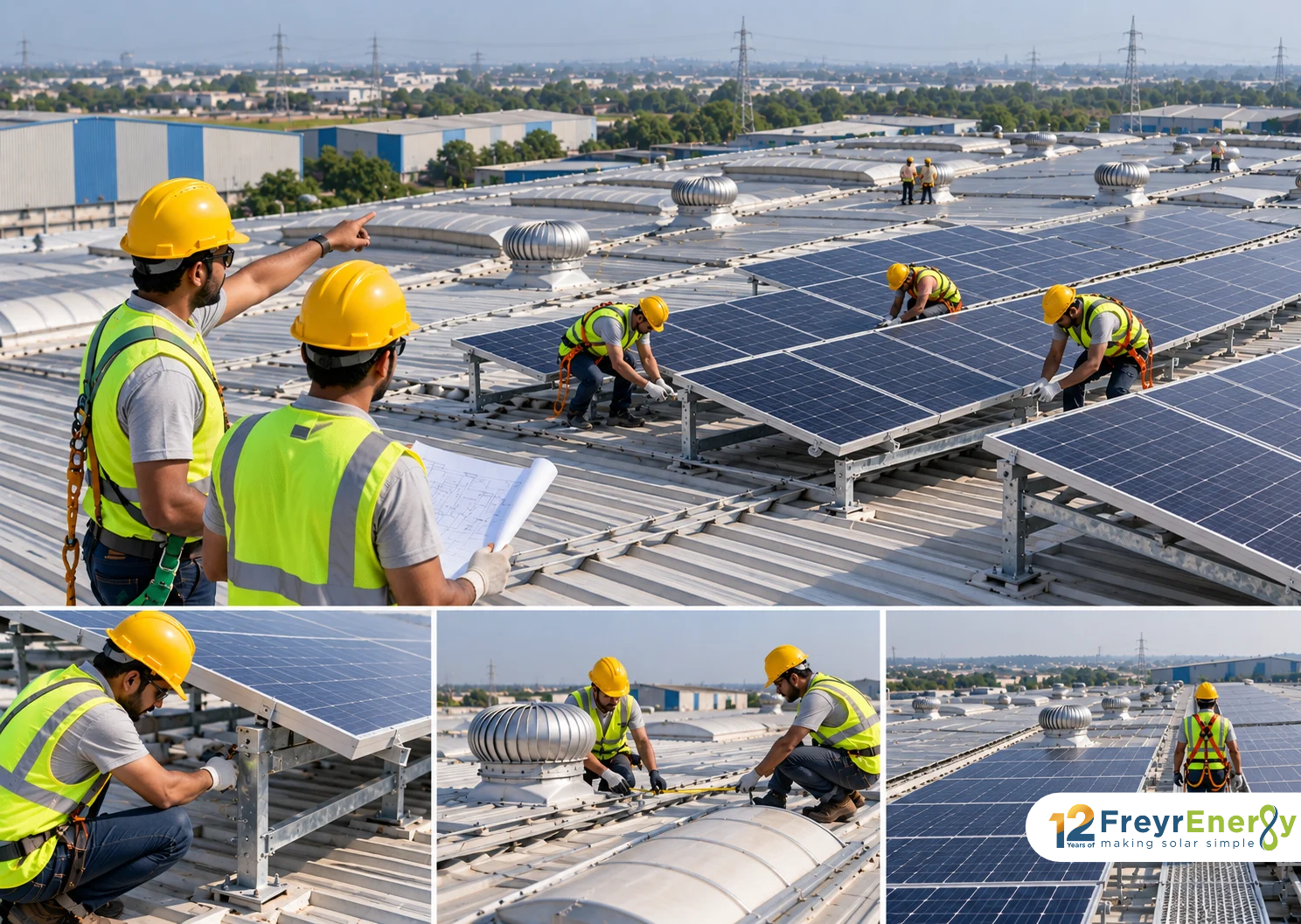
Structural capacity and remaining roof life
A qualified structural engineer should evaluate the roof deck, purlins, trusses, connections, corrosion, deflection, wind uplift and permissible loads. If the roof will need replacement well before the solar system, coordinate reroofing first or price the future removal and reinstallation of the array.
Mounting and waterproofing
Standing-seam, trapezoidal-sheet and RCC roofs need different attachment strategies. The mounting design should protect roof warranties, manage thermal movement, resist local wind conditions and avoid uncontrolled penetrations. Responsibilities for leaks and roof damage should be explicit in the contract.
Fire and emergency access
The layout should preserve required pathways, smoke vents, roof access, drainage and firefighting operations. Provide suitable isolation, labels, cable management, earthing, lightning and surge protection, and emergency documentation. The final design must follow applicable electrical, fire, building, insurer and authority requirements.
Operational continuity
Plan lifting, work-at-height controls, material storage, cable routes and electrical shutdowns around warehouse operations. Logistics sites may have continuous vehicle movement, sensitive inventory and strict dock schedules. A construction method statement should define barricading, permit-to-work controls, roof access and outage windows.
Quality and performance
MNRE technical specifications list core rooftop components and relevant module, inverter, protection, metering, earthing and documentation requirements for covered projects. A commercial procurement team should use applicable BIS, IEC, CEA, DISCOM and project-specific standards rather than accepting a panel-brand comparison as a complete quality review.
Do warehouses need batteries
Not necessarily. A grid-connected warehouse can reduce daytime grid purchases without batteries. Storage becomes relevant when the business needs backup for selected loads, peak-demand management, time-of-day optimisation, export limitation or power-quality support. Batteries add capital cost, controls, space, thermal and fire considerations, replacement planning and operating complexity. Compare the incremental battery benefit against these lifecycle costs.
Solar for cold storage warehouses
Cold storage often has a stronger load match than dry warehousing because compressors, fans and auxiliary equipment can run through the day. However, refrigeration duty changes with ambient temperature, product movement and operating practices. The solar design should use measured interval data and examine whether thermal storage, pre-cooling or battery storage can shift demand without compromising product conditions.
Backup design is especially important for temperature-sensitive inventory. A standard grid-tied solar plant is not a substitute for the facility’s emergency-power strategy.
Warehouse solar installation process

- Define the objective: energy-cost reduction, sustainability target, backup, peak control or roof monetisation.
- Collect 12 months of bills, interval data, sanctioned-load documents, roof drawings, lease documents and operating schedules.
- Complete roof, structural, shadow, electrical, safety and access surveys.
- Confirm the metering or export route with the state regulations and DISCOM.
- Prepare a detailed design, yield simulation, single-line diagram, bill of quantities, project schedule and risk register.
- Compare CAPEX, OPEX or RESCO and financing options using the same energy and tariff assumptions.
- Execute contracts covering scope, exclusions, roof responsibility, performance, warranties, insurance, delays and O&M.
- Install with approved safety and operational controls, then test protection, meters, inverter functions and system performance.
- Commission, train facility staff, hand over drawings and manuals, and begin monitored O&M.
Maintenance and performance monitoring
A warehouse solar system should be managed as an operating asset. Monitor generation, inverter availability, performance ratio or another agreed KPI, alarms, string behaviour and deviations from the weather-adjusted expectation. Cleaning frequency should reflect local dust, rainfall, roof access, water quality and safety; a fixed national cleaning interval is not appropriate for every site.
- Inspect modules, mounting, fasteners, roof interfaces and corrosion.
- Test earthing, protection and surge devices at the required intervals.
- Check cable trays, connectors, junction boxes, thermal hotspots and animal damage.
- Track inverter outages and response times.
- Coordinate roof work so other contractors do not damage the array or compromise safety.
- Keep spares, warranties, serial records, drawings, test reports and maintenance logs accessible.
Risks that can weaken warehouse solar ROI
| Risk | Why it matters | Mitigation |
| Oversizing | Creates low-value export or curtailment. | Size against interval load and confirmed export rules. |
| Weak roof or short remaining life | Adds reinforcement or future removal cost. | Complete structural and roof-life assessment before award. |
| Optimistic yield | Inflates savings and shortens claimed payback. | Review simulation inputs, losses and independent benchmarks. |
| Unclear lease rights | Can strand the asset or create disputes. | Align project term, access, ownership and exit obligations. |
| Ignored exclusions | Transformer, HT, access or roof work can create budget overruns. | Require an itemised scope and exclusions schedule. |
| Poor O&M response | Extended faults reduce generation. | Define monitoring, response, uptime and reporting obligations. |
| Policy assumption | Export valuation or eligibility may differ from the proposal. | Obtain current state and DISCOM confirmation. |
| Operational disruption | Work can affect docks, inventory and staff safety. | Use a site-specific construction and shutdown plan. |
How to compare warehouse solar proposals
- Compare projected kWh, not only kW and project price.
- Use the same irradiance, degradation, tariff and self-consumption assumptions across bidders.
- Ask for usable-roof drawings, shading results, structural basis and cable routes.
- Check module and inverter model, certifications, warranty terms and service access.
- Review generation guarantees wording, exclusions, measurement method and remedy.
- Confirm whether price includes taxes, metering, statutory fees, transformer or HT work, access systems, water supply and roof repairs.
- Review installation safety, insurance, workmanship warranty and roof-leak responsibility.
- Ask for commissioning tests, as-built documentation, monitoring ownership, O&M scope and response times.
- Run downside sensitivities before approving the warehouse solar ROI or payback period.
When solar may not be the right first step
Delay or redesign the project when the roof is unsafe or due for replacement, the electricity connection or lease will change soon, daytime load is too low, export is constrained, the business cannot accept a long PPA, or critical electrical upgrades are not included in the budget. Energy-efficiency measures may also deserve priority because reducing waste can lower the solar capacity required.
Planning a warehouse solar project with Freyr Energy
A useful warehouse proposal should connect roof conditions, interval demand, regulations and commercial assumptions in one design. Freyr Energy’s verified commercial and industrial solar pages describe customised project design, installation, monitoring and support for C&I facilities, including warehouses. The appropriate next step is a technical and financial feasibility assessment rather than a generic capacity or savings promise.
For a decision-ready assessment, prepare recent electricity bills, interval data if available, sanctioned-load details, roof drawings, site photographs, lease or ownership documents, planned load additions and the warehouse operating schedule. These inputs make it possible to test the right capacity, expected self-consumption, interconnection scope and project economics.
Conclusion
Solar for warehouses can convert underused roof area into a long-term energy asset, but the project succeeds on the quality of its assumptions. Start with the warehouse’s hourly load and the roof’s engineering condition. Confirm metering and export rules before valuing surplus energy. Compare proposals on expected kWh, scope, safety, warranties and downside economics, not only the lowest cost per kW.
A dry warehouse, cold store, fulfilment centre and multi-tenant logistics park may need different designs and commercial models. A site-specific feasibility study should therefore determine the warehouse solar system size, number of panels, cost, annual generation and payback period before an investment decision is made.