
The demand for household solar panels in India is rising at a high rate as families seek ways of saving on electricity bills and going to be energy uncover. The increasing power bills and frequent power outages in certain regions have turned solar energy into one of the most intelligent and certain selections of homes. It is long-term savings and constant power supply regardless of whether you live in an urban or a small town, which makes the installation of a solar system worthwhile, and a cleaner environment.
This blog will make you know it all, including the kinds of solar panels, the costs of installation, benefits, maintenance guidelines, among others, so that you are able to select the right kind of solar panels to install in your house.
What are the Solar panels in the house?
Household solar panels refer to roof-mounted systems that transform solar energy into power to be used in the household. They are used to run everyday appliances like lights, fans, TV, refrigerators and even small motors. Newer systems provided by companies such as Freyr Energy provide a soundless panel, have very minimal maintenance and have extensive warranties of 25-30 years. Today’s systems are designed for Indian weather conditions, making solar panels for household use a practical and affordable solution for all homes.
Types of Solar Panels & Systems
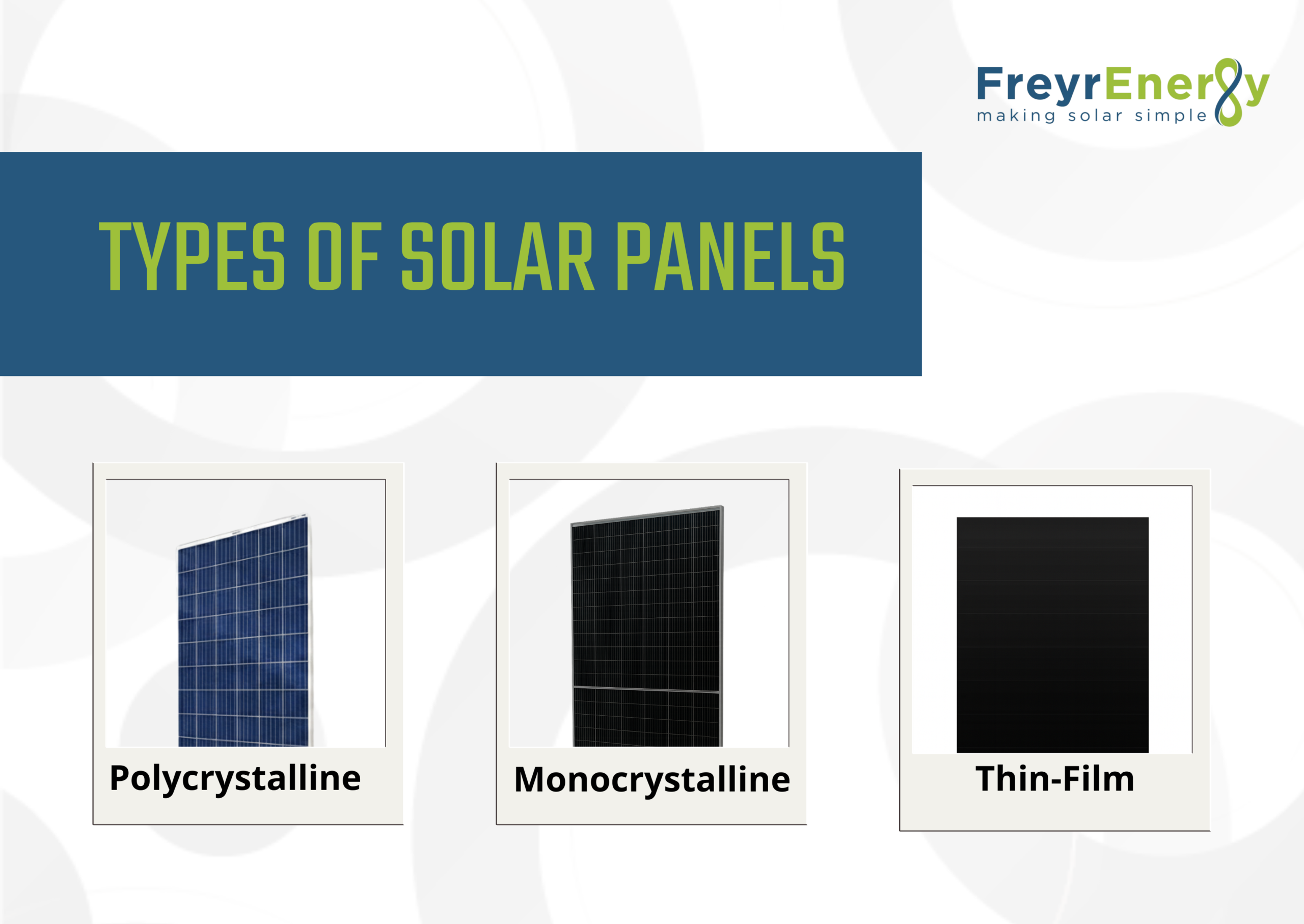
- Monocrystalline Solar Panels (Mono): Monocrystalline panels are produced with a crystal (silicon) and are uniform (black), most efficient (around 19-22%), and can utilise a small area of the roof, and are extremely expensive.
- Polycrystalline Solar Panels (Poly): These are made of many fragments of silicon, dark blue and are not as efficient (probably 15-17 percent), less costly, ideal in large facilities where space is not an issue.
- Thin-Film Solar Panels: Coated on the substrate, flexible and the least efficient (only 10-12 percent), are used in cars, industrial roofs and as portable devices.
Types of Solar Systems
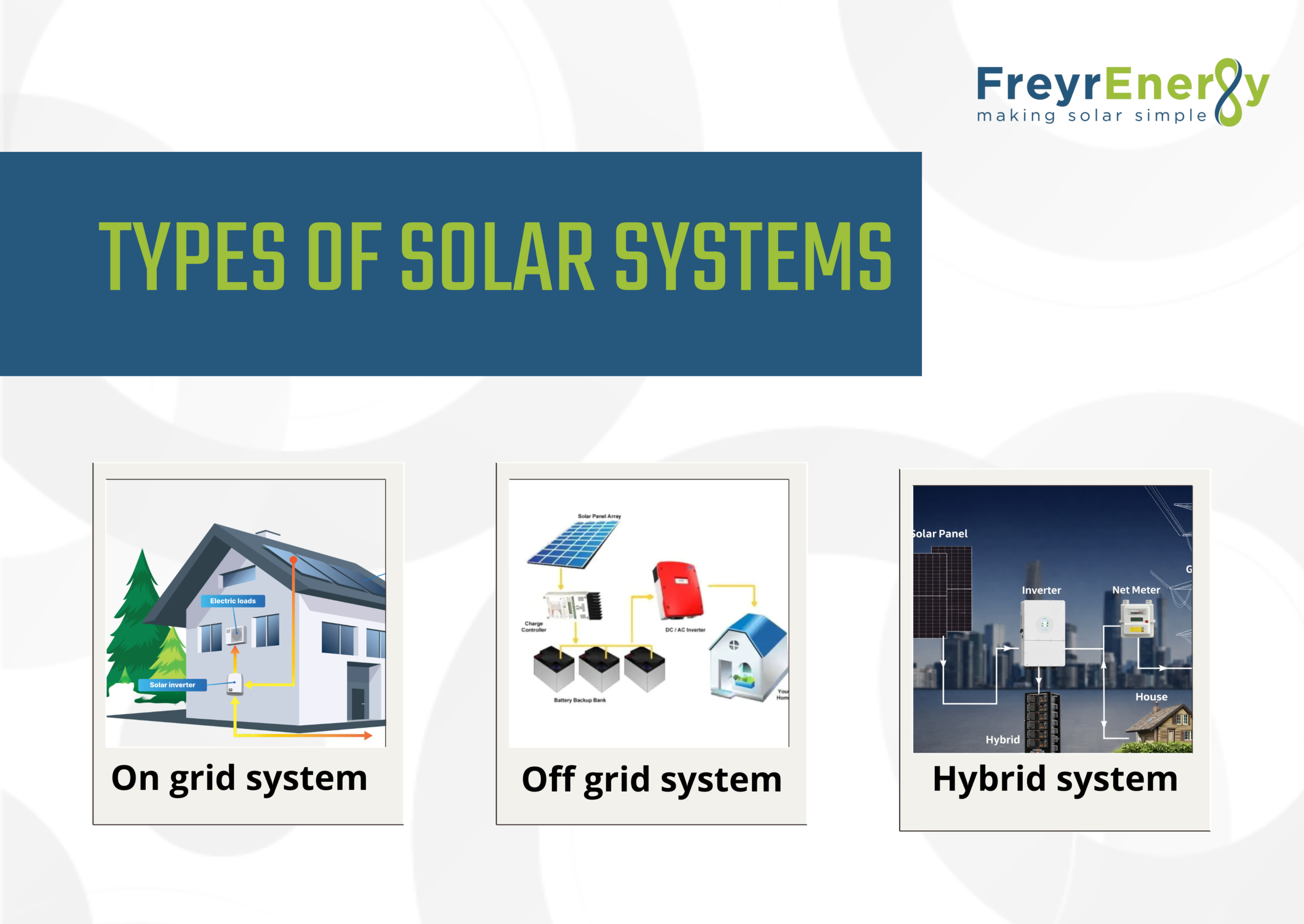
- On-Grid (Grid-Tied):
- Principle: It is connected to the public electricity grid, the surplus of electricity is sent to the grid to get credits (net metering), and in times when there is a low production of the sun, you take power out of the grid.
- Best for: It works well in urban localities with stable grid connectivity, in which you intend to cut on utility bills.
- Off-Grid (Stand-Alone):
- How it works: 100 percent independent, with large battery banks to store energy during the night or cloudy days; in most cases, it requires a generator backup.
- Best for: Remote areas, where grid access is unavailable, since it is complicated and expensive in a city.
- Hybrid (Grid-Tied with Battery Backup):
- How it works: It is connected to the grid, but it has batteries to store energy, so that it can be used when there is an outage and can lessen the dependence on the grid.
- Best for: Homeowners who want to be independent of energy and have a backup power supply without going off-grid.
Comparison Table Monocrystalline Panels vs Polycrystalline Panels vs Thin-Film Panels
| Feature | Monocrystalline Panels | Polycrystalline Panels | Thin-Film Panels |
| Efficiency | High | Medium | Low |
| Roof Space Required | Less | Medium | More |
| Cost | Higher | Medium | Low |
| Best For | Small rooftops, high output | Regular homes | Temporary installations |
Factors to Consider Before Choosing a Solar Panel
Roof Size & Direction
- The roof should receive clear sunlight throughout the day.
- South-facing roofs perform best.
- Avoid shade from trees, buildings, or water tanks.
Power Consumption
- Check your monthly electricity usage to choose the right system size.
- A solar power system for a small home usually ranges from 1 kW to 3 kW.
- Larger homes may require 5 kW or more.
Budget and EMI Options
Affordable Solar Solutions by Freyr Energy
Easy EMI options starting from ₹1,466
Flexible repayment tenures from 6 to 120 months
Government subsidies available to reduce upfront costs
Lower overall household solar panel investment
Brand & Warranty
- Choose panels with a 25–30-year performance warranty.
- Reputed brands ensure durability and better performance.
After-Sales Service
- Look for companies offering installation support and yearly maintenance.
- Quick customer service ensures long-term smooth operation.
Cost of Installing Household Solar Panels in India
The household solar panel cost in India varies depending on the size, type of panel, inverter, and installation quality.
Here is an approximate price range:
- 1 kW System: ₹1,20,000 – ₹1,30,000
- 2 kW System: ₹1,80,000 – ₹1,90,000
- 3 kW System: ₹2,30,000 – ₹2,40,000
- 5 kW System: ₹3,50,000 – ₹3,70,000
Government subsidies can help reduce costs significantly for residential rooftops. This makes household solar panels a smart long-term investment.
Benefits of Installing Household Solar Panels
Saves Up to 90% on Electricity Bills
- On-grid solar systems lower monthly bills through net metering.
- Families experience major long-term savings.
Protection from Rising Power Costs
- Electricity rates keep increasing every year.
- Solar helps lock your energy expenses for 25-30 years.
Backup Power During Outages
- Hybrid and off-grid systems provide electricity even during power cuts.
- Very useful in areas with frequent blackouts.
Clean and Renewable Energy
- Solar energy reduces pollution and supports a greener future.
- Eco-friendly choice for every household.
Increases Property Value
- Homes with solar systems attract more buyers.
- Property value often increases due to energy savings.
Low Maintenance
- The best household solar panels need minimal cleaning and care.
- Panels last for decades with very little upkeep.
Common Mistakes to Avoid While Selecting Solar Panels
- Choosing the cheapest option without checking quality
- Ignoring inverter quality
- Not selecting the right system size
- Overlooking installation space and shading
- Not verifying warranty and service support
Avoiding these mistakes ensures you get the most value from your solar panels for household use.
How to Maintain Your Solar Panels for Long-Term Performance
1. Regular Cleaning
- Dust and pollution reduce performance
- Panels should be cleaned every 2–4 weeks
Freyr Energy Makes Cleaning Easy
Freyr Energy offers India’s first self-cleaning solar technology, which cleans your panels automatically every morning.
This means:
- No manual cleaning
- No climbing on the roof
- Higher energy generation
- Zero effort from your side
A major benefit for elderly users and busy households.
Remove Leaves and Debris
- Ensure nothing blocks sunlight from reaching the panels.
- Keep the surface and surrounding area clean.
Monitor the Inverter
- The inverter display indicates if the system is working correctly.
- Contact your service provider if any warnings or errors appear.
Check for Shade Over Time
- Trees grow, and buildings change—new shade can lower power output.
- Trim branches or adjust placement if necessary.
Annual Professional Service
- A yearly inspection ensures smooth and efficient performance.
- Technicians can detect issues early and maintain system health.
With simple and regular care, your solar power system for small home can deliver reliable energy for 25–30 years or more.
Conclusion
One of the most appropriate things that Indian families can do today is to install household solar panels. It is possible to save on electricity and have a continuous power supply with the right system, coupled with protecting against the increase in the cost of energy.
Homeowners receive quality panels, quality service, smart financing and upscale features such as self-cleaning solar systems by contracting trusted providers like Freyr Energy. An off-grid, an on-grid, or mixed system will suit you; the most optimal household solar panels available in Freyr Energy will protect your wallet, bring convenience and tranquility.
Solar energy is not merely a fad; it is a brilliant move to the future with a brighter, cleaner and more sustainable future of your home.