Direct Answer
The Government of India provides financial assistance for installing rooftop solar installations on homes. The starting amount is ₹30,000/-, and max amount available is ₹78,000/- for 3 kW and above apply by logging through official PM Surya Ghar portal.
If you are under the impression that you will get rooftop solar panels completely free from the Government of India, then you are wrong. Instead, the GOI offers a subsidy under the PM Surya Ghar: Muft Bijli Yojana, where the eligible residents can avail financial aid for solar installation. For 1 kW system, the subsidy amount is ₹30,000/-
The subsidy amount is capped at ₹78,000/- for systems more than 3kW or above. You have to pay the remaining amount of the entire solar project cost. The scheme is available for residential consumers who are already using grid electricity.
Key Takeaways
- PM Surya Ghar was launched on 13 February 2024.
- Eligible households can get up to ₹78,000.
- States may provide extra assistance, subject to availability.
- DCR solar panels are compulsory.
- The subsidy is transferred after installation. DISCOM approval is mandatory.
- The homeowner has to pay the remaining cost.
What Is the Free Solar Panel Scheme by the Government of India?
The government scheme commonly called the free solar panel scheme is PM Surya Ghar: Muft Bijli Yojana.
What is PM Surya Ghar Muft Bijli Yojana?
It is a central government programme. It’s objective is to encourages households generate their own electricity. Homeowners install rooftop solar. Residents get their financial assistance upon process completion.
The system can supply electricity during the day. Surplus electricity can also go to the grid under an approved net-metering arrangement.
When was the scheme launched?
The Prime Minister launched the scheme on 13 February 2024.
What is the main objective of the scheme?
The government aims to install rooftop solar systems across one crore households.
How does the government solar subsidy programme work?
You register on the National Portal. Then select a registered solar vendor. Once you procure the required approvals, the vendor is free to install the system.
The DISCOM inspects the installation and completes the commissioning process. The eligible subsidy is then transferred to your bank account.
Does the government provide completely free solar panels?
No. The government pays only a part of the installation cost.
You have to pay the remaining amount. You can look out for financing with low EMIs to reduce the load.
How Much Subsidy Can You Get Under PM Surya Ghar Yojana?
The central subsidy depends on the installed solar capacity. Here is the standard structure applicable across most Indian states.
| Rooftop solar capacity | Central subsidy |
| 1 kW | ₹30,000 |
| 2 kW | ₹60,000 |
| 3 kW | ₹78,000 |
| 4 kW | ₹78,000 |
| 5 kW | ₹78,000 |
There is no additional central subsidy beyond 3 kW.
Is the subsidy the same across India?
Most states follow the standard subsidy structure shown above. However, special-category states and Union Territories receive higher assistance.
Are there additional benefits in special-category states?
Yes. Eligible installations receive ₹33,000 per kW for the first 2 kW. The additional 1 kW receives ₹19,800.
The maximum central subsidy becomes ₹85,800.
Is there any state-level subsidy in addition to the central subsidy?
Some states have initiated their own program apart from the central assistance. It helps them provide extra support to the consumers. Uttar Pradesh, for example, has published an additional benefit of ₹15,000 per kW, up to ₹30,000.
Does the subsidy cover the entire installation cost?
No. It covers a particular amount, but not the whole. You have to pay certain amount from your own pocket.
Who Is Eligible for the Free Solar Panel Scheme?
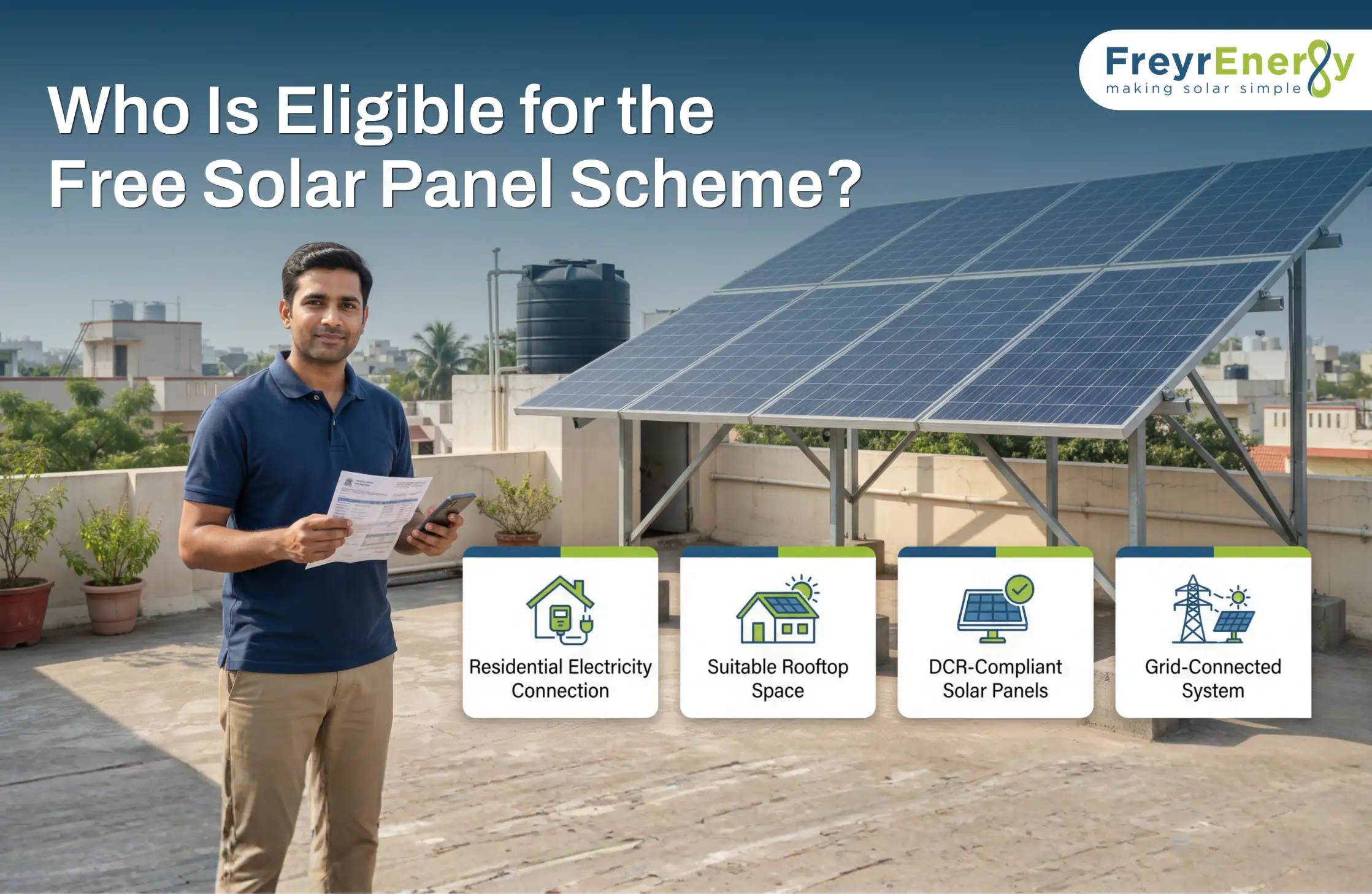
The scheme is meant for residential electricity consumers.
Eligibility criteria for PM Surya Ghar Yojana
The applicant needs:
- A valid residential electricity connection.
- A consumer account number from the local DISCOM.
- Suitable roof, terrace, balcony or approved elevated space.
- A grid-connected system meeting scheme requirements.
- DCR-compliant solar modules when claiming central subsidy.
Can tenants apply for rooftop solar subsidies?
The application is linked to the consumer’s electricity consumer number. Mostly, the electricity meter is in the homeowner’s name. Both parties have to agree, and if the landlord/homeowner is ready to give written permission, then a tenant can also apply
However, whether the solar system installed by the tenant is portable or not is a call that can be answered by the local supplier and authorities.
Can apartment residents apply?
Yes, if an eligible residential connection and suitable installation space are available.
Housing societies and RWAs can also apply for common facilities. This includes lifts, pumps, common lighting and EV charging.
Can households with existing solar panels apply?
Anyone who has already received the subsidy, cannot apply for another.
Are commercial and industrial properties eligible?
Commercial and industrial properties aren’t eligible for the residential central subsidy under this scheme.
How to Apply for the PM Surya Ghar Solar Subsidy?
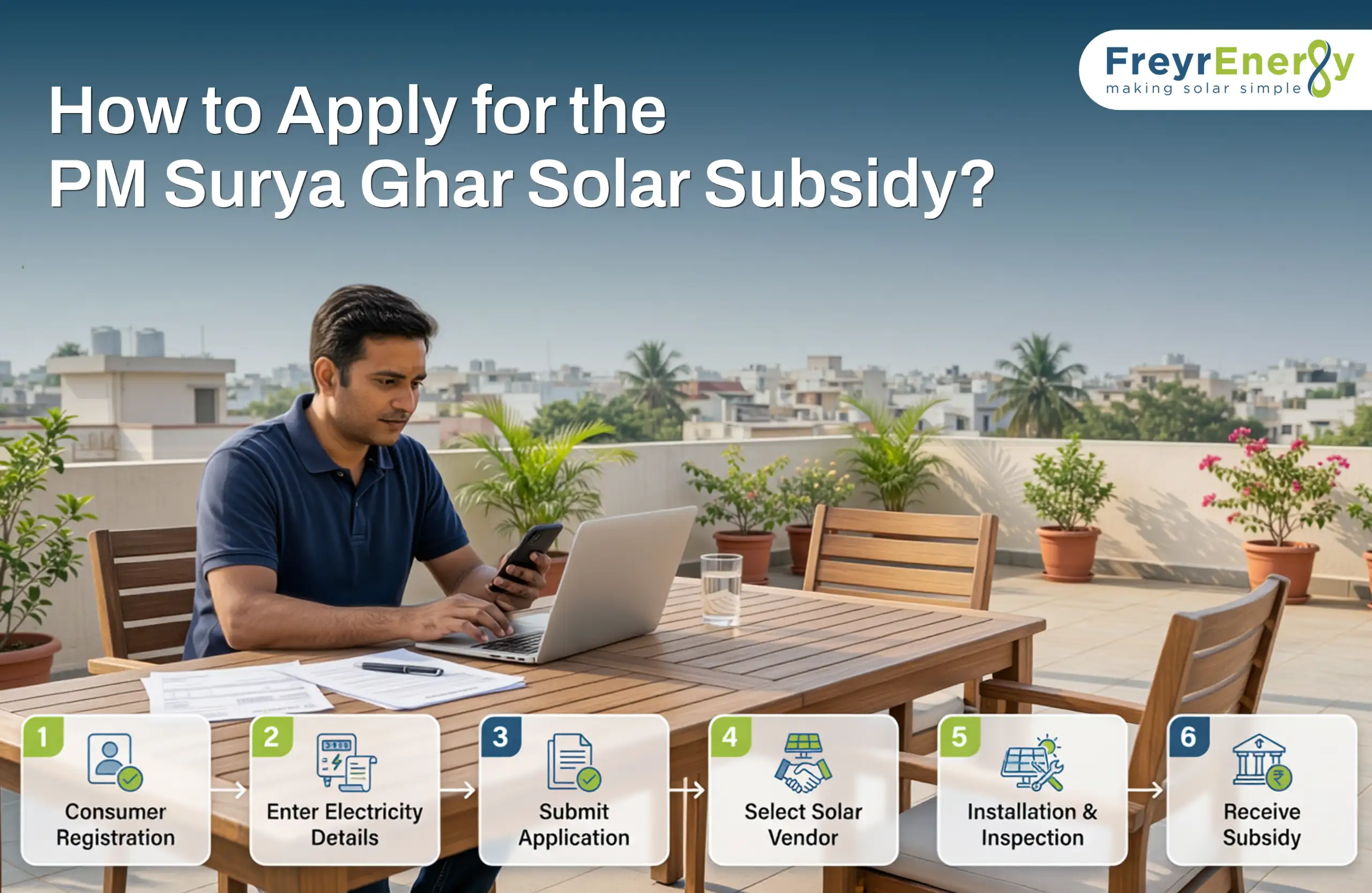
Apply through the official PM Surya Ghar National Portal.
How to register on the PM Surya Ghar portal
Apply through the official PM Surya Ghar National Portal.
- Visit the portal.
- Select consumer registration.
- Enter your state, DISCOM, electricity consumer number and mobile details.
- An application ID will be generated. Keep it safe for future reference.
How to select your electricity distribution company (DISCOM)
You will be able to find the DISCOM on your latest electricity bill.
How to submit a rooftop solar application
Fill in the rooftop solar application and submit it online. Complete the approval steps required by your DISCOM.
How to choose a registered solar vendor
You will find a list of vendors on the portal. Choose one.
How to complete installation and inspection
The vendor installs the system using eligible DCR modules. System details and required photographs are uploaded to the portal.
The DISCOM then inspects the installation and completes commissioning and metering formalities.
How to receive the subsidy in your bank account
Upload your bank account details with proof of account ownership. Eventually, DISCOM approves the application and the eligibile subsidy amount is activated via an e-token.
You need to redeem this amount through your consumer login. The subsidy process takes about 15 days.
What Is the Cost of Installing Solar Panels After Government Subsidy?
The cost depends on a few factors, such as system size, equipment and installation requirements. Indicative prices are as follows:
| System capacity | Indicative gross cost | Central subsidy | Estimated customer cost |
| 1 kW | ₹1.20–1.30 lakh | ₹30,000 | ₹90,000–1.00 lakh |
| 2 kW | ₹1.80–1.90 lakh | ₹60,000 | ₹1.20–1.30 lakh |
| 3 kW | ₹2.30–2.40 lakh | ₹78,000 | ₹1.52–1.62 lakh |
| 5 kW | ₹3.50–3.70 lakh | ₹78,000 | ₹2.72–2.92 lakh |
Prices vary between suppliers and locations. State support, where available, can reduce the final amount.
What is the cost of a 1kW solar system after subsidy?
A 1 kW system cost ₹1.20–₹1.30 lakh. After subsidy: ₹90,000–₹1 lakh.
What is the cost of a 2kW solar system after subsidy?
A 2 kW system cost ₹1.80–₹1.90 lakh. After subsidy: ₹1.20–₹1.30 lakh.
What is the cost of a 3kW solar system after subsidy?
A 3 kW system cost ₹2.30–₹2.40 lakh. After subsidy: ₹1.52–₹1.62 lakh.
How much does a 5kW rooftop solar system cost after subsidy?
A 5 kW system may cost ₹3.50–₹3.70 lakh. After subsidy: ₹2.72–₹2.92 lakh.
What additional expenses should homeowners consider?
They are as follows:
- Mounting Structures
- Wiring
- Protection Devices
- Net-metering Expenses
- Roof Repairs
- Electrical upgrades
How Much Electricity Can You Get from a Government-Supported Solar System
How many units can a 1kW solar system generate?
A 1 kW system can generate around 4–5 units every day. Monthly 120–150 units.
How many units can a 3kW solar system generate?
Around 12–15 units daily. 360–450 units monthly.
Can a 3kW solar system generate 300 units per month?
Yes. A 3 kW system can if the region receives suitable sunlight.
How can rooftop solar reduce monthly electricity bills?
Since you use your own electricity produced from sunlight, you use less grid electricity provided by DISCOM. Also, you earn credits for transfering the surplus energy to the grid, which offsets your electricity bill amount.
Does the Government Provide 300 Units of Free Electricity Every Month?
The scheme is designed to help households access up to 300 units of free or low-cost electricity.
Does PM Surya Ghar provide 300 free units directly?
No. Households use their solar energy system to produce electricity, which they consume for their own requirements.
How does rooftop solar generation reduce electricity bills?
You use solar energy from rooftop solar panels. It means you don’t use grid electricity. You use external grid energy only during night, saving substantial amount of money over electricity bills.
What happens when solar panels generate excess electricity?
You pass the surplus electricity to the grid and earn credits for that.
Can homeowners receive credits for surplus electricity?
Yes. Eligible net-metering consumers can receive bill adjustments for exported electricity. Settlement rules depend on the local DISCOM and state regulations.
What Types of Solar Panels Can Be Used Under the Government Scheme?
Are DCR solar panels mandatory for PM Surya Ghar?
Yes. To become eligible, modules manufactured in India must be used.
Can Non-DCR solar panels qualify for the subsidy?
No. If you use non-DCR panels, then you won’t be eligible for the central subsidy.
What are the technical requirements for eligible solar panels?
Modules must comply with the guidelines laid down by MNRE.
How to verify approved solar panel manufacturers?
Ask your installer for the exact manufacturer and model details. Check the applicable MNRE ALMM list and request supporting DCR documents.
Can You Get a Solar Subsidy Without Paying the Full Installation Cost Upfront?
Are loans available under PM Surya Ghar?
Yes. You can procure loans from reputed banks.
Can homeowners install solar panels through EMI?
Yes. Banks and financial institutions offer repayment options. Freyr Energy helps you procure a loan with easy EMIs.
What are the financing options for residential rooftop solar?
Homeowners can explore bank loans, EMI plans and eligible RESCO or utility-led models.
Is collateral-free financing available?
Yes. A July 2026 government announcement described loans at repo rate plus 50 basis points.
State-Wise Solar Subsidy and Additional Benefits in India
The central subsidy applies across most states. Some states may provide additional assistance through separate programmes.
Solar panel subsidy in Maharashtra
Eligible households can receive the standard central subsidy. Check MSEDCL and the National Portal for application details.
Solar panel subsidy in Telangana
The standard central subsidy applies. TSREDCO and the local DISCOM provide scheme information.
Solar panel subsidy in Uttar Pradesh
UPNEDA has published an additional state benefit of ₹15,000 per kW, up to ₹30,000. Confirm current availability before applying.
Solar panel subsidy in Kerala
Eligible households can claim central assistance. Check KSEB and ANERT for any targeted state support.
Solar panel subsidy in Madhya Pradesh
The central subsidy applies to eligible homes. Check the local DISCOM for any additional assistance.
Solar panel subsidy in Andhra Pradesh
The central subsidy applies. In November 2026, Andhra Pradesh proposed an additional ₹20,000 for eligible BC households. This proposal should not be treated as an approved benefit yet.
Solar panel subsidy in special-category states
Uttarakhand, Himachal Pradesh, Jammu and Kashmir, Ladakh, North-Eastern states, Sikkim, Andaman and Nicobar Islands and Lakshadweep receive higher central subsidy rates.
Common Mistakes to Avoid When Applying for a Solar Subsidy
You must understand how the portal process works, before you install your solar. Before selecting a vendor, check DCR compliance, equipment and service quality, reputation of the vendor and then select one. Be careful while entering your consumer number and bank details.
Read the quotation and warranty conditions before signing. Keep your application ID, invoice and commissioning documents safely.
Is the Government Solar Panel Scheme Worth It?
For homes with suitable roof space and regular electricity use, the scheme can reduce the initial investment. The best results come from choosing the right system size and understanding the subsidy conditions.
Solar panels are not free. However, government assistance can make rooftop solar more affordable and help households manage electricity expenses over time.