
Installing rooftop solar in 2026 can significantly reduce a household’s electricity costs, but understanding the subsidy available in your state is just as important as choosing the right solar system.
Under PM Surya Ghar: Muft Bijli Yojana, eligible residential consumers can receive Central Financial Assistance (CFA) for rooftop solar. However, the final benefit available to a homeowner may differ depending on the state, consumer category, local DISCOM rules and whether an additional state-level scheme is active.
The scheme has already reached substantial scale. As of 22 July 2026, nearly 39.72 lakh rooftop solar systems covering more than 48 lakh households had been installed under PM Surya Ghar.
This guide explains the state-wise solar subsidy landscape in 2026, the central subsidy amounts, eligibility requirements, application process and the checks homeowners should make before installing rooftop solar.
Quick Takeaways
- Eligible residential consumers can apply for rooftop solar subsidy through PM Surya Ghar: Muft Bijli Yojana.
- The commonly communicated central subsidy is ₹30,000 for 1 kW, ₹60,000 for 2 kW and ₹78,000 for 3 kW or above.
- The central household subsidy is capped at the eligible amount applicable up to 3 kW; installing a larger household system does not increase the standard central subsidy beyond the applicable maximum.
- State-level benefits are not uniform across India. Additional assistance, where available, depends on the state scheme and eligibility conditions.
- Your DISCOM, consumer category, metering arrangement and system approval can affect the application process.
- Always verify the latest benefit on the PM Surya Ghar National Portal and your state/DISCOM’s official channels before purchasing a system.
How Much Central Solar Subsidy Can You Get in 2026?
For homeowners, the simplest way to understand the currently communicated PM Surya Ghar subsidy is through the standard system-size slabs.
| Residential rooftop solar capacity | Central subsidy |
| 1 kW solar panel | ₹30,000 |
| 2 kW solar panel | ₹60,000 |
| 3 kW solar panel or above | ₹78,000 maximum |
The Government of India continues to communicate these three figures in its public-facing information on the scheme.
For example, installing a 5 kW rooftop solar system does not mean receiving ₹30,000 × 5. For a standard residential installation, the central subsidy is capped at the applicable maximum for capacity up to 3 kW.
Which system size may suit your electricity consumption?
Government guidance broadly connects household electricity consumption with suitable rooftop solar capacity:
| Average monthly electricity consumption | Suggested rooftop solar capacity | Indicative subsidy support |
| 0–150 units | 1–2 kW | ₹30,000–₹60,000 |
| 150–300 units | 2–3 kW | ₹60,000–₹78,000 |
| Above 300 units | Above 3 kW | ₹78,000 |
These are indicative capacity ranges. Your actual system size should also consider available roof area, daytime consumption, sanctioned load, electricity tariff and future electricity requirements.
Is Solar Subsidy the Same in Every State?
Not necessarily.
The central PM Surya Ghar scheme applies nationally, but homeowners should not assume that every state’s overall rooftop solar benefit or implementation process is identical.
There are two layers to understand:
Central subsidy: The CFA available through PM Surya Ghar forms the primary subsidy available to eligible residential consumers.
State-level benefit: A state may introduce additional assistance for certain consumers or programmes. These benefits can have separate eligibility criteria, budgets, application windows and implementation conditions.
Therefore, when someone says, for example, “solar subsidy in Uttar Pradesh” or “solar subsidy in Maharashtra,” the correct question is not simply how much subsidy does that state give?
You need to determine:
Central CFA + currently active state benefit, if any + eligibility conditions + DISCOM requirements.
This distinction prevents homeowners from treating old announcements or expired state programmes as currently available subsidies.
State-Wise Solar Subsidy: What Homeowners Should Check
State subsidy policies can change more frequently than the central scheme. Instead of relying on a static “subsidy amount” copied from an old article, homeowners should verify the current position for their electricity connection.
| State | Central CFA (PM Surya Ghar) | Additional state benefit (verified position) | Maximum combined support | Implementing agency / DISCOM |
| Telangana | Up to ₹78,000 ₹30,000: 1 kWp ₹60,000: 2 kWp ₹78,000: 3 kWp+ | ₹0 universal top-up verified Check for any targeted programme before applying. | Up to ₹78,000 Central CFA only | TGREDCO; TGSPDCL / TGNPDCL |
| Andhra Pradesh | Up to ₹78,000 ₹30,000: 1 kWp ₹60,000: 2 kWp ₹78,000: 3 kWp+ | ₹0 universal top-up verified Targeted beneficiary programmes should not be treated as a general subsidy. | Up to ₹78,000 Central CFA only | NREDCAP; APEPDCL / APCPDCL / APSPDCL |
| Kerala | Up to ₹78,000 ₹30,000: 1 kWp ₹60,000: 2 kWp ₹78,000: 3 kWp+ | ₹0 universal top-up verified Follow the live KSEB and National Portal route. | Up to ₹78,000 Central CFA only | KSEB; eKiran and National Portal |
| Maharashtra | Up to ₹78,000 ₹30,000: 1 kWp ₹60,000: 2 kWp ₹78,000: 3 kWp+ | No universal top-up verified MSEDCL SMART benefits are scheme- and category-specific. | Up to ₹78,000 under central CFA Higher only where a live targeted scheme applies. | MSEDCL; SMART portal where eligible |
| Madhya Pradesh | Up to ₹78,000 ₹30,000: 1 kWp ₹60,000: 2 kWp ₹78,000: 3 kWp+ | ₹0 universal top-up verified Ask for the current order before counting any additional amount. | Up to ₹78,000 Central CFA only | MP Urja Vikas Nigam; relevant DISCOM |
| Uttar Pradesh ★ | Up to ₹78,000 ₹30,000: 1 kWp ₹60,000: 2 kWp ₹78,000: 3 kWp+ | UPNEDA state subsidy ₹15,000 per kWp up to 2 kWp; maximum ₹30,000 per consumer, subject to live eligibility and funding. | 1 kWp: up to ₹45,000 2 kWp: up to ₹90,000 3 kWp+: up to ₹1,08,000 | UPNEDA; UPPCL and the relevant DISCOM |
Solar Subsidy in Andhra Pradesh
Residential consumers should begin with the PM Surya Ghar central subsidy and check the latest rooftop-solar requirements with the relevant Andhra Pradesh DISCOM and state renewable-energy authorities.
Before installation, verify:
- Consumer-category eligibility
- DISCOM application requirements
- Metering requirements
- Registered vendor status
- Whether any additional targeted state programme applies to your category
Solar Subsidy in Telangana
Homeowners in Telangana can apply under PM Surya Ghar subject to the applicable residential and DISCOM requirements.
Check the latest information from the relevant DISCOM and state renewable-energy authorities before assuming that an additional state subsidy is available.
Solar Subsidy in Maharashtra
Maharashtra homeowners should verify their PM Surya Ghar entitlement along with any currently active state or utility programme for their specific consumer category.
Do not combine central CFA with a state benefit in your cost calculation unless the additional benefit is confirmed for your electricity connection and application.
Solar Subsidy in Madhya Pradesh
For Madhya Pradesh, homeowners should use PM Surya Ghar central assistance as their baseline and confirm any additional current benefit through the relevant DISCOM or official state channel.
Solar Subsidy in Uttar Pradesh
Uttar Pradesh has had additional state-level support alongside the central rooftop-solar programme. Because state allocations and eligibility conditions can change, homeowners should verify the current UPNEDA/DISCOM position before treating the state benefit as guaranteed.
Your quotation should clearly separate:
Central subsidy → State benefit → Installer discount → Financing/loan
These are four different things.
Solar Subsidy in Kerala
Kerala homeowners should verify their central PM Surya Ghar entitlement and follow the applicable KSEB rooftop-solar application and metering process.
Any additional benefit should be confirmed through the current official scheme rather than assumed from older subsidy articles.
Why State-Wise Solar Subsidy Is About More Than the Subsidy Amount
Two homeowners installing the same capacity rooftop solar system can have different experiences even if their central subsidy is similar.
That’s because several other factors vary by location.
1. DISCOM process
Your local electricity distribution company plays an important role in rooftop solar commissioning and the scheme workflow.
2. Metering arrangement
The applicable metering and settlement framework depends on state electricity regulations and DISCOM implementation.
3. Electricity tariff
A subsidy reduces the initial investment, while your electricity tariff and solar consumption determine how much money you can save over time.
4. Roof and system design
Roof orientation, shading, available area, structure and system configuration influence generation and project cost.
5. Additional state programmes
Some benefits may apply only to specific consumer groups rather than every homeowner in a state.
This is why choosing solar solely on the basis of the “highest subsidy” can be misleading.
Who Is Eligible for PM Surya Ghar Subsidy?
PM Surya Ghar is designed for residential rooftop solar consumers with grid-connected electricity connections who meet the applicable scheme requirements. The government confirmed in July 2026 that residential consumers, including rural households with grid-connected DISCOM connections, can participate through the National Portal.
Homeowners should check:
- Whether the electricity connection qualifies as residential
- Whether the rooftop is suitable for solar installation
- Whether the proposed system meets scheme requirements
- Whether the selected vendor is eligible under the programme
- Whether required equipment and installation standards are met
- Whether the application is completed through the prescribed portal/DISCOM process
Eligibility should always be checked against the current National Portal record for the consumer connection rather than assumed from general online information.
How to Apply for Solar Subsidy Under PM Surya Ghar
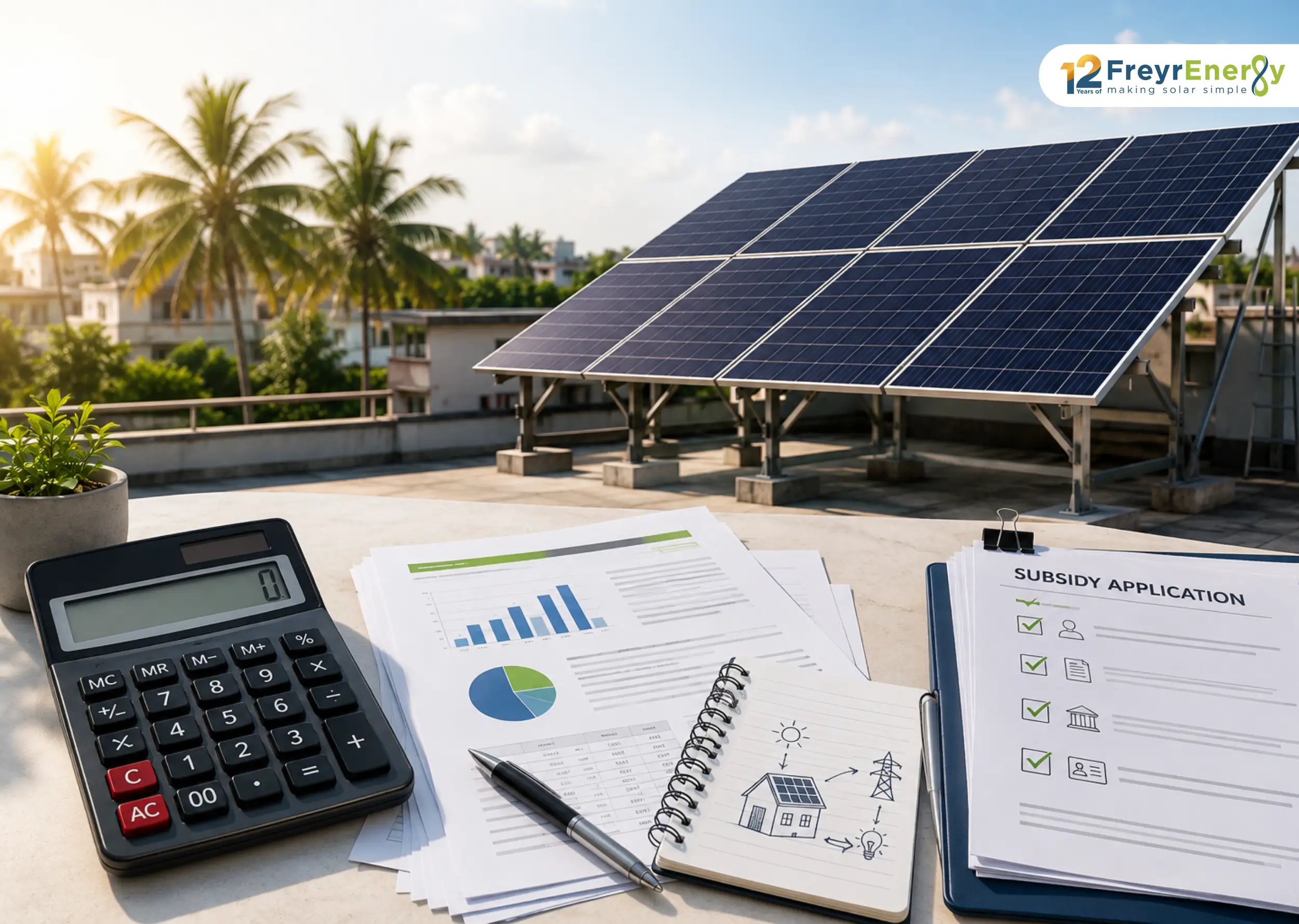
The application begins through the PM Surya Ghar National Portal.
Step 1: Register on the National Portal
Select your state and electricity distribution company and enter the required consumer details.
Step 2: Complete the rooftop solar application
Provide the information required for your electricity connection and proposed rooftop solar installation.
Step 3: Select an eligible vendor
Compare installers based not only on price but also on system components, warranties, installation quality and after-sales service.
Step 4: Install the rooftop solar system
The installation should follow the technical and equipment requirements applicable under the scheme.
Step 5: Complete the DISCOM process
Required inspection, commissioning and metering steps need to be completed according to the applicable process.
Step 6: Complete subsidy redemption
After the required approval and verification stages, eligible CFA is processed through the scheme mechanism.
Government reporting in March 2026 stated that the average CFA processing time was around 15 days after the consumer’s redemption request when portal credentials were correct. This should not be interpreted as the total time from first registration to completed installation, because installation, inspection and commissioning happen before subsidy processing.
How to Check Whether Your State Offers an Additional Solar Subsidy
Before signing a solar contract, follow this verification process:
- Check your central entitlement through the PM Surya Ghar National Portal.
- Check the official website of your state renewable-energy agency.
- Check your DISCOM’s rooftop-solar page.
- Look for a current notification, government order or live application programme.
- Confirm whether the scheme applies to your consumer category and system size.
- Ask your installer to show any state subsidy separately from central CFA.
- Confirm eligibility before paying an advance.
An announcement that a subsidy was launched does not necessarily mean funds are currently available for every new applicant.
Central Subsidy vs State Subsidy vs Installer Discount
This distinction is particularly important when comparing solar quotations.
Suppose an installer tells you that your “total benefit” is ₹1 lakh.
Ask them to break it down.
| Benefit | What it means |
| Central CFA | Government of India assistance under the applicable PM Surya Ghar rules |
| State subsidy/benefit | Additional state assistance, if currently applicable |
| Installer discount | Commercial discount offered by the solar company |
| Loan/financing | Payment facility; not a subsidy |
A solar loan does not increase the subsidy amount. It changes how you finance the remaining cost of the solar system.
What Can Delay Your Solar Subsidy?
Most subsidy problems are easier to avoid before installation than after it.
Common issues include:
- Incorrect consumer information
- Bank-account detail mismatches
- Choosing an ineligible or unregistered vendor
- Equipment that does not meet scheme requirements
- Missing documents
- Incomplete installation information
- Pending DISCOM inspection
- Metering delays
- Incorrect portal information
Check your application details carefully and keep copies of your quotation, invoices, equipment details and application records.
Why Choosing the Right Solar Installer Matters
The solar subsidy is only one part of the economics of rooftop solar.
A lower-quality system that qualifies for subsidy can still perform poorly over its lifetime.
When comparing installers, evaluate:
- Solar module and inverter specifications
- System design
- Installation quality
- Structural safety
- Generation estimates
- Warranty coverage
- Monitoring
- Documentation support
- Subsidy-process assistance
- After-sales service
The goal should be to reduce your lifetime electricity cost, not simply maximize the subsidy shown in a quotation.
The Bottom Line
The best way to evaluate a state-wise solar subsidy in 2026 is not to chase the largest number advertised online.
Start with the current central PM Surya Ghar entitlement for your residential connection. Then check whether your state has an additional active benefit. Finally, compare the net installed cost, expected solar generation, electricity savings, equipment quality, warranty and after-sales support.