
Solar Subsidy in India 2026: PM Surya Ghar Yojana Eligibility, Amount & Complete Application Guide
Installing rooftop solar has become more affordable than ever with the Government of India’s PM Surya Ghar Muft Bijli Yojana. Eligible homeowners can receive a solar subsidy of up to ₹78,000, helping reduce the upfront cost of installing a rooftop solar system while lowering electricity bills for years to come.
However, many homeowners still have questions about who is eligible, how much subsidy they can receive, what documents are required, and how to apply without delays. Understanding the complete process before installation can help you avoid common mistakes and ensure a smooth subsidy claim.
This comprehensive guide explains everything you need to know about the solar subsidy in India, including the latest subsidy amount, eligibility criteria, state-wise availability, required documents, application process, DISCOM verification, net metering, subsidy timelines, common reasons for rejection, and financing options. Whether you’re planning to install a 1 kW, 3 kW, or 5 kW rooftop solar system, you’ll find all the information you need in one place.
Quick Takeaways
PM Surya Ghar: Muft Bijli Yojana, launched in February 2024 by the Ministry of New and Renewable Energy (MNRE), offers a government subsidy of up to ₹78,000 for eligible residential rooftop solar systems.
The subsidy is available only for grid-connected residential rooftop solar installations that meet the scheme's eligibility criteria.
Eligible homeowners can receive ₹30,000 for a 1 kW system, ₹60,000 for a 2 kW system (₹30,000 per kW for the first 2 kW), and up to ₹78,000 for a 3 kW or larger system (an added ₹18,000 for the third kW, capped there - larger systems don't get more).
The subsidy is transferred directly to the beneficiary's bank account through Direct Benefit Transfer (DBT), typically within 30–45 days of successful installation and DISCOM verification/commissioning.
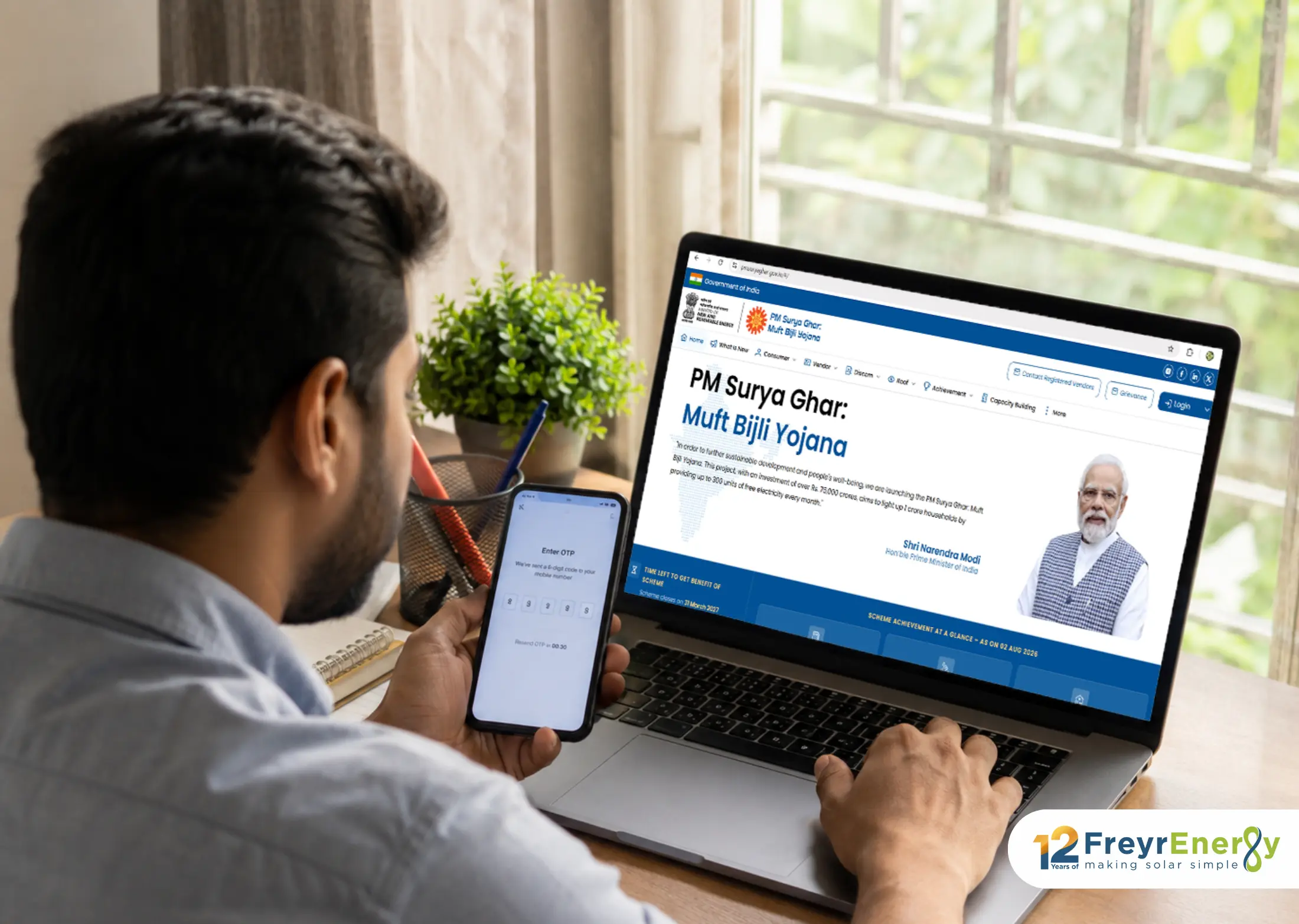
Homeowners must apply through the official PM Surya Ghar portal and install the system using an approved/empanelled vendor.
A commissioning certificate and net metering approval are essential steps before the subsidy is disbursed.
A rooftop solar system can significantly reduce electricity bills and continue generating clean energy for 25 years or more with proper maintenance.
This guide explains everything you need to know, including eligibility, subsidy amounts, required documents, application process, timeline, common mistakes, and financing options.
What is Solar Subsidy?

A solar subsidy is money the government pays you back for installing a rooftop solar system on your home. It doesn’t lower the sticker price at the shop – you still pay the full installation cost upfront – but once your system is inspected and switched on by your local electricity distribution company (DISCOM), the government transfers a fixed amount directly into your bank account.
In India, this is delivered through one scheme: the PM Surya Ghar Muft Bijli Yojana. It provides a subsidy of up to ₹78,000 for eligible residential rooftop solar systems. The scheme aims to help eligible households generate enough rooftop solar electricity to significantly reduce their monthly electricity bills. Depending on the system size and household energy consumption, many homes can offset around 300 units of electricity per month, resulting in substantial long-term savings. For a household that used to spend ₹15,000–₹20,000 a year on electricity, this can significantly reduce annual power costs.
Understanding the subsidy process before installation can help you avoid delays, choose the right system, and maximize your long-term savings.
Latest Solar Subsidy Updates (2026)
A few things have changed or firmed up recently, and they matter if you’re applying this year:
Bigger budget, more urgency. The Union Budget 2026-27 allocated ₹22,000 crore to the scheme, up from a revised ₹17,000 crore in FY26 - a clear signal the government is pushing to clear the application backlog faster.
Scale so far. As of May 2026, the scheme had received 60.95 lakh applications, with 31.38 lakh rooftop installations completed and 38.40 lakh households covered, adding up to over 11,335 MW of installed rooftop capacity nationwide.
Stricter equipment requirements. Solar modules installed under the PM Surya Ghar Muft Bijli Yojana should comply with applicable MNRE requirements, including ALMM (Approved List of Models and Manufacturers) provisions where applicable. Homeowners should always choose an MNRE-approved vendor and verify that the equipment meets the latest scheme requirements before installation.
Tighter document checks. Verification has become stricter through 2026. Applications with even minor documentation mismatches - like a name that doesn't exactly match across Aadhaar, the electricity bill, and the bank account - are now being flagged earlier in the process rather than after months of waiting.
Portal is more stable. The pmsuryaghar.gov.in portal had frequent crashes and OTP failures through 2024. As of 2026, most of these reliability issues have been resolved, and status tracking now works consistently.
Financing is scaling too. Over 5.79 lakh solar loans worth more than ₹10,900 crore have been sanctioned under the scheme, making financing a genuinely mainstream part of how households are affording their systems.
Source: Ministry of New and Renewable Energy (MNRE), Press Information Bureau (PIB), Government of India. Last updated: July 2026.
PM Surya Ghar Yojana Explained
PM Surya Ghar: Muft Bijli Yojana was launched by Prime Minister Narendra Modi on February 13, 2024, with a target of solarising 1 crore (10 million) households by 2027. It replaced the earlier Grid Connected Rooftop Solar Programme Phase II and is run by the Ministry of New and Renewable Energy (MNRE) through a single national portal, implemented on the ground by each state’s DISCOM.
Here's the mechanism in plain terms:
You install a grid-connected rooftop solar system through an MNRE-empanelled vendor.
01
Your DISCOM inspects the installation and issues a commissioning certificate confirming it meets technical standards.
02
The government pays your subsidy – calculated by system size – as a one-time Direct Benefit Transfer (DBT) straight into your Aadhaar-linked bank account, typically within 30 to 45 days of commissioning.
03
Going forward, your system generates power for your home, and with net metering, any surplus you don’t use is exported to the grid and credited against future bills.
04
It’s important to understand what this scheme is not: it isn’t a discount at the point of purchase, and it isn’t free hardware. You pay the full cost of installation first, and the subsidy comes back to you afterward, once the system is live and verified.
Who Is Eligible for Solar Subsidy?
You’re eligible if you meet all of the following:
You are an Indian resident applying for a property located in India (this excludes NRIs and Indians whose property in India is unoccupied and where they reside abroad).
You own the home, or hold joint ownership of it - the roof needs to legally be yours to use.
You have an active, grid-connected residential electricity connection with your local DISCOM, in your name or an immediate family member's name.
Your roof has enough shadow-free space - as a rule of thumb, budget roughly 10 square metres per kW of system capacity, unshaded during peak sun hours.
You have an Aadhaar-linked bank account where the account holder's name matches your Aadhaar and electricity bill exactly.
Group Housing Societies (GHS) and Resident Welfare Associations (RWAs) can also apply, specifically for common-area installations like streetlights, EV charging points, and shared facilities.
Who Is Not Eligible for Solar Subsidy?
Even a well-prepared applicant will be rejected outright if any of these apply:
Tenants - Tenants generally aren't eligible to claim the subsidy independently because the scheme requires property ownership and an eligible residential electricity connection..
NRIs, or Indian citizens whose property in India isn't their primary residence while they live abroad.
Commercial, industrial, or agricultural electricity consumers - this scheme is strictly for residential (domestic) connections.
Homes with no legal rights to the roof - for example, top-floor tenants in a building they don't own.
Off-grid properties with no DISCOM connection, since the scheme requires grid-tied net metering.
Anyone who has already claimed the subsidy on that same electricity consumer number - it's a one-time benefit per connection, and it doesn't reset even if the property changes hands.
Solar Subsidy Amount
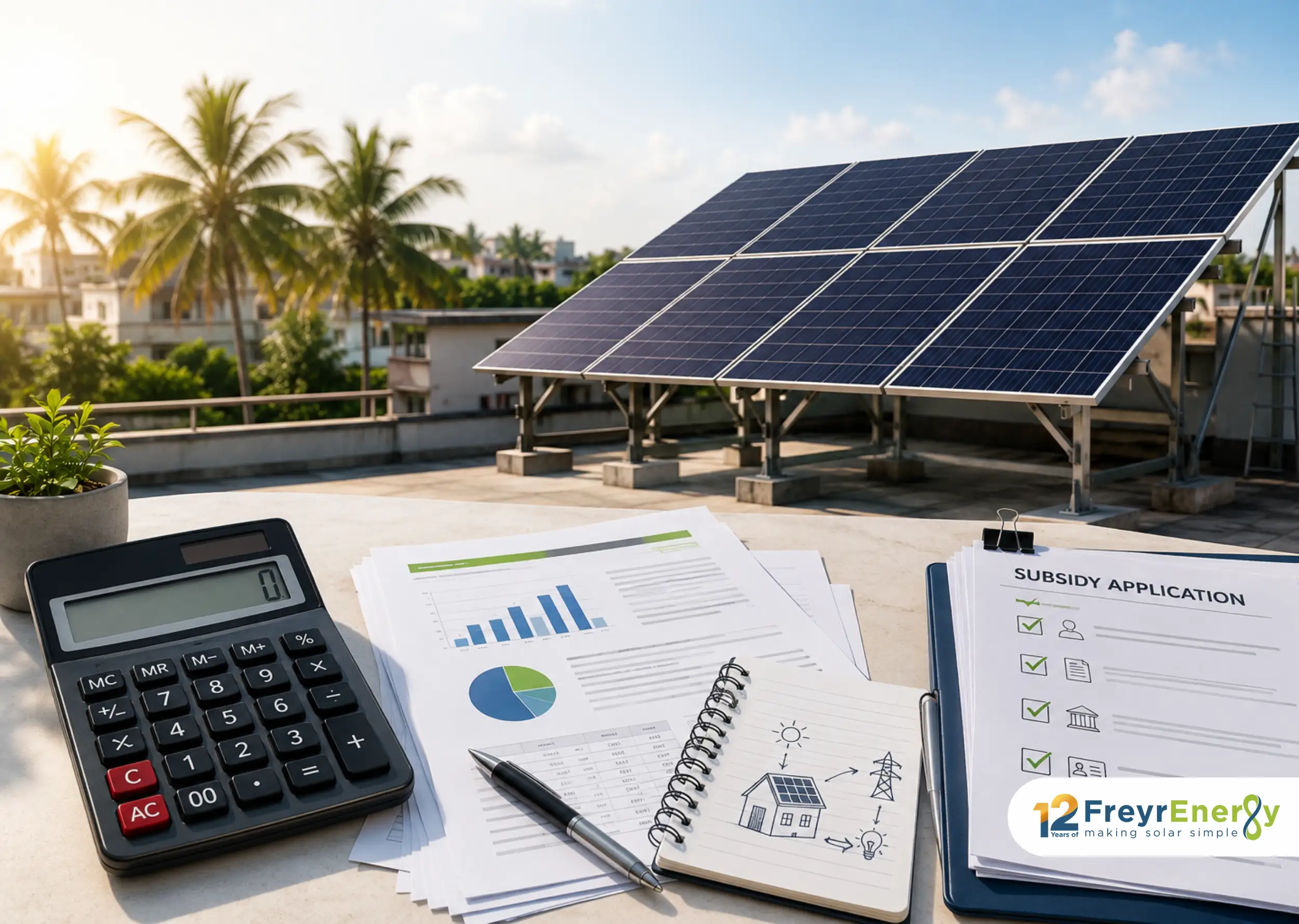
The central subsidy is calculated per kilowatt of installed capacity, with a hard cap:
| System Size | Subsidy Amount |
| 1 kW | ₹30,000 |
| 2 kW | ₹60,000 |
| 3 kW or above | ₹78,000 (maximum) |
The calculation logic: you get ₹30,000 for each of the first 2 kW, then ₹18,000 for the third kW – capped at ₹78,000 regardless of how much larger your system actually is. Installing a 5 kW or 10 kW system doesn’t increase your subsidy beyond ₹78,000; it just means you’re covering more of the additional cost yourself (and generating more power).
Some special category states – largely in the Northeast and hill regions – reportedly qualify for enhanced subsidy slabs going up to around ₹1,17,000. If you’re in one of these states, confirm the exact figure on the official portal or with your DISCOM, since slab structures for special categories are updated periodically.
State-wise Solar Subsidy Availability
The PM Surya Ghar Muft Bijli Yojana offers a central government subsidy of up to ₹78,000 for eligible residential rooftop solar systems across India. However, some states also provide additional financial incentives through their respective state nodal agencies, allowing homeowners to save even more on their solar installation.
The table below compares the central subsidy, additional state subsidy (if applicable), and the maximum total subsidy available in the states served by Freyr Energy.
| State | Central Subsidy (PM Surya Ghar) | Additional State Subsidy (2026) | Maximum Total Subsidy (Central + State) | Implementing Agency / DISCOM |
|---|---|---|---|---|
| Telangana | Up to ₹78,000 • ₹30,000 for 1 kW • ₹60,000 for 2 kW • ₹78,000 for 3 kW and above | ₹0 No additional state subsidy | Up to ₹78,000 | TGSPDCL, TGNPDCL |
| Andhra Pradesh | Up to ₹78,000 • ₹30,000 for 1 kW • ₹60,000 for 2 kW • ₹78,000 for 3 kW and above | ₹0 No additional state subsidy | Up to ₹78,000 | APEPDCL, APCPDCL, APSPDCL |
| Kerala | Up to ₹78,000 • ₹30,000 for 1 kW • ₹60,000 for 2 kW • ₹78,000 for 3 kW and above | ₹0 No additional state subsidy | Up to ₹78,000 | KSEB |
| Maharashtra | Up to ₹78,000 • ₹30,000 for 1 kW • ₹60,000 for 2 kW • ₹78,000 for 3 kW and above | ₹0* No universal additional subsidy for all residential consumers. (Scheme-specific benefits may apply for select categories.) | Up to ₹78,000* | MSEDCL |
| Madhya Pradesh | Up to ₹78,000 • ₹30,000 for 1 kW • ₹60,000 for 2 kW • ₹78,000 for 3 kW and above | ₹0 No additional state subsidy | Up to ₹78,000 | MPPKVVCL, MPMKVVCL, MPEZ |
| Uttar Pradesh ★ (Best Additional Benefit) | Up to ₹78,000 • ₹30,000 for 1 kW • ₹60,000 for 2 kW • ₹78,000 for 3 kW and above | Additional State Subsidy (UPNEDA) 1 kW System: ₹15,000 + Central Subsidy (₹30,000) 2 kW System: ₹30,000 + Central Subsidy (₹60,000) 3 kW & Above: ₹30,000 + Central Subsidy (₹78,000) Maximum additional state subsidy: ₹30,000 per consumer | 1 kW System: ₹45,000 2 kW System: ₹90,000 3 kW & Above: Up to ₹1,08,000 (Maximum total subsidy up to ₹1,08,000) | UPNEDA, UPPCL & DISCOMs |
Note: The central subsidy is provided under the PM Surya Ghar Muft Bijli Yojana. Among the states served by Freyr Energy, Uttar Pradesh currently offers an additional state subsidy through UPNEDA, while Telangana, Andhra Pradesh, Kerala, Maharashtra, and Madhya Pradesh currently rely on the central government subsidy. State policies may change over time, so always verify the latest guidelines before applying.
Solar Subsidy Calculator: Check Your Eligible Subsidy, Savings & System Size

Planning to install rooftop solar but unsure how much government subsidy you’re eligible for? Use our Solar Subsidy Calculator to get an instant estimate based on your monthly electricity bill or preferred solar system size.
Our calculator helps you estimate:
- Recommended solar system size for your home
- Government subsidy amount under the PM Surya Ghar Muft Bijli Yojana
- Estimated solar installation cost
- Final cost after subsidy
- Expected monthly and annual electricity savings
- Estimated annual solar power generation
- Approximate payback period
Simply enter your monthly electricity bill or choose your preferred system size to see your estimated savings and investment details instantly.
Freyr Energy Solar Calculator
Calculate Your Savings
Explore the potential of solar energy and start saving from Day One!
Your Ideal System Size
3 kW
Annual Savings
₹ 30,000

Annually Generated Energy
4,286 Units
Roof Space Required
238 Sqft
 Price (Excluding Subsidy & GST) ₹ 1,99,138
 Subsidy + Freyr Energy Discount
 Effective Cost ₹ 99,138
 Down payment
₹ 21,138Loan Amount
₹ 78,000Option 1: Shortest Tenure
6 Months
₹ 0
Option 2: Longest Tenure
120 Months
₹ 0
Calculate your savings in seconds!
You Save
₹12,000
Every Year
(*Taxes + Net-metering Extra)
Connect With us For More Details.
Down payment
₹ 9,354Loan Amount
₹ 37,415Option 1: Shortest Tenure
6 Months
₹ 6,512
Option 2: Longest Tenure
120 Months
₹ 604
Disclaimer
The calculator provides estimated results based on the current PM Surya Ghar Yojana subsidy structure, average electricity tariffs, and standard system performance assumptions. Actual subsidy amounts, installation costs, electricity generation, and savings may vary depending on your location, roof conditions, electricity consumption, DISCOM guidelines, and the final system design.
Solar Subsidy - Eligibility Checklist
Before you start your application, confirm every box below:
- I own the property (or hold joint ownership)
- I have an active residential DISCOM electricity connection
- My connection is grid-connected, not off-grid
- My roof has adequate shadow-free space for the system size I want
- My name matches exactly across my Aadhaar card, electricity bill, and bank account
- My bank account is Aadhaar-linked and active
- I have not previously claimed a subsidy on this electricity consumer number
- I am applying through an MNRE-empanelled vendor
Documents Required for Solar Subsidy
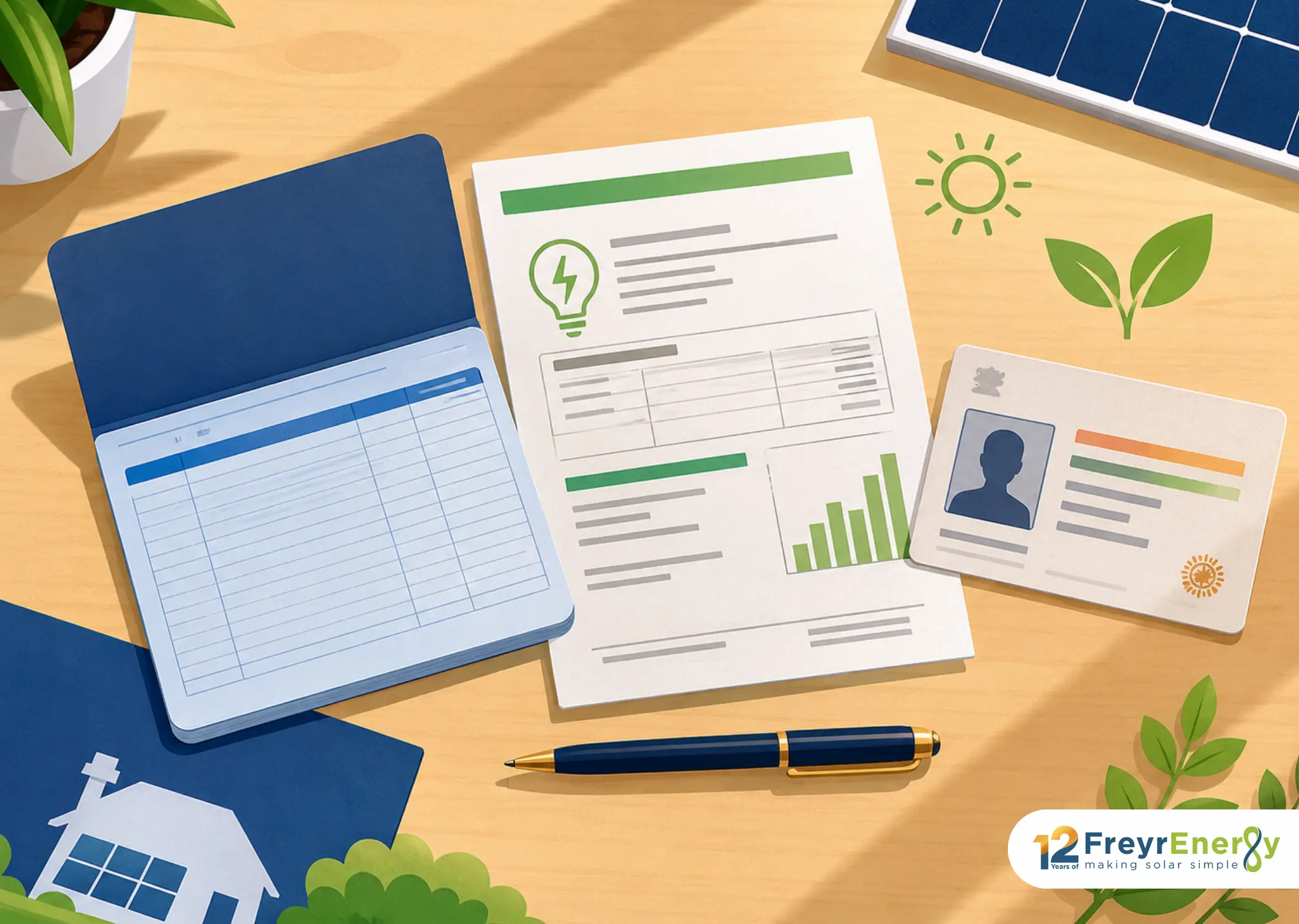
Keep these ready before you begin the online application:
| Document | Purpose |
| Aadhaar Card | Identity verification |
| Electricity Bill | Consumer and DISCOM verification |
| Bank Passbook / Cancelled Cheque | Subsidy transfer through DBT |
| Address Proof | Residential verification |
| Property Ownership Proof | Rooftop eligibility verification |
Note:
Scan quality matters more than people expect. Blurry or low-resolution uploads are one of the most common reasons documents get rejected by the portal’s automated verification. Scan everything at a minimum of 200 DPI, keep each file under 2 MB, and upload in PDF or JPEG format
Step-by-Step Rooftop Solar Subsidy Application Process
- 1. Visit the official portal at pmsuryaghar.gov.in
- 2. Click on "Apply for Rooftop Solar" under the Consumer section
- 3. Select your state and DISCOM, then enter your electricity consumer number
- 4. Enter your mobile number and complete the OTP verification
- 5. Fill in your personal details - name, address, and email - matching your Aadhaar exactly
- 6. Submit your feasibility application; the DISCOM checks whether your connection and roof are suitable
- 7. Once approved, choose an MNRE-empanelled vendor from your DISCOM's approved list (or provide your own vendor's registration details if they're already empanelled)
- 8. The vendor installs your rooftop solar system using components that comply with applicable MNRE guidelines, including ALMM requirements where applicable.
- 9. After installation, apply for net metering through the portal
- 10. Your DISCOM inspects the site and issues a commissioning certificate
- 11. Log back into the portal, upload your bank account details and the commissioning certificate
- 12. The subsidy is transferred via Direct Benefit Transfer to your registered bank account, typically within 30 days

How DISCOM Verification Works
Your DISCOM (the local electricity distribution company – like BESCOM, TANGEDCO, or your state’s equivalent) acts as the on-ground verification authority for the entire scheme, and your application passes through them at two separate stages:
Feasibility Check.
Before installation, the DISCOM confirms your connection is genuinely residential, grid-connected, and technically suitable for a rooftop system of your chosen size. This is what determines whether you're cleared to proceed with a vendor.
Commissioning Inspection.
After your system is installed, a DISCOM engineer physically inspects the site to confirm the installation matches the approved technical specifications, that the equipment used is ALMM-compliant, and that it's safely and correctly grid-connected. Only after this inspection passes does the DISCOM issue your commissioning certificate - the single most important document in your entire application, since nothing moves forward without it.
What Is a Commissioning Certificate?
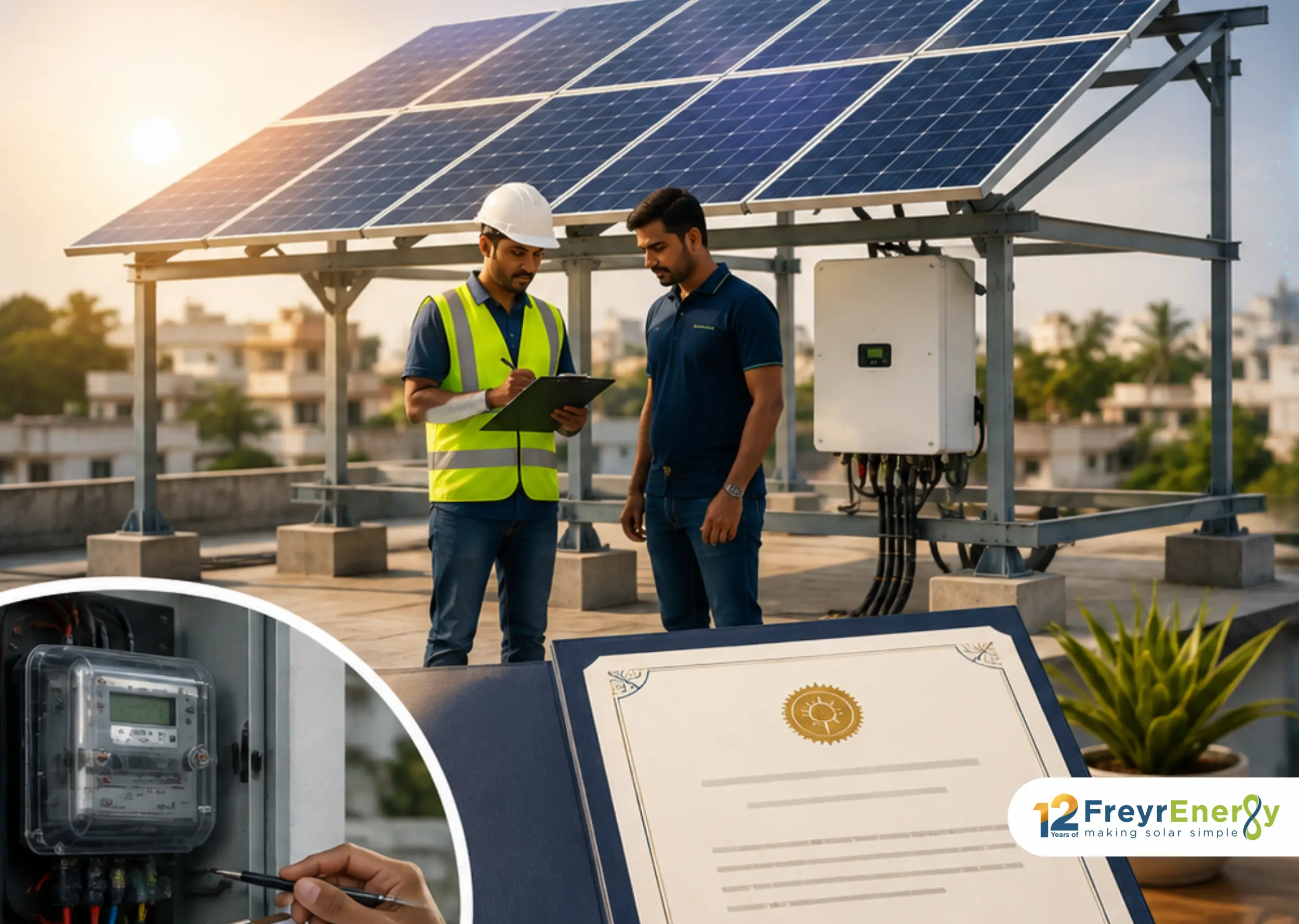
The commissioning certificate is the DISCOM’s official confirmation that your solar installation is complete, technically compliant, and safely connected to the grid. Think of it as the “go-ahead” document that unlocks your subsidy payment – without it, your application simply cannot progress to disbursement, no matter how correctly everything else was filed.
It’s issued only after the physical site inspection described above, and it certifies details including your system’s actual installed capacity, the equipment used, and confirmation that it meets MNRE’s technical and safety standards. Once issued, you (or your vendor) upload it to the pmsuryaghar.gov.in portal as part of your final subsidy claim.
Net Metering & Subsidy
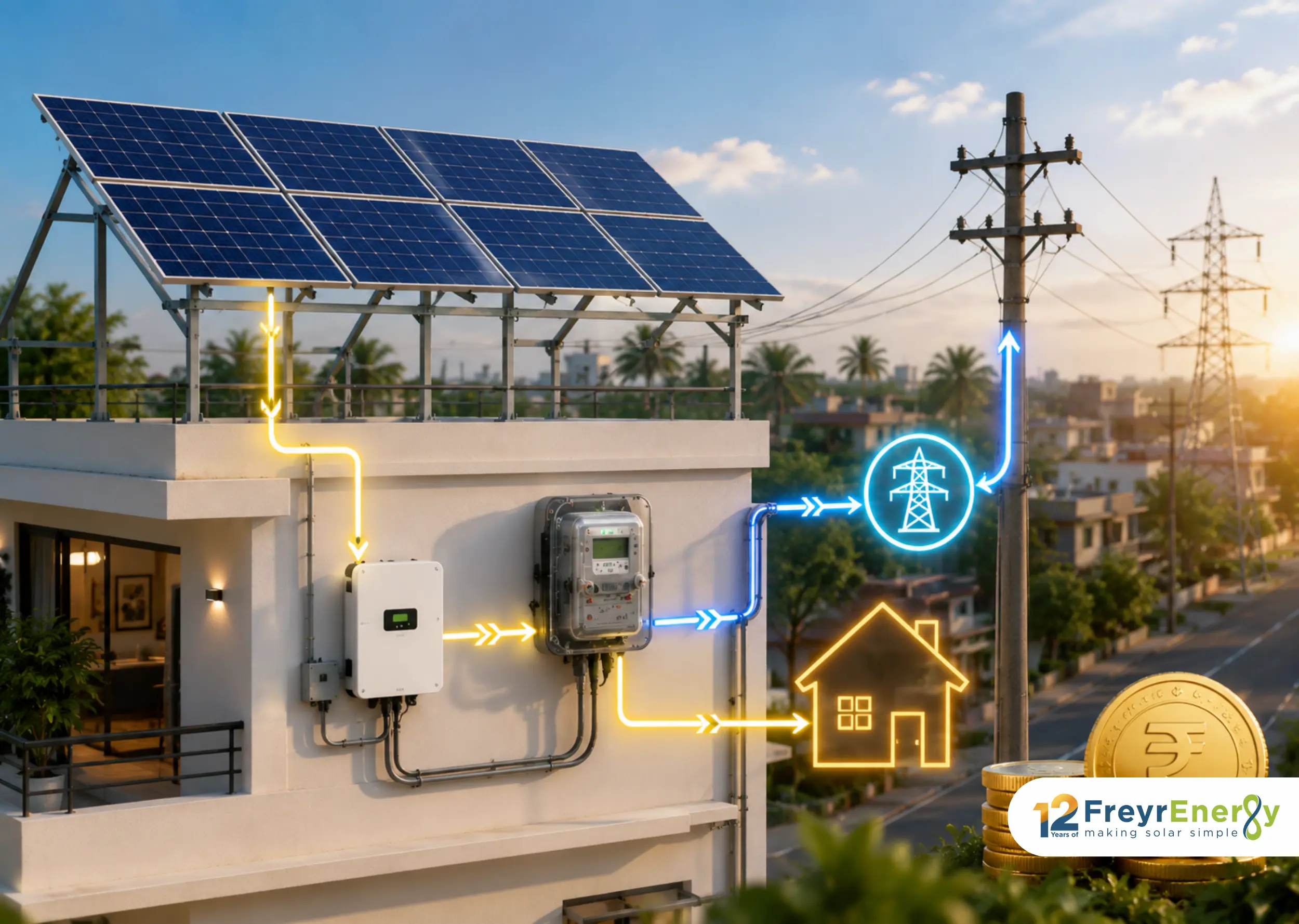
Net metering is what turns your rooftop system from “power for your own use” into a genuine bill-reduction tool. Here’s how the two work together:
Your solar panels generate electricity throughout the day. When your home uses less than what the system produces – which is common during daytime hours when many households are out or using less power – the surplus is automatically exported back to the grid through your net meter. Your DISCOM credits these exported units against the electricity you draw from the grid at night or on low-sunlight days.
The subsidy and net metering are separate but connected: the subsidy reduces your upfront installation cost, while net metering determines your ongoing savings. Applying for net metering is a required step in the application process (Step 9 above) and typically happens after installation but before your final commissioning inspection – your DISCOM needs the net meter in place to complete verification.
Solar Subsidy Timeline:
From Application to Subsidy
The time required to complete the solar subsidy process depends on your DISCOM, installation schedule, document verification, and overall application volume. The table below provides an estimated timeline for each stage.
Note:
These timelines are indicative and may vary depending on your state’s DISCOM, vendor availability, application volume, and document verification. Delays may occur if additional information or corrections are required.
Common Mistakes That Delay Subsidy
-
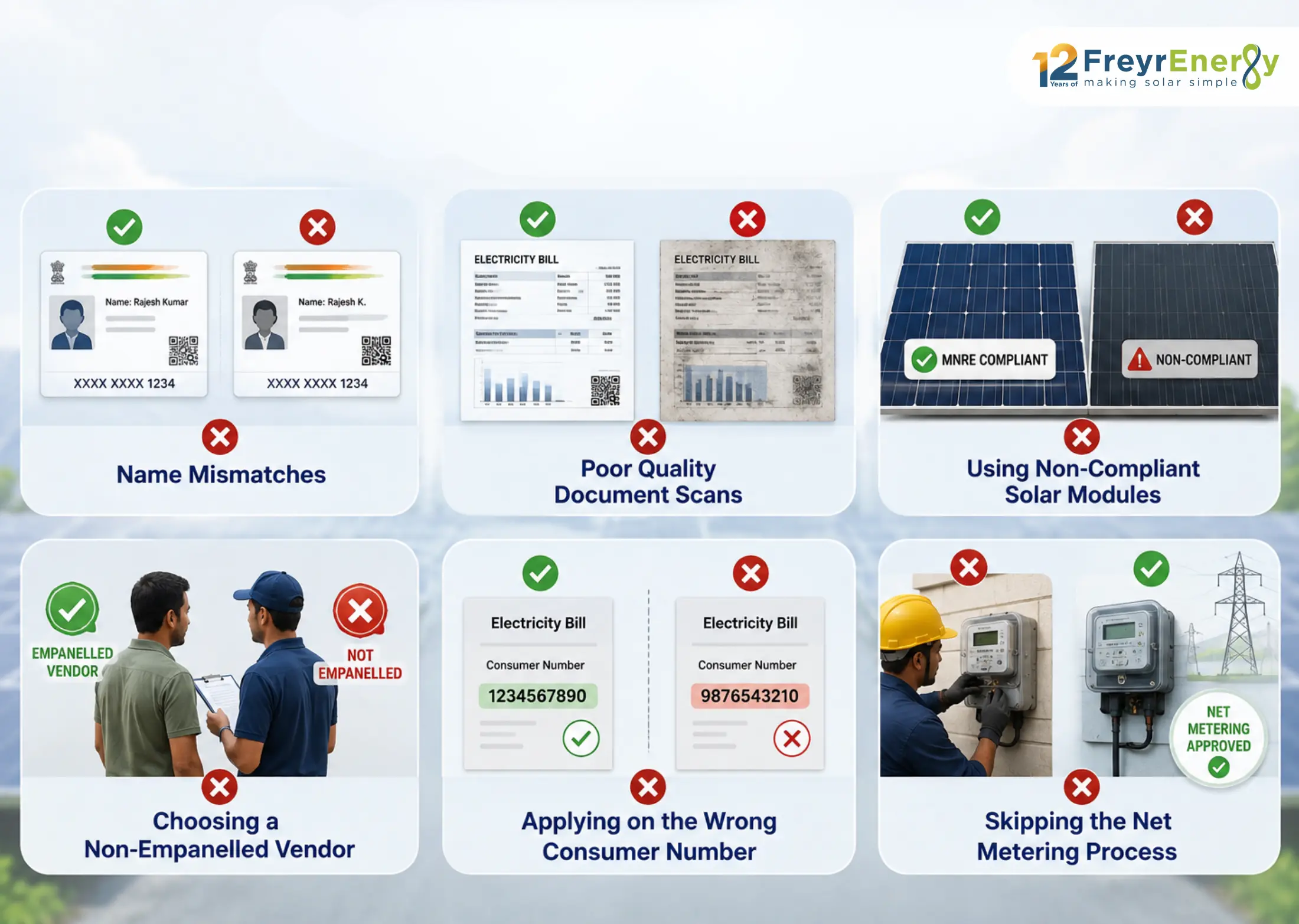
Name mismatches
The portal cross-checks your name across your Aadhaar, electricity bill, and bank account. Even a missing middle name or initial can trigger a hold.
-
Low-quality document scans
Blurry, low-resolution, or oversized files get auto-rejected by the portal's verification system before a human ever reviews them.
-
Using non-compliant solar modules
Modules that don't meet applicable MNRE requirements, including ALMM provisions where relevant, may affect your eligibility. Always confirm compliance with your MNRE-empanelled vendor before installation.
-
Choosing a non-empanelled vendor
Only MNRE-empanelled vendors can process claims under the scheme. Installations through unlisted vendors risk delays or outright rejection of the subsidy claim.
-
Applying on the wrong consumer number
If your household has multiple electricity connections, apply using the one with higher consumption for the best savings benefit — and remember, the subsidy can only be claimed once per consumer number.
-
Skipping the net metering step
Some homeowners install the system and assume commissioning happens automatically — DISCOMs won't issue a certificate until net metering is separately applied for and approved.
Reasons Applications Get Rejected
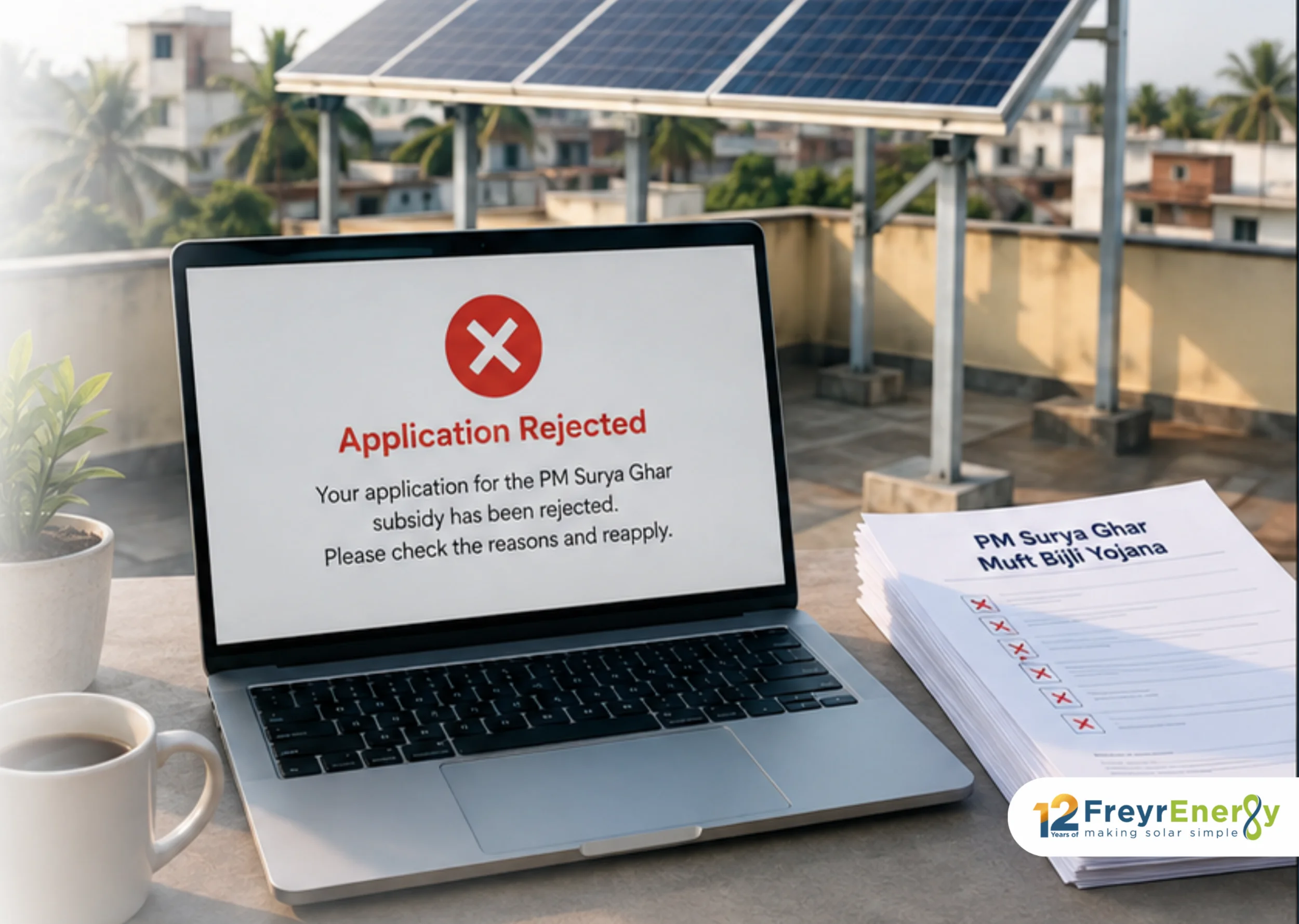
- Name inconsistency across documents - the single most common rejection reason
- Non-ALMM listed equipment used during installation
- Non-empanelled vendor completed the installation
- Ineligible consumer category - commercial or agricultural connections mistakenly applied under the residential scheme
- Duplicate claim - a subsidy already claimed on that consumer number previously
- Incomplete or unclear documentation flagged by the portal's automated checks
- Roof or technical infeasibility identified during the DISCOM's site inspection, such as an insufficient shadow-free area
If your application is rejected, most of these issues are fixable – you can correct the documentation, switch to an empanelled vendor, or resubmit with the right consumer number and reapply rather than losing the opportunity entirely. Contact your DISCOM or the PM Surya Ghar helpdesk with your consumer number to get the specific rejection reason clarified before resubmitting.
Solar Loan + Subsidy
You don’t need the full installation cost in cash upfront. Solar loans are now a mainstream part of how households finance their systems under this scheme – over 5.79 lakh loans worth more than ₹10,900 crore have already been sanctioned nationally.
How it typically works:
- Public sector banks including SBI, PNB, and Canara Bank offer collateral-free solar loans at concessional interest rates, with SBI's rate around 7.25% for eligible applicants.
- Loan eligibility generally follows subsidy eligibility - if you qualify for PM Surya Ghar, you're likely to qualify for a participating bank's solar loan, though each bank applies its own credit checks, including CIBIL score.
- The subsidy is paid to you directly after commissioning - it's not automatically applied to reduce your loan amount, so you'll typically use the disbursed subsidy to make a lump-sum prepayment against your loan once it arrives.
- Flexible EMI structures mean you can start seeing bill savings and repaying the loan simultaneously, rather than needing to save up the full installation cost before going solar.
This combination – subsidy plus low-interest financing – is what makes the economics work for most households: little to no upfront cash outlay, an immediate drop in your monthly electricity bill, and a lump-sum subsidy that arrives within weeks to offset a meaningful chunk of what you borrowed.
Save 1 lakh on Rooftop Solar Installation
Installing rooftop solar is now more affordable than ever. Under the PM Surya Ghar Muft Bijli Yojana, eligible homeowners can receive a government subsidy of up to ₹78,000. In addition, Freyr Energy offers an exclusive discount of up to ₹22,000 on eligible 2 kW and above rooftop solar systems.
Your Total Savings Include:
- Government subsidy of up to ₹78,000
- Freyr Energy discount of up to ₹22,000 on eligible 2 kW and above systems
- Total savings of up to ₹1,00,000 on eligible installations*
Terms and conditions apply.
The Freyr Energy discount is available on eligible 2 kW and above rooftop solar systems and is separate from the government subsidy. Total savings depend on the selected system size, eligibility, and applicable offers at the time of purchase.
Why Choose Us?
Self-Cleaning Rooftop Solar System
Automated sprinklers keep solar panels clean, maintaining efficiency & boost energy output.
Freyr Energy App
Free quotaions, project tracking and payments, to savings via Smart Energy Optimizer's AI powered insights.
24x7 Sales Support
Get expert solar advice and resolutions anytime with our 24×7 support.
EMIs Starting From ₹1,466
Own your solar system with easy EMIs & flexible payment tenures ranging from 6-120 months.
Design / Detailed Project Report
Get a 3D preview & shadow analysis of the solar system customized to your requirement.
Freyr Energy Inverter
The heart of your solar system, designed to generate more electricity, run cooler & deliver reliable performance, with a 10-year warranty.
Save ₹1 Lakh on Solar
For 3kW systems and above, save ₹1 Lakh (₹78,000 Govt. Subsidy + ₹22,000 Freyr Energy Discount).
Insurance coverage up to ₹3 Lakh
Free 1-year insurance coverage upto ₹3L coverage against fire, burglary & natural disasters.
Why Choose Us?
Self-Cleaning Rooftop Solar System
Automated sprinklers keep solar panels clean, maintaining efficiency & boost energy output.
Freyr Energy App
Free quotations, project tracking and payments, to savings via Smart Energy Optimizer's AI powered insights.
24x7 Sales Support
Get expert solar advice and resolutions anytime with our 24×7 support.
EMIs Starting From ₹1,466
Own your solar system with easy EMIs & flexible payment tenures ranging from 6-120 months.
Design / Detailed Project Report
Get a 3D preview & shadow analysis of the solar system customized to your requirement.
Freyr Energy Inverter
The heart of your solar system, designed to generate more electricity, run cooler & deliver reliable performance, with a 10-year warranty.
Insurance coverage up to ₹3 Lakh
Free 1-year insurance coverage upto ₹3L coverage against fire, burglary & natural disasters.
Save ₹1 Lakh on Solar
For 3kW systems and above, save ₹1 Lakh (₹78,000 Govt. Subsidy + ₹22,000 Freyr Energy Discount).
FAQs
Have any specific Question ?
Connect with our solar specialists for personalized guidance.
1 What is the maximum solar subsidy available in India in 2026?
Under the PM Surya Ghar Muft Bijli Yojana, eligible homeowners can receive a government subsidy of up to ₹78,000 for installing a grid-connected residential rooftop solar system. The subsidy amount depends on the system size and is credited directly to the beneficiary’s bank account after successful installation and DISCOM verification.
2 Who is eligible for the PM Surya Ghar solar subsidy?
Indian homeowners with a grid-connected residential electricity connection are eligible for the subsidy, provided they install a rooftop solar system through an approved vendor and meet the scheme’s eligibility criteria. Group Housing Societies (GHS) and Resident Welfare Associations (RWAs) may also be eligible for common-area installations.
3 How much subsidy can I get for a 1 kW, 2 kW, 3 kW, or 5 kW solar system?
The current central government subsidy is:
- 1 kW: ₹30,000
- 2 kW: ₹60,000
- 3 kW and above: ₹78,000 (maximum)
Installing a system larger than 3 kW increases electricity generation but does not increase the subsidy beyond ₹78,000.
4 How do I apply for a solar subsidy online?
You can apply through the PM Surya Ghar Muft Bijli Yojana portal by registering your residential electricity connection, obtaining DISCOM feasibility approval, selecting an approved vendor, completing the installation, and submitting the required documents after commissioning. Once verified, the subsidy is transferred directly to your bank account through Direct Benefit Transfer (DBT).
5 What documents are required to apply for a solar subsidy?
Typically, you need:
- Aadhaar Card
- Recent electricity bill
- Bank passbook or cancelled cheque
- Address proof (if required)
- Property ownership documents (where applicable)
Ensure that your name matches across all submitted documents to avoid delays.
6 How long does it take to receive the solar subsidy?
After successful installation, DISCOM inspection, commissioning, and document verification, the subsidy is generally credited within about 30 days, although the timeline may vary depending on your DISCOM and application processing.
7 Can I get a solar subsidy for a 5 kW or 10 kW solar system?
Yes. You can install a 5 kW, 10 kW, or larger residential rooftop solar system, but the maximum central subsidy remains ₹78,000. Larger systems provide higher electricity generation and greater long-term savings, even though the subsidy amount does not increase.
8 Can I apply for both a solar loan and a government subsidy?
Yes. Eligible homeowners can apply for a solar loan from participating banks or financial institutions and also claim the government subsidy under the PM Surya Ghar Muft Bijli Yojana. The subsidy is transferred separately after successful installation and verification.
9Is net metering mandatory to receive the solar subsidy?
Yes. Net metering is an essential part of the subsidy process for grid-connected rooftop solar systems. Your DISCOM must approve the net metering connection before issuing the commissioning certificate required for subsidy disbursement.
10How can I check my PM Surya Ghar subsidy application status?
You can check your application status by logging into the PM Surya Ghar Muft Bijli Yojana portal using your registered mobile number and OTP. The portal displays updates on feasibility approval, installation, commissioning, and subsidy disbursement. You can also contact your DISCOM or installer for assistance.
11Which states offer additional solar subsidies apart from the central subsidy?
The central government subsidy is available across India. Some states may offer additional incentives through their renewable energy departments or DISCOMs. Check with your state nodal agency or DISCOM to confirm the latest state-specific benefits.
12Can apartments and housing societies get a solar subsidy?
Yes. Group Housing Societies (GHS) and Resident Welfare Associations (RWAs) are eligible for financial assistance to install rooftop solar systems for common facilities such as lifts, water pumps, and common lighting, subject to the latest scheme guidelines.
13What are the common reasons for solar subsidy application rejection?
Applications may be rejected due to:
- Name mismatch across documents
- Incorrect or incomplete document submission
- Installation by a non-approved vendor
- Non-compliance with MNRE guidelines
- Failed DISCOM verification
- Duplicate subsidy claims
14How much money can I save after installing rooftop solar with a government subsidy?
A rooftop solar system can reduce electricity bills by up to 90%, depending on your electricity usage and system size. Combined with a government subsidy of up to ₹78,000, most homeowners recover their investment within 4–6 years and continue saving for 25 years or more.