
Direct answer: A hybrid solar system coordinates panels, the grid and a battery through a compatible inverter. It can use solar for loads, charge the battery, export permitted surplus and supply designated circuits during an outage. Its value depends on correctly sizing critical loads and usable battery energy rather than matching battery capacity mechanically to panel capacity. A complete decision must compare usable battery kWh, continuous and surge kW, recharge capability, installed cost, safety, warranty and replacement planning.
Introduction
Hybrid solar promises two outcomes many buyers want at once: lower grid consumption and backup during outages. Achieving both requires more engineering than simply adding a battery to rooftop panels. The loads, inverter, battery chemistry, usable capacity, control logic, export settings and backup circuits must work together. This guide covers system operation, battery sizing, applications, advantages, trade-offs, maintenance, cost drivers and the questions to settle before requesting a quotation.
Quick Takeaways
- Hybrid systems combine grid, PV, storage and control logic.
- Battery sizing begins with critical loads and backup hours.
- Usable kWh matters more than the nameplate alone.
- Export and subsidy treatment must be checked for the exact configuration.
- Higher resilience comes with higher cost and complexity.
Hybrid-system design decisions
Input | Why it matters | What to document |
|---|---|---|
Critical running load | Sets inverter output need | Watts by circuit |
Starting surge | Affects short-duration rating | Largest motor/compressor |
Backup duration | Sets usable energy | Required hours |
Usable depth of discharge | Protects battery/life | Manufacturer limit |
Losses and ageing | Prevents undersizing | Design margin |
Hybrid Solar System at a Glance
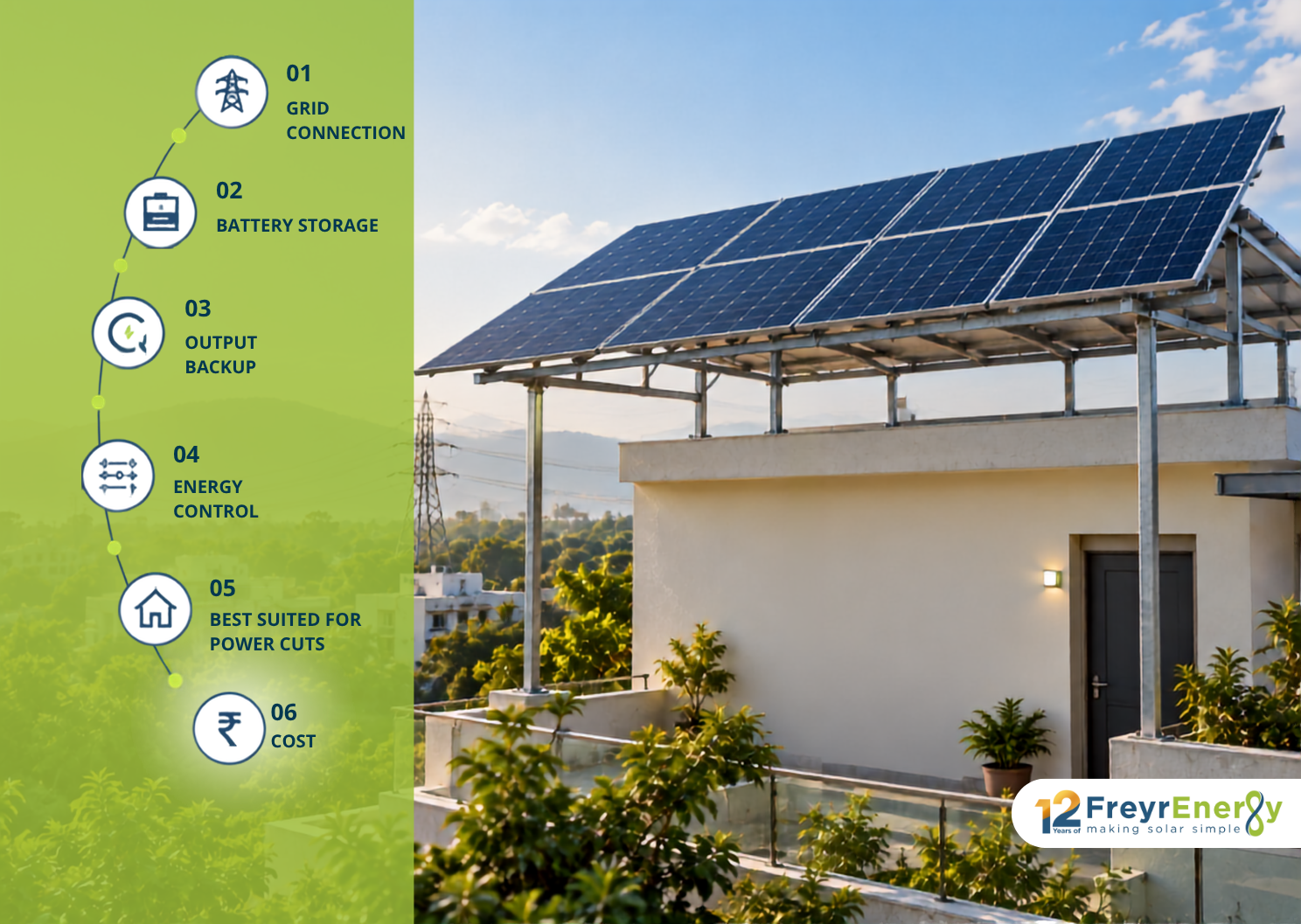
- Grid connection: Yes
- Battery storage: Yes
- Outage backup: Available within battery limits
- Best suited for: Properties with frequent power cuts
- Cost: Higher than a standard on-grid system
How Does a Hybrid Solar System Work?
A hybrid system includes solar panels, a hybrid inverter, batteries and safety equipment. During the day, solar power runs appliances and can charge the battery. Surplus electricity may be exported to the grid where regulations allow. At night or when solar generation is low, the system can use battery or grid electricity. During a power cut, stored battery energy supplies selected appliances. The available backup time depends on battery capacity and electricity consumption.
Which Battery Is Best?
The two main options are:
- Lithium-ion batteries: Longer life, faster charging and lower maintenance, but a higher purchase cost
- Lead-acid batteries: Lower initial cost, but shorter life and more maintenance
The right battery depends on the required backup time, connected appliances and budget. Battery selection should be based on a proper load assessment rather than brand alone.
Benefits of a Hybrid Solar System
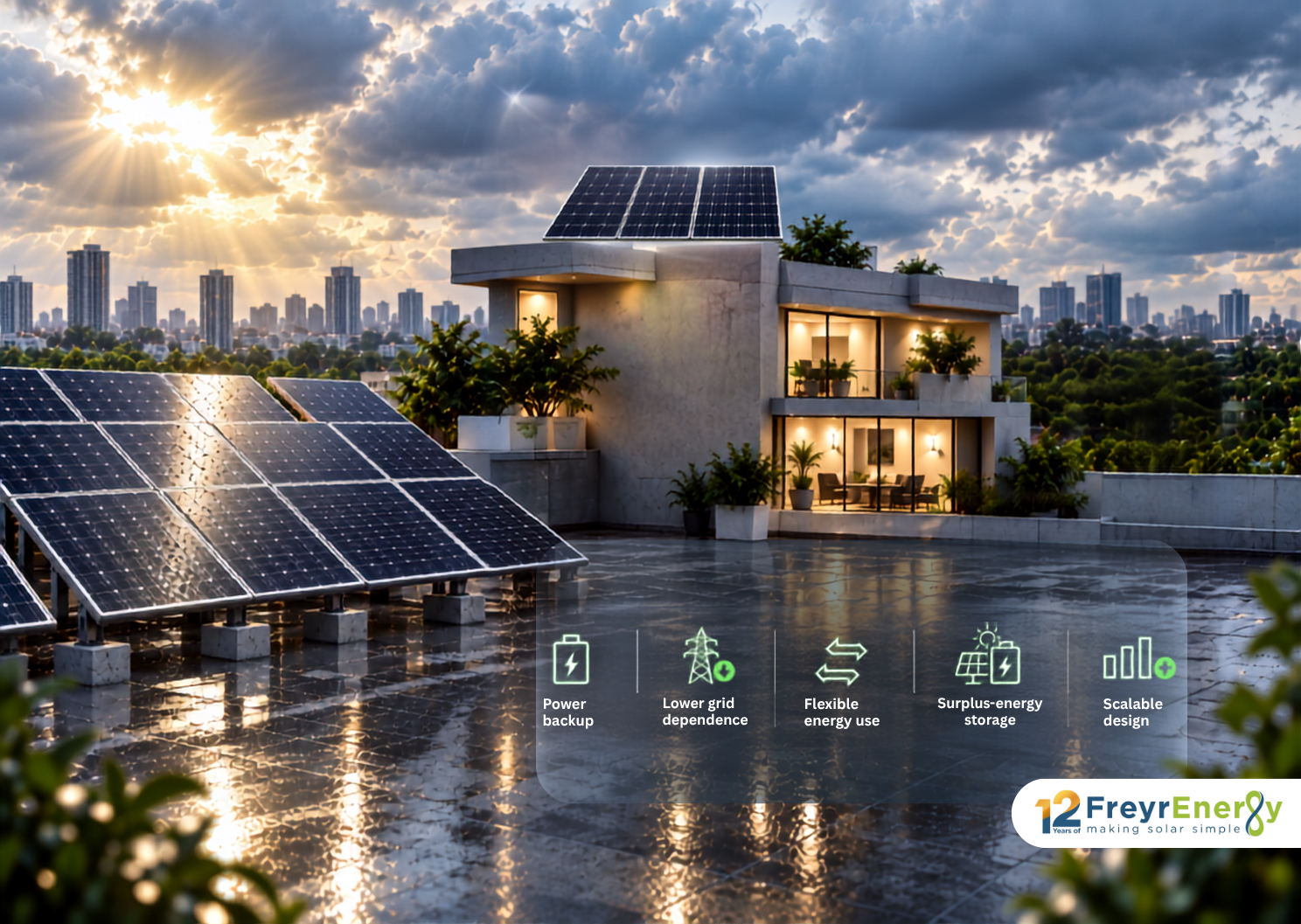
- Power backup: Supports essential appliances during outages.
- Lower grid dependence: Uses solar and stored energy before drawing grid power.
- Flexible energy use: Combines solar, battery and grid electricity.
- Surplus-energy storage: Saves excess daytime generation for later use.
- Scalable design: Solar and battery capacity can be selected according to the property’s requirements.
Hybrid systems cost more than on-grid systems because batteries and advanced controls are required. Batteries will also need eventual replacement.
Hybrid vs Off-Grid Solar
A hybrid system remains connected to the grid, while an off-grid solar system operates independently. Hybrid solar is generally suitable where a grid connection exists but outages are common. Off-grid solar is more appropriate for remote locations without dependable grid access.
Applications of Hybrid Solar Systems
Hybrid solar systems can be used for:
- Homes experiencing regular power cuts
- Shops and small offices
- Clinics and educational facilities
- Farms and rural properties
- Properties with high evening electricity use
- Essential loads such as lights, fans, routers and refrigerators
Large appliances require a higher-capacity inverter and battery bank.
Size the Backup From Loads, Not Panel Capacity
List only the appliances that must operate during an outage. For each, multiply running watts by quantity and required hours, then add the energy values. Check starting surges separately for pumps, refrigerators and compressors. Battery energy must be adjusted for permitted depth of discharge, inverter losses, wiring losses, ageing margin and the desired reserve.
Illustrative sizing method: Required nominal battery energy = critical-load energy divided by usable depth of discharge and expected system efficiency. If critical loads need 3 kWh, usable depth of discharge is 80% and conversion efficiency is 90%, the starting nominal estimate is about 4.17 kWh before ageing or reserve margin.
Critical load | Example power | Backup hours | Energy |
|---|---|---|---|
Six LED lights | 60 W | 4 | 0.24 kWh |
Three efficient fans | 105 W | 4 | 0.42 kWh |
Refrigerator, duty-cycle estimate | 120 W average | 4 | 0.48 kWh |
Router and laptop | 100 W | 4 | 0.40 kWh |
Illustrative subtotal | 1.54 kWh |
The table is an example, not a design. Actual nameplate power, duty cycle, surge and critical operating time must be measured or conservatively specified.
LFP vs Lead-Acid for Hybrid Solar
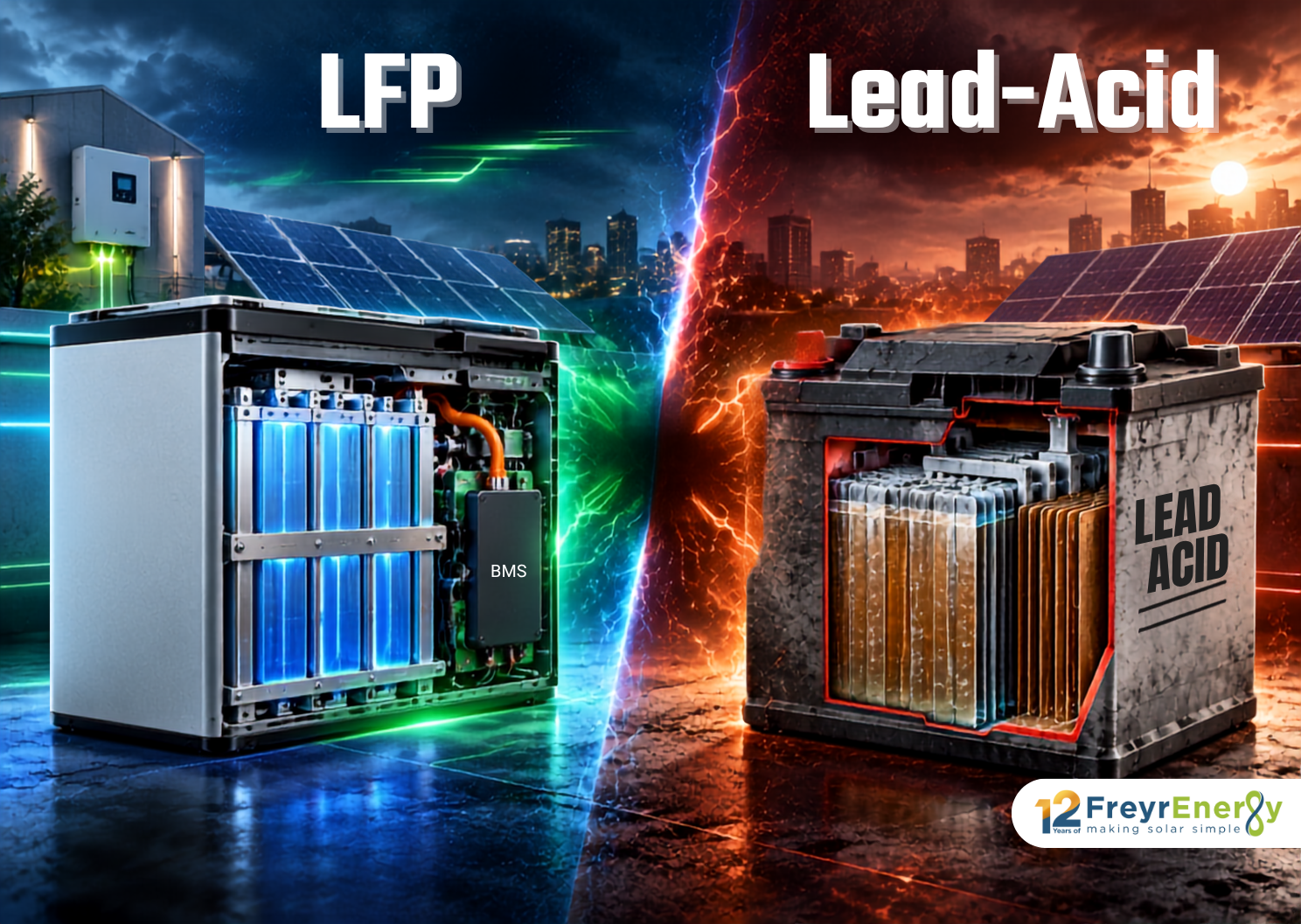
Factor | LFP lithium battery | Tubular lead-acid battery |
|---|---|---|
Initial cost | Usually higher | Usually lower |
Usable depth and cycling | Often better suited to frequent cycling when correctly controlled | More sensitive to deep discharge and recharge quality |
Maintenance | Low routine maintenance; BMS is essential | Ventilation and periodic electrolyte checks may be required |
Space and weight | Typically more compact and lighter | Bulkier and heavier |
Decision requirement | Verify cell quality, BMS, inverter protocol, warranty and service | Verify solar charge profile, ventilation, warranty and replacement access |
Hybrid Operating Modes to Specify
- Self-consumption mode: solar serves loads, then charges the battery, with surplus exported where permitted.
- Backup-reserve mode: the controller preserves a minimum state of charge for outages.
- Time-of-use mode: the battery charges or discharges according to tariff periods, where supported and permitted.
- Off-grid or emergency mode: designated circuits operate within inverter power and battery-energy limits while isolated from the grid.
- Generator integration: charging and changeover logic must be engineered; compatibility should never be assumed.
Safety, Warranty and Quotation Checks
A battery installation needs a suitable location, ventilation or thermal management appropriate to the chemistry, restricted access, correct cable and protection sizing, isolation, earthing, signage and an emergency procedure. Ask for both power and energy ratings, usable capacity, warranted cycles or throughput, temperature limits, end-of-warranty capacity, BMS compatibility, commissioning settings and responsibility for software updates. The quote should also state which loads are on the backup distribution board and the maximum continuous and surge power available.
Battery Capacity and Power Are Different
Specification | What it answers | Common mistake |
|---|---|---|
Rated energy (kWh) | How much energy is stored at nameplate conditions | Treating it as fully usable AC energy |
Usable energy (kWh) | How much can be discharged within configured limits | Ignoring reserve, efficiency and ageing |
Continuous power (kW) | Which loads can run together | Sizing only from backup hours |
Surge power (kW and seconds) | Whether motors or compressors can start | Assuming any battery can start an AC or pump |
Recharge power (kW) | How quickly energy can be restored | Buying more storage than the array can recharge |
Do You Actually Need a Battery?
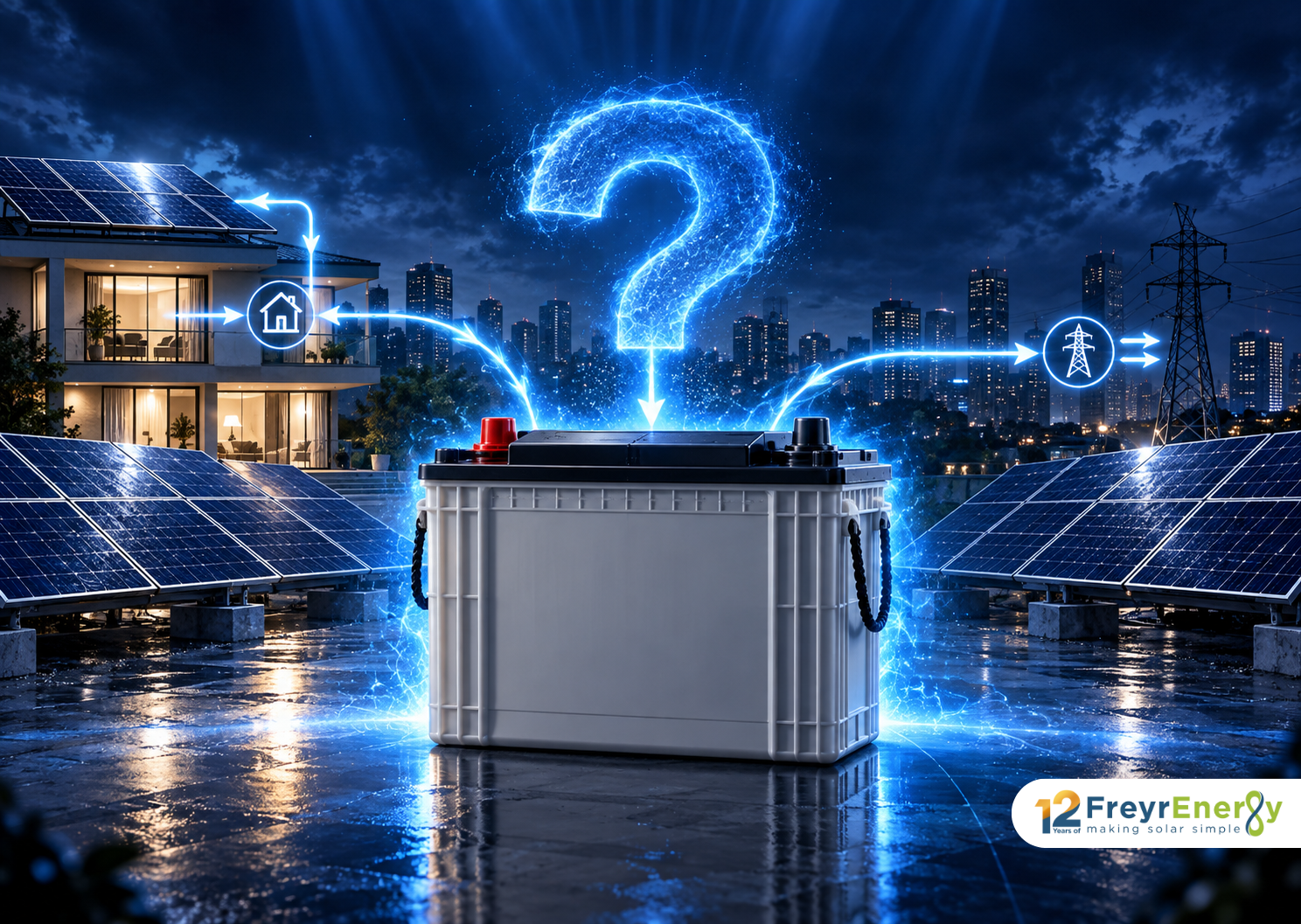
Situation | Likely direction | Reason |
|---|---|---|
Reliable grid and favourable export value | Often on-grid without storage | Avoids storage cost and conversion losses |
Frequent outages affecting essential loads | Hybrid may be justified | Backup has operational value beyond bill savings |
Remote property without a usable grid | Off-grid or hybrid design | Storage balances generation and demand |
High evening use and weak export compensation | Model battery economics | Stored solar may replace higher-value imports |
Whole-home high-power backup expectation | Detailed engineering required | Power, surge and energy requirements can make the system large |
Battery Economics
For each stored solar unit, the bill benefit is approximately the import tariff avoided minus the export credit forgone, adjusted for round-trip losses. Add maintenance and expected replacement to the cost. Where export credit is close to the import value, a battery may have weak payback even though its resilience value is high. Present resilience and cash savings separately.
Maintenance and End-of-Life Planning
Follow the product manual and keep the battery within its environmental limits. Do not bypass a lithium BMS, mix unmatched modules or change charging parameters without the manufacturer’s procedure. Flooded batteries need appropriate ventilation and electrolyte maintenance. Before purchase, identify the service location, labour and transport responsibility, replacement compatibility and the lawful collection or recycling route.
Solar Battery Price: What a Quote Must Include
Solar battery price cannot be compared responsibly without chemistry, voltage, rated and usable energy, continuous and surge power, warranty and installation scope. Official online listings reviewed in the uploaded September 2026 reference ranged from ₹6,599 for a 12 V 40 Ah tubular product to ₹19,099 for a 12 V 150 Ah tubular product; listed LFP examples ranged from ₹34,500 for 1.28 kWh to roughly ₹99,000-₹115,000 for 5-5.12 kWh. These dated product-only examples are not local installed quotations and can change by stock, pincode, tax and configuration.
A complete hybrid quote may also require a compatible inverter, backup distribution board, isolators, fuses or breakers, cables, enclosure or rack, monitoring, labour, commissioning, tax and electrical upgrades. Ask every vendor to mark inclusions and exclusions so a battery-only online price is not compared with a commissioned system.
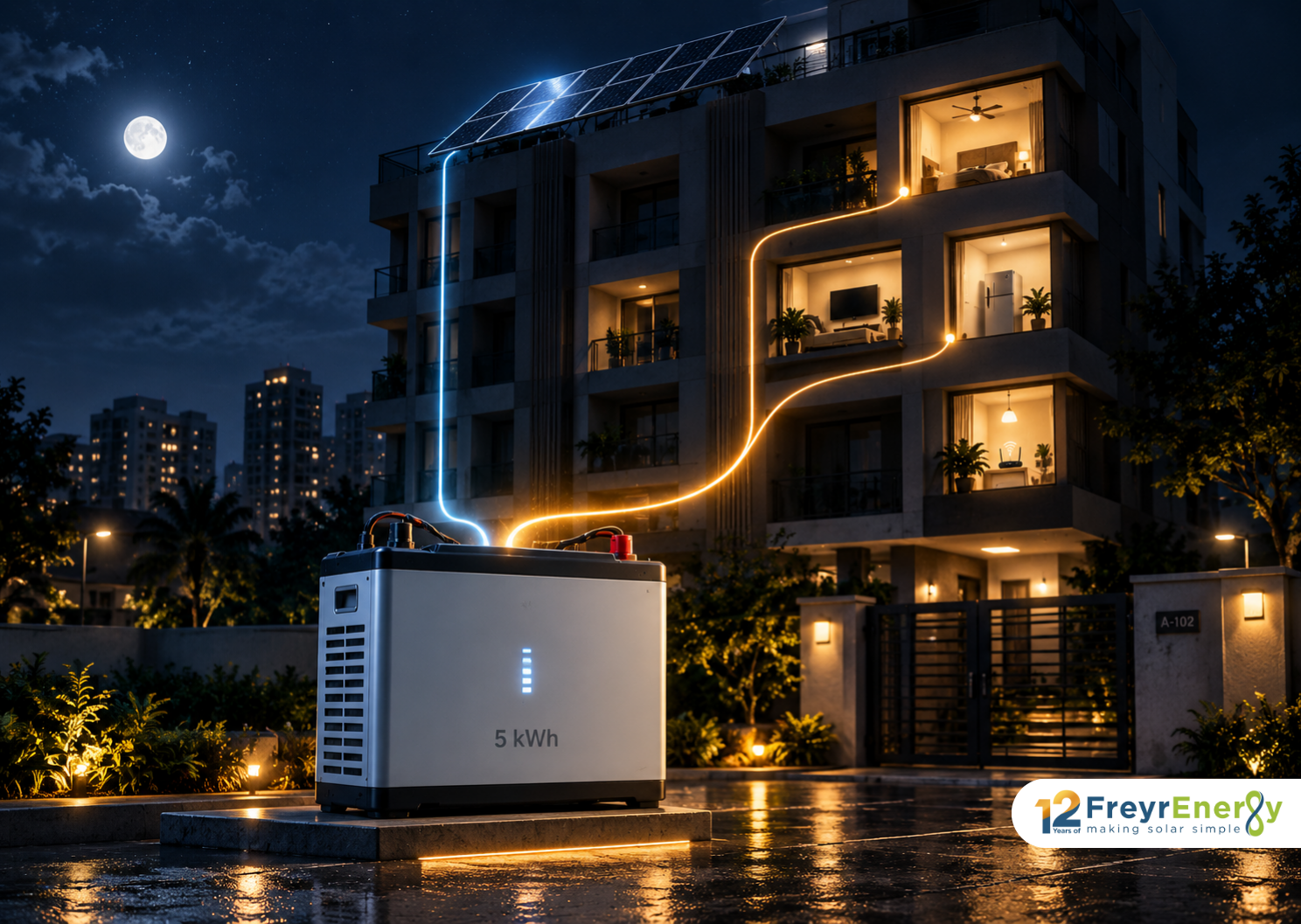
How Long Will a 5 kWh Battery Run?
Runtime estimate: Backup hours ≈ rated kWh × permitted depth of discharge × inverter efficiency ÷ average load in kW.
At a steady 500 W load, 5 kWh divided by 0.5 kW equals a loss-free maximum of ten hours. If usable depth is 90% and inverter efficiency is 90%, estimated delivered AC energy is 4.05 kWh, or about 8.1 hours at that load. Reserve settings, ageing, temperature, surge and changing appliance demand reduce real runtime. Use the exact product data and measured loads.
Can an Existing On-Grid System Add a Battery?
Often yes, but a battery cannot be connected to an arbitrary grid-tied inverter. A retrofit may replace the inverter with a compatible hybrid model or add an engineered AC-coupled battery inverter. The design must address isolation, protection, backup circuits, communication, charging limits, monitoring and any approval implications. Obtain a single-line diagram and manufacturer compatibility confirmation before purchase.
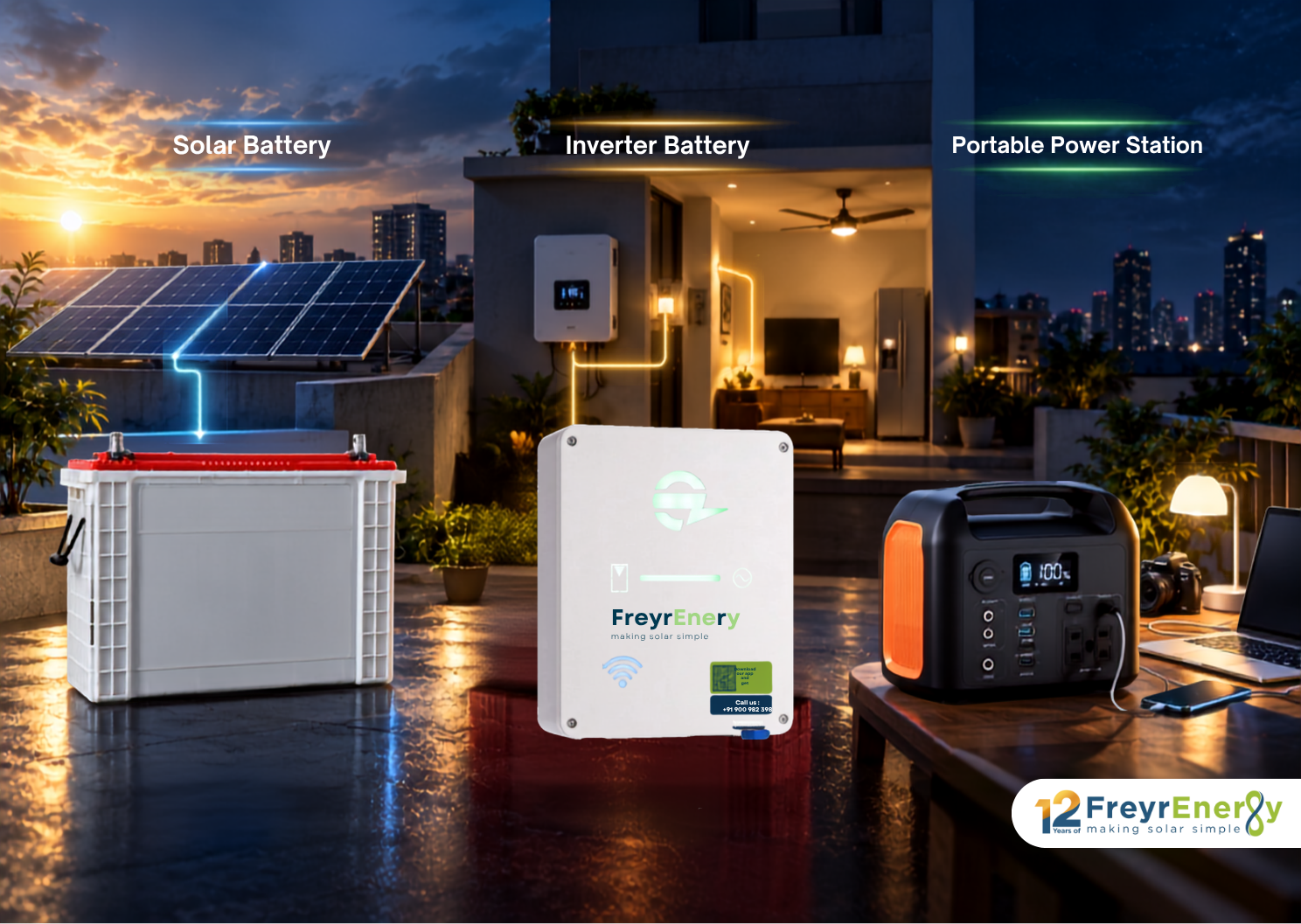
Solar Battery, Inverter Battery or Portable Power Station?
Product | Best use | Key limitation |
|---|---|---|
Integrated solar battery system | Regular solar cycling and fixed-circuit backup | Requires compatible architecture and professional installation |
Conventional inverter/UPS battery | Occasional household backup | May not suit daily solar cycling or the existing PV inverter |
Portable power station | Portable backup for limited plug-in devices | Output, solar input and fixed-circuit integration are limited |
Common Hybrid-System Buying Mistakes
- Buying by ampere-hours without converting voltage and usable kWh.
- Sizing energy while ignoring simultaneous power and compressor or pump surge.
- Assuming an existing grid-tied inverter can accept any battery.
- Backing up the whole house when a protected essential-load circuit would meet the need.
- Treating a model-specific cycle claim as guaranteed service life in every climate and duty cycle.
- Assuming PM Surya Ghar assistance is calculated from battery capacity.
- Choosing storage that the solar array cannot reliably recharge.
Hybrid Inverter and Battery Compatibility Matrix
Compatibility item | Why it matters | Evidence required |
|---|---|---|
Nominal/DC voltage range | Battery and inverter must operate in the same electrical window | Approved model list and datasheets |
BMS communication | Lithium protection and state data may depend on CAN/RS-485 | Protocol, firmware and cable confirmation |
Charge/discharge current | Limits recharge speed and deliverable power | Continuous and peak current ratings |
Backup output | Defines which loads and phase can operate in an outage | EPS/backup rating, transfer time and circuit schedule |
Parallel expansion | Determines whether storage can grow later | Maximum modules, matching rules and warranty conditions |
Grid/export mode | Must follow local rules and approved settings | Commissioning record and control permissions |
Battery Sizing Sensitivity Table
Required delivered energy | Usable DoD | Conversion efficiency | Minimum rated energy before reserve |
|---|---|---|---|
2 kWh | 80% | 90% | 2.78 kWh |
4 kWh | 80% | 90% | 5.56 kWh |
4 kWh | 90% | 92% | 4.83 kWh |
6 kWh | 90% | 92% | 7.25 kWh |
The table shows why chemistry and operating settings affect nameplate capacity. Add ageing, temperature and emergency reserve after this minimum calculation, then check simultaneous kW and surge separately.
Two-Day Outage Example
A household needing 2 kWh each evening for two cloudy outage days requires more than a 2 kWh battery. The design must cover two cycles, preserve the minimum state of charge and consider how much the solar array can recharge between them. A generator or load-shedding plan can be more economical than doubling storage for rare extreme events.
Hybrid-System Commissioning Tests
- Demonstrate normal solar, grid-charge and battery-charge priorities.
- Open the grid isolator under controlled conditions and confirm only approved backup circuits remain energised.
- Start the largest permitted motor or compressor and record voltage and alarm behaviour.
- Confirm reserve state of charge, export limit, time-of-use schedule and generator settings.
- Verify monitoring values against inverter and battery displays.
- Provide safe shutdown, emergency and recovery instructions to the owner.
Conclusion
A hybrid system can combine solar savings with resilience, but only a load-led design can deliver useful backup. Specify critical circuits, surge loads and required hours; then verify usable battery capacity, inverter compatibility, protection, control behaviour and warranty. Compare the lifetime cost with a standard on-grid system plus a conventional backup alternative. The right hybrid system is not the one with the largest battery; it is the one whose operating logic matches the user’s real priorities.