
| Direct answer: Fuel stations can use rooftop or canopy solar to supply daytime loads such as dispensers, lighting, offices, CCTV and approved EV-charging equipment. A standard grid-tied plant reduces grid purchases but normally shuts down during an outage. Capacity, hazardous-area separation, structural design, electrical protection, OMC approval and backup architecture must therefore be assessed before installation. |
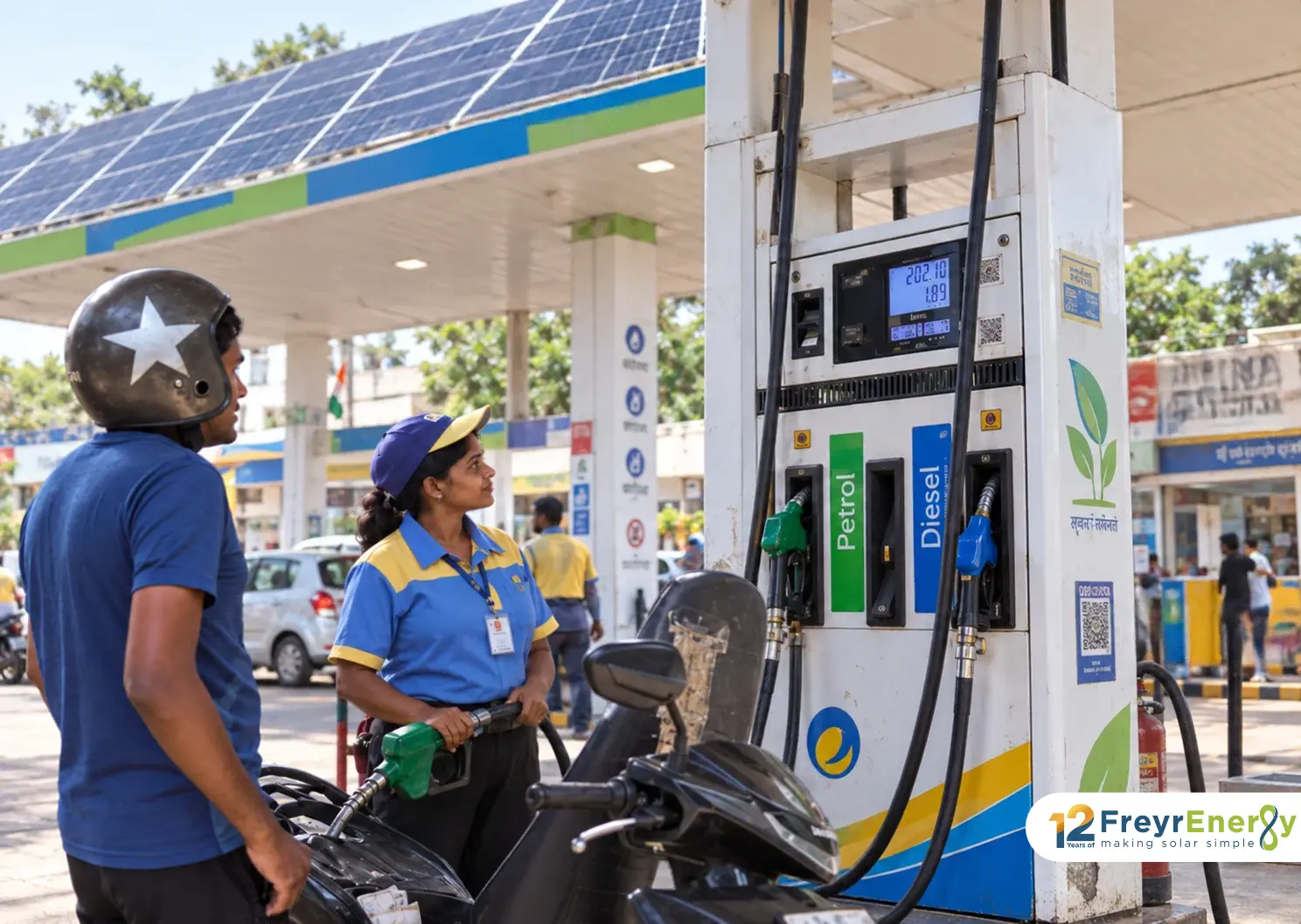
Fuel stations require electricity for dispensing equipment, canopy lighting, air compressors, offices, signage and other daily operations. Installing solar panels can reduce grid-electricity consumption and support the transition towards cleaner energy.
In 2020, the Government of India announced a mission to solarise approximately 50% of fuel stations owned by public-sector oil companies within five years. This was a target, not a statement that half of all Indian fuel stations had already adopted solar. Press Information Bureau
Quick Takeaways
- The “50%” headline came from a 2020 public target for state-run fuel stations; it should now be presented as historical context, not as a current nationwide forecast or completed result.
- Fuel-station solar works best when the hourly load profile is measured and matched to daylight demand; annual bills alone can hide dispenser, compressor, lighting and EV-charger peaks.
- Solar modules, inverters, isolators and cable routes must be positioned outside classified hazardous zones and coordinated with OMC, electrical, fire and petroleum-safety requirements.
- Grid-tied solar is not backup. Critical loads require a separately engineered UPS, battery, generator or hybrid arrangement with a tested changeover philosophy.
- Freyr’s published IOCL case study provides relevant project evidence, but its generation and savings figures are site-specific and should not be generalized to every outlet.
How Has Fuel-Station Solarisation Progressed?
Major public-sector oil companies have since reported substantial adoption:
IndianOil reported that 35,874 retail outlets, representing 89.2% of its network, had been solarised by March 2025. IndianOil
HPCL reported 22,353 solarised retail outlets, covering approximately 94% of its network, in FY 2024–25. HPCL
BPCL reported 12,244 solarised outlets out of a network of 23,642 in FY 2024–25. BPCL
These figures show that solarisation has moved well beyond the initial 2020 announcement, although adoption differs across companies and outlet types.
Benefits of Solar Power for Petrol Pumps
Lower Electricity Expenses
Fuel stations often operate for long hours and consume electricity throughout the day. A suitably designed solar system can supply part of this demand and reduce electricity purchased from the grid.
Actual savings depend on:
- Electricity consumption
- Solar-system capacity
- Available installation space
- Local electricity tariffs
- Daytime operating load
- System generation and maintenance
- Financing and applicable metering rules
A site-specific financial assessment is necessary before estimating savings or payback.
Productive Use of Canopy and Roof Space
The canopy above the dispensing area and the roofs of associated buildings may provide suitable space for solar panels. Ground-mounted systems can also be considered where sufficient land is available.
Businesses should compare rooftop and ground-mounted solar panels based on shading, structural strength, safety clearances and available space.
Reduced Environmental Impact
Solar panels generate electricity without direct greenhouse-gas emissions during operation. Replacing part of a fuel station’s grid consumption with solar power can reduce the emissions associated with its electricity use.
Environmental savings should be calculated from actual generation and an appropriate grid-emissions factor instead of applying a single estimate to every system.
Support for Additional Services
A properly sized solar system can support eligible daytime loads such as lighting, offices and other electrical equipment. It may also offset part of the demand created by convenience stores or EV chargers.
The system must be designed according to the outlet’s load profile and electrical infrastructure.
Does Solar Provide Backup During Power Cuts?
A standard grid-connected solar system normally shuts down during an outage to prevent electricity from flowing back into the grid.
Fuel stations requiring uninterrupted power need a properly engineered hybrid arrangement involving compatible battery storage or another backup source. Solar panels alone do not guarantee continuous operation during power cuts.
Learn more about on-grid, off-grid and hybrid solar systems.
What Should Fuel-Station Owners Consider?
Before installing solar panels, evaluate:
- Monthly and daytime electricity consumption
- Structural condition of the canopy or roof
- Shadows from signs, trees and nearby structures
- Electrical and fire-safety requirements
- Hazardous-area classifications
- Panel, inverter and mounting specifications
- Required approvals and metering arrangements
- Equipment warranties and maintenance support
Because fuel stations handle flammable materials, system design, cable routing, earthing and equipment placement require particular attention. Installation should comply with applicable electrical, fire and petroleum-safety requirements.
Review these solar-panel installation precautions before planning the project.
How Freyr Energy Can Help
Freyr Energy provides customised commercial solar solutions based on electricity consumption, available space and site conditions.
Support can include site assessment, shadow analysis, system design, installation coordination and performance monitoring. The final system capacity and expected savings should be confirmed after a detailed technical survey.
Useful next steps include the commercial solar solutions and the IOCL fuel-station case study. These pages support planning and comparison; final capacity, pricing, approvals and savings remain site-specific.
The 50 Percent Claim Needs a Date and Context
In September 2020, India’s petroleum minister described an objective to solarise roughly half of state-run fuel stations within five years. Later public reporting referred to a broader ambition to solarise the OMC network. Because those target dates have passed, the defensible 2026 article should explain the history and then rely on current company disclosures rather than repeating “set to adopt” as a live prediction.
IndianOil reported 35,874 solarised retail outlets, representing 89.2% of its network, as of March 2025. HPCL reported 22,353 solarised outlets and BPCL reported 12,244 out of 23,642 outlets for FY2024-25. These company disclosures show substantial adoption, but they do not prove that a fixed share of every fuel-station category in India is solar-powered.
Fuel-Station Feasibility and Safety Checklist
Record at least 15-minute load data where available. Separate dispensers, canopy and signage lighting, office loads, compressors, air and water services, convenience retail, EV charging and any proposed expansion. Map which loads are critical during an outage and which may be shed. Inspect canopy capacity, roof warranties, drainage, corrosion exposure, vehicle clearance, crane access and maintenance access.
The design review should document hazardous-area boundaries, equipment locations, AC and DC isolation, surge protection, earthing, lightning protection, emergency shutdown interfaces, fire access and cable containment. Obtain required owner, OMC, DISCOM, electrical-inspector and safety approvals before construction.
Freyr Energy IOCL Case Study
Freyr Energy reports installing a combined 275 kW of grid-connected rooftop solar at IOCL fuel stations in Guwahati and Varanasi: 150 kW and 125 kW respectively. The company reports an estimated combined annual generation of 376,200 kWh and estimated annual savings of about ₹26.8 lakh. These figures are useful evidence of scale and application, but they remain company-reported estimates for the named sites.
The transferable lesson is the method: assess each outlet’s operating load, design around business continuity, install with minimal disruption and monitor performance. The reported savings should not be used as a default benchmark for another station without its tariff, generation model and load profile.
Worked Fuel Station Load and Continuity Example
A fuel station may have steady dispenser, lighting, CCTV and office loads, intermittent compressor demand and a new EV charger with large peaks. Annual units alone do not show whether solar will be self-consumed. Interval data should therefore be separated into a normal trading day, a low-demand day and the proposed EV-charging case before the array and inverter are selected.
The continuity design must then be drawn separately. A standard grid-tied inverter will disconnect during a utility outage, even at noon. If dispensers, payment systems or emergency lighting must continue, the proposal needs an approved generator, UPS or hybrid architecture, load priority, changeover logic and periodic testing. Hazardous-area boundaries and OMC approvals remain controlling constraints.
Choosing a Fuel-Station Solar Configuration
| Option or situation | Best use or meaning | What to verify |
| Building roof | Uses an existing roof away from traffic | Structure, waterproofing, shadow and cable route |
| Canopy | Can combine shade and generation | Vehicle clearance, wind, corrosion, drainage and classified zones |
| Ground or boundary area | May avoid a weak roof | Land use, collision protection, security and trenching |
| EV-charging canopy | Pairs visible solar with a new electrical load | Charger peaks, sanctioned load, storage and operating model |
Fuel-Station Solar Risks and Controls
| Risk or mistake | Why it matters | Control |
| Historical 50% target is presented as current fact | Creates a stale or misleading headline | Date the 2020 target and use current disclosures |
| Grid-tied solar is sold as backup | Critical operations can still stop | Engineer backup and islanding separately |
| Equipment enters a classified area | Creates safety and approval risk | Map zones before fixing equipment locations |
| EV charging is added without demand study | Can increase peaks and sanctioned-load cost | Model charger power and coincidence |
Questions the Outlet Owner and OMC Should Resolve
| Question | Evidence to request | Why the answer matters |
| How much solar will be self-consumed? | Interval load and hourly generation overlay | Determines the main economic value |
| What constrains the site? | Structural, fire, roof-life and electrical studies | Defines feasible capacity and construction risk |
| Who carries performance risk? | Yield, availability, O&M and remedy clauses | Clarifies ownership and accountability |
| How are shutdowns handled? | Method statement and operating calendar | Protects production and customer operations |
| What happens at roof or contract end? | Removal, restoration, transfer and termination terms | Prevents long-term property disputes |
How to Size Solar Around a Fuel Station Load Profile
A fuel station should be sized from interval demand, not from the roof area or a single monthly bill. Dispensers, canopy lighting, signage and office equipment may create a stable daytime base, while compressors, pumps and EV chargers create short peaks. Fifteen-minute meter data shows how much solar can be used immediately and how much would be exported or curtailed.
- Separate normal trading days, low-volume days and seasonal peaks before selecting capacity.
- Model existing EV chargers separately from planned chargers; their utilisation can change faster than the core outlet load.
- Keep outage-critical loads on a separate schedule so backup capacity is not confused with the grid-tied solar size.
The proposal should show at least two capacities and a monthly energy balance. A larger array may produce more annual units, but it is not automatically better if midday surplus has limited value or the canopy requires costly reinforcement.
Safety Evidence Required Before Installation
Fuel vapours make equipment location and cable routing unusually important. The solar designer must work from the outlet’s hazardous-area drawings and coordinate with the oil-marketing company, electrical team, fire-safety requirements and any petroleum-sector approvals. The design should identify isolation points, emergency shutdown interfaces and how maintenance will occur without obstructing fuel operations.
- Request structural calculations for the canopy and the exact attachment or foundation detail.
- Confirm that inverters, junction boxes and switching equipment remain outside classified zones unless specifically certified and approved.
- Record earthing, surge protection, lightning protection and cable-containment details on the as-built drawing.
Sources and Verification Notes
Policy, subsidy, tax, equipment and metering information can change. The primary sources below were checked for this revision; reverify material claims immediately before publication.
- IndianOil retail network: IndianOil Integrated Annual Report 2024-25 — solarised retail-outlet count and installed capacity
- HPCL retail network: HPCL Integrated Annual Report 2024-25 — solar installations across the retail network
- National context: Press Information Bureau solar programme information — PM Surya Ghar and national rooftop context