
Rooftop solar is no longer a choice for Indian homeowners. Rising electricity tariffs, government subsidy schemes, and awareness of clean energy have all pushed more households toward installing solar panels. But as soon as installation planning begins, a question surfaces: should the panels face the direction that generates the most electricity, or the direction recommended by Vastu Shastra?
For families, this isn’t an either-or question. They want a system that performs efficiently while respecting the principles of Vastu. This makes the question more relevant: Is the Vastu-approved direction always the most efficient solar direction?
Honestly, the answer depends on a lot of things. Solar panel direction as per Vastu and solar panel direction for maximum energy production aren’t always the same thing. This guide breaks down the factors that will help you make an informed decision.
Freyr Energy has installed over 20,000 rooftop solar systems across multiple Indian states. Based on this experience, the company has found that roof orientation, shading, tilt angle, and structural constraints often have a greater impact on energy generation than the direction a house faces. During every site assessment, Freyr Energy’s solar experts evaluate sunlight exposure, roof orientation, roof slope, shading, and structural safety to recommend the optimal panel placement while accommodating homeowners’ Vastu preferences wherever practical.
Quick Takeaways
- South-facing panels generally produce the highest annual energy in India.
- Southeast is commonly recommended in Vastu and can often align well with efficient solar placement.
- Roof orientation matters more than the direction your main entrance faces.
- Correct tilt angle and minimal shading are just as important as panel direction.
- A professional site assessment helps balance solar performance with Vastu preferences.
Finding the best solar panel direction for Indian homes
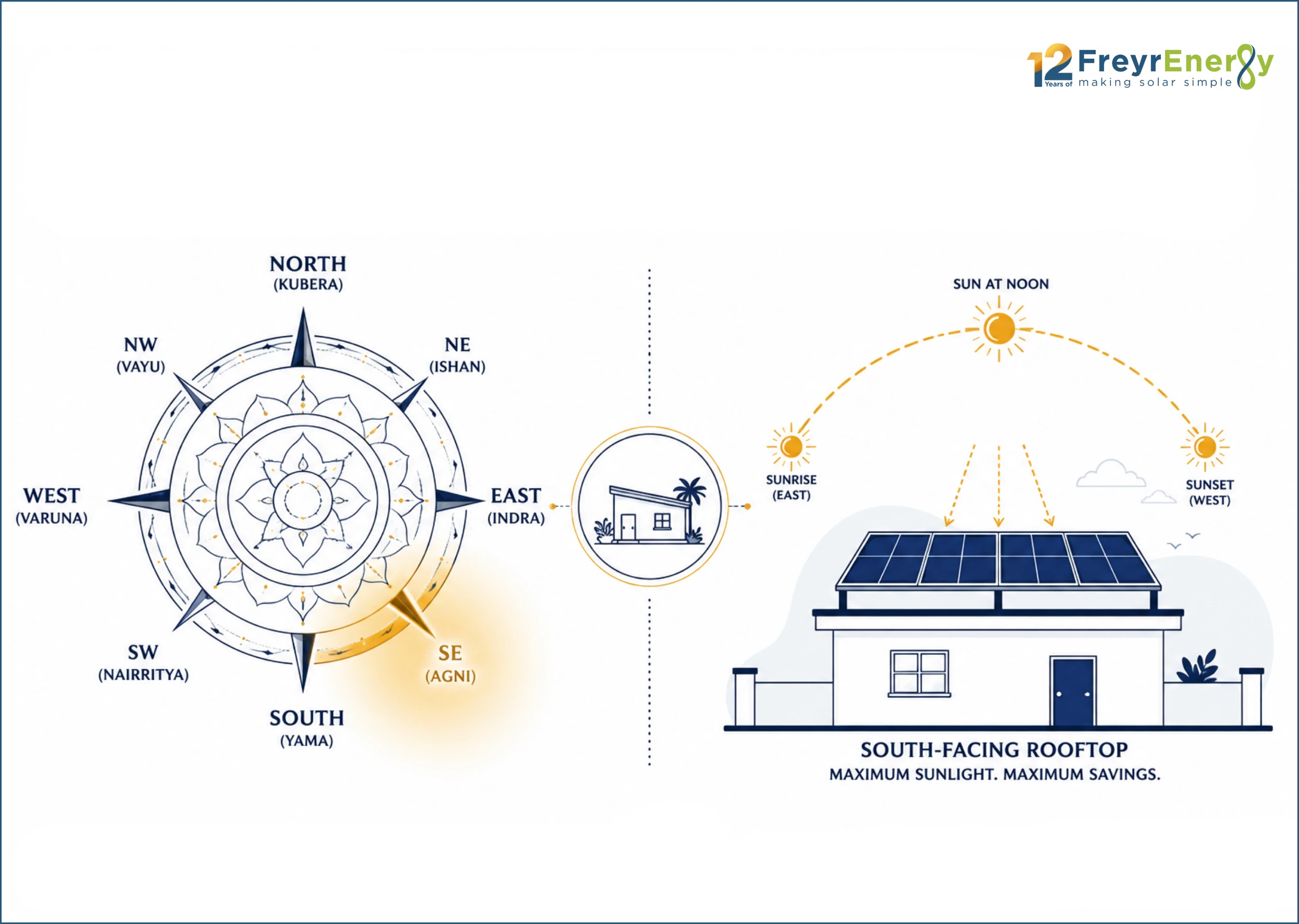
India lies in the northern hemisphere, allowing south-facing solar panels to receive the most consistent and direct sunlight throughout the day. This makes the south the most recommended solar panel facing direction for maximum energy generation.
That said, the south isn’t the only workable option. East-facing panels capture strong morning sunlight, which can be useful for households whose energy consumption peaks earlier in the day.
- West-facing panels absorb more afternoon and evening sun, which may suit homes with higher evening power usage.
- North-facing installations are the least efficient since the Sun’s path stays largely to the south throughout the year. North-facing panels receive limited sunlight and are generally avoided unless no better roof space is available.
To be brief, the best direction for solar panels isn’t a one-size-fits-all answer. It depends on your home’s geographic location and the shape and slope of your roof. The factors are best evaluated through a proper site assessment and system design.
The table below compares the most common solar panel directions based on energy generation, Vastu suitability, and the type of home they are best suited for.
| Solar Panel Direction | Estimated Energy Generation | Vastu Suitability | Best Suited For |
| South | Highest | Good | Maximum year-round solar energy generation |
| Southeast | High | Excellent | Homeowners looking to balance Vastu principles with strong solar performance |
| East | Moderate to High | Good | Homes with higher morning electricity consumption |
| West | Moderate | Acceptable | Homes with higher afternoon and evening electricity usage |
| North | Low | Not Recommended | Only when no other roof orientation is available |
While south-facing installations generally provide the highest annual energy generation, the optimal direction for your home ultimately depends on roof orientation, shading, tilt angle, and your household’s electricity consumption pattern.
Solar panel direction as per Vastu: What does Vastu Shastra recommend?
When it comes to learning solar panel direction as per Vastu, the traditional principles associate the southeast zone with fire and energy, making it the favored placement for solar equipment, since solar panels convert sunlight into a form of energy. Some Vastu practitioners also consider the south and southwest zones acceptable, provided the placement does not obstruct the home’s main energy flow or block sunlight to living areas.
It is important to distinguish between Vastu principles and solar engineering. Vastu is a philosophical and cultural framework focused on energy balance and peace within the home. Solar panel direction and angle, by contrast, are determined by measurable factors like sun path, latitude, and shading.
In practice, homeowners often don’t have to choose between Vastu and solar performance. During a professional site assessment, experienced solar installers can usually identify a panel placement that balances engineering requirements with Vastu preferences, without significantly affecting energy generation.
This distinction is important so that homeowners shouldn’t feel compelled to sacrifice meaningful sunlight exposure purely to align with Vastu preferences.
Does your house-facing direction decide where solar panels should go?
A common misconception is that the direction your house faces determines where solar panels should be installed. In reality, these are two different things.
- North-facing house: The house entrance faces north, but the roof still has a south-facing slope or section ideal for solar panels.
- South-facing house: The home has natural advantages, like roof sections that already align well with the sun’s path.
- East-facing house: The main facade faces east, but panels can still be mounted on a south or west-facing roof section for better output.
- West-facing house: Similar to east-facing homes, the building’s orientation does not limit panel placement if the roof offers south-facing space.
Myth vs Reality
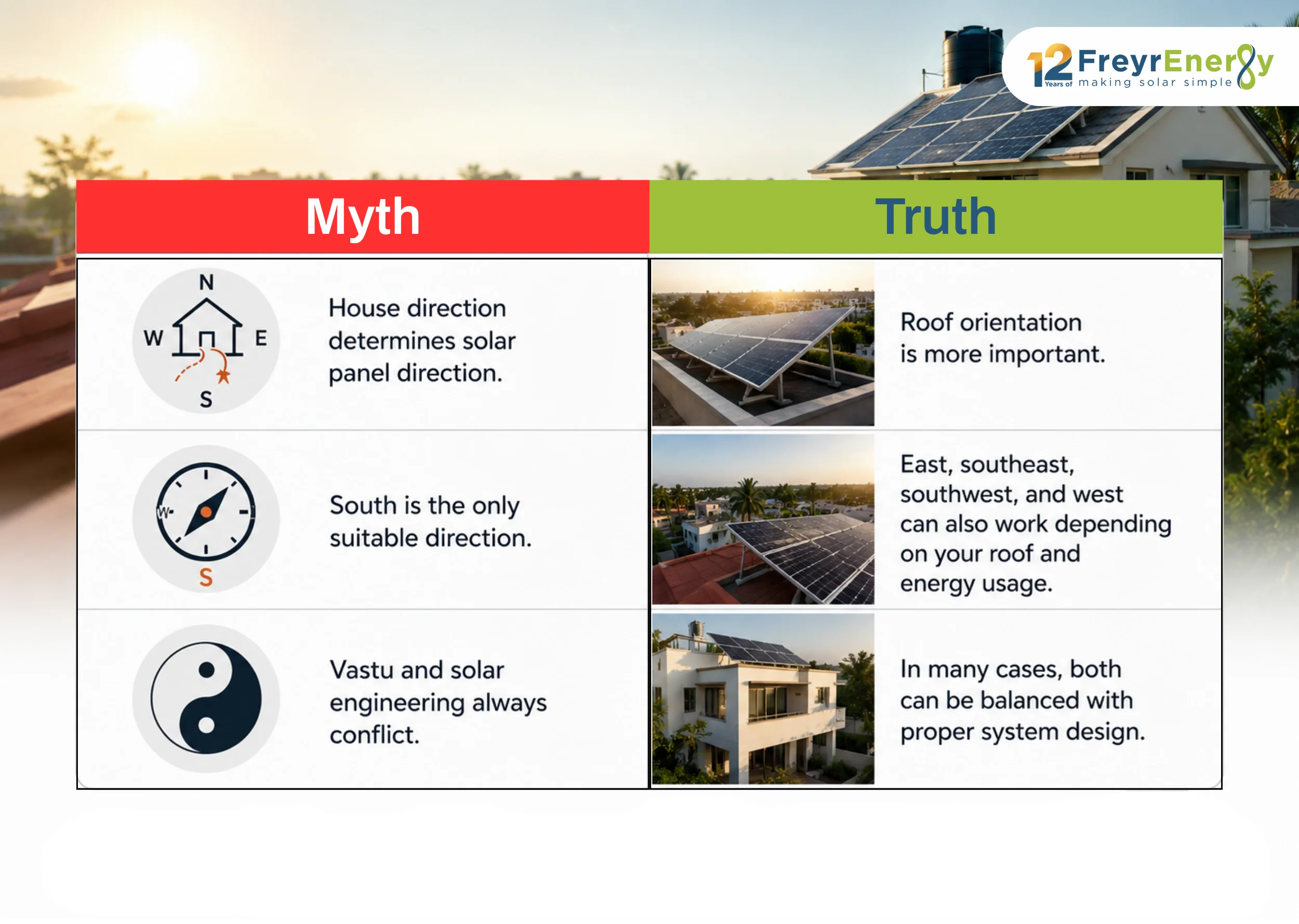
| Myth | Reality |
| House direction determines solar panel direction | Roof orientation is more important. |
| South is the only suitable direction | East, southeast, southwest, and west can also work depending on your roof and energy usage. |
| Vastu and solar engineering always conflict | In many cases, both can be balanced with proper system design. |
How tilt and shading affect solar panel performance?
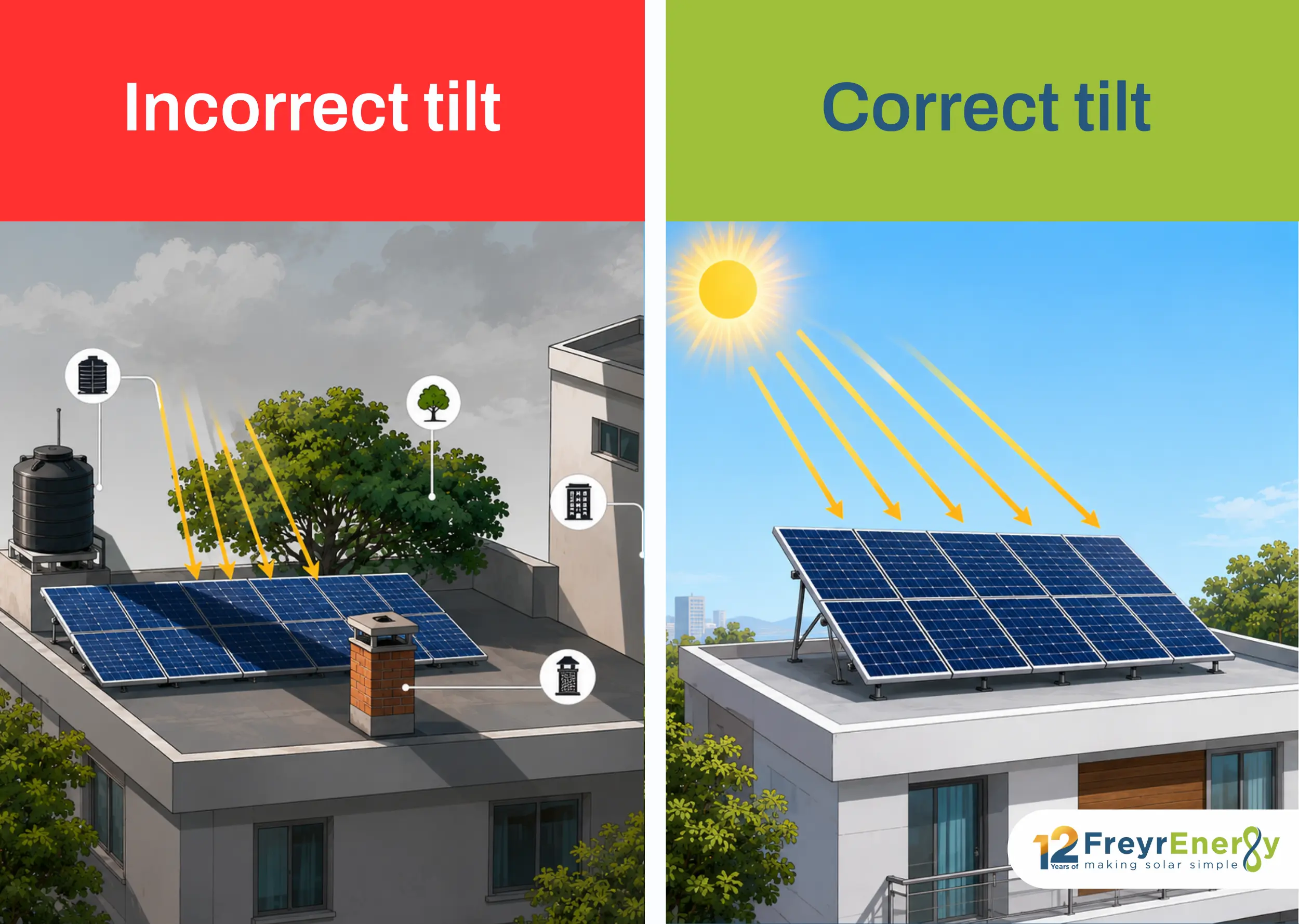
The best solar panel direction will not deliver the best output if the tilt angle is not right. Solar panel direction and angle work as a team. The tilt determines how directly sunlight hits the panel surface throughout the year. A tilt angle roughly equal to a location’s latitude is considered a good starting point for year-round performance, with slight seasonal adjustments improving performance.
Shading is another factor that’s easy to overlook. Water tanks, parapet walls, overhead cables, nearby trees, and buildings can cast shadows on panels during parts of the day, reducing power generation.
This is why an ideal installation always considers direction, shading, and tilt. A perfectly south-facing panel with poor tilt or partial shading can underperform compared to a well-angled, shadow-free panel facing southeast or southwest.
Choosing an experienced rooftop solar installation company will help you account for these factors correctly.
Pro Tip: Even a perfectly south-facing solar panel can underperform if it is partially shaded by nearby buildings, trees, water tanks, or overhead structures. A professional site assessment helps identify the location that delivers the highest long-term energy generation.
How to balance solar efficiency with Vastu?
A practical step-by-step approach for homeowners includes:
- Identify the roof area receiving maximum sunlight across most of the day, ideally during peak light hours.
- Check the best solar panel facing direction for your roof layout and location.
- Assess whether Vastu performance can be incorporated without meaningfully reducing energy performance- southeast or south zones.
- Finalize the tilt and placement through professional site assessment since real-world shading and structural factors vary from home to home.
To Conclude
South-facing installation is the general recommendation for solar panels in India, thanks to the sunlight exposure throughout the year. But no two homes are the same- roof shape, shading, and regional location can influence the performance.
Vastu Shastra can guide the decision-making process, since many vastu-approved zones align with solar-efficient directions. However, it is advised to understand technical factors like tilt angle and shading.
Choosing the right solar panel direction is about balancing technical performance with your personal preferences. While south-facing installations generally provide the highest annual energy generation in India, factors such as roof orientation, shading, tilt angle, and structural safety have an equally important impact on overall system performance. If Vastu is important to your family, a professional site assessment can often identify a placement that respects Vastu principles without compromising solar efficiency. Use Freyr Energy’s Solar Calculator or book a free site survey to find the ideal panel placement for your home.