
Direct answer: Industries should consider solar when a meaningful share of demand occurs during daylight and suitable roof or land and grid capacity are available. A robust decision compares CAPEX and RESCO models, sizes for self-consumption, models downside generation and includes structure, safety, approvals, O&M, financing, insurance and tax advice. A bankable project requires interval load data, downside generation and tariff cases, structural and electrical studies, clear contract risk and measurable post-commissioning KPIs.
Introduction
Industrial solar should be evaluated as an operating and capital project, not only as an environmental initiative. The value depends on the factory load curve, grid tariff, usable roof or land, self-consumption, interconnection, financing and downtime risk. This guide covers feasibility data, sizing, CAPEX and RESCO structures, technical design, approvals, tax context, O&M, sensitivity analysis and the questions plant and finance teams should resolve before investment.
Quick Takeaways
- Daytime load alignment drives industrial self-consumption.
- Use interval data and downside cases, not only annual totals.
- CAPEX and RESCO shift financing, ownership and risk.
- Structure, fire safety, interconnection and downtime matter.
- Tax and regulatory treatment requires current professional advice.
Industrial solar feasibility snapshot
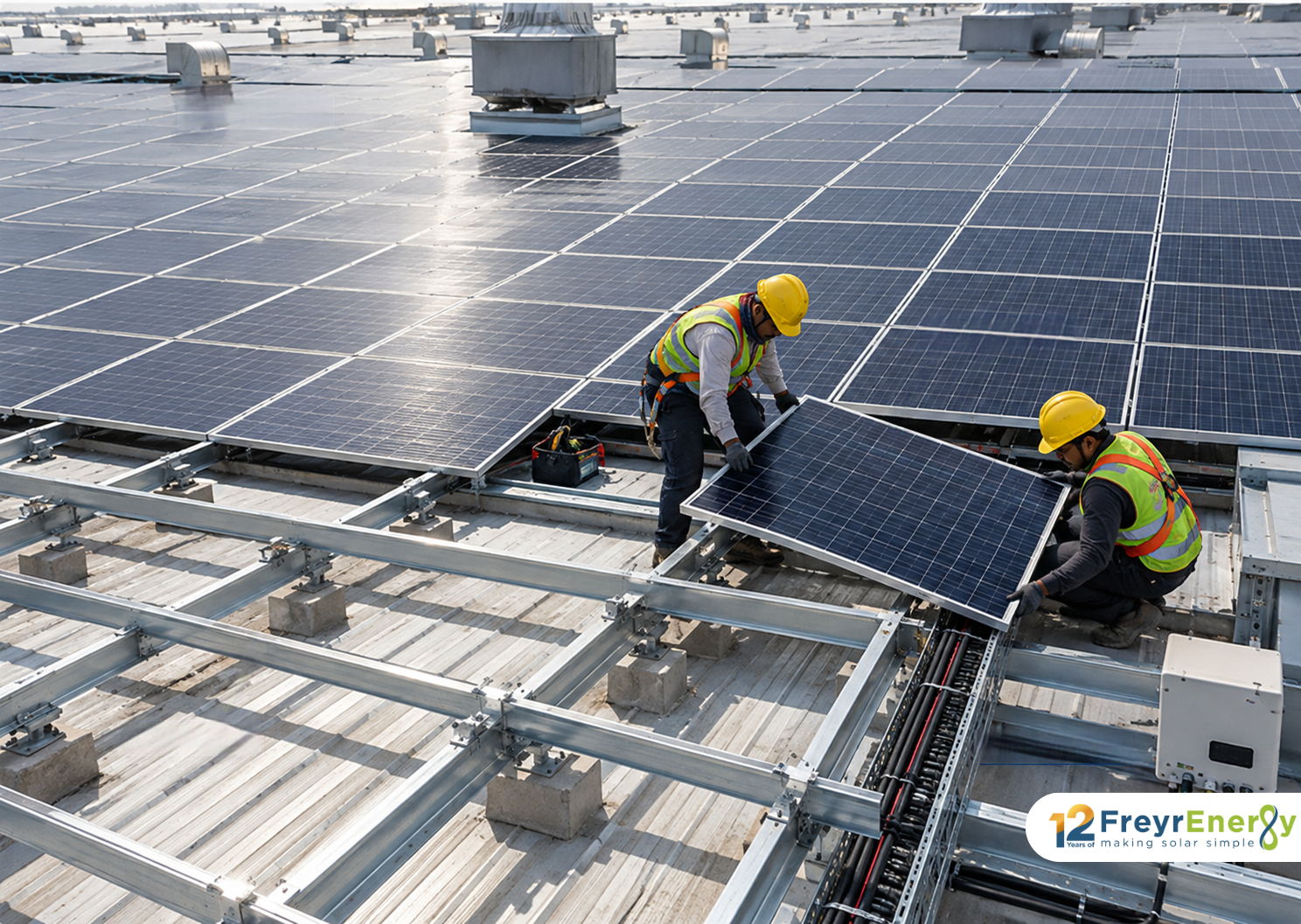
| Business-case area | Required input | Risk if omitted |
|---|---|---|
| Load | Interval or monthly data | Oversizing/export dependence |
| Site | Usable area/structure | Delay or strengthening |
| Grid | Sanctioned load/interconnection | Curtailment or approval issue |
| Financial | CAPEX, tariff, finance | Misleading payback |
| Lifecycle | O&M, degradation, replacement | Understated cost |
Installing solar power for industrial use allows businesses to generate electricity at their premises, reduce grid dependence and support long-term sustainability goals.
1. Lower Electricity Costs
Industrial electricity tariffs can represent a significant portion of operating expenses. A rooftop or ground-mounted solar plant can supply part of an industrial facility’s daytime demand, reducing the number of units purchased from the grid.
Actual savings depend on:
- Solar system capacity
- Daytime electricity consumption
- Applicable grid tariff
- Roof or land conditions
- Solar generation
- Financing costs
- Net-metering or open-access regulations
Businesses should request a site-specific generation estimate and financial analysis before making an investment in solar energy.
2. Protection Against Tariff Increases
Grid tariffs and related charges may change over time. Generating solar electricity on-site can make part of an industry’s energy cost more predictable.
While solar may not eliminate every electricity charge, it can reduce exposure to variable grid-energy costs over the system’s operating life.
3. Productive Use of Roof or Open Land
Factories, warehouses and production facilities often have large roofs or unused land suitable for solar installation. These spaces can be converted into electricity-generating assets without interfering with core manufacturing activities.
A professional assessment should evaluate structural strength, shading, usable area, electrical infrastructure and fire-safety access. Businesses can compare rooftop and ground-mounted solar systems before selecting an installation type.
4. Potential Tax Benefits
Eligible businesses may be able to claim depreciation on qualifying solar-power-generating equipment. The Income Tax Department’s depreciation schedule lists solar power generating systems under renewable-energy devices at a prescribed rate of 40%.
Tax treatment depends on ownership, commissioning date, asset use and applicable income-tax rules. Businesses should confirm eligibility and calculations with a qualified tax professional before including accelerated depreciation in their financial projections. See the current Income Tax Department depreciation schedule.
5. Progress Towards Sustainability Goals
Solar electricity can reduce an organisation’s dependence on conventional grid power and lower the emissions associated with its electricity consumption.
Generation data from a monitored solar system can also support environmental reporting and sustainability initiatives. However, businesses should calculate and disclose emissions reductions using an appropriate methodology instead of relying on generic claims.
6. Relatively Low Maintenance
Solar photovoltaic systems have no fuel requirement and few moving parts. Routine maintenance generally includes:
- Cleaning the solar modules
- Inspecting cables and connections
- Checking mounting structures
- Monitoring inverter performance
- Reviewing generation data
- Conducting scheduled safety inspections
Maintenance requirements depend on site conditions, equipment and system design. Dusty or industrial environments may require more frequent cleaning.
7. Flexible System Design
An industrial solar plant can be designed according to available space, operating hours and electricity demand. It may work alongside the utility grid, while compatible control systems can support integration with diesel generators or battery storage where required.
A standard on-grid solar system normally shuts down during a power outage for safety. Industries that need backup should consider an appropriately engineered hybrid or battery-storage solution.
Is Industrial Solar the Right Choice?
Solar may be suitable for an industrial facility when:
- Electricity consumption is high during daylight hours
- The roof or available land receives adequate sunlight
- The property has sufficient structural capacity
- The business plans to operate at the premises for several years
- The project meets DISCOM and regulatory requirements
- The expected savings justify the investment
Businesses should compare equipment quality, warranties, installation standards, maintenance support and projected generation rather than selecting a vendor based only on price.
Choose the Commercial Model Before Optimising the Design
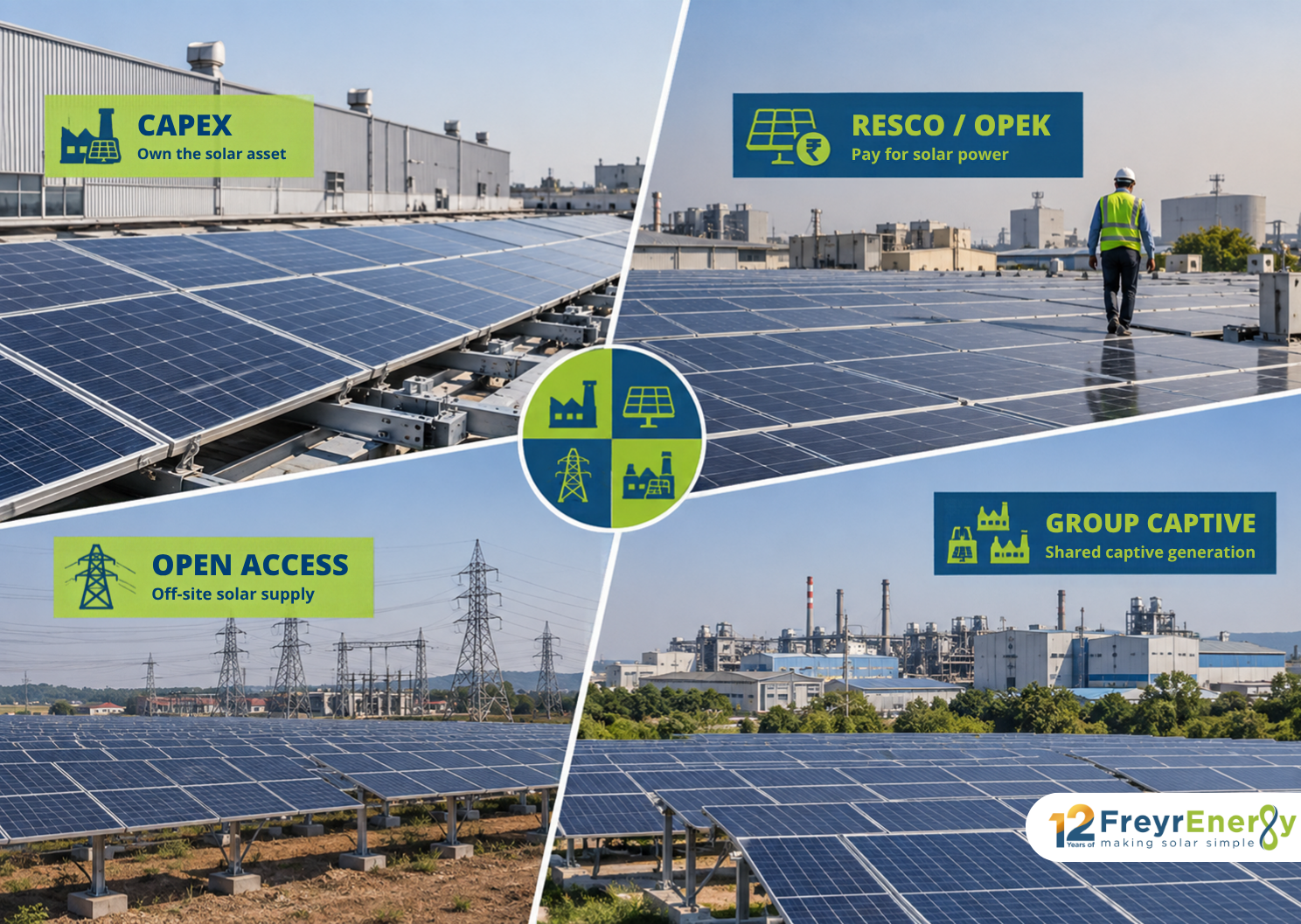
| Model | Who generally owns the asset? | How the customer pays | Key diligence |
|---|---|---|---|
| CAPEX | Industrial customer | Upfront funds or loan repayments | Equipment, EPC scope, generation, tax, O&M and lifecycle cost |
| RESCO/OPEX rooftop | Project developer | Contracted tariff or service payment | Escalation, minimum offtake, deemed generation, roof rights and exit |
| Open-access solar | Developer or captive structure | Energy and network-related charges under the arrangement | Eligibility, wheeling, banking, cross-subsidy, scheduling and regulatory change |
| Group captive | Special-purpose project with qualifying users | Equity plus energy charges | Captive-consumption and ownership tests, governance and legal advice |
The exact legal, tax and regulatory treatment changes by state, voltage level and consumer category. Obtain current professional advice before treating an open-access or group-captive structure as equivalent to an on-site rooftop project.
Minimum Data for an Industrial Feasibility Study
- Twelve months of interval demand, import energy, maximum demand, power factor and tariff components.
- Production shifts, shutdown calendar, planned expansion and loads that cannot be interrupted.
- Roof drawings, age, condition, structural capacity, fire paths and expected replacement date.
- Land title or lease, drainage, geotechnical information and future development plans for ground mounting.
- Single-line diagram, transformer ratings, protection study and available interconnection capacity.
- Diesel or backup strategy, because standard grid-tied solar normally trips during an outage.
- Corporate hurdle rate, financing assumptions, tax position, insurance and preferred ownership model.
Build a Bankable Financial Model
Model generation using a stated weather dataset, design and loss assumptions. Split self-consumed and exported energy, then value each at the applicable avoided tariff or settlement rate. Include degradation, downtime, cleaning, O&M, insurance, inverter or major-component replacement, financing, taxes and regulatory sensitivity. Test low-generation, lower-tariff-escalation and delayed-commissioning cases rather than presenting a single payback number.
Engineering and Operational Risks
| Risk | Consequence | Mitigation evidence |
|---|---|---|
| Weak or ageing roof | Leaks, reinforcement cost or early removal | Structural assessment and roof-life coordination |
| Fire-access conflict | Unsafe emergency response and approval risk | Approved layout, pathways, isolation and labelling |
| Export-dependent sizing | Lower value if settlement changes or export is constrained | Load-led sizing and downside case |
| Production shutdown | Unexpected export and reduced savings | Shift and shutdown modelling |
| Poor monitoring response | Undetected generation loss | Data access, alarm ownership and service SLA |
| Contract ambiguity | Disputes over downtime, roof work or early exit | Clear performance, access, change and termination clauses |
How to Use the Sanvira Case Study Responsibly
Freyr Energy reports a 368 kW rooftop installation for Sanvira Biosciences in Visakhapatnam and annual savings of about ₹28 lakh. This is useful evidence that a large industrial rooftop project was delivered, but its financial result is not a benchmark for another factory. Recalculate generation, self-consumption, tariff, financing and operating schedule for the new site, and label the published number as company-reported.
Tax and Depreciation Need Professional Review
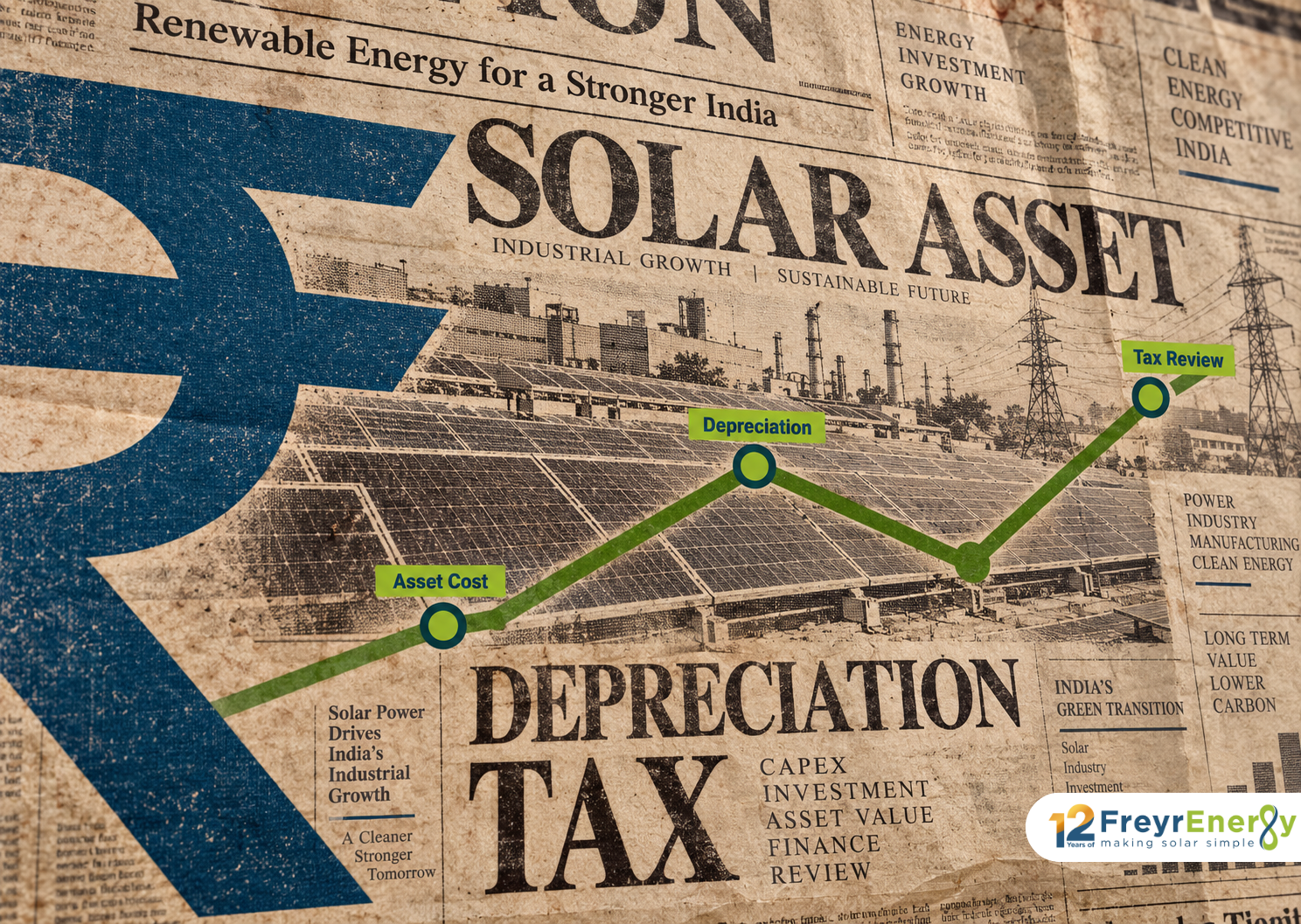
India’s income-tax depreciation schedule includes specified renewable-energy devices, including solar-power generating systems, within a 40% written-down-value rate category. Whether and how a particular taxpayer can claim depreciation depends on ownership, use, commissioning date, accounting and current tax law. Treat depreciation as a tax-timing matter reviewed by the company’s adviser, not as a universal cash rebate or subsidy.
Measure Operational Performance
Track specific yield, performance ratio where properly calculated, inverter availability, self-consumption, export, outages and curtailment. Compare actual data with the same weather period and the contractual model. An unexplained fall should trigger checks for soiling, shading changes, string or inverter faults, meter problems and production-schedule changes.
Industrial Procurement Checklist
- Technical specifications and approved-equivalent rules.
- Structural, electrical, fire and construction method statements.
- Generation model, degradation, availability and performance-remedy method.
- Grid, metering and statutory responsibility matrix.
- Construction shutdowns, access, safety and production-interface plan.
- O&M scope, spares, response times and monitoring-data ownership.
- Insurance, force majeure, change in law, termination and end-of-life duties.
Industrial Solar Model Comparison
| Model | Capital/ownership | Best fit | Key risks |
|---|---|---|---|
| On-site CAPEX | Customer funds and owns | Strong balance sheet and long site tenure | Performance, O&M, technology and asset risk |
| On-site RESCO/PPA | Developer funds/owns; customer buys energy | Capital preservation and stable roof rights | Escalation, deemed generation, lock-in and exit |
| Open access | Remote project supplies through network | Large eligible demand and suitable regulation | Wheeling, banking, CSS, scheduling and change in law |
| Group captive | Consumer holds qualifying project interest | Large users able to manage compliance/governance | Ownership/consumption tests and counterparty structure |
| Solar plus storage | Adds battery to on-site or remote supply | Demand shaping, resilience or time-value use case | High cost, controls, degradation and replacement |
Industrial Feasibility Data Room
| Data category | Minimum information | Owner |
|---|---|---|
| Electricity | 12-month bills, interval load, demand and power factor | Energy/finance team |
| Operations | Shifts, shutdowns, future equipment and critical loads | Plant team |
| Site | Roof drawings, condition, fire routes, land and drainage | Facilities/engineering |
| Electrical | SLD, transformer, protection and connection capacity | Electrical team |
| Commercial | Hurdle rate, finance, tariff and tax position | CFO/tax adviser |
| Contract | Site tenure, insurance, lender and offtake terms | Legal/procurement |
Sensitivity Analysis
Test lower generation, lower tariff escalation, reduced production, delayed commissioning, higher O&M and inverter replacement. For RESCO, test tariff escalation, deemed generation and early exit. For open access, test banking, wheeling, cross-subsidy and curtailment changes. A bankable decision is one that remains acceptable under plausible downside conditions.
Post-Commissioning KPIs
- Monthly and annual generation and specific yield.
- Inverter/plant availability and recorded outages.
- Self-consumption, export and curtailment.
- Actual tariff avoided and demand-charge effect.
- Safety observations, preventive maintenance and fault closure time.
- Financial variance against the approved business case.
Conclusion
Industrial solar can be a valuable cost and decarbonisation measure when it is sized around a real daytime load and backed by engineering and financial diligence. Compare CAPEX and RESCO on the same generation and risk assumptions, include structure, grid, safety, downtime and lifecycle costs, and test downside cases. Use current professional advice for tax and regulatory treatment. The investment case should remain acceptable without transferring another factory’s tariff, generation or payback figures to the site under review.