
Solar energy is undeniably the most effective solution to face the global threat of climate change. With its unlimited availability, this clean energy source is bound to have a great positive impact on the environment.
The use of devices like solar collectors are an added advantage in the use of renewable sources of energy. They can capture sunlight from different angels, which aids in efficent heat absorption. In this blog, we have discussed one of the types of solar collectors, namely flat plate collector, and its advantages.
What are solar collectors and their types?
Solar collectors are devices that absorb sunlight using plates to convert it into thermal energy. This is done to increase the temperature of water and air for household and commercial applications.
There are two types of solar collectors: non-concentrating and concentrating solar collectors. Non-concentrating collectors are used in domestic applications and concentrating collectors are used in industrial heating. Flare plate collectors are non-concentrating solar collectors.
What are flat plate collectors?
It is the most commonly used solar collector. Flat plate solar thermal collectors are thermal devices that absorb heat energy from sunlight and convert them into thermal energy. These collectors have a flat surface for sunlight absorption.
They have a capacity to heat below 100 ℃, and is typically used for domestic water and air heating as also commercial heating. These flat plates can absorb direct and diffuse sunlight efficiently.
Components that make a flat plate solar collector
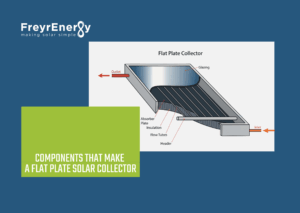
Here are the major components that make a flat plate collector:
Glazing cover
It is the top layer of the plate, which is generally made of glass or plastic film. This layer creates a greenhouse effect that allows sunlight to reach the plate. It also helps reduce the heat loss from the solar collector.
Absorber plate
This is a metal surface coating with black, typically made of copper or aluminium. The coating improves heat absorption.
Heat transfer tubes
These are copper pipes connected to the absorber plate to transfer the heating fluid.
Insulation
To prevent loss of heat to the atmosphere, the absorber plate is covered with insulation material such as foam or mineral wool on the front and back.
Casing
It is a structure made from weather-resistant material to protect the components of the flat plate from external damage.
Working principle of flat plate collectors
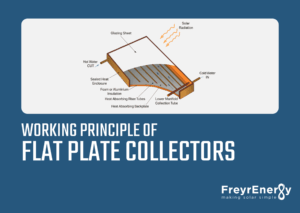
Flat plate solar thermal collectors work on the principle of greenhouse effect. Here’s a detailed list of steps involved:
Sunlight absorption
The glazing cover on top of the flat plate receives and passes the sunlight to the absorber plate, which is coloured dark. There is minimal heat loss, hence the plate gets instantly heated.
Heat transfer to tubes
Once the plate is heated, it is transferred to the attached tubes. The fluid, typically water, which is stored in the tubes, thus gets heated.
Transfer to storage
The heated fluid moves to a heat exchanger or a storage tank through pipes. Households then use this for bathing.
Cooler fluid reheats
Once the heat is delivered to the tank, the cooler fluid returns to the collector and the same heating process continues again.
The use of a transparent cover on the top and the insulation prevents heat loss. This enables the efficient functioning of the flat plate collectors.
Types of flat plate collectors
Based on the glaze
- Glazed flat plate collectors: These have a transparent glass or plastic cover on the top of the plate to trap heat efficiently.
- Unglazed flat plate collectors: They do not have an insulation cover on top and are mostly suited for low temperature heating such as pool heating.
Based on fluid
- Liquid flat plate collectors: They use water or anti-freeze liquids and are used for domestic water heating.
- Air flat plate collectors: They use air to transfer heat and are effectively used in space heating.
Based on configuration
- Parallel absorbing plates: Used in big apartment complexes, here heat can be dispersed through a larger volume of fluid.
- Series absorbing plate: Lesser volume of circulating fluid is involved here. They have a sole continuous circuit.
Advantages and limitations of flat plate collectors
Advantages
- Flat plate solar energy collector absorbs both direct and diffuse sunlight, making it highly effective.
- They require low maintenance and are durable.
- Orientation and tilt do not matter, making them easy to install.
- They are highly suitable for low-temperature applications like domestic water heating.
- They are simple and cost-effective than concentrating solar plate collectors.
Limitations
- They are not suitable for higher temperature applications.
- Metal components are prone to corrosion due to exposure to various environmental factors.
- It may not be suitable for areas that experience heavy snowfall, as it can impact performance.
Conclusion
When the country is working towards environmentally friendly energy options, flat plate collectors support the task by helping in efficient heat absorption. They are instrumental in our country, where there is abundant sunlight throughout the year.
They are cost-effective option for low temperature applications in domestic and commercial uses. The adoption of flat plate collectors takes us one step closer to realise the environment sustainability goals of the nation.