
Direct answer: Rewa Ultra Mega Solar is a 750 MW project in Madhya Pradesh comprising three 250 MW units. RUMSL reports a first-year tariff of ₹2.97/kWh and a ₹3.30/kWh levelised tariff over 25 years, with 76% of power allocated to Madhya Pradesh and 24% to Delhi Metro. Full capacity was commissioned on 3 January 2020. Its importance lies in procurement and risk allocation as much as capacity, and its tariff should not be used as a residential rooftop price benchmark.
Introduction
Rewa Ultra Mega Solar is important not only because it is a 750 MW plant. Its auction, contracting structure, payment security, interstate customer and historically low tariff influenced how large solar projects were discussed and procured in India. This guide presents the verified capacity, site, developers, buyers, tariff, financing, timeline, emissions estimate and continuing significance, while distinguishing figures that official sources describe differently.
Quick Takeaways
- Rewa has three 250 MW generating units.
- Its first-year and levelised tariffs were historically significant.
- Madhya Pradesh receives 76% and Delhi Metro 24% of power.
- Commissioning and dedication dates are different milestones.
- Official sources use both 1,500-hectare park and 1,590-hectare project descriptions.
Rewa solar project at a glance
Milestone | Verified detail | Why it matters |
|---|---|---|
Project capacity | 750 MW: 3 × 250 MW | Scale and phased development |
Commercial production | From 2018; full commissioning Jan 2020 | Separates unit and full-plant dates |
Dedication | 10 July 2020 | Public inauguration |
First-year tariff | ₹2.97/kWh | Historic auction outcome |
Power allocation | 76% MP; 24% DMRC | Interstate procurement model |
Prime Minister Narendra Modi formally dedicated the project to the nation through a video conference on 10 July 2020. At the time of its inauguration, it was described as one of Asia’s largest single-site solar projects.
Rewa Solar Plant at a Glance
- Location: Rewa district, Madhya Pradesh
- Total capacity: 750 MW
- Generating units: Three units of 250 MW each
- Total area: Approximately 1,500 hectares
- Solar park developer: Rewa Ultra Mega Solar Limited
- Major power buyers: Madhya Pradesh DISCOMs and Delhi Metro Rail Corporation
- Inauguration: 10 July 2020
The solar park was developed by Rewa Ultra Mega Solar Limited, a joint venture between Madhya Pradesh Urja Vikas Nigam Limited and the Solar Energy Corporation of India. Solar parks of this size use shared infrastructure to support multiple generating units within one designated area.
Key Features of the Rewa Solar Project
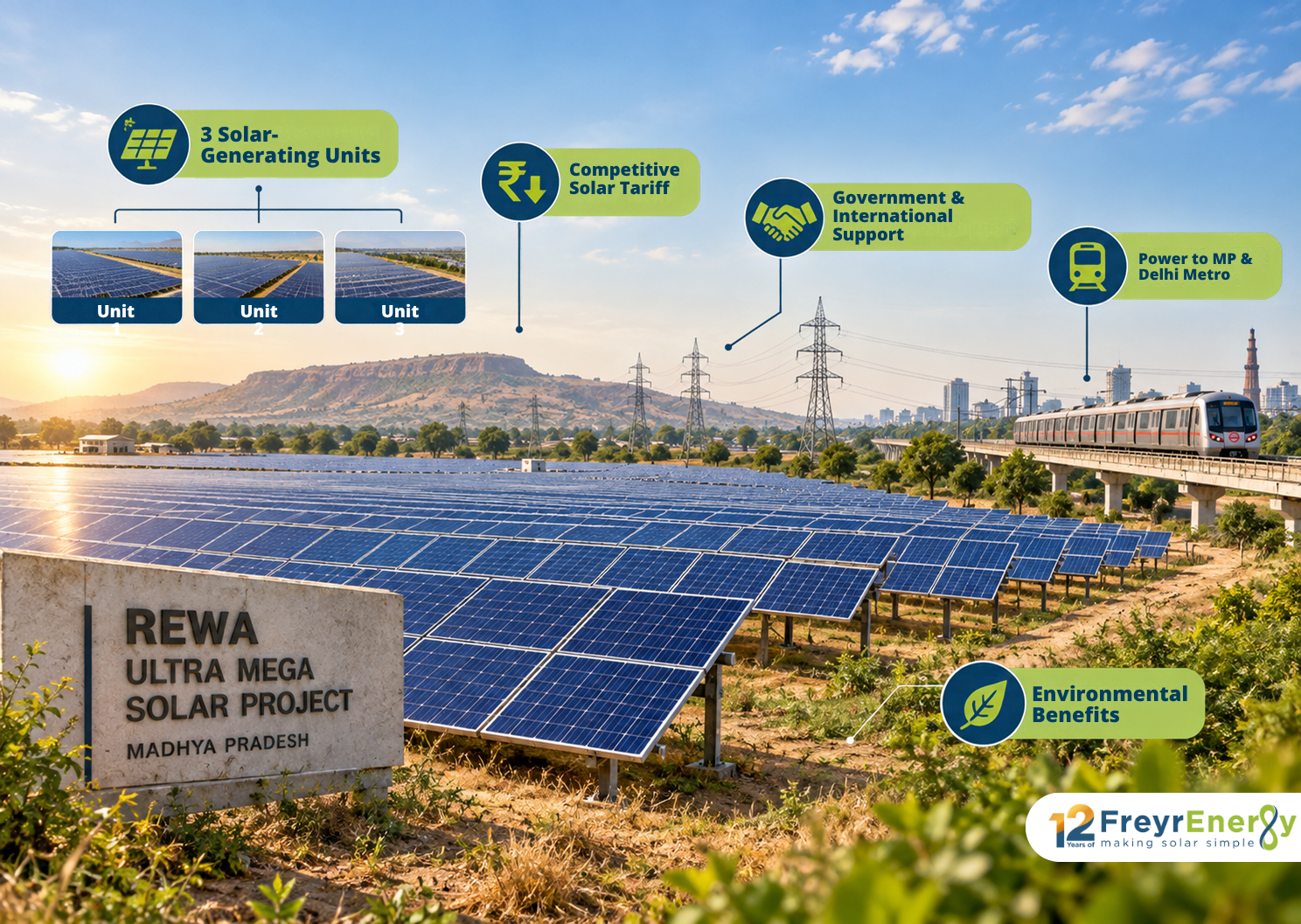
1. Three Large Solar-Generating Units
The Rewa project consists of three generating units with a capacity of 250 MW each. Every unit occupies approximately 500 hectares, creating a combined project area of around 1,500 hectares.
This structure allowed three developers to establish separate generating units within the same solar park.
2. Competitive Solar Tariff
The project received attention for achieving a first-year tariff of ₹2.97 per unit, with an annual escalation of ₹0.05 per unit for 15 years. Its levelised tariff was ₹3.30 per unit over 25 years.
This was considered an important development because the tariff fell below prevailing grid-power costs at the time. The project demonstrated how competitive bidding and carefully structured agreements could reduce the cost of large-scale solar power generation.
3. Government and International Support
The Central Government provided ₹138 crore in financial assistance for developing the solar park. Its shared infrastructure also received support through financing arrangements involving the World Bank and the Clean Technology Fund.
The project’s financial structure, payment-security mechanism and allocation of risks helped attract private investment and became a model for other large solar developments.
4. Power Supply to Madhya Pradesh and Delhi Metro
The Rewa project was among India’s first renewable-energy projects to supply electricity to an institutional customer outside its home state.
Its power allocation was structured as follows:
- 76%: Supplied to Madhya Pradesh’s state electricity distribution companies
- 24%: Supplied to the Delhi Metro Rail Corporation
This arrangement allowed Delhi Metro to meet part of its daytime electricity requirement with solar power generated in Madhya Pradesh.
5. Environmental Benefits
According to government estimates, the Rewa solar project can avoid carbon emissions equivalent to approximately 15 lakh tonnes of carbon dioxide annually.
Large-scale solar energy projects can reduce dependence on conventional electricity generation and support India’s transition towards cleaner energy sources.
Recognition and Awards
The Rewa Ultra Mega Solar Project received the World Bank Group President’s Award for Innovation and Excellence. It was also featured in A Book of Innovation: New Beginnings.
Its project structure was recognised for:
- Competitive tariff discovery
- Effective allocation of project risks
- A strong payment-security mechanism
- Interstate supply to an institutional buyer
- Successful participation by private developers
The Ministry of New and Renewable Energy also recommended elements of the project’s transaction structure as a model for other states.
Why the Rewa Solar Project Matters
The Rewa project showed that utility-scale solar could deliver electricity at a competitive tariff while serving different categories of buyers. It also demonstrated how government agencies, institutional consumers, international lenders and private developers could collaborate on a major renewable-energy project.
Although a utility-scale plant differs from a rooftop system, both contribute to wider solar-energy adoption in India.
Verified Project Timeline
Milestone | Date or period | Why the distinction matters |
|---|---|---|
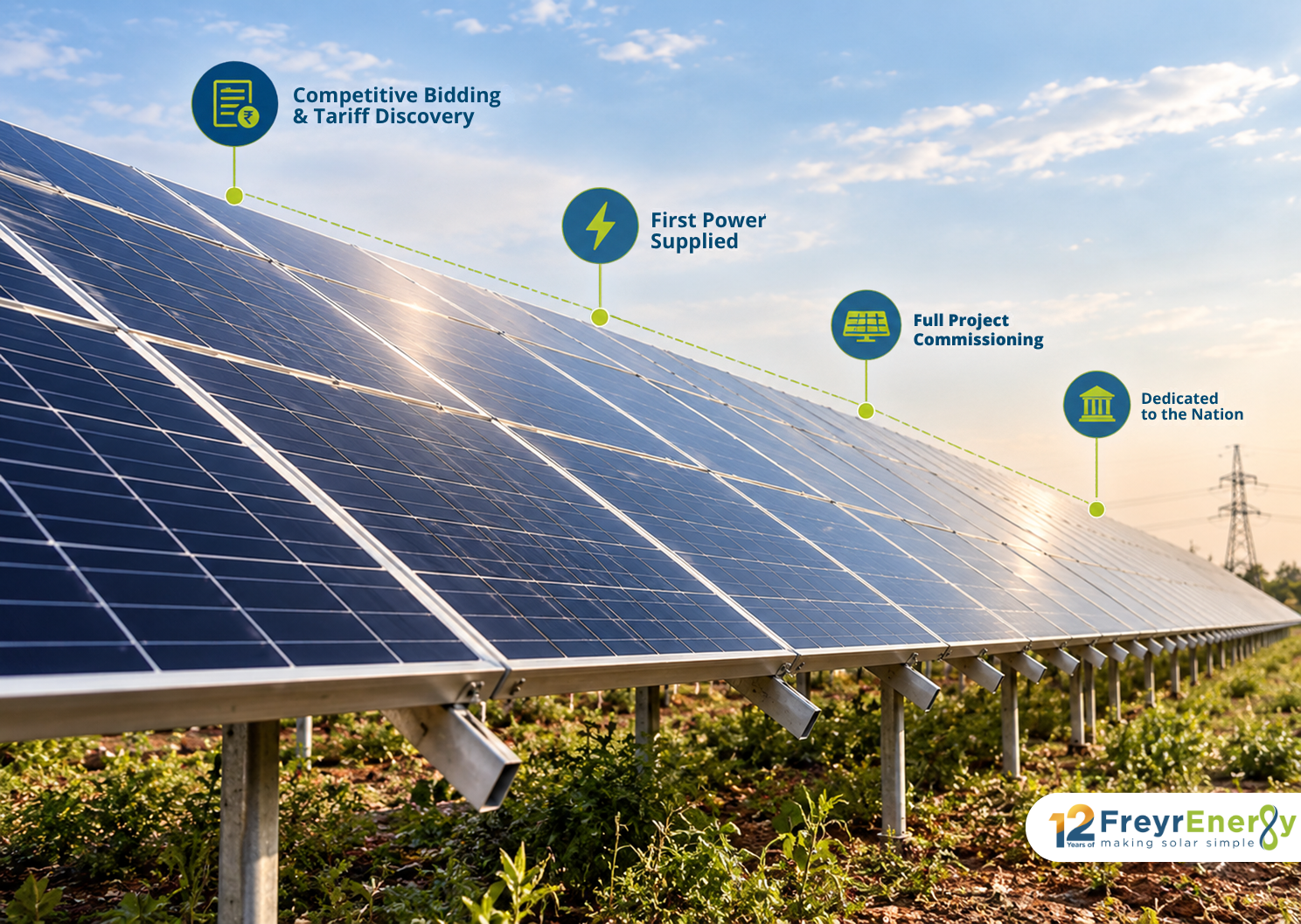
Competitive bidding and tariff discovery | 2017 | Established the contracted tariff and selected three developers |
First power supplied | 2018 | Generation began before the entire 750 MW was commissioned |
Full project commissioning | 3 January 2020 | All three 250 MW units were operating |
Project dedicated to the nation | 10 July 2020 | A public inauguration milestone, not the commissioning date |
Articles often use inauguration, first generation and full commissioning interchangeably. Keeping them separate makes the project history accurate and prevents the misleading claim that no power was produced until July 2020.
How the Project Was Structured
Rewa Ultra Mega Solar Limited developed the park and competitively procured power from three 250 MW units. Official project information identifies Mahindra Renewables, ACME Solar and Solengeri Power as the selected developers. The contracted power was allocated primarily to Madhya Pradesh distribution companies, with 24% allocated to Delhi Metro. The project also used institutional support, land and evacuation planning, standardised contracting and payment-security arrangements to reduce risks that commonly raise renewable tariffs.
Why the Tariff Was Historically Important
RUMSL reports a first-year tariff of ₹2.97 per kWh and a levelised tariff of ₹3.30 per kWh over 25 years. The result was notable at the time because it demonstrated that a large Indian solar project could secure long-term buyers at a tariff competitive with conventional procurement benchmarks then under discussion. It should not be compared directly with a current rooftop quotation: utility-scale tariffs exclude the customer-side distribution, roof, retail billing and service context of rooftop solar.
What Rewa Can and Cannot Prove
Lesson supported by the project | Claim the project does not prove |
|---|---|
Competitive, well-structured procurement can reduce project risk and tariffs | Every future solar auction will achieve a lower tariff |
Large buyers can contract solar across state boundaries | A household can buy power on the same commercial terms |
Payment security and bankable contracts matter | Capacity alone guarantees project performance |
Phased milestones should be reported accurately | Rewa remains India’s largest solar project today |
Official sources also report the project area differently: a 2020 PIB note describes three 500-hectare plots, while RUMSL’s current page states 1,590 hectares. Both figures should be attributed and dated rather than silently reconciled. Environmental-benefit figures likewise depend on the stated methodology and operating period.
Capacity, Land and Grid Infrastructure
The 750 MW capacity is divided equally across three generating units. The park model allowed common planning of land and evacuation infrastructure while developers built the individual projects. Large-project output still depends on module performance, inverter availability, grid evacuation and operating conditions; capacity should not be described as continuous generation.
Why Delhi Metro’s Participation Mattered
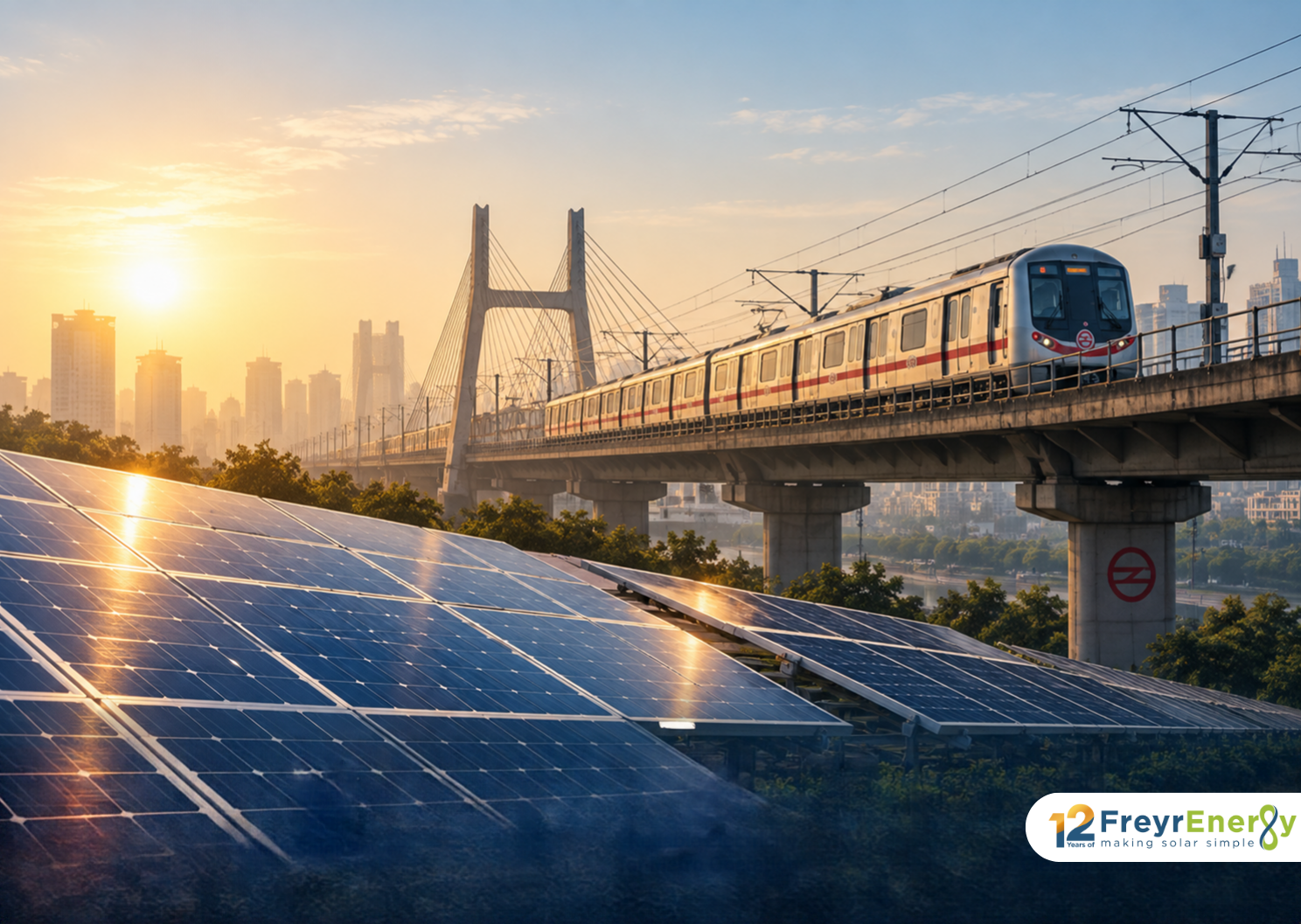
The 24% allocation to Delhi Metro created a prominent interstate institutional buyer for solar power. It demonstrated that a large urban transport consumer could contract renewable electricity from a project located in another state under an appropriate legal and transmission arrangement. That precedent is more informative than simply calling Rewa “one of the world’s largest” without a date.
How to Cite Rewa Accurately
- Use RUMSL or PIB for capacity, unit structure, allocation and dates.
- Label first-year and levelised tariffs correctly; do not present them as the same figure.
- Distinguish generation start, full commissioning and dedication.
- Attribute the 1,500-hectare and 1,590-hectare figures to their respective official sources.
- Date comparative superlatives and environmental estimates.
- Do not use a utility-scale tariff as a residential rooftop price benchmark.
Rewa Project Facts: Source-Controlled Table
Fact | Verified value | Reporting note |
|---|---|---|
Total capacity | 750 MW | Three units of 250 MW each |
Location | Gurh tehsil, Rewa district, Madhya Pradesh | Use official project description |
Power allocation | 76% Madhya Pradesh; 24% Delhi Metro | Interstate institutional offtake is a key distinction |
First-year tariff | ₹2.97/kWh | Do not confuse with levelised tariff |
Levelised tariff | ₹3.30/kWh over 25 years | Contract measure, not a rooftop retail tariff |
Full commissioning | 3 January 2020 | Different from first generation and dedication |
Dedication | 10 July 2020 | Public milestone after commissioning |
Official Figures That Require Attribution
Topic | PIB description | RUMSL description | Editorial treatment |
|---|---|---|---|
Project area | Three 500-hectare plots / 1,500 hectares | Project spread over 1,590 hectares | Report both with source and date |
Environmental benefit | Published estimate under stated assumptions | May use a different operating basis | Do not present as measured lifetime avoidance |
Project status | Commissioning/dedication press context | Current project/operator context | Use milestone-specific wording |
Procurement Features Behind the Tariff
- Competitive selection of developers for three equal units.
- Pre-planned land and evacuation infrastructure through the solar-park model.
- Long-term power offtake with Madhya Pradesh distribution companies and Delhi Metro.
- Payment-security and contract provisions designed to improve bankability.
- Institutional and development-finance support connected to project preparation.
Why Rewa Still Matters
Rewa’s enduring lesson is that low bids are supported by credible land, transmission, offtake and payment arrangements. Capacity and sunlight alone do not make a project financeable. Modern articles should explain those enabling conditions and avoid outdated “largest” labels unless they are tied to a date and comparison set.
Conclusion
Rewa’s importance comes from the combination of scale, tariff discovery, procurement structure and interstate supply. The project’s verified timeline explains why production, full commissioning and dedication dates differ. Its payment-security and contracting features are as significant as the 750 MW capacity. Readers and publishers should cite RUMSL and PIB directly, date area and emissions figures, and avoid repeating outdated “largest” labels without a time qualifier. That approach preserves the project’s real significance without turning history into hype.