| Direct answer: Solar can be financed through cash purchase, a loan or EMI under customer-owned CAPEX, or through third-party arrangements such as RESCO, lease or PPA where available. The best option is the one that matches ownership preference, cash flow, credit eligibility, roof tenure and risk. Compare total repayment and contract obligations, not only the advertised monthly EMI. |
The upfront cost of rooftop solar can discourage homeowners and businesses from making the switch. Financing options can make the investment more manageable by spreading the cost over monthly payments.
India’s grid-connected rooftop solar capacity reached 30.74 GW by 31 July 2026, according to the Ministry of New and Renewable Energy. Wider access to financing can support further rooftop solar adoption.
Quick Takeaways
- A low EMI can result from a longer tenure and may increase total interest; request the annual percentage rate, processing fees, down payment, tenure and total amount payable in writing.
- Under a typical loan-funded CAPEX project, the customer owns the system and carries performance and repayment obligations; under a PPA or RESCO structure, a third party usually owns and operates it.
- PM Surya Ghar assistance is tied to eligible residential grid-connected installations and scheme compliance, not to the mere existence of a loan.
- Commercial buyers should compare CAPEX and OPEX on lifetime savings, tax treatment, roof control, contract exit terms, performance guarantees and escalation clauses.
- Freyr publishes financing support through multiple partners, but approval, interest, EMI and zero-cost eligibility depend on lender assessment and current terms.
What Is Solar Financing?
Solar financing allows customers to install a solar system without paying its entire cost upfront. Depending on the arrangement, customers may repay a loan, lease the equipment or purchase the electricity generated under a power purchase agreement.
The main options include:
Cash purchase: The customer pays upfront and owns the system.
Solar loan: The customer owns the system while repaying the lender through EMIs.
Solar Lease: A third party generally owns the equipment, while the customer pays an agreed rental.
RESCO or PPA: A provider owns the system, and the customer pays for the electricity generated or consumed.
Ownership, maintenance responsibilities and subsidy treatment differ between these models. Review this guide to solar financing options before deciding.
Freyr Energy Solar-Loan Options
Freyr Energy works with financing partners to offer solar loans for eligible homes and businesses. Current features can include:
- Financing of up to 100% of the eligible project cost
- EMIs starting from ₹1,466
- Repayment tenures from 6 to 120 months
- Collateral-free loans in eligible cases
- Digital processing with limited documentation
These features are subject to lender policies, credit assessment, project cost and borrower eligibility. Approval, interest rates, processing fees, down payments and repayment terms are not guaranteed.
Visit the Freyr Energy solar-loan page for the latest available terms.
Benefits of a Solar Loan
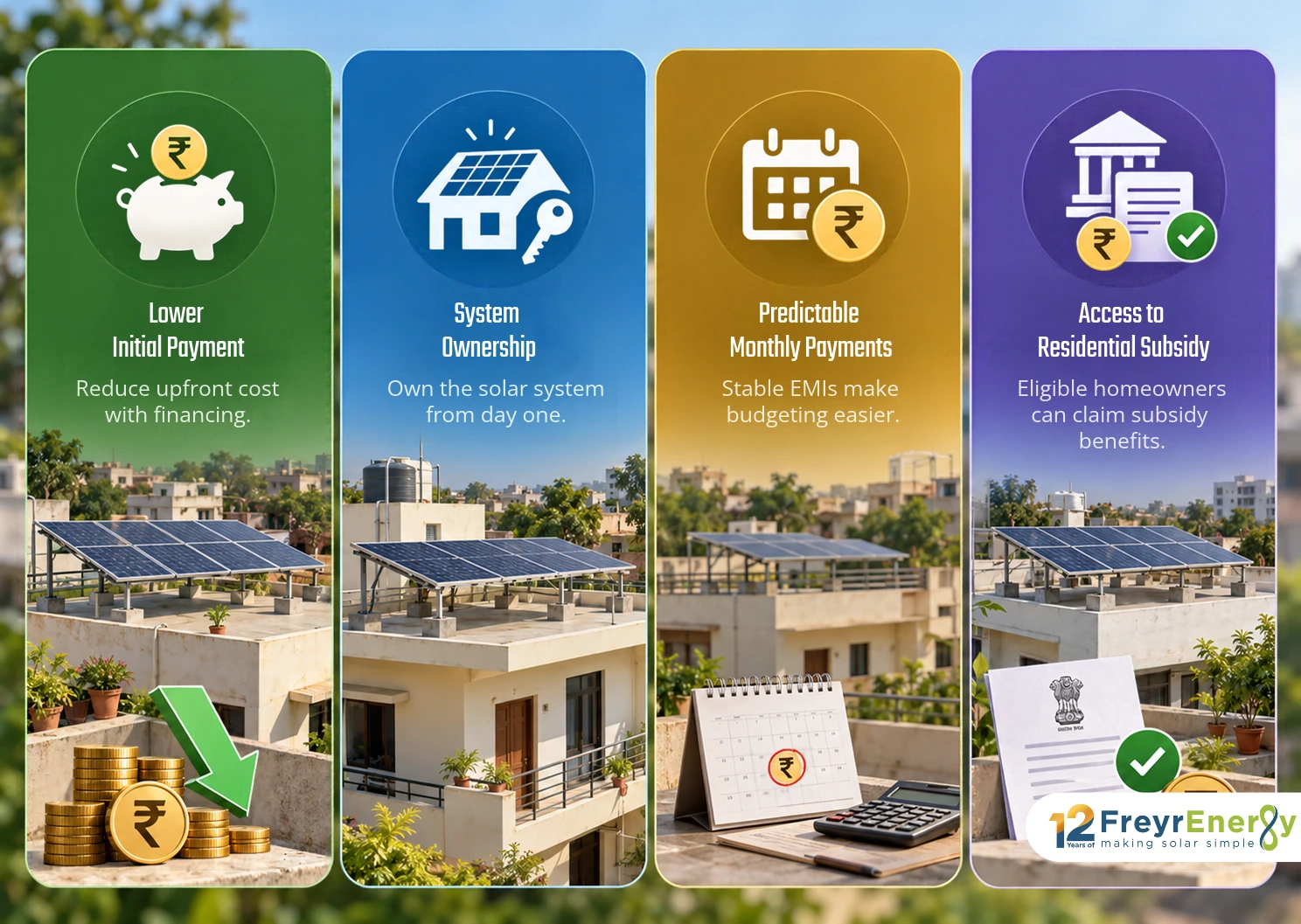
Lower Initial Payment
A loan can reduce or eliminate the need to pay the complete installation cost at once. This allows customers to retain funds for other requirements.
System Ownership
With a loan-based purchase, the customer generally owns the solar system, subject to any security interest created in favour of the lender.
Predictable Monthly Payments
A fixed repayment schedule can make budgeting easier. However, customers should compare the EMI with expected solar savings rather than assuming the savings will always cover the repayment.
Access to Residential Subsidy
Eligible homeowners purchasing a grid-connected system through an approved loan arrangement may qualify for government assistance. Subsidy approval depends on the current scheme rules, equipment compliance and DISCOM verification.
Read the latest solar-subsidy guidelines before applying.
What Should You Compare Before Taking a Solar Loan?
Do not evaluate a financing offer using only the advertised EMI. Compare:
- Interest rate
- Loan tenure
- Total repayment amount
- Required down payment
- Processing and documentation fees
- Late-payment charges
- Prepayment or foreclosure conditions
- Collateral or guarantee requirements
- Insurance requirements
- Subsidy-adjustment process
A longer tenure may lower the monthly EMI but increase the total interest paid. Ask for a written repayment schedule before accepting an offer.
Loans, Leases and PPAs: Which Is Better?
A solar loan may be suitable if you want to own the system without paying the full cost upfront.
A solar lease or power purchase agreement may suit eligible projects where preserving capital is more important than system ownership.
Availability depends on the customer category, project capacity, location and provider terms. PPAs and RESCO arrangements are more commonly offered for larger commercial projects than small residential systems.
How to Apply for Solar Financing
The usual process includes:
- Estimate the required solar-system capacity.
- Complete a consultation and site survey.
- Review the system design and itemised quotation.
- Select an eligible financing option.
- Submit identity, income and property documents.
- Complete the lender’s credit assessment.
- Review and accept the approved loan terms.
- Coordinate installation after approval.
Use the Freyr Energy solar calculator to obtain an initial system-size and cost estimate.
How Freyr Energy Can Help
Freyr Energy provides customised solar solutions for homes and businesses. Support can include system assessment, design, installation coordination, subsidy documentation and financing assistance.
The final financing arrangement remains subject to approval and the lending partner’s terms.
Useful next steps include the solar financing guide and the solar roof calculator. These pages support planning and comparison; final capacity, pricing, approvals and savings remain site-specific.
Compare Finance on Total Cost, Not Monthly EMI
Ask the lender for loan amount, down payment, interest method, effective annual rate, processing and documentation charges, insurance, number of EMIs, total interest, total repayment, late-payment terms and foreclosure conditions. Then compare the repayment schedule with a conservative solar-savings estimate that retains fixed utility charges and allows for seasonal generation.
A sound affordability test keeps the household or business able to pay during low-generation months and tariff changes. Savings should not be described as guaranteed loan repayment because weather, consumption, downtime and utility rules can change.
Freyr Energy Financing Trust Signals
Freyr Energy’s approved information lists financing partners including Fibe, Ecofy, Bajaj and CreditFair, a 10–20% indicative down payment, tenures from 6 to 120 months and EMI starting from ₹1,466 per month. Zero-cost EMI may be available for up to 12 months through eligible CreditFair plans.
These are promotional starting terms, not entitlements. The article should state that lender credit assessment, loan amount, interest, processing fees, system price and customer eligibility determine the actual offer and that current terms must be reconfirmed before publication or purchase.
Finance Red Flags
Be cautious when a proposal hides the cash price, labels financing as a “saving,” assumes the maximum subsidy before eligibility is established, omits the total repayment or requires large non-refundable payments before technical feasibility. A third-party contract also needs clear provisions for roof repair, sale or lease expiry, early termination, system removal, insurance and underperformance.
Worked Finance Comparison Beyond the EMI
A 12-month promotional EMI and a long-tenure term loan solve different cash-flow problems. Put the cash price beside the down payment, financed principal, all fees, number of instalments and total amount payable. A lower monthly instalment can still cost more overall when the tenure is longer, while a short offer can require a larger monthly commitment.
Next, model electricity savings conservatively and retain fixed utility charges. Keep the subsidy as a separate, potentially delayed receipt. The finance choice is resilient only if the borrower can make payments during low-generation months and if the system remains affordable when output or tariffs differ from the sales illustration.
Which Financing Route Fits Your Situation?
| Option or situation | Best use or meaning | What to verify |
| Cash CAPEX | Customer | No finance interest; highest upfront cash use |
| Loan-funded CAPEX | Customer | Spreads payment; adds interest, fees and credit conditions |
| Lease | Usually third party | Lower initial outlay; contract and roof-access obligations |
| PPA or RESCO | Third party | Payment for energy; tariff escalation and exit terms matter |
Financing Risks and Contract Checks
| Risk or mistake | Why it matters | Control |
| Only EMI is disclosed | Total borrowing cost is hidden | Request the full repayment schedule |
| Subsidy is used as loan approval | Separate eligibility tests are ignored | Verify scheme and lender independently |
| Savings equal EMI in every month | Seasonality and fixed charges are omitted | Use a monthly downside case |
| Property exit is not covered | Sale, lease expiry or roof work can create disputes | Write transfer and termination terms |
Questions to Ask the Lender or PPA Provider
| Question | Evidence to request | Why the answer matters |
| What is the unfunded cash price? | Complete installed quotation | Separates the asset price from borrowing cost |
| What is the total amount payable? | Signed repayment schedule including every fee | A monthly EMI does not show total cost |
| When does payment begin? | Disbursement and milestone schedule | Avoids repayment before useful delivery |
| What if subsidy is delayed or denied? | Downside cash-flow case | Tests affordability without an assumed receipt |
| Can the borrower exit early? | Prepayment, foreclosure and transfer clauses | Long-tenure flexibility can affect value |
Compare Total Repayment, Not Only the EMI
A low EMI can come from a longer tenure rather than a lower borrowing cost. Compare the sanctioned amount, customer contribution, annual percentage rate or equivalent disclosed cost, processing fee, insurance, taxes, repayment tenure, total interest and total amount payable. Ask how prepayment, foreclosure, late payment and failed subsidy receipt affect the schedule.
- Match the EMI start date with the expected commissioning and billing-benefit date.
- Do not use expected subsidy as the down payment unless the lender’s written product structure explicitly permits it.
- Test whether the monthly electricity saving remains below, equal to or above the EMI in a conservative generation year.
Financing can improve cash flow, but it does not make an oversized or poorly designed plant economical. Technical feasibility should be approved before the borrower selects tenure.
Who Owns the Asset and the Performance Risk?
Under a purchase or loan, the consumer usually owns the system and carries performance and maintenance risk, subject to warranties. Under a lease or PPA, a third party may own the asset and sell use or energy under a long contract. The agreement must state roof access, insurance, meter treatment, minimum purchase obligations, tariff escalation, early termination, relocation and end-of-term ownership.
For businesses, tax treatment and accounting depend on ownership and the applicable law. Accelerated depreciation should be reviewed with a qualified tax adviser; it should not be presented as a universal cash discount.
Sources and Verification Notes
Policy, subsidy, tax, equipment and metering information can change. The primary sources below were checked for this revision; reverify material claims immediately before publication.
- Residential CFA: PM Surya Ghar operational guidelines — assistance rules relevant to financed residential systems
- Tax depreciation: Income Tax Department Appendix I — depreciation categories for eligible renewable-energy devices
- Consumer planning: PM Surya Ghar official portal — official application and consumer workflow