
Electricity bills are rising every year. At the same time, more people want clean and reliable energy for their homes. This is where solar power comes in.
The government has also stepped in with the PM Surya Ghar Muft Bijli Yojana. This scheme makes rooftop solar more affordable for households across India.
Still, many people feel confused when they start exploring it.
- Should I take a loan?
- Will I get a subsidy?
- Can I use both together?
These are common questions. And they are valid.
Here’s a simple thought:
What if you could install solar with almost zero upfront cost?
This blog will help you understand the difference between solar loan vs. solar subsidy, and whether you can use both together.
What is a Solar Subsidy?
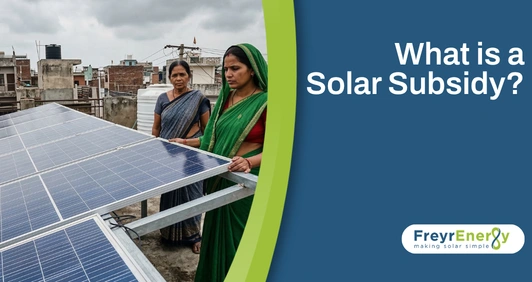
A solar subsidy is financial support given by the government. It helps reduce the cost of installing a rooftop solar system.
How does it work?
- You install the solar system first
- It gets inspected and approved
- The subsidy amount is sent directly to your bank account
Subsidy structure under PM Surya Ghar
- ₹30,000 per kW (up to 2 kW)
- ₹18,000 per kW (from 2 to 3 kW)
- Maximum subsidy: ₹78,000
This support can make a big difference.
Example:
If your solar system costs ₹2 lakh, the subsidy can reduce your final cost by a large amount. This makes solar much more affordable.
What is a Solar Loan?

A solar loan is a financing option offered by banks or NBFCs. It helps you install solar without paying the full amount upfront.
Key features of solar bank loans
- Loan amount: Usually between ₹2 lakh to ₹6 lakh
- Repayment: Monthly EMIs
- Collateral: Often not required for smaller loans
In simple terms:
A loan helps you install now and pay later.
This is helpful for families who want to switch to solar but do not have full savings ready.
Solar Loan vs. Solar Subsidy (Core Comparison)
Understanding solar loan vs. solar subsidy is very important before you decide.
| Feature | Solar Subsidy | Solar Loan |
| Source | Government | Bank/NBFC |
| Nature | Financial aid | Borrowed money |
| Repayment | No | Yes (EMI) |
| Timing | After installation | Before or during installation |
| Benefit | Reduces cost | Makes solar affordable |
Key takeaway
- A subsidy reduces your total cost.
- A loan helps you manage the payment.
Both serve different purposes.
Can You Get Both Solar Loan and Subsidy Together?
Yes, you can use both.
This is one of the biggest advantages of the PM Surya Ghar scheme.
How it works
- You take a solar loan to install the system
- The system is installed and inspected
- The subsidy is approved
- The amount is transferred to your bank account
- You can use this amount to reduce your loan burden
This means you do not have to choose between the two.
Important clarity
- The subsidy does not replace your loan
- It reduces the overall cost of your system
So, combining both is a smart move for many households.
Eligibility Conditions You Must Know
Before applying, you need to meet some basic conditions:
- You must be an Indian citizen
- You should own a house with a suitable rooftop
- You must have a valid electricity connection
- You should not have taken a solar subsidy before
Common mistake
Many people think tenants can apply. In most cases, this is not allowed because the property owner is required.
Step-by-Step Process to Get Loan + Subsidy
The process is simple if you follow the right steps.
Register on the official portal
Sign up under the PM Surya Ghar scheme
Choose a vendor
Select an approved solar installer
Apply for a loan
If needed, apply through a bank or NBFC
Install the system
Get the solar panels installed
Inspection
Your DISCOM will inspect the system
Get subsidy
The subsidy is credited to your bank account
In most cases, the subsidy is received within about 30 days after approval.
Real-Life Scenario
Let’s look at a practical case.
- Total system cost: ₹2.5 lakh
- Loan taken: ₹2 lakh
- Subsidy received: ₹78,000
After receiving the subsidy, the actual financial burden reduces a lot. The EMI becomes easier to manage.
This is how many middle-class families are now going solar.
Benefits of Combining Solar Loan + Subsidy
Using both options together offers strong advantages.
- Very low upfront cost
- Easy transition to solar energy
- Reduced electricity bills
- Long-term savings
On average, a household can save around ₹15,000 to ₹18,000 per year, depending on usage.
Over time, the system pays for itself.
Common Myths About Solar Finance
There are many misunderstandings around solar loan vs. solar subsidy.
Let’s clear a few:
- “I must pay the full amount upfront” — Not true
- “Loan means I won’t get subsidy” — Not true
- “Subsidy comes before installation” — Not true
- “Solar is only for rich people” — Not true
Solar is now within reach for most households.
Challenges & Practical Considerations
While the system is helpful, there are some real challenges.
- Loan approvals may take time
- Documentation can feel complex
- Choosing the right vendor is very important
In some cases, delays in financing have slowed down solar adoption. So planning ahead is always better.
Expert Tips Before You Apply
A few simple tips can make your journey smoother:
- Choose vendors approved under the scheme
- Compare loan interest rates across banks
- Select the right solar system size for your needs
- Do not depend only on the subsidy—plan your budget wisely
Small decisions can make a big difference in your overall savings.
Conclusion
So, when it comes to solar loan vs. solar subsidy, the answer is clear.
You can use both together.
A loan helps you start.
A subsidy reduces your cost.
If budget is a concern, combining both is a smart and practical approach.
Solar energy is no longer out of reach.
Solar is no longer expensive; it’s just misunderstood.