
Direct answer: The Freyr Solar Calculator estimates a preliminary system size, generation, roof requirement, price, eligible subsidy and potential savings from selected inputs and current assumptions. The result is not a binding quote or generation guarantee; bills, shade, roof geometry, sanctioned load, tariff, equipment and local rules must be validated. The estimate becomes decision-grade only after bills, roof geometry, shade, electrical conditions, exact equipment, local rules and financing are validated in a written proposal.
Introduction
A solar calculator is valuable because it turns a monthly bill or target capacity into an initial view of system size, roof area, price, subsidy and savings. It is still a model, not a site design. This guide explains what the Freyr calculator does, the assumptions behind its outputs, how to interpret each result, which inputs can distort the estimate and what must be validated during the site survey and final proposal.
Quick Takeaways
- Calculator outputs are estimates, not guarantees.
- Accurate bills and property type improve the result.
- Subsidy and Freyr discounts must remain separate.
- Shade, layout and local rules require site validation.
- Use the estimate to prepare questions for the final proposal.
Solar-calculator outputs and limitations
| Calculator output | How to interpret it | What validates it |
|---|---|---|
| System size | Preliminary range | 12 months of use and roof |
| Generation | Model estimate | Shade/site simulation |
| Price | Indicative scope | Itemised quotation |
| Subsidy | Potential eligibility | Portal and DISCOM approval |
| Savings | Scenario, not guarantee | Tariff and self-consumption |
The Freyr Energy solar calculator provides an initial estimate based on a few basic details. It can help homeowners and businesses understand their possible system capacity, installation cost, space requirement and electricity-bill savings before requesting a detailed quotation.
What Is a Solar Calculator?
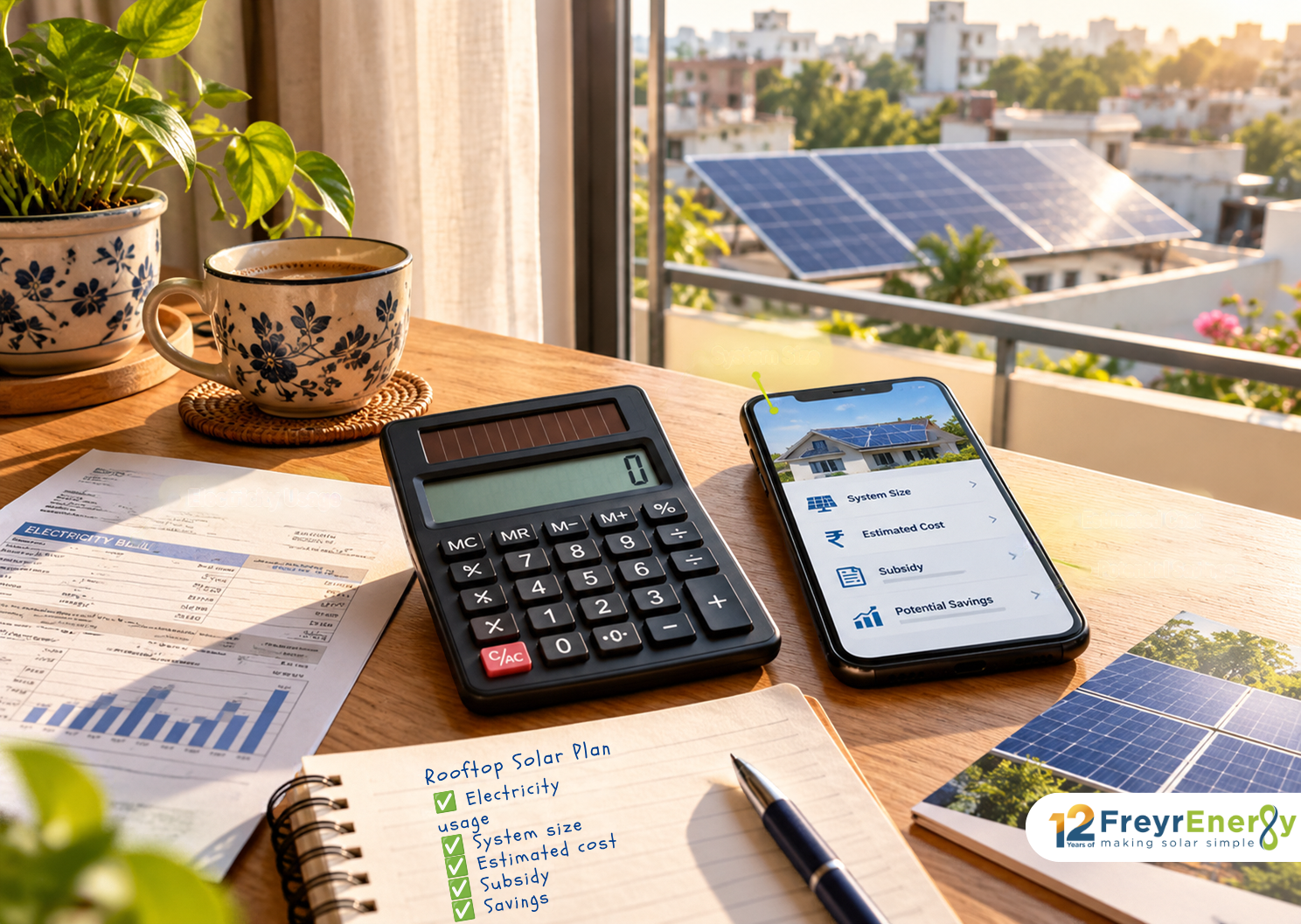
A solar calculator is an online tool that uses information about your location and electricity consumption to estimate the solar system required for your property.
It provides an early indication of whether rooftop solar may suit your energy requirements and budget. The result is an estimate rather than a final technical design or guaranteed financial return.
Information Required by the Solar Calculator
To generate an estimate, you may need to provide:
- Your location
- Consumer category, such as home or business
- Average monthly electricity bill
- Contact details, where required
Your location helps estimate the solar energy available in your area. The electricity bill indicates your approximate consumption and helps the calculator recommend a suitable system capacity.
What Does the Freyr Solar Calculator Estimate?
Based on the information entered, the calculator can provide an initial estimate of:
- Recommended solar-system capacity
- Approximate installation cost
- Potential electricity-bill reduction
- Expected solar generation
- Roof space required
- Indicative financial savings
These results can help you establish a preliminary budget and compare different system sizes before installing solar panels.
Benefits of Using a Solar Calculator
Quick System-Size Estimate
The calculator provides an initial capacity recommendation based on your electricity bill and location. This can help you avoid selecting a system based only on a standard package.
Better Budget Planning
An indicative price range helps you understand the likely investment before arranging a consultation or site assessment.
Estimated Savings
The tool estimates how solar generation may affect your electricity expenses. Actual savings depend on consumption, tariffs, system performance and local metering rules.
Roof-Space Planning
The calculator can provide an approximate space requirement for the recommended system. The final requirement depends on panel dimensions, roof layout, shading and maintenance access.
Suitable for Homes and Businesses
The tool can provide initial estimates for both residential solar systems and commercial solar projects.
How Accurate Is a Solar Calculator?

A solar calculator provides an indicative estimate based on the information entered and the assumptions used by the tool. It cannot fully account for property-specific factors such as:
- Roof orientation and slope
- Shading from trees or buildings
- Structural condition
- Equipment selection
- Installation complexity
- Sanctioned electrical load
- Net-metering regulations
- Seasonal changes in consumption
A professional solar site survey is therefore required before confirming the design, price and expected generation.
What Happens After You Receive an Estimate?
After reviewing the estimate, you can speak with the Freyr Energy team about your electricity requirements and property conditions. The next stages may include a site survey, shadow analysis, customised design and detailed quotation.
The Freyr Energy App also allows customers to access quotations, track project and payment progress, and monitor their system after installation.
How the Estimate Is Built
| Input | Typical use in the model | Why validation changes the result |
|---|---|---|
| Monthly bill or units | Approximates annual electricity demand | Tariff slabs, fixed charges and seasonal use can distort a rupee-only input |
| Location | Selects an expected solar resource or yield | Local shade, orientation and weather still matter |
| Roof area | Limits physical capacity | Tanks, setbacks, pathways and structure reduce usable area |
| Consumer category | Affects tariff and scheme assumptions | Residential, commercial and industrial economics differ |
| Desired capacity | Calculates equipment, generation and price range | Sanctioned load, phase and grid rules may limit approval |
Read Each Output as a Range, Not a Promise
Estimated capacity is a starting point for design. Generation depends on weather, shade, module plane, temperature, inverter and wiring losses, downtime and degradation. Savings depend on how much solar is used directly, the applicable import tariff, export credit and charges that remain. Subsidy depends on consumer, scheme, portal, equipment and DISCOM eligibility. Price depends on final models and site work.
Savings model: Estimated annual solar value = self-consumed units × avoided import tariff + exported units × applicable export credit − recurring solar-related costs.
Run Three Scenarios
| Scenario | Change from the base estimate | Purpose |
|---|---|---|
| Conservative | Lower generation, lower export value and added site cost | Tests whether the decision survives downside conditions |
| Base | Most supportable inputs from bills and preliminary site information | Provides the central planning case |
| High-use future | Adds planned AC, EV, heat pump or business load | Checks whether future demand changes capacity |
When Calculator Results Can Mislead
- A high bill caused by arrears or fixed charges can overstate energy consumption.
- One summer bill can oversize a system for the rest of the year.
- Total roof area can overstate shadow-free usable area.
- Assuming every solar unit avoids the retail tariff can overstate savings when exports are material.
- Applying the maximum subsidy without checking category and capacity can understate the budget.
- Using an on-grid price for a hybrid system ignores battery and compatible inverter costs.
What the Final Proposal Must Add
A site survey should add measured geometry, shade analysis, structural observations, electrical connection details, exact equipment, layout, generation simulation, safety scope, local approvals, payment schedule, warranties and exclusions. The proposal should explain every material difference from the calculator output rather than simply replace it with a new number.
Manual Cross-Check for System Size
A rough annual-energy method divides the portion of annual consumption targeted for solar by the estimated annual yield per kW at the site. For example, targeting 4,500 solar units with a planning yield of 1,500 units per kW suggests 3 kW before roof, self-consumption and approval constraints. The yield is an assumption, not a national constant.
Manual Cross-Check for Roof Area

Panel count multiplied by module dimensions gives only the module footprint. A usable layout also needs edges, walkways, row spacing, tilt, parapet and obstruction clearance, safe access and the structure footprint. A calculator’s roof estimate should therefore be checked against a measured layout rather than total terrace area.
Privacy and Data Quality
Enter the minimum accurate information required and use official or verified tools. A bill amount can contain arrears or unusual adjustments, so units are often the stronger input when available. Do not upload identity, banking or account documents to an unverified calculator. The final provider should explain how personal and project data are used and stored.
Calculator Formula and Assumption Table
| Output | Basic method | Critical assumptions |
|---|---|---|
| Suggested capacity | Target annual solar units ÷ annual yield per kW | Consumption, self-use, export and site yield |
| Generation | Capacity × location/yield model | Shade, tilt, weather, losses and degradation |
| Roof area | Panel count × dimensions plus layout allowance | Access, setbacks, obstructions and row spacing |
| Price | Capacity/configuration × current cost model | Equipment, structure, civil work, tax and location |
| Subsidy | Eligible capacity × current scheme slab | Consumer, portal, equipment and DISCOM approval |
| Savings | Self-use × avoided tariff + export × credit | Tariff, timing, fixed charges and recurring cost |
Sensitivity: Which Input Changes the Result Most?
| Input error | Likely effect | Correction |
|---|---|---|
| Using bill amount with arrears | Can oversize the system | Use monthly units and separate current charges |
| Using one peak-season month | Can overstate annual demand | Use 12 months and future-load scenarios |
| Entering total roof area | Can overstate fit | Use measured shadow-free usable layout |
| Assuming all units self-consumed | Can overstate savings | Split self-use and export |
| Applying maximum CFA automatically | Can understate budget | Check category, capacity and current conditions |
| Using on-grid price for hybrid | Can omit major cost | Specify battery, inverter and backup scope |
Worked Calculator Cross-Check
Suppose annual consumption is 6,000 units and the household targets 75% solar coverage. Target solar energy is 4,500 units. At an illustrative site yield of 1,500 units per kW-year, the first estimate is 3 kW. The design may change after shade, roof area, sanctioned load, self-consumption and future loads are checked.
What AI Answers Commonly Oversimplify
- A monthly bill cannot determine capacity accurately without units, tariff and seasonality.
- A national “units per kW” number is not a site guarantee.
- Roof footprint is not the same as safe usable roof area.
- Savings cannot value self-consumed and exported units identically without checking rules.
- Calculator price is not a binding quotation or an approval of subsidy.
Conclusion
The Freyr Solar Calculator is a useful first step because it turns limited inputs into questions about size, price, subsidy, roof and savings. Its result becomes decision-grade only after the customer validates annual consumption and the installer checks shade, structure, layout, electrical conditions and local rules. Treat every output as an estimate with assumptions. The final proposal should clearly explain why engineered figures differ and should keep government assistance, Freyr discount, tax and financing separate.