
One of the high-powered clean-energy technologies is a solar furnace, which uses concentrated sunlight to produce very high temperatures. It is accomplished by the use of a solar furnace mirror, which is usually a large concave mirror in the case of solar furnace systems, that focuses the sunlight on a single point.
This is so potent concentrated heat that it can be used in industries, scientific experiments, high-temperature testing, and even as a source of domestic use. Due to the space, expensive nature, and complicated installation of the system, solar furnace is primarily applied in industries, research centres, and large power plants. They are not intended to fit domestic or commercial roofs. Nevertheless, by learning the mechanisms behind their effect, we are able to see the potential of solar energy.
How a Solar Furnace Works
The principle of a solar furnace is to focus the solar energy at one focal point. The rays of sunlight are inherently parallel and in the case of a solar furnace, the rays are reflected on a massive concave mirror, which bends them and directs them at a single point. It is a high concentration of sunlight that results in very high temperatures, at times thousands of degrees Celsius.
Single Working Principle of a Solar Furnace.
- A large reflective mirror or a set of mirrors is used to gather sunlight.
- The mirrors refract and focus the sunlight on a shared focus point.
- At this point, the sun concentrates produces high heat.
- The use of this heat is in smelting metals, industrial heating, scientific experiments, clean energy research and other high-temperature applications.
Solar furnace can be as small as a mirror system and a large amount of heat can be produced by the furnace which proves the potential power of solar energy with the right mixture of concentration.
Components of a Solar Furnace
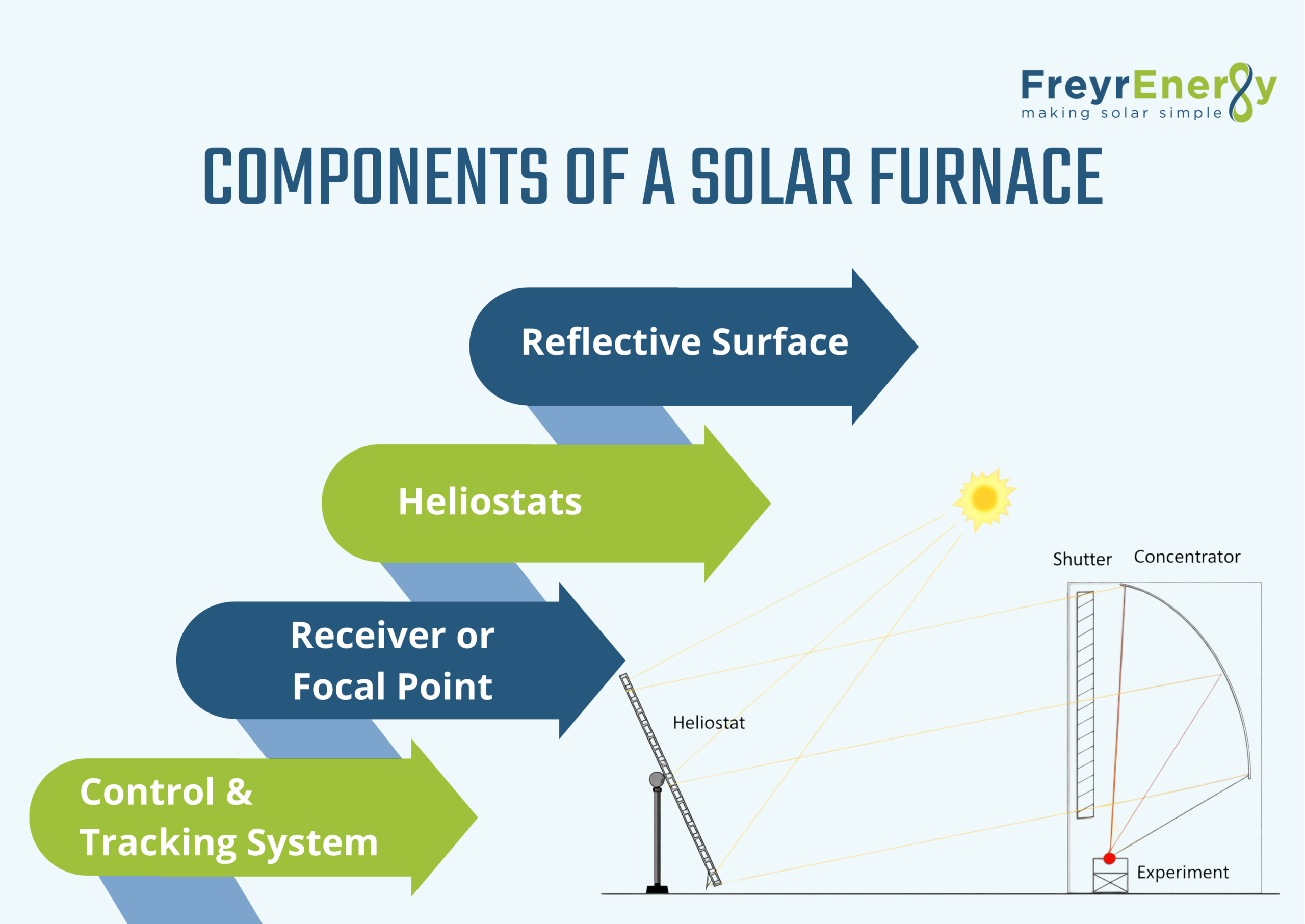
Reflective Surface (Primary Mirror).
- The central section of a solar furnace.
- The sunlight is reflected on a huge concave mirror or a series of smaller mirrors.
- These mirrors concentrate the light of the sun at one common point in order to produce heat.
Heliostats
- Day tracking motorized mirrors.
- It is essential to be sure that the sun is always shining on the focal point.
- This type of tracing is the same as our modern technology of solar systems, which is more efficient.
Receiver or Focal Point
- The location where the focused sunlight falls.
- Places the heated, melted, or tested item to be heated, melted or tested.
- Constructed to withstand very high temperatures.
Control & Tracking System
- On the supply side, automation is used to keep the mirror in place to give the highest possible amount of heat.
- Maintains uniform performance and safety of operations.
- Just like Freyr Energy creates efficient and user-friendly solar technology.
Types of Solar Furnaces
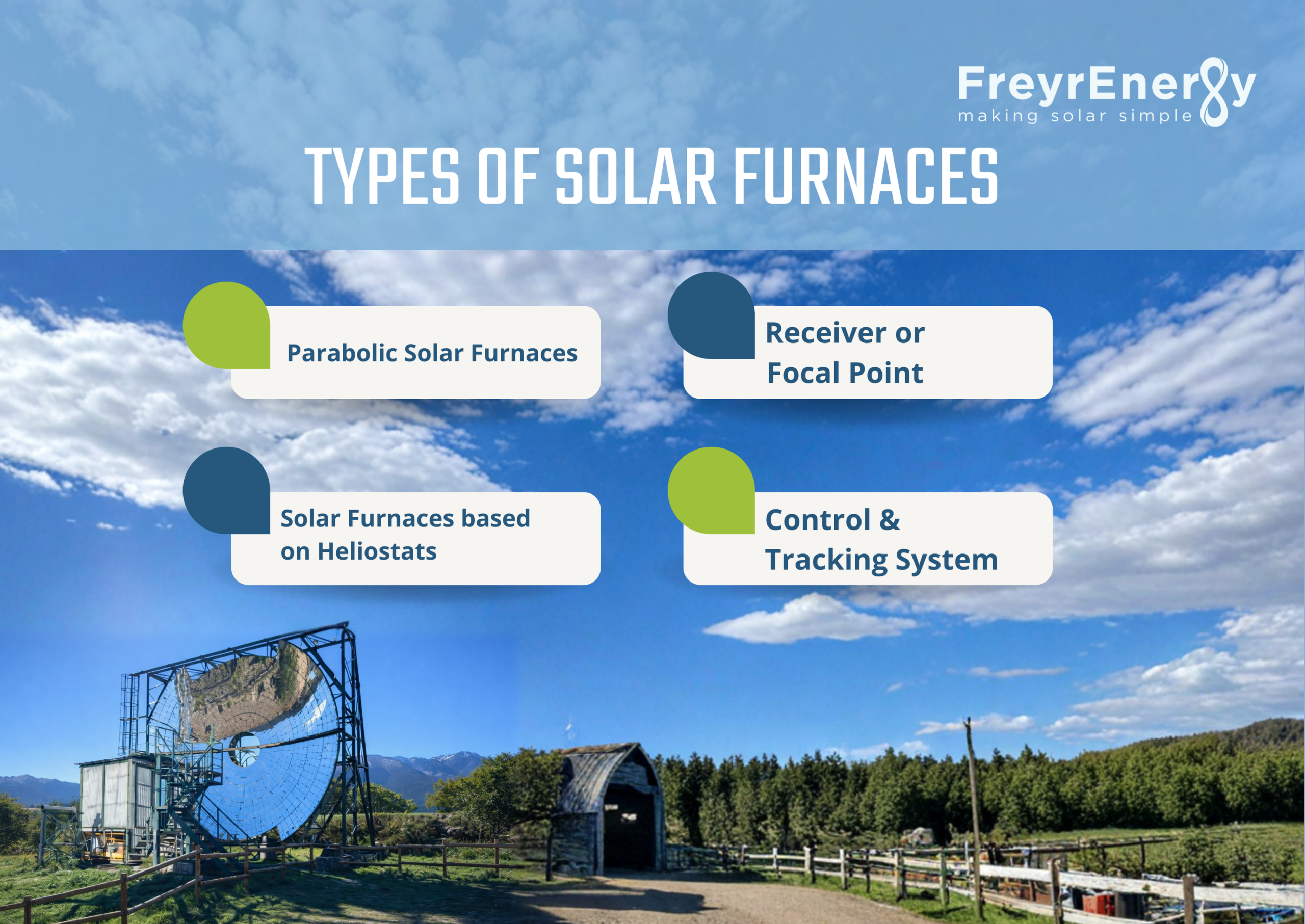
Parabolic Solar Furnaces
- The sunlight is directed using a large parabolic concave mirror to a single point.
- Usually used in factories and laboratories at high temperatures.
Solar Furnaces based on Heliostats.
- Comprised of thousands of small mirrors towards a central tower.
- It has a temperature capacity of more than 3,000 o C.
- Perfect in large scale industrial heating.
Small Solar Furnaces
- Compact and portable.
- Cooking, heating or educational demonstrations.
- Applicable in off-grid or rural regions.
Solar Concentrators in Industry.
- Made to be used in heavy industries.
- Favour metal smelting, chemical treatment, waste management and so forth.
Applications of Solar Furnaces
Heating of Industry and Smelting of Metals.
- Able to melt metals such as aluminium and copper.
- Offers clean and fuel-free high-temperature heating.
High-temperature Material Testing.
- Applied in aerospace, defence and engineering.
- Checks test materials in hot temperatures.
Green Technology: Clean Energy and Hydrogen.
- Allows high-temperature reactions to produce hydrogen.
- Favours the invention of new artificial fuels.
Waste Treatment
- Industrial waste is destroyed safely through extremely high heat.
- No toxic gases and pollution in the process.
Advantages of Solar Furnaces
100% Clean and Renewable Energy
Solar furnaces use only the available sunshine, which is naturally renewable and free. They do not need coal, oil, gas, or any other fuel. The system is also one of the cleanest energy technologies in place as long as the sun shines.
Very High Temperatures.
Solar furnaces are able to create temperatures in excess of 3,000 C by focusing the sunlight on a very small space. Traditional heating systems are not able to achieve such high temperatures, consuming huge quantities of fuel. This contributes to the fact that solar furnaces are perfect for metal melting, testing materials and complex industrial operations.
High Low Operation cost after installation.
After installing a solar furnace, it has a low cost of operation. The fuel cost is nonexistent and the sun’s energy is free. The only maintenance that is done is cleaning of mirrors and maintenance of tracking systems, which are much cheaper than the cost of operating conventional furnaces.
No Pollution or Combustion
Solar furnace, unlike a traditional furnace, does not burn fossil fuels to generate heat. This means:
- No smoke
- No harmful gases
- No carbon emissions
- No ash or waste
This renders the solar furnace environmentally friendly and can be used in the long-term perspective.
Long System Life
The materials used in constructing solar furnaces are of high quality including high-quality mirrors, metal and metal structures, and high-quality tracking systems. These systems are also long-term available and reliable with proper maintenance taking up to decades to operate efficiently.
Favors Clean-Energy Innovation and Sustainability.
Solar furnaces help in creating a sustainable future because they will lessen the reliance on fossil fuels. They fund the studies of clean energy, hydrogen generation, and advanced materials. The technology is significant in the creation of more environment-friendly industrial methods and decrease in the total carbon footprint.
Appropriate to Small System Clean Cooking and Heating.
Smaller solar furnace systems may be utilized in:
- Clean cooking
- Water heating
- Space heating
They particularly come in handy in remote or off-grid regions where power or fuel is not readily accessible. These systems lower the rate of air pollution indoors and assist households in saving on fuel.
Conclusion
One of the most evident instances of how clean energy, with the help of the correct technology, can produce strong outcomes is a solar furnace. Solar furnaces can generate very high temperatures by concentrating sunlight with the aid of concave mirrors. This renders them applicable in scientific studies, industry applications, and even small-scale domestic use. Learning what a solar furnace is, the key parts of this device, and the ways of its use helps people realize all possibilities of solar energy as compared to electrical production.
With the world shifting to sustainable and renewable energy solutions, there is an increased awareness of advanced solar technologies, such as solar furnaces. These systems emphasize the use of sunlight in not only generating power but also high-temperature heating, clean processing and long-term power autonomy- some of the elements in building a cleaner, greener future.